Interactive E-Sync Deep Learning: Drone Swarms and Emergency Services
Show transcript [en]
Thank you. Um, good morning everyone. So, my name is Muhammad Alat and I'm from Eating Deep. So, Eating Deep has two parts. We have education and technology. Part of what we do is we look at LLMs, guard railing, and understanding how different elements of object orientation can affect various ways of um computer languages that are used with technology, not only in LLM native languages, but in also how we're trying to figure out what the blackbox is doing and more. Our rubber side is education. So in the education side, we've worked with schools to universities and we found that a lot of the students don't actually know what they want to do. So they'll end up doing
a computer science degree and work in Tesco's. We found that there's a disconnect between actual skills and the things that they're doing. So I've come up with this course here. It's an ESYNC learning course. So effectively what I'm going to do is going to ask you to go into small teams. There's no sitting quietly. Unfortunately, everyone will have to take part and provide an answer as we go along. It's all time so it's very strict but at the same time it should be a lot of fun. Now, is anybody before we start a bit apprehensious about speaking out loud or is everybody okay with answering questions as we get to it? Brilliant response. I love it.
Great. So, first things first, I just want you to take your serious hats off and let's get creative. So, let's pick a field. Firstly, do we want to be in the fire brigade, Coast Guard, or paramed? Um, paramedics. Sorry, not some people coming. Take a seat, guys. What we're doing is we're just going into small groups. It's an interactive session. So, I'm going to ask you two to join a little group together if that's okay. Now, because there's three groups, let's say the first group here, you're going to be the fire brigade. Second group here, you're going to be coast guard. And at the end, you're going to be paramedics. So, what we're going to do is we're
going to take a few minutes and we're going to try to answer the following questions. Now, it's a feel free to ask me questions at any time and if you need any more information, I will provide it. But there are three things which we're looking for. We are looking for fast adoption. So it's great saying we can use VR headsets, but is that the fastest way we can train people coming into doing this job? Maybe a controller, maybe a joystick, maybe a keyboard. So that's for you and your team to think about. So let's get started. For the fiber brigade, can you tell me one or more ways we can control a drone for the
fiber brigade? Shall we say >> remote control? >> Remote control. Brilliant. Excellent. >> Just took my answer. Why not? >> And for the Coast Guard, what are you guys going to choose? >> I would say like AI tracking if there's a boat there. >> Okay. So, are you >> track it like circle? >> Brilliant. Brilliant. So, shall we say hybrid control where you're using your computer, maybe an element of machine vision and you're controlling it remotely. >> Excellent. And paramedics, the most important one. >> Fantastic. Okay, great. And voice control is brilliant because people coming from college and university can walk into the job as most people can speak coherently. Excellent. Now, drawn swarms. Does everybody know what a drawn
swarm is? No, we have a headshake, right? Imagine eight or 80 drones all doing the same operation, whether it's scanning an area or whether it's searching for something, whatever. So, I want you to think, what could a drone swarm do for your particular um division? >> Maybe like set buildings on fire, get 360 view of it, see where it's spread. >> Fantastic. Excellent. And back to the coast guard.
>> Excellent. Absolutely. And for the paramedics, >> mark
something.
>> Fantastic. Thank you. And finally, my favorite, geo fencing. So, do we all know what a geo fence is? I have some nods and some shakes. So, let's say a drone is operating here. And this square is the invisible wall. The drone can't leave. That's a geoence, right? So, for yourselves, what would you use the geoence for with your drones? So, we know how to control them. We know how to use the drone swarm, but finally we just now need to utilize the geoence. >> Try to monitor for fires. You could um it's probably different councils and things which cover certain regions. They would just fly into them regions so that they're not going in flight spaces.
>> Brilliant. It could be someone next door having a barbecue and all of a sudden a thousand drones fly over. It's like what's going on, right? And for yourselves, >> if something is near a cliff, avoid it from smashing into a cliff. And uh like if it's like what this guy said with restricted airspace, like you would want it to go over into a different border if you're like in the middle of an ocean, you know, going into countries. >> Exactly. Brilliant. Thank you. And for the paramedics, I I think if do you want to have a go? Cuz he's taken a lot lot of maybe service area or something. >> Fantastic. So I mean I think the
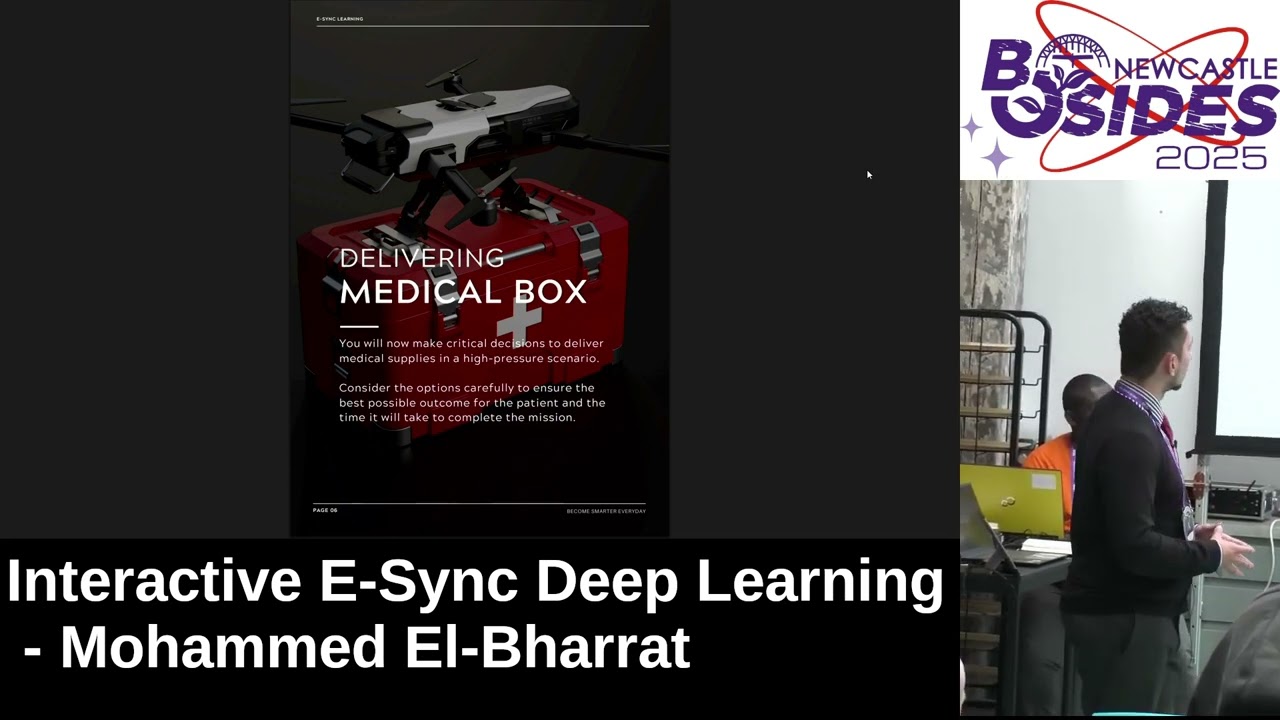
military have their own paramedics, but you could potentially be seeing somebody near there too. So now that was the easy part. Now the pressure begins. So um in order for us to get so we're doing search and rescue predominantly and that's something that I focus on how can we have drone swarms and robotic swarms to save lives. So part and parcel of that in the north Yorkshire mowers there is no mobile signal and there is no way for us to connect to a cloud or anything to support users. However somebody is in need and right now we need to basically get them a medical park. So you have options A, B and C. You have
2 minutes to come up with an answer and then to justify that answer. Feel free to talk amongst yourself or reach out and ask any questions if you need any more answers. So your time's already started. So you have a minute and 14 seconds. >> All right, guys.
people when they're answering the questions. >> Thank you. >> Just be here. >> Yeah. Thank you. >> Brilliant. And just to be fun, I'm going to give you all a 10-second countdown.
3 2 1 and now we're in for the answers. So I'm going to start with yourselves. So option A, B, or C and why? >> Uh we're going to say option A. um purely because even though it's going to be a slower flight time, uh the all the equipment will get there in the right for whoever needs it really. >> Fantastic. Thank you. Um, the next team >> I'd probably say option C because if you can send everything out at a maximum speed cuz if it's like in the scenario proposed where someone's lost an inhaler, it could be several they could only have several minutes before you know they have an asthmare attack or or
whatever. So, if you can get the um medical supplies there the quickest then that's I think that would probably be the best option. >> Excellent. Okay. And the last team, >> do do you want to join the last team over there? >> Yes. >> Thank you. >> I can't see where um option A is possible at all obviously because of the weight limitations. Um option B is going to be difficult simply because you don't have that um connection to be able to probably use AI unless it was in some sort of local system. Um so it has to be by default um three. >> Fantastic. And yes, the right answer is C. So the reason for that is like you
rightly explained, it's great if we do pile everything onto there, but when we get there, the flight time may be slow. We may have run out of battery or face disruptions. A uh sorry, B is fantastic, but if we have no access, then it's absolutely pointless. Also, AI can misinterpret. So it thinks somebody has an ear injury, but the person's having an asthma attack. It says the inhaler doesn't apply to 80% of the nation. So by statistics, let's remove it. Option C, as you know, is the right answer. So we always try to use humans where we can with all our decision-m although AI is great. You obviously all know it has its flaws as do we. Now moving forward. So,
we were talking about um critical airspace and not being allowed to fly over humans not being allowed allowed to fly over driving cars and over residential properties and certain commercial properties. However, we are in an emergency situation at the moment and a decision has landed on your lap. You now have half of the time you had last time. So, you only have 60 seconds of time. This is your question.
No pressure. Just 20 seconds left.
I was going to say you can feel free to try to use AI. It won't help you right now.
>> Oh, and that's 60 seconds, right? So, what is your answer? Uh, I'd probably go with B. Um, cuz with I guess A that's just longer in general, so waiting the 3 minutes isn't a problem and C, >> you're running risk of not getting anything there. >> I will argue we are in an emergency situation and lives are on the line. However, we're going to park with your answer for now >> and then we'll circle back. Yeah, I think we'd probably go with B as well. Um, A, obviously 20 minutes is is a very long time in an emergency situation, but C, um, you know, that strong magnetic field could disrupt the drone, um, which could potentially cause
it to crash or or cause another incident. Um, so I think, yeah, adding an extra 3 minutes is is probably the best option in those three scenarios. >> Fantastic. Thank you. And the last team, >> yeah, option C seems the most uh the fastest option. Uh I know there are penalties uh added by this action, but most laws are able to be suspended for case of emergency. That's why ambulances can speed. That's why, you know, they can go down runway oneway roads etc. >> Fantastic. And the argument there is actually one that we've had a few times. However, according to the CCA laws, we are not allowed under any circumstances unless it's military to fly over these
areas. And you did point out something which is quite interesting, the magnetic fields. So, as we all know, drones with batteries and all their equipment could literally be wiped or another incident could occur, a bigger one because of that. So, 3 minutes isn't a long time. We could argue that right we need to get there but by the laws we just simply can't. Now this one is a bit more difficult. The obvious answer might not be the obvious answer. So take your time. I'm going to give you two minutes and we'll see where we go. Are we all ready? Lots of nods. Let's go.
If you uh finish early, you You can put your hand up and we'll stop the time. If not, take your time. >> Is the time under it the time that it will take to find >> It's the additional time that we're expecting. Yeah. >> Yeah.
Again, it is a bit of a trick question in itself. So, it's meant to be difficult. It's not meant to be easy.
Nice. 20 seconds left. No pressure.
>> Great. So first team. Are you guys ready? >> Yeah, I think >> I think we're a bit stuck on this one between A and B because I guess it depends why. Um, obviously there's infrared which I think could be if there was someone laid in a field, it'd be quicker to get to them because um you can pick up on heat signatures and things like that and find them quickly. But if you're sending it into somewhere where there's a a forest fire, it's not going to see anything. So liar might be better, but I mean don't know everything about liar, but it just picks up on shapes. There's someone just laid in some brush. You're never going to find
them. So, I'm a bit So, I guess it'll >> We'll circle back to you if you want. Yeah. >> I'll uh No pressure. You're not being judged. I'm just taking marks, but >> I'm clueless. I'm not going to lie. >> It's okay. I mean, does it >> remember >> guessing game as well? Um we me and my friend were just discussing the difference between A and B and uh I think this this gentleman did bring up an important point about infrared being able to detect detect heat. >> Mhm. >> Which totally valid honestly. So I would go with A. >> You go for it. >> Yeah. >> Fantastic. Okay. Okay. So, we're going to go for the heat searching approach
from your side >> because LA is right detects shapes more. So, >> brilliant. Thank you. >> Oh, our team's managed to split into three. >> Okay, good. I' I'd love to know why. >> Um, okay. Hey, I think the consensus that we're going to go with the infrared um in as much as that technical expert here tells us that the lie won't work in um fog conditions uh simply because of the water content of of fog. >> Well done. Excellent. >> Which I didn't know. Um and uh number three doesn't seem to be it seems to be a non-starter. Just cancel and go home. Although >> I want to take this microphone. >> Okay. I think it is option C because you
said it was a trick question for one and you think about the drone breach safely if it's infrared is a possibility does work obviously lie that won't work I think it's option C but I mean we're a misplit so well done the correct answer according to oh is that me um according to the way we do things is >> yeah option C so why is option C so we have something called VS vertical um visual line of sight So, if I lose contact, if I lose visual contact with my drone, I'm not legally allowed to fly it. Light will refra the off the excuse me, off the moisture in the air and your image instead of it
being here will be over there, but then it'll be scattered and that will drive you guys crazy in the control room. Infrared, that's not going to work. I'm sorry. In a fog using infrared is >> even with emergency services, do you have to keep that line of sight? >> Yes. Um, the police are working on something, but I don't know too much about it. >> Yeah. I've got a small drone, so I've kind of went through it. I know that you need that for that, but I thought emergency services and like mountain rescue would be >> would be different. >> Do you think? >> Yeah. You think you think like you said bending rules for the sake of saving
lives but >> should you be able to walk anywhere in 20 minutes? You can see a line. >> Yeah, that's what I was thinking. >> It's Yeah. Well, it's I'm I'm glad we've uh kind of covered that one. Now, I'm going to go to a much harder one. So, we've kind of just gently touched on a few different things. Drone swarms, basically, how we should be interacting with our environment, and now situational awareness. Last but not least, a major accidents taking place. We have smart highways now in the UK. drones are able to fly to emergency situations and there is no restrictions with them getting over cars and people for for argument sake here. Now, a disaster's happened.
This one is a bit more difficult than usual. So, I'm going to give you even less time. So, we have a minute and 13 seconds to pick an answer. Go.
No pressure. Just 59 seconds left.
Right, it looks like we have less than 20 seconds, 19 seconds left.
So, this time I'm going to do it a little bit different. I'm going to start with you guys in the back and then we'll work our way forward.
>> Okay, we're going to be controversial again and we're going to go for all three. >> All three. Okay. Why? >> Because every every one of those um options is a requirement and that um that can be completed by drone stroke drones cuz you say you've got a swarm. Correct. There's no there's no necessary reason why you have to use it as a swarm or two smaller swarms or whatever. But all those three options are very much a requirement to to tackle this this problem. And if I was to say I must have one unanimous answer from the group, >> we would then go for option C, but only slightly. >> Excellent. Excellent. Thank you. Um,
we'll move to the next team. No pressure. I see. >> Um I'm I'm veering towards option A because it seems the safest. Um option C. I don't really see how that would actually work to be honest. >> Okay. Um because you're you're using something flying in the air to divert traffic. Like would it would someone flying past in a car really stop? >> Um I think the traffic has come to a stop. Um but that's fine. No, I appreciate all answers. I mean, there's only one right answer, but uh um and option B, you don't you don't really know who's going to pick up those medical supplies and attempt to use them. >> Thank you. That that's brilliant.
Um, I was just picking ones which I don't think and then I think you picked one that we like. So with a I think that's what traffic cameras do now. >> Mhm. >> So I don't think it'd be quicker flying a drone out there doing that. Um B, similar to kind of what you said, I don't think this question is about swarms. I don't think a swarm of medical supplies is going to help loads of bystanders with w with with with things. So, in terms of like swarms, I don't think that work. But >> yeah, logical for option C. Just uh um yeah, to to map all the area, make it so it's a safe place to for both the
paramedics and everyone else traveling. >> Fantastic. The correct answer is C. So with this one here, I thought this was a great idea. But then my friends in the medical side, they said, "No, Muhammad, you cannot start administering a first aid kit to somebody without first aid training. We don't know who they are. You don't know what their medical history is. You cannot do that." So I thought, "Okay, how are we supposed to help people?" Then we go to the first one where we say right okay let's get the ambulance as fast as we can from this side of the room to that side of the room. So the drone goes up and it says go right go left. However it turns
out that sats already do that for us. Now the last one a drone swarm circling a certain area. Yes, there is a little risk. However, drones can also stand and they can display messages collectively and that's kind of where that one would come in there. So, I've taken you guys through a bit of stress there. I appreciate it. But now, we're going to get into the creative side and leave the critical thinking and logical thinking behind. In your groups, I want you to think about either for your division or for the ambulance in itself. How could a drone support an ambulance, a fire engine, a helicopter? H how could they do that? So let's have an open
discussion now and let's try to uh come up with this solution ourselves. This is an optional task. If if you don't want to do it, you don't have to. However, I'd recommend you do. It's a lot of fun.
>> Is it specific to the ambulance? >> It could be for ambulance. This could be for fire engine. It could be for cog guard. It's up to you. Or even better, if you can find a hidden application, you'd get bonus points.
>> Great. So, we have 20 seconds left. No pressure.
Brilliant. So, I'm going to have to cut the creativity unfortunately. And the group in the back sounded like you were talking about something quite interesting. Can we have your innovation please? >> So, we have two. Um, I was watching the rescue boat show on BBC last night and they were driving around for two hours looking for some guys on some jet skis. If they had a a drone or drone swarm, they could have sent them up and surveyed much more areas than they were able to do on their on their boats, it seemed like. And then they had some idea. We had some more ideas about ambulances. >> Yeah, I mean to add that if um a drone's
probably quicker than ambulance. they could get to the scene quicker and it could identify what's going on in the scene and then maybe you could either send more medical personnel or if there's, you know, need fire and rescues or things for that. Yeah. >> Yeah. >> It would allow it would allow the the ambulance driver or the paramedics on their way to actually start to see what the uh what the situation is that they're about to encounter. >> Excellent. That's a wonderful answer. Thank you. Um I think we were um on the Coast Guard once again with the drone swamp sort of um going quadrant to quadrant um potentially with infrared maybe to find someone who's who's out lost in the
water. Um it'd be I mean as the gentleman back there said um with a boat it could take hours and by that time someone could have you know got hypothermia and died or drowned um from exhaustion. Um so a drone storm in that particular application could be um incredibly useful. >> Excellent. Thank you. And I think not that massive outside of the box thinking but um obviously drones lights cameras. So in terms of finding someone out sea or my thought was mountain rescue and things like that where it's really hard to pinpoint where somebody is. the drones can find them and give people eyes on what's happening so they know what to expect when they
get there along with maybe having big flashing lights to point out where somebody is. It's a lot quicker to to get to that point on location. >> Excellent. Okay, great. Absolutely. >> Can I ask you a question? >> Um, sure. We'll just finish off and then Yep. So, sorry I I went a bit over on the time today, but these are all brilliant answers and I hope you've had fun doing this little experiment here. So you guys actually took part in a psychometrics and basically a gamification uh learning tool that I have. I teach from primary all the way to university and enterprises to change the way that they learn and the information they receive to be faster and better. So now
if I could ask anybody what's a what's a geoence? >> Specific. >> Excellent. And does light out work in fog? Yeah. >> Not why. >> Excellent. Great. So now you've learned different things that probably if somebody else would have had just said it to you, it would have been in one ear and out the other. So this is something that I teach and I do. And a big part of what I do is there's 173,000 jobs in the STEM sector which is costing which are in demand and it's costing the government 1.4 billionish per year. to plug that that was last year before the adoption of AI which is around 60 67% adoption across all businesses in the
UK. So this means that we need more cyber engineers with our brilliant AI tools that go out there and start doing things that we all all want it not to do and we support get people into different sectors. Now um the last part I was going to say is it was great what we were looking at there but is everybody here in the cyber field cyber cyber security field? So everybody know about red teaming purple teaming. Yep. So what are the difficulties that we have if somebody for example starts to connect their personal device to the drone that they're flying? Can anybody answer me that? stop or control.
>> Thank you. Fantastic. Um, and is there any other edge cases or any CVE reports that we've come across with drones being changed from their mission and to do things that they're not supposed to do? DJI has biased and Ukraine Russian is becoming a bastion for for drone blocking drone interference. They've actually started using fiber drones. So >> fiber optic drones with five kilometer long fiber cables. >> Yeah, we'll be using pigeons next. But hey, anyways, my name is Muhammad Aliad. I'm from Ein Deep. I've gone over but I hope you've had a wonderful session today and if anything go away innovate and create and let's have a uh let's have a wonderful day here. Thank you.
Related talks
 40:04
40:04 44:33
44:33 34:42
34:42 30:07
30:07 44:52
44:52 16:22
16:22