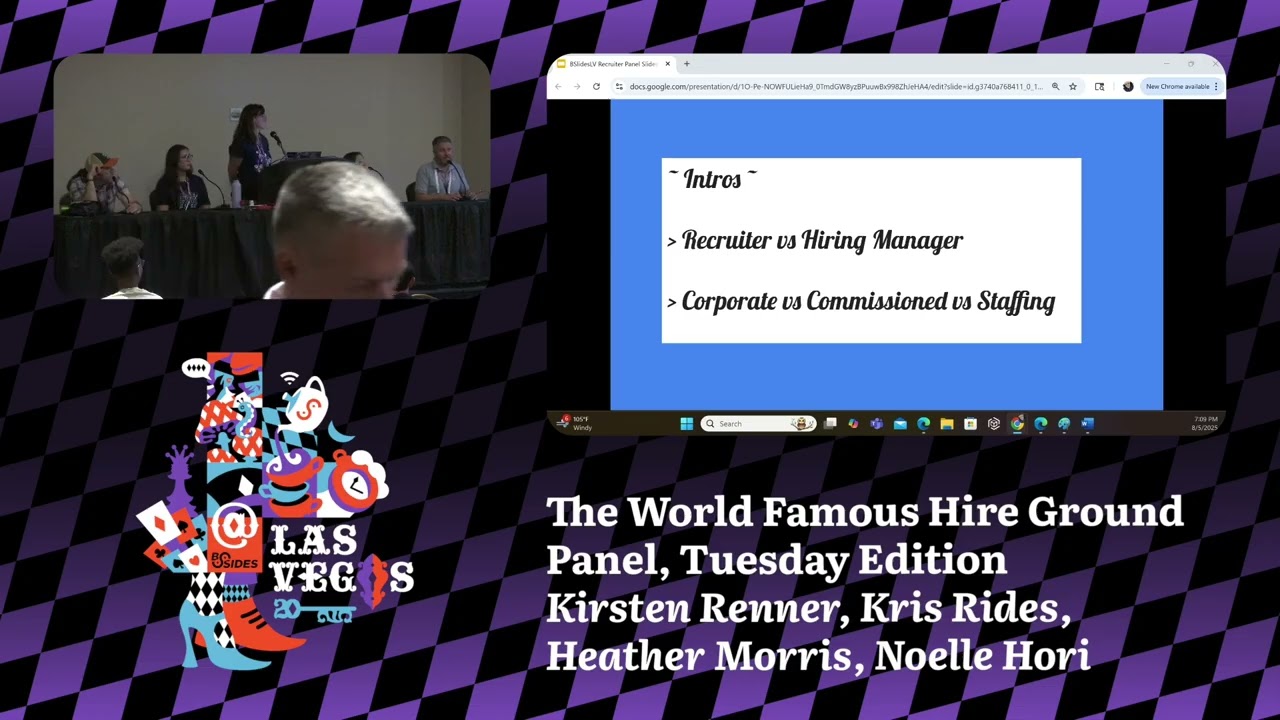
The World Famous Hire Ground Panel, Tuesday Edition
Show original YouTube description
Show transcript [en]
All right, let's jump right into it. I did not do a who am I slide. Um, I'm Kirsten aka Krener. I run Higher Ground. Uh, obviously, um, I was bequeafd this honor from the one and only Kathleen Smith, who is the pioneer of pretty much every hiring village effort you see across cons across our community. So, let's give her a round of applause real quick. She made all this happen all around the world, all around the year, you see people, volunteers pulling pulling content together uh to help to help candidates because of her work. So very very very honored um to be able to to carry the torch as best as I can. Um that's enough about me. All
right. Here's the important people today on the stage. He's not looking. He doesn't know. >> I saw it. I'm familiar. >> Okay. >> Familiar with your shenanigans. >> Shenanigans. I'm trying to pay him back for I'm a contestant in Task Mooster and uh it's going to be really embarrassing. >> Yes, it will be embarrassing for you. >> Not going to win. Okay, let's start over here. Tell us who you are and a little bit about the way that you we're mixing it up a little bit this year. So, it's always recruiters, right? So, there's different types of recruiters that affect you in different kinds of ways. but I brought other people whose roles uh entail recruiting in different
aspects, hiring managers and community managers and so forth. So, let's talk about who you are and your role. >> Uh, hi, I'm Chris Rides for anybody that wasn't here 10 minutes ago. Um, I'm a I'm a I'm a CEO and founder of Tyro Security. We're a cyber security staffing and professional services firm. I've been going since 2012, 25 years in recruitment, and I'm what people would deem an agency recruiter. So, I'm an external recruiter that works with and partners with companies uh to find people um when their talent acquisition people either can't find them or are too busy working on other roles. >> Um my name is Heather Morris. Um I'm the director of recruiting for a company
called uh Red Horse Corporation. I come from a staffing background. Um, and I actually now am a corporate recruiter working directly for the organization. Uh, specifically within the GovCon space. >> Do I press the button? >> I think it's hot right now. >> Yeah, you're good. >> Okay. Sorry. >> It's all good. >> Um, my name is Noel Horry. I work for Cobalt. Um, I'm a community operations manager. So, a little bit different than recruitment. I support our pentesters through their life cycle with Cobalt. So through the onboarding process, support as needed on projects and continuous evaluation. So I'm kind of here as like a perspective of community management, but then also kind of a hiring manager
as well. >> Uh Bruce Potter. Uh in my life, I've been a consultant and CEO in Sizo and other odds and ends. I was at Booze Allen for a while where I hired probably over 100 people for various commercial and public sector work. And then I ran a research engineering company focused on Intel, DoD, and finance where I hired probably another 40 or 50 folks. Um, and then Sizzo a couple times. And now I'm at a I run a small startup called Turngate where I hire. So I've hired a lot of people in my lifetime as well as interns and mentored people at schools. So on the practitioner side of things. >> Awesome. So I I call it an ecosystem
really. People need to understand all the different roles and we're going to try to peel back the curtain so you understand uh you either as a candidate or a hiring manager. There are a lot of different people that are part of the full life cycle, the full journey of the of the candidate. Um people sometimes think, you know, and depending on the size of the organization, there's going to be a lot of other people in that in that journey as well. So, um, I'm hoping that we offer you a lot of different perspectives and at any point if you have a question, this fine young man is going to run the mic over to you. So, I I really want
this to be interactive and I've heard a lot of questions all throughout today and yesterday that I think the people on the stage are going to be able to help you with. All right. So, we talked about some of the different roles and we did the intros and so forth. Can you expand a little bit further on and we'll start in this direction how you think that the different types of recruiters could the pros and cons could benefit or um or have a have an impact on the candidate that goes for you as well as as a as a hiring manager and an executive. >> So the the role of the recruiter as far as how their impact on the candidate is
concerned. So um I've worked with recruiters both internally and externally uh over my career and I will say that the one of the challenges I've had is that sometimes recruiters don't necessarily understand the specific nature of the job or the requirement and what they'll end up doing is coloring their perception of the job in the candidates's eyes. So when the candidate talks to me they've come with some preconceived notion some kind of idea preparation for what they think the job is and sometimes it's correct and sometimes it's not. Um, I've had to learn to kind of see that and accept it and redirect on the fly. Um, because it can be kind of awkward when you get a
person that lands in your lap, you're like, "This is not at all what I was looking for." And then you realize that there's a disconnect with the recruiter. So then I spend quality time with the recruiter. Help them understand, help them target, and help them work. So as a candidate, I think one of your challenges is like don't take everything the recruiter says to you as ground truth about the job. Uh, take it as like directionally correct, right? It's a driving range, not a hole. You're not aiming at one spot. you're aiming in that rough direction and prepare for that as the general direction of the job and I think you'd be well served uh in
your in your pursuits. >> Yeah. And I think asking a lot of questions too and and knowing what you're looking for in a role is really important. So if you're talking to a recruiter um and they might not know exactly the ins and outs of exactly what you're doing, sorry I'm not speaking loud enough. um or what this position is. Understanding what you want out of the position from the job description and selling yourself obviously as a candidate is really important as well. >> Very good. So from the perspective of a having both sides of the house being staffing and also being corporate, you know, I think that corporate recruiters have an advantage, if you will, because we
have the opportunity to sit down with the hiring managers and really get the insight of what the job is. Yes, we're not super technical, so we don't know the ins and outs of it, but we can know enough to to be dangerous, right? To really talk to the candidate, explain the jobs, sell it that way. Uh versus a staffing agency is one step removed from that. And they're kind of the recruiters typically are moving so fast when they're talking to the agencies. It's just like here we need help with this role. However, there are pros of a staffing partner is that they don't have all of the additional information that really will help them expand their
horizons of the candidates that they might be talking to to potentially find the right one. Um, so I think it goes goes both ways. >> So, yeah, it's interesting. I think um I think it also depends how you work as an agency on on that sort of stuff. So for us uh we will not work on any job where we haven't spoken to the hiring manager just absolutely we won't because uh we want to hear directly from them and ask our questions and and we've got our own sort of ways of going through that. Um and the fact that we only do cyber security um that gives us not only a great network because we've got the time
to network because we we're not going to be speaking to that one person for one job. We're going to have multiple potential jobs over the time. So you're creating a relationship with them. Um, and so that helps us uh with candidates to to get to know candidates a little bit better. And it's just impossible, I think, for the internal teams, you know, who may be working. Some some very large companies are lucky enough to have people that specialize in one area. Like they might have a cyber security recruit and that's all they do, but for most companies, they're diving between different areas. And so there's a benefit for an agency in that we should have other clients that have other
roles. Um, we can get to know the area very well. So, you know, I've been on calls um where we're talking looking for an AM person and the recruiter throughout the whole of the call called it IMA because they didn't they didn't know the area, right? And and the trouble is if you're having that kind of conversation sometimes with candidates, you can lose some of the uh some of the belief that people have in you and and in the business. So, we we we we're lucky in that respect. Um, we also tend to most of our roles will tend to be working on will be exclusive. Um, and so that we're not got six other companies
that are all trying to phone as well. And that be because we do just security because at the end of the day, if you can trust us, we just filled a position. It was open for 11 months. We filled it in three weeks. Um, and so we did that because we knew the network, we knew the local area, we knew who was around and was available. And then we really really got to know what they were looking for. And there was a few areas where the hiring manager themselves didn't hadn't put things on the job description because they hadn't talked to somebody that had the knowledge to ask more questions and delve that little bit deeper. Um so yeah, that's kind of
the value that that that we can bring. The common denominator across all four answers, these are four very unique perspectives is relationships, right? relationships, taking the time to have a personal relationship. There's going to be a difference between one corporate recruiter and another and between one agency recruiter and another. Are how are they bonused? What what is the uh what is their productivity measured on? Are they trying to what kind of buck are they trying to make off the less they pay you, the more the the higher points they get, or the more they pay you, the higher commission they get? Right? There's a lot of things to work out here. And the way that you're going to
figure out how it benefits you is by having a relationship with the first person you talk to. Ask them straight questions. Are you a corporate recruiter? Are you an agency recruiter? Is this an exclusive relationship? Did you just scrape this job off the interwebs? Do you know the hiring manager? Do you know the customer? Do you know the client? Do you know anything about this? You're going to get vastly different answers. Brilliant. All right. Okay. I have been trying for the past several weeks to pay attention to what you all are saying on LinkedIn and on social. Um, and I I'm trying to pay attention to what what is happening to you, what's affecting you. And one of
the things is you're getting ghosted. You're applying, it falls into a black hole. You never hear back. You go to an interview, you never get feedback. what the heck is going on and what can you do about it? So, I'm going to start with Heather. If the recruiter ghosts you, if you go through two or three interviews and you never get feedback, what would you suggest the candidate should do? So, if you've been through interviews, you typically h should have connections with a hiring manager at that point. So you, yes, it's a respect thing to go through your recruiter, but if they're not being responsive to you, you should have every right to reach out to the
hiring manager that you interviewed with. Um, and also keep keep on with the recruiter. Sometimes our inboxes kind of get overwhelming. So trying a different avenue like LinkedIn might be helpful. Um but it it it's disrespectful in a way. So the recruiter owes you feedback. So, it's absolutely fine to to chase them around and and ask. >> Uh, you got it spot on, Heather. Totally agree with you. Um, don't feel like you can't bug us. Please bug me. I I had um I always say I never ghost anybody. Um, and then I had somebody who was a friend of a friend reach out and said, "That's funny. You ghosted me on this message." And I was like, "This email." I was
like, "Really?" me and then I had to search through my inbox and there was the email that at some point maybe I'd marked as red and some but I never remember reading it right so it wasn't purposeful um and I think what you'll find with most good recruiters is that they won't avoid you they don't avoid the difficult conversations they'll tell you when it's a no um sometimes it's tough because uh we'll have like as an external recruiter and the the extra the actual advantage that the internal recruiters have is they can necessarily see the notes internally. They can see the reasoning behind. We don't get access to that. So, we might only be able to tell you yes or no. Um, we might
not get the feedback. That's not because we're not trying. We can only do a better job as a recruiter if we have the feedback on why people are nos. Um, and then we can deliver that feedback. So, we are trying very hard to get it, but we don't always get that. So, just know that we should at least be able to tell you whether it's a yes or a no. or in some cases like recently um we had somebody that left that was uh internally that was one of the managers as part of the recruiting and so we didn't get feedback and everything was we weren't wasn't told that it was put on hold um but somebody didn't hear you
know hear hear any news on their on their final interview and it had gone over a week and we were kind of chasing and we didn't know what was going on. um we got hold of hold of and found out why and and then we could go back and actually give the person reasonably positive news that okay they're going to go through and they're going to make a decision but it's going to take an extra couple of days. So you know bug us please annoy us. We will tell you if we haven't got any news. We'll tell you that it's a yes or no. Um but but trust that we are trying to get that that
information for you. So Kirsten is trying to hustle things along and I'm going to stop the conversation for a second just to be a pain in the ass. Um the reality is that providing you feedback at best is a netneutral uh thing for the person on the other end. If they're a staffing agency, they want to retain a relationship with you in case they can place you somewhere else. They are more likely to give you the feedback. Corporate recruiters and the hiring manager have no incentive to make you better. Period. And I mean that bluntly, right? They're all busy. They have a day job. they have something else to do. If you want feedback from other
people, the best way to do that is to humanize yourself from jump. Form a relationship. Be a human in their mind, right? They will respect you. They may give you feedback, right? Tell them during the interview, hey, if this doesn't work out, I'd really love to know how to improve. I'm trying to break it in the market. whatever you can do to humanize yourself, you're far more likely they'll skip the value part of that and just try to be a good human because if they don't if they haven't humanized you and you're just another person they've talked to, they are going to flat out ghost you and I just it's a value prop. There's a transition to
value that occurs and me giving you feedback if I've not humanized you've not humanized yourself to me is very unlikely to happen. Not I'm not a dick. I'll give you feedback but my peers. So anyway sorry. >> No, that was great. That was great. Did you have anything? No, I think it'll be a broken record. Communication is key and you know, we want to be communicated with just as much. Persistency is a great quality. So, you know, >> and I'm not trying to be a jerk to the corporate recruiters. I'm just trying to be honest about the situation. >> That's awesome. No, they need to hear it. So, um I mean, Heather, if you wanted to fight him real quick or Laura
want to fight Bruce. Heard he was a ninja. Okay. Um, I want to talk about and I'm I'm not allowed to give away any of the challenges that they tortured us with on Taskmooster, but um, something popped into my head during the adventure. Uh, and um, I want to talk about because I have heard this multiple times today and I didn't even know that when I built the slides. Uh, I want to talk about opinions across this whole whole table on degree requirements and certification requirements coming from someone without a degree who thinks that some of the most brilliant people I've ever met didn't have one either. But sometimes your customer tells you you have to and then the government steps in
and says, "Nuhuh, you don't have to." But here we are. So, opinions and I'll start with the will. >> Yeah. So, specifically for the community that I hire for, it's pentesters. So, hackers. So, a degree is not required to become a pentester with Cobalt. Um, and with that, neither are certifications. Um, however, you do have to have a specific skill set and, uh, experience as well. So, in my opinion of it, I don't think it's like a degree is key or it's what you need to get a job. However, you do have to show up and have, you know, practice and experience in your skill set. Um, so I have kind of a mixed opinion of it. I think degrees
are great or degrees and certifications are great um if that's the route that you want to take but it's also not necessary you know and if you can prove yourself as an individual as a professional and as a technical human or pentester then that's all that we would be looking for um and I think like externally outside of this position in general again if you have the communication skills professionalism and experience in jobs that may not need a degree or you know you've built your you've grown up and you've had a bunch of different uh I guess positions professionally. Um working your way up Megan is a big huge part of I don't know gaining your skill set professionally
and um doing well in managerial skills, people skills, all of that is not coming with a degree. So that's kind of my opinion on just community but then also cobalt as well. >> I unsurprisingly have an opinion. Um so there's there's two very uh distinct sides of this problem. One is if someone's writing a job description um and they're going to post it, they need a set of criteria in which to kind of say these are the things that we expect and a degree and a certification is a very easy and oftenimes lazy thing to put on there. Um it's for government jobs. Uh I did a lot of government recruiting as a contractor over the
years. Um it's one of those things like the government person who wrote the LCAT doesn't want to take responsibility for things going wrong. So they set a high bar and they put a lot of requirements including degrees and all that kind of stuff and you just have to deal with it. The reality of the current market forces though is that knowledge is not a surrogate for experience, right? So you have to be able to jump the bar and check all the boxes on the on the job description, but the market is heavily heavily heavily leaning against experience and the specific things that they are involved in the tools, the mission, the the whatever. So you have
to get it. It's a predicate. I don't have a degree, but that's because I got in this industry at a time with like YOLO, there was no degrees, right? But everybody now in this day and age generally has to have one to get through just the resume screening process. I'm not a fan, but I think it's the reality. >> I definitely agree. So obviously I come from the govcon space and there's just sometimes we we're just stuck with the elcats and the that that are put up upon us and though I do not think that it determines somebody's skill set and their levels sometimes it's a requirement but every now and then we'll get that absolute rockstar person and
we'll push back a little bit and we'll be like hey could we get a waiver? That's that's something that's real. you can get a waiver on specific jobs. Um, so just know that if it says on the job description that it requires a degree, I don't think you should you shouldn't apply. You should still apply. Talk to a recruiter and sometimes there are loopholes and and like Bruce said, like sometimes people put it on the job descriptions just to have a requirement on there, but it's flexible. So yeah. >> Yeah. It's I'm I'm I've got I do a little bit of business in the govcon space, but most of my business by far a majority is in commercial world. Um, and
so it's rare for us to have degrees as absolute requirements. Having said that, they're on virtually all the job descriptions. So, um, so what I would say is we often have that conversation with managers, you know, is this a nice to have? And most of the time it is a nice to have. Experience is always going to to going to sort of get get over the top of needing a degree. Having said that, we got a huge project on right now with a company and they insist on having degrees. Um, strangely enough, the CISO doesn't it doesn't really uh see it the same way. He doesn't think is important. He thinks experience is more important,
but the people above him uh want people all in all on board with degrees. Um, and so that's been challenging. Um I will say that in the current market there's a lot of candidates available and when there's lots of candidates available you can use the degree as a filter. Um and in this case because it's essential we have to use it as a filter. Um however there are some areas where there's obviously still very high demand like Noel you know you you you recruit for pentesters for their pentesting team. We've just placed somebody that has no degree and is working remote and their absolute essential requirements for everybody that we've been hiring is that they're five days a week in office
and have a degree. So you like the waiverss that you get, there are points in in time when you can show and it doesn't happen straight away usually with with people that insist you have a degree, but there are points where you get to the point where you say this is the marketplace. these are the people that you're losing out on because you're insisting on a degree. Um, if you want the best people, which is what you're telling me, this is what you need to do about it. Takes time for them to con to be convinced of that, but it can happen. >> But the the reality, I think, is that a degree is a type of checkbox that they
put on there. And the more checkboxes that are on there, the more you're trying to kind of whittle down the candidate pool. But the reality is the way it's interpreted and and there's studies behind this, but you know, you put more hard requirements on a job description, you end up getting more white males to apply as a percentage, right? More women will self- select out. I don't know how to do that. Dudes are like, I could do anything, right? I could fly a plane, you know? I I know how to use Microsoft Flight Simulator and horseshit like that. people of color, other minorities. The longer the job description, the more hard requirements, the the less diverse the
workforce, the the the smaller the pool that you're applying from, and you get more people who look the same, right? Our job descriptions are soft and squishy because we want everyone to apply. We're a startup, though, so we want to see everyone. I'm not a government contractor that gets 10,000, you know, candidates for a single job. So, you got to balance it. But I get in I get furious when I see a hundred freaking hard hard requirements on a on a JD because I know who's going to apply and it's not okay. >> Yeah. Our job that's I want to jump on that because funny enough as an external agency recruiter our job is to get to
negotiate on the job description. Often I sit down with a hiring manager. They run through everything they're looking for and my job is to find out what really is essential because at the start of that conversation the essential list is like this. by the essential might >> you have to do that you want to widen the pool of people that we can give you um so yeah spot on >> so real quick a couple things first of all thank you for mentioning waiverss right a lot of people uh I I participated the in the last two administrations worked very hard to create a policy got a policy lady right here uh to make sure that that waiverss
and exceptions are in place for degrees. Okay. So, and that's that's being expanded upon. Does the group and I I want the whole group to feel like you're part of the conversation, right? I care about what you guys are thinking and wondering right now feel differently about certifications. I've heard some crazy yeses and nos on certifications in the last couple days. Do you feel differently about certifications as being a requirement? Does it matter if I have my CISSP? Does it make me smarter or stronger? What about my C Security Plus? Nobody cares. Government cares. Does anybody else care? >> Not really. In the commercial world, they don't really care. Um it's all a all a nice to have. And you know, I
guess in times like this when you you might have, you know, a thousand replies in two days for a for an advert or for a job that you've put out there. Um maybe some recruiters, and I feel like this is where some really good candidates get missed. Um, some recruiters are just trying to get that number down to the number of people they can speak to >> or look at physically look at and they'll take a job description and they'll use the things that get it down to that number. So they all of a sudden something that isn't essential like a CISSP, they might make it essential because it then brings that thousand, you know, one and a half thousand people
down to 50 people and now I can look at that and go through them. So are they essential? Very rarely. I think I said in the last panel, if you're going to try and decide what one to pick or what what you want to pick, pick the stuff you're interested in so you can actually talk about it and maybe use it rather than picking something that you think will get a job. But I am talking in the commercial world rather than Govcom, which is a bit different. >> Yeah, I I don't think it makes you more qualified. It doesn't obviously it doesn't mean that you gained more skills all of a sudden, but it might be the one
ingredient that gets through the applicant tracking system or if you lack experience that gets you looked at, right? It's a it's a balancing act, I think. So, uh I think this really drives us right into the last point, marketing or the the actual market right now. So, the market's a little bit crazy. I've been doing this since prior to the turn of the century. um for a bit. Um there's a large volume of people looking in our space right now. So I did a little bit of um a little bit of research, got a little bit of data. Some of it conflicted. Um so I, you know, I will share the shot the slides with you all
later, but I pulled out what I thought made sense to me. Um because you keep hearing that, you know, people are getting laid off and um that there aren't that many positions open. First of all, I've believed and I I probably spoke two, three years in a row at Schmukon and I said there aren't a half a million jobs open. What's happening is that one job is getting posted by five or 10 or 50 different organizations that either have the ability to hire you into the position or would like to gain the opportunity to hire you into the position. And so keep that in mind when you're starting to feel a certain kind of way about why are there all these
openings and yet nobody's looking at my at my application or my resume. And I just want to also just quickly add and we can talk about it during the social or whatever somebody mentioned earlier about you know all the different job boards and why does certain things get seen and not get seen. It's all about money. Literally different companies have different pocketbooks and ability to promote their positions, right? So, what you see on I'm not going to list all the job boards because I don't want to get in trouble for doing that. Um, but you know what they all are. Um, what you're seeing at the top of the result is whoever paid the most that day. Okay?
I just wanted you guys to to understand that piece behind the curtain of of what's going on. I'm interested in how this this panel of people that are all in the on the front lines hiring, how what what how is it impacting you? Do you have less positions to fill? Are you seeing tons more candidates? What's what's happening on on your recruiting desk? We can start with Noel. >> Okay. Okay. So, I'm probably the most niche person up here because I manage a specific position within my organization and we are hiring for the same position that I've been hiring for since I joined four years ago. So, um it's a contract position. So, I think in just relation
to this and people looking right now, I know that the job market is pretty uh competitive I guess is the best way to say it and it's difficult. Um, in a different perspective, we it's a contract position that I hire for and a lot of the times for people who are looking for full-time work, um, immediately kind of turn it down. So, I would say be open to side hustles and be open to other opportunities that might not be what you're looking for exactly in the meantime because there are opportunities out there and it's maybe something that you will love that you can also do in parallel to a full-time position that you are looking for. Um,
and so, you know, I don't know if I can answer this exactly in relation to this slide and everything, but I think just the conversations that I have a lot with people who I'm interviewing or have roadblocks in terms of these kinds of positions, um, find that maybe after a deeper conversation or learning more about those opportunities that that's something that they would want to do and can do um, and would be interested in in like I said, parallel to a full-time position, too. So, I would say be open and apply for things that maybe you wouldn't have initially, even if it's not within your exact skill set because you never know what could happen.
>> I know it's not my turn to talk, but I really want to highlight I want to put a big asterric on what she just said. That's very important with the market being what it is right now. Um, many of the positions uh that that I ended up with that were good and that anyone could tell you this same story. They're going to nod their head and say it's true and and think about this for your journey. you may have had to start doing something else first to grow into the role that you were really targeting. Right? So, don't be afraid of doing that. >> Anybody else? >> I I I'll talk from a commercial aspect.
Um, so the market's weird. I've been doing this for a long time. Been through a couple of downturns. Market's just weird right now. Um, there are some areas that are in really high demand and make they they make those roles very hard to to fill. Um, there are a lot of people on the market. Uh, there are a lot of people laid off that need work immediately that are starting to open up their flexibility for the type of jobs they'll accept. There are a lot of people being dragged back into the office kicking and screaming and so they want to look at at staying remote. Um, there are I I see very very few remote
roles now. The roles that we're getting are pretty much all on site and hybrid. Um, the demand for for remote roles is through the roof. um companies don't want to spend the money with agencies, recruitment agencies. Um some see us as a luxury and the internal teams are are under more pressure and and actually be given more time to fill roles when we would usually see them maybe after 30 60 90 days. some of them that you know like I gave you the example earlier they had that role open for 11 months and the hiring manager was trying to get approval to work with us but through the 11 months nobody would approve and the
money doesn't come out of the the security team's pocket so even though the CISO wants that it comes out of the talent acquisition or or HR uh area so somebody else decides on that so the market's weird um we have roles that uh we're in an unusual situation uh where I think most of our competitors probably struggling and feeling the struggle. We've got a huge project on at the moment to build out a whole uh team um a whole tips whole security team. So, we're probably going to have a record year, which is great, but it is unusual um because most of the roles that we're getting outside of that, we're probably getting maybe 50% of what we would
normally see. So, ordinarily, we'd be having a pretty tough time of it. Um so, yeah, strange market. Uh I would definitely agree that a lot of jobs are readvertised. You know, some companies will deal with six recruitment companies and so six recruitment companies will put it on their website and then just to make it worse, we have a load of uh company a load of websites that and advertisements that will scrape your jobs and put them up even though you've not asked them to and they stay up forever because you can't bring them back down. So even LinkedIn, I had LinkedIn asked me if I wanted to own 14 jobs and at the time we didn't have 14
jobs open and so they'd scraped it from somebody else, put it under our company, published them to make the jobs stuff look higher. So it's it's it's crazy some of the stuff that goes on out there and we can't talk we can't take them down without claiming ownership of them. And the reason why they want you to claim ownership of them is because they then want to start charging you for the adverts that you haven't asked them to do for jobs that you don't have. So, I I had to switch to the next slide. Hopefully, you guys didn't you you can punch me if you had something else to say, but um based on what he said, I had
to switch over to here. So, this drives me nuts. Um there's, by the way, there's I'm going to if if Heather doesn't mind me, I would like her to explain different types of jobs that are real that might seem fake, which is different from this craziness that you see right here. Right. So, I I snagged a couple things that people were talking about. thought there was a bunch of different things. Um, but when you change your status to open to work, first of all, if you don't change your settings such that somebody like like myself or Heather or Noel can uh get in touch with you, then then we can't do anything with what you've done. If you check your settings,
make sure we can communicate with you, comment on your profile, and share your profile. I'll see that you're open to work. I won't have anything for you. I'd love to send it to Heather and I can't because of your settings. So, take a minute to look at that. But more importantly, Heather, just take a couple seconds to tell them what different types of positions are real versus fake. So, within internal recruiting, we have a few different categories of jobs that we post on our websites. Um the three primary ones are going to be funded direct which means if you're familiar with the government contracting space there's prime and subcontracts. Um so the direct funded is typically prime
contracts work that we have open ready to fill right now. Um and then we have unfunded contingent which are more of our jump balls which means that we are partnered with another company to um help fill their wrecks. So, as a subcontractor typically um and they typically open it up to multiple companies. So, but that wreck is very much open and very much fillable. Um and then you'll also see something called um I guess there's two more categories. Um there's also proposal wrecks which is work that us as an organization were actively going after to try to win new work into the organization. So, if you talk to a recruiter, they might say, "Hey, would you be willing to sign a
letter commitment or letter of intent? Um, this is a brand new contract. We anticipate that it'll be awarded on X date." Um, and that's a really cool way to get in on the ground level of a brand new contract with an organization. Um, so do not be afraid of those. And then the last ones you'll see are what we call evergreen wrecks, which are more of our revolving door wrecks of like a skill set that we know that we'll always need. So, you know, like CNO developers, software, software engineers, things of that nature where if we leave a wreck open and anybody can apply to that and you know, if we don't have a position
open right now, we're confident we'll have one in a week or two. So, um, yeah, I think that answered your question. Sorry. Okay. But these fake these fake positions are real and also fake recruiters. Fake recruiters are real. That's a conundrum. But uh I I mean if you all are having this experience, you want to talk about it, let me know. Uh I my youngest when he was coming getting out of the army, uh I logged into his account and changed it to looking for work and instantly yes I did. instantly. Uh, he had hundreds of recruiters in his inbox, right? What if his what if I wasn't looking at it and they were all
interested and they all just wanted to connect, you don't need to connect, right? So, if the very first here's some warning flags for you. If the first thing they says is, "Let's connect." You can have a conversation with a real recruiter without connecting to them. You can figure out later after they've added value to your life if you want to have a connection with them or not. Have an actual conversation with them. A lot of them are not real. Look at their profile. How many connections do they have? Do they have a picture on their profile? Are they a real human being? Have a conversation with them. Um, it's very very frustrating. It's a real
thing. It's a it's it's out there. There's a robot waiting for you to change your status. So, and then you don't know who to talk to and who to connect with, right? Ask real questions that they have to answer that a human being would have to answer. Um, I say that to protect you because it's unfortunate. There's a lot of real recruiters out there that want to help you and and this is just happening like crazy right now. Did you guys have anything on that? >> Nope. Okay. >> Well, it's it's it's tough for us, right? It makes our job so hard. So we, you know, how we distinguish ourselves probably by doing things like this where
you can see we're real people, right? Um by maybe putting more uh, you know, thinking about our individual branding on LinkedIn and being more involved. And I know sometimes those like little videos that people put or the the comments might seem a bit, you know, bit too much, I guess, for for some, but it's part of us trying to show that we're real people. Um, and there's so many fakes, unfortunately, out there. And well, I'm sure there's many people that are missing out on good job opportunities because they're so overdone with too many messages from recruiters for jobs that don't even exist. So, >> okay, I want to go through some good advice, bad advice, some tips and
tricks, like your top three, like if we were building a survival guide, uh, for the candidates, uh, what would you suggest? And, and you have all, you know, some people say send a thank you note. I say do that. Some people say covered letters, some people say don't. Earlier uh this week, I was asked how many seconds I spend on a resume. I would just like to clarify. I said three. And what I meant by that was 3 to 5 seconds to compel me to continue to read the resume that could take and I timed it one day when I had nothing better to do. I went through 50 rumés. I spend about seven minutes reading an
actual resume. But right off the bat, you're interacting with us to compel us to continue, you know, to have the conversation with you. So, um, let's talk about like your top one or two things that you would suggest a candidate do so that they can kind of weave through this, uh, crazy journey that they're on right now. So, one of my favorite things that I like to tell people is let's say you're applying to a whole bunch of jobs and your resume is just kind of falling into a black hole and you're not getting any traction on it. What I would say is take the time to research. Like let's say you find the perfect job on LinkedIn, take
the time to research the organization. See if let's say it's a pentester role. See if you can find another pentester at the organization that would willing be willing to send your information in as an internal referral. See if you can find the recruiter that's assigned on to that job posting. Reach out them to them directly and that'll help get your resume to the top of the deck and hopefully out of the black hole. Um that's something that you know I'd like to tell people to kind of get their mind thinking in a different way. >> All right, I have to just jump in and that was so so smart. Um, if you said to me in 30 years, how many of the roles
that you filled were filled by a referral? My goal every year, I mean, it's like is not less than 50%. I read in a couple places this week that in our industry specifically, it's 80%. Right? Talk to someone. And hell, uh, look who's paying referral bonuses, right? if they're paying referral bonuses, and I think everyone up here does, um, find someone that you know there. Do the research on their website, right? Don't get off Indeed, get off LinkedIn, figure out what the company is, go to their webs, who do I know there, right? Um, that's brilliant thing to say. All right, tips and tricks. Um, so I guess the the one thing for me, I mean, uh, to the point of like how
long you look at a resume before you make a decision, um, I've seen so many résumés, especially for people mid in their career, that were like, um, they put everything on it and I would be like, I actually don't know what you do, right? Uh, like I get that you've done a lot, but um, this job is exactly this thing and I need you to communicate to me that you can do that thing. And so have a series of resumes that are tailored to the different types of jobs that you're committing to or trying to apply to, not just like this barf of stuff because it's very hard for me and and I have a very short attention span
and I will spend 3 seconds to be like I don't get it next. Um it's not that it needs to be colorful and I certainly don't need you reaching out to me like you're some LinkedIn SAS genius and you're going to like have some clever story to get my attention because that'll also annoy the [ __ ] out of me. Um, but the reality is like tailor it to what I'm asking and let me make a reasonable decision. I know I've overlooked people who could have done the job I wanted because I couldn't figure it out from their resume, right? And I feel bad about that, but there's only a limited amount of time that I
could commit to be like, how much am I going to try to understand this person from this piece of paper before I'm going to say yes or no? And it tends to be a very limited amount of time. >> Yeah, I would say exactly that. Like it's concise to the job that you're applying for. Um, if you know it's super super long. I if I wanted to read a book, I would go to my fantasy novel, not read a resume. So, just making sure that it is clear and has points that are relevant to what you're applying for and um go into detail on LinkedIn or your social profiles on your GitHub, etc. That's where we'll look to see dive
deeper into your actual experience and um we'll look at your resume as like yes or no kind of points too. So, that's definitely >> Yeah. Like I'll go and like look at somebody's LinkedIn and I'm amazed like how thin someone will be. Like I worked at this place for eight years. I did networking and like that's the extent of it. Like holy [ __ ] Like here's your opportunity. Like I took the time to pivot from the piece of paper to your LinkedIn. Please God tell me what you did. And I actually learned less about the person when it was free for them to tell me and my mind was like blown. So like take the opportunity the one place
that you've asked them to look. If they're at all interested, put some [ __ ] there, right? help them understand who you are as a person. >> Yeah, exactly. >> Yeah, I I great points. Totally agree with them. Reach out to people within the business. The resume thing is so important. Um we will actually ask you is the here's the job description, right? Your resume, you've got so much experience. You can't get everything on a piece of paper, right? We're we're placing experienced people. You won't get everything on there. And the more [ __ ] you have on there, the harder it is to find the stuff we want, right? So, write your resume. And this some sounds
a bit bad, but write your resume for the job description, right? So, I'm not saying make things up because you're not going to get the job by doing that either. Um, but think about the projects you've done that are relevant for that particular job. And that's the project you should put on there. Maybe you don't normally keep it on your general resume. Um, so don't send general résumés. I get frustrated with candidates that are like, well, um, I don't want to change my resume. All right? Then you don't really want the job, right? if you're not willing to make a small change or some changes on your resume to actually sell you so that you'll do better,
you're you're kind of screwed, right? So, I agree with that. I think outside the things that that that haven't been said, um branding, LinkedIn is very important. Uh if you can put yourself out there, um I've got something I always talk about the 321 rule. um where I always think that if you can put yourself out there and spend some time each day on LinkedIn, uh it still is quite a powerful way to to get your role. And I think most people are are going to find it a challenge not having a LinkedIn. Um the 321 is three connection requests uh sorry, yeah, three connection requests a day uh to people that are relevant, either
companies you want to work for or people that are doing similar jobs or people that you'd want to work under. Um two responses to posts. So find the people that you're interested in following, respond to their post, not with great point, you know, actually have some dialogue and show that you've read it, you know, that sort of thing. And and maybe even get a conversation going over that. Um, so two of those a day and then one post a day. That's my that's what I recommend for people that are solidly looking. I know that is a big lift, but if you're really looking for a job, especially if you're out of work, looking for a job is your job. So find
the time to do it and structure that. Uh, I think that's important. And then I was speaking to somebody earlier on today um who a lot of companies use job titles um that are very different from other companies. In our industry, job title doesn't really tell me what you do. Um, and you can use a job title that tells me what you do even if it's not the job title you use internally. So don't feel like you're stuck. You know, I see people with very random job titles when in tr in truth they're an AM engineer, right? you know. So, >> that's different from the Defcon 321 with regard to your personal hygiene and your nutrition.
>> I I was confused. I'll be honest. Yeah. [laughter] >> Sorry for any confusion we may have caused. Also, I just have to say for the love of everything, don't say I'm interested. >> Yes. >> In what? Uh and don't go, what do you have for me? I don't know. What do you have for me? Right. So, let's let's do a little give and take. Um, I'm running out of time, but I will I'm actually out of time. Uh, speaking of résumés, we're going to spend the next two hours helping you with yours andor providing career coaching right here in this room. Uh, so I will quickly show you, oh, hey, for reals, this was a candidate uh who
was like, why doesn't anybody respond to me? And I was like, uh, check your settings. and then they checked their settings and got a 500% increase on views on their and this is just I will share this. I will post this. This is just a whole bunch of uh how long does it take me to get through your resumes? Here's things that you shouldn't have said and things that you should say. You can take a picture. I'll share it online. And I really did want you guys, you're all here. Points for you to ask questions if you have any. I'm running the village, so you have three minutes to ask questions. >> I have a question.
>> Oh, you have in the back. >> All right, you go first. Sorry. >> So, I've heard this um over the last couple days a few times when you mentioned you spend 3 to 5 seconds uh on a resume and uh you need somebody to, you know, pull your interest in that time. Uh and apologies, this was already uh asked previously, but where are your eyes focused in that 3 to 5 seconds? Is it the alphabet soup, the objective, recent experience? Where do folks uh maximize the the 3 to 5 seconds they have with you? >> Bottom line, up front, right at the tippity top, I'm a this, I want to be a that. I'm a systems engineer. I would
love to leverage my expertise in Linux and my certifications to become a solutions architect. Where are you? Where do you want to be? And how you going to get there? What about you guys? What are you doing currently? Want to know what you're doing. Is it is it is it an easy move into the job that I've got open? Yeah, >> that's it. If I see something and it's like, okay, makes sense. Then I'll read more. >> Yeah, I look at the current job more than anything. Like the aspirational like I want to be an astronaut. I'm not particularly interested in it. Uh what have you been doing recently? And then I'll go back and look at what you want
to do. >> Yeah. Same what you're doing currently maybe when you started. Um and is it relevant to what I'm looking for? >> And so you got to be specific in that, right? I mean, like, I can't believe the number of times like the current job description is like 20 words that have zero meaning. I'm like, be specific about what you're doing so I can understand it because I'd rather give you the benefit of the doubt. But if it's it's literally words like I do networking guy, like I can't help you with that one. >> And then also, if you are uniquely in a pivot position where what you're currently doing yesterday, I met a
brilliant math teacher who went and got a bunch of certifications and wants to break into cyber, right? So what he they are currently doing is not relevant to what they want to do. So that's when you have to make it clear. Never assume that we can figure it out, right? Because if all you said was math teacher, this this business owner isn't going to realize that you want to do this other thing, right? So you have to help us in that case. What I just said is exceptional as opposed to that role. >> You're next. Uh, regarding AI, how are you using AI to screen candidates and what type of success are you seeing from that? And
how are you seeing candidates use AI to their advantage or working against them? >> Can I start with that one? Um, so we don't use uh AI to screen our candidates. Um, but we use stuff that PE this stuff's been going on for a long time. So first of all, you know, people know about word searching and things like that, right? For us, we'll we'll use a lot of questions. So for instance, if if you a lot of the time we'veorked and we found and met people, right? So we know enough about them. But let's say you're somebody new to us. Um you come through LinkedIn uh and maybe an advert or something. They we'll have questions
built in that you will answer yes or no to and that will quickly get down the number of people. Really those questions, by the way, are have you really read the job description because it tells you what you must have or be? You know, are you a green card holder or a US citizen for one of our clients, right? Do you have a degree? Can you work in Las Vegas, Nevada? Um, you know, will you relocate or can you commute? Questions like that, which it says it's a five days a week job in there. Um, and those questions in one of the jobs got the applicants down from 1,400 to I think about 70 something. That many
people are just applying for jobs without reading them, right? So, um, we kind of use it that way. Uh, we we'll use AI. Um, I I'll say, well, let me tell you probably the best way I've seen candidates use AI. I've seen them upload the job descriptions into AI and then I've seen them say, "Here's my resume. How good a fit am I? What are the pros and cons? What are my weaknesses and strengths?" And then they sit there and say, "Actually, that's not really a weakness. I've done that before. I've got a project. Let me put that on my resume." That's a great way. It seems to be really successful. Um, but you've got
to be brave enough to upload your stuff and feel comfortable that you're you're willing to do that. So, that's the stuff that I kind of see. Um, I do think that AI is going to come into our industry like alls and and is already having an impact. Um, we don't use AI because we're such a niche. Uh, I think we we we are starting to use parts of it, but we're not really using it for filtering right now. I think some of the more generic agencies are are probably doing the opposite to that. Um, we can't do that because a lot of us stuff is about personal relationships. >> I agree. So like within our space, the
the GovCon space, we're not really utilizing the AI yet. I do think it is coming for sure. I think there's a lot of ways like through the applicant tracking systems that we use, so on and so forth. Um I think we're going to start to see that a lot more. I know I as a director of recruiting, I'm starting to think about different tools that I can bring to my team that utilize AI, but it's not part of our our standard day-to-day right now for for identifying and finding candidates. Um what we also do use the um our applicant tracking system does have the knockout questions for when people fill out their applications it'll automatically um
autoreject them I guess is the disqualify them. >> Yeah. >> So that that's really helpful. >> And the and the applicant tracking systems also will try to filter things out for you. Right. So, uh, but the but the recruiters still have the ability to see what they filtered out to figure out if they just read it wrong or just didn't interpret it right. Did you guys have anything? >> Um, the one thing I would say is, um, we're long past the point of having spelling errors and grammatical errors because of like, you know, basic tools. We should now be past the point where the language is straight up confusing. I've had like intro paragraphs where I'm
literally like English teachering the whole thing and being like, what what was this person thinking? like please for the love of God at least shove the sentences through an AI tool and be like does this make sense? Um and if it says no like I encourage you to take its advice a little bit. Um it's not that you should all use adm dashes and semicolons but at the end of the day like you know sentences that have like subjects and you know it's it's like conventional sentence structure matter, right? So let's maybe use tools for that. >> Yeah, we don't I that's a good point. I love Grammarly. that people know Grammarly. So, I use that. Yeah. And and
um >> it makes me sound way better personally. But when we run it through, so when I'm writing a cover sheet, we'll use Grammarly to make sure that it's it's it's written in a nice way and it comes across the way it should do. No spelling mistakes. It does make mistakes, so you do have to still read through it. Um, uh, but I would say I then see, you know, when I'm doing the cover sheets, sometimes they're on top of the resume and I'll see a lot of a lot of issues with résumés that way. Um, we don't change resumes for people. It's just not something I know some some companies may do that. It's not something that we will
do. Uh, we will feed back to the candidate. Um, but ultimately kind of we see that that resume is an example of their written communication and if we change it, we're not we're not showing that written communication. So if there's issues there, if there's problems, that's up to the manager to decide whether whether that's something that they they can handle. But they but you should as a candidate be using tools. >> Also, I think it's fine to use chat GPT and things like that to help you write your resume to get content, but definitely make sure that you're going through and you're making sure that it's correct and also making sure that you're adding your personal touch on there,
right? because it's the more and more we see all these AI tools, it's pretty easy to spot out a chat GBT resume. So, taking the time adding your stats, adding like things that make you human to it um is is very important. >> Yes. So, I know um good amount of you've been in the industry for a while. Are there any kind of areas that you're seeing potentially a lot of growth in the next 5 to 10 years? And then on that same note, is there anything where you think we're going to see less of it going forward? Just so people in this room can kind of be aware of what to work on, what to look at uh kind of
going forward. >> Red teaming and pen testing for LLM. >> Oh, come on. >> Listen. >> No. >> Listen. >> Nope. Not having it. >> You're next. >> Do him as soon as he's done. Go ahead. >> Do we want to answer his question or >> Yeah. Yeah. Yeah. Go. >> Okay. Okay. >> Go for it. And then he'll go next. All right. I So, okay. For >> we are at the early days of this AI thing, right? And like what we are doing to ask the magic box the right [ __ ] questions is not testing, right? We're literal children playing with a ball. We don't understand object persistence. All of the technology that we use for AI
right now is going to change in six months and another six months and another six months. Don't get attached to it. Don't get attached to the weaknesses. Don't get attached to the methods and the ways that we assess them. It's all going to be [ __ ] so different in five years. I cannot even begin to imagine. My wife's pointing at me and telling me to slow down and shut up. So, I'm going to chill out just to scotch and say that I think in general I would be thinking more about industries that are going to thrive and industries are going to get punished in the next 5 years and focus on that. Industries are
doing great right now. Banking. Banking. CNBC says all the banking bonuses went up 20% this year. Why? Wall Street's making a [ __ ] ton of money. You know who else is making money? All the IT and security people on Wall Street. Woohoo. If you haven't done Fins serve work, you're not going to get a Fins serve job and you're not going to go get your break on Wall Street. One or two people do and 100 people don't. Right? If you want to make money right now, it's banking. In a few years, it's probably going to be manufacturing. We're also building more data centers than like a Dyson sphere needs, right? What's that going to result in down the road?
There's going to be more operational components supporting those data centers. Those people need security. Focus on that. Think about the industry and the industry specific certifications you need, not the underlying technology because there will not be LLM pen testing in five years. That's my my thing. >> I was just trying to fill a job. No, he's that that sorry, and it's remote, but anyway. Um, [laughter] >> yeah, sorry. >> Yeah, I know I'm sometimes reserved with my opinions. I'll be more specific later, so sorry. >> Don't be shy. No, I promised the crowd that you would make this interesting. I I I'll actually also care a lot. I think that another thing for you to look at.
Look at this. Look at infrastructure. Look at construction. Look at medical. They're not going anywhere. And their needs specific to our space are very, very critical. That's why we call it critical infrastructure, right? All of our nemesis, all of the bad guys are trying to break our sec our our infrastructure, right? That's what they're coming after. One [ __ ] water. one water hammer and we shut down every hospital. What are you gonna do? Shut down all the traffic lights in one town for 10 minutes. What's going to happen? The impact is I almost said huger. I don't know if that's a word, but bigger, right, than than we can even imagine. So infrastructure construction and
medical and everything he said. >> And they use a lot of energy. Energy sector is going to do well. >> Yep. Yep. Energy sector will do well, too. I got one quick question. >> Thank you for your patience. >> All right.
I don't know.
Okay, I'm going to read it back for the recording and then I'm going to let the audience answer. Um, I think I heard it's a little bit hard to hear up here uh with the fan uh recent grad uh experiencing a lot of the difficulties that you all are having looking at is is the current craziness in the market is it a temporary thing? I think the answer is yes. Okay. I think it is cyclical. I think it will bounce back. Um, and what was the second part?
>> Gotcha.
>> Okay.
>> I understand. So recent grad right around the the the time of the epidemic. I I think that uh the point that Noel made earlier is is pretty important uh regardless of where your entry point is or where your present uh uh space is in the candidate journey and that is being willing to get into a position that might lead to the your endgame. Right? I think I think that might be key. You're going to gain experience that way. I'm interested in in the rest of the in the rest of the uh group. They're starting to bring the food in now, so they're really going to shut us down maybe. But >> I'll add just um for the job, I think
you want to have your ability to apply and for as many positions as possible. So, um and a lot of people start off with right, I need very much these specifics and then over the months that they may be out of work for, they open it up and open it up. I would suggest you open it up early, right? Can you relocate? If you can relocate, there's a whole bunch of on-site jobs that will pay for relocation, right? Is that possible? Can you have a Is it just you relocating? Is it your family? >> So So I think the diff so I would say so it's very difficult for me to answer that because I I place
experience. My company places experienced people, right? The the demand for entry level people um isn't at the same level as it is for experienced and there's a whole lot of people competing for it. So it is a tough job to getting into the industry looking to get into it sidewards. Um, being open to maybe being paid less than what you thought you would be, especially after you spent a fortune on a degree. I get it. Especially after people have been promising you 100 grand in your first role. You know, lots of promises out there that people make, they're not usually the ones that have to deliver on them. So, um, I think being open and accepting the
flexibilities you can around what you need just to get your chance. And then truly the people I see that are getting the jobs is who they know. You know, who do you know? Who's your friends of friends? What do they do? Where do they work? Might not be in security, but who do they know in security? >> So, one last question and then I'll close it out with the final question. >> Thank you. Have you seen an increase in security related hiring even related in precision machining for instance? A lot of these CNC machines are becoming internet connected. They all have computers in them and varying levels of Windows installs from 95 up to modern
era. Have you seen an increase in precision machining, IT, security? >> I I think in general I haven't seen an uptick in in manufacturing or anything in that space yet because I think that the uh at least the perception by the executives is that um the the bad outcome that they're isolating against is not worth the investment. Um you know they still even though it runs Windows and it's connected and whatever you know there hasn't been enough impact to their peers to matter. Now as more ransomware hits that industry and things like that I think it it will in it'll happen. Um but my experience in manufacturing agriculture things like that the leadership is kind of cut from a
different cloth and it's going to be a generational change for them to get to the point where at the industries at large have uh internalized the need for security. You'll always find a few people who get it but I think we're for some of those industries we're still a generation away from them uh really finding religion on it. Sorry, I've always got something to say, haven't I? My goodness, I love the sound of my own voice clearly. Um, and not talking about CNC machines and and and specifically that, but I will say that really hard to find people with embedded security, firmware, that sort of stuff. Um, very very hard to find. There's not a huge amount of jobs uh in there, but
those jobs that are out there don't have a lot of people applying that have the skills. So if you're thinking about a technology that's kind of related to that, that might be something worth sort of building some experience in. >> So I have a question for the audience. How many people in here are hoping to get an interview in the next six months? All right. Of those who are looking to interview, how many have gotten an interview in the past six months? Okay. Of those who got an interview, did you get it by applying for the job? Raise your hand if yes one. So my question for the panel now is and Chris you just mentioned this.
What is the ratio of candidates that you hire that applied versus you guys went and found? Because there's a lot of talk right now about how do you make your application to the recruiter sound better? And then a lot of talk about how do I improve my profile? Much like Bruce said, I'm going to look at your profile and if you don't have anything, tell me what you did at a company for 9 or 10 years. I'm done and moving on. But what is the percentage of you're finding us versus we're coming to you? Because what it sounds like is the only ones who are going to get an interview are you finding us. So, how do you make the
candidates look better to you? And >> is and is my assessment accurate? >> Um yeah, >> keep in mind I have inside knowledge on this. >> Yeah. Yeah. I I think your assessment is very accurate. Um you know, the other thing is if you're let's say you're applying for a job, right? If you're not one of the first to apply and that and you're not top of the the list of applications when a recruiter looks at that, um you could be perfect for the job, but you might be 80 people down and they never get to you. >> Yeah. >> Right. and and so you know I I generally say I think it's very broken.
Advertising is very broken. We fill a majority of our roles um through connections um through either reaching out and headunting. We use LinkedIn recruiter. We'll reach out send messages. That is tougher because of the amount of rubbish that you get sent through LinkedIn nowadays. Um but we do that and the best way right now is like introductions. like I had a CISO um introduce me to somebody for a director role and that person has an interview. Uh I had somebody reach out and send me a LinkedIn message and say I've applied for the job. I'm really interested it this is what I'm currently doing and I didn't they didn't include their resume but I clicked on who they were and
straight away I saw what they're doing currently in their LinkedIn and I was like this person is actually a great fit and I responded. I probably would never have seen their resume. And it's not because they're filtered out by AI. It's just because there's so many responses, which by the way, most of the people aren't even relevant for the job. They're just hitting auto apply. So, you're getting hidden. The good people get hidden >> in job applications. So, it's it's kind of a broken system. Reach out um and you're much more likely to get further down the line with with where you want to go. >> So, our space is definitely different. I wish I had a thousand applications to
look at. Um [laughter] but uh you know really so stats wise 40% of our hires are through referrals. Um and the rest of them are really you know I'd say probably 10% are actually applicants and the rest are our recruiters actually going out networking finding these people through the space. Um you know it's it's it's a lot of networking in the GovCon space. Um, a lot of the good people are are currently on program, so it's a lot about who you know. Um, but like I mentioned earlier, um, and like Eric touched on, definitely if you do apply, reach out to the recruiter directly and and try to get your your resume to the top of the list
because we usually have a short list of people that we're running through first. >> Heather, you do not want the amount of applications. And this is true. We we only just put our jobs page live again on our website. We had it turned off for two years because 90 over 90% of the people haven't read. They're not interested. And a lot of them the toughest thing is a lot of entry- level people applying for for very very high level jobs. Yeah. and and in their mind they think well at least I'm going to get seen or and when but when we see that we think like what on earth is this person thinking like we're not thinking
positively oh yeah but we might have you know we might have an entry level position or we might recommend them to somebody I'm like why did they waste my time so >> all right we have alcohol we have food and all the volunteers and our amazing sponsors Cobalt and into it in the back are all hiring so you have an opportunity over the starting now for the next two hours and uh open to close tomorrow to interact with recruiters and hiring managers at uh a dozen hiring companies. So, I hope we can offer you some help. Thank you.
Related talks
 35:08
35:08 48:22
48:22 59:59
59:59 55:27
55:27 26:49
26:49 47:23
47:23