Neurodiversity and Accessibility in Cybersecurity
Show transcript [en]
afternoon. Hope everyone's been having a good day. Um, so neurodyiversity and accessibility in cyber. All the rooms real shady, please stand up. Oh, wait. That's a long speech. Uh, so in cyber security, neurodeiversity tends to not really be approached very well um much at all. It's almost as a broad term. People assume colloally that we've got a love of trains or uh something like that. But to a lot of people it can be funny, we tend to joke about it within ourselves. But to the outside world um you know people just think it's uh being lazy, being different, being um just socially awkward. you know it it it isn't and where that becomes prevalent in cyber security is
because we work with heavily technical backgrounds topics um often research. So where I see this going is that in the holistic sense neurodyiversity isn't necessarily just a linear line from A to B where you can only be know one section of that line. There's many different flavors, many different styles, many different combinations that we have uh as part of being um neurodyiverse. Um so what I like to think of it is is a sphere 3D objects in the ball. There's a lot of different combinations you can pick from, an untold combination of stuff that you can uh you can do. And as this graphic shows, there's a number of different uh flavors types uh particular areas where you feel
uh a sense of value and a sense of justice. So stuttering, anxiety, um dysregulation, um you know, different types of ticks, um and then you've got things like social justice. There are difference between right and wrong. the concepts for security come into that where you know you're having to be trusted with secrets. You're having to work on policies such as zero trust where you want to believe the best in people. You want to give people the credence and authority to make those decisions with their own automation, but you have to protect the platforms and the systems that you're working on. So, you know, there there's a lot of different uh topics and a lot of different facets
within, you know, the Eurodiverse uh community within cyber. And that makes us very valuable to be able to um drill down and be specific in the topics that we're working on. Um but often seen as a group that can only do those things and can't really work in the wider sense of a business uh organization, corporate structure. Um so in a world where these abilities can be encompassed uh opens us up to a wider um array of opportunities and a a wider kind of acceptance as to our strengths and weaknesses within um these these kind of environments that we uh find ourselves in. Any questions? Uh I would like to do this throughout and I
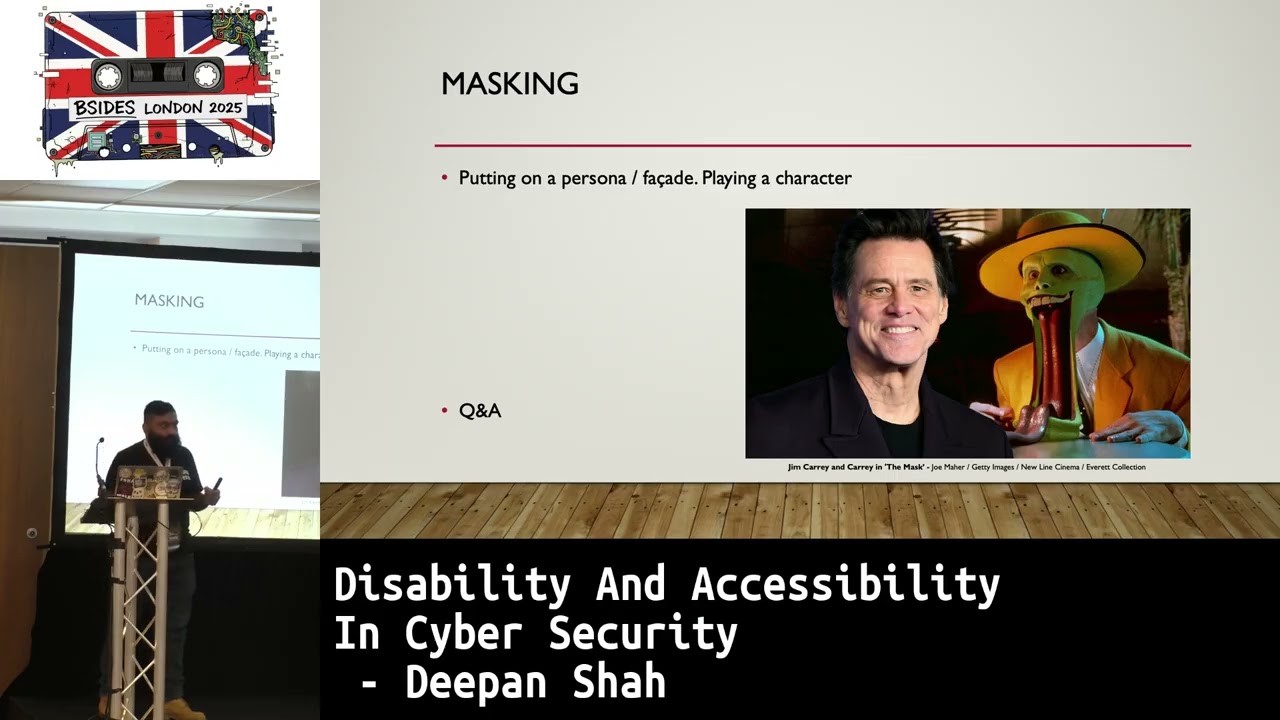
will between each side pick up on uh some questions that are answered if you would like to QR code or the code on slido and then I can pick them up either during the the presentation or I can pick that up at the end. um and respond to it in in the last couple of minutes. Um the next topic I'd like to talk about, does anybody have any questions at this moment? Oh, fantastic. Um, so the next topic and is a pretty big one when it comes to being in not necessarily public environments but environments where we find ourselves communicating with a lot of people. masking. The mask um masking is a name that has or a term that's been
coined where us in the neurodyiverse community put on a character or a facade um a persona when we go out in the wider public um environments. uh you know at at the office with family with friends we put on an air of a character that we play that we like to find other people accepting of us. Um this can lead to fatigue. This can lead to us getting too bogged down with understanding the roles that we play. You know, we may end up playing a number of different characters or a number of different masking scenarios for different environments. So, for that it takes a lot of effort. Um, it takes a lot of trust in the people that we surround
ourselves with to be able to accept us as those roles and understanding that at least for ourselves that takes a big mental strain. That means that for a lot of people within this area that the persona that we put on takes a lot of effort. And then when we go back to home, personal space, whatever we find ourselves in, we often have to seclude ourselves and take time to reeregulate our bodies, our minds. Sometimes when the masking gets too much, we it can lead to other physical um manifestations. So ticking um shaking of your leg, you know, if you're sitting on the chair and you tap your foot or picking a pen or anything like that. Um, and
generally the effort between putting on that masking scenario and then coming out of it takes a lot of um effort for us. But then also fa we face greater challenges in self-confidence self-regulation self-awareness, understanding how we perceive ourselves. there's a lot of uh emotional intention that goes into playing those characters. Um, and however deeply we choose to mask those um confidences and those um attributes can then unravel into self-esteem, self-confidence issues. Um and then such as the technical fatigue and having to dive very deeply into a particular topic then coming out of that and completely disregulating not having an understanding of what you're doing, who you're talking to, where you are. Um that leads to sometimes having things
like object permanence, not understanding that the multitude of mundane tasks we might have as people, washing clothes, eating, taking medication, sometimes the fatigue of everything that we've done during the day then leads us to not do anything else. self-care effectively goes out the window until you've had a chance to reregulate, ground yourself, and bring yourself back into the present. Um, and that's where sometimes techniques like mindfulness and breathing can help. Um, should I Oh, I'm finished. That was quick.
Sorry, got a bit confused there. Um, yeah, technical fatigue. Um more leads to technical fatigue. often that means that conversations that we have with stakeholders, conversations that we have with budget holders, um if we're uh working in a sock and we have to do a problem investigation and write reports at the end of it. If we're working research, um being able to explain the premise of your research to get funding or even explaining at the end of it, this is what your money's paid for. Um having those conversations even here today having the conversations with uh new people um stands and sales reps downstairs generally catching up with people tends to give us the fatigue that then leads to
the dysregulation from the masking bit and etc. And that often in work environments leads people to believe that we can't enter into upper levels of line management, people management. Um you know just generally the typical hierarchy that you would see in a corporate environment where you know you're leading people, you're influencing, you're communicating. So often we need talks like this, but also just conversations within our uh organizations to be able to say that you know we are able to have these conversations but we need some space, some breadth, some understanding to be able to um showcase ourselves in the best light. One thing that is very very typical um and often misunderstood is projection sensitivity. So um when somebody doesn't
like you or somebody tells you that you know there's something negative or negative criticism um something that's not quite correct with what you're doing. um tends to for a lot of people in this uh space uh conflate itself for one of a better word um tends to snowball in its effects and we often take it personally. It's not necessarily intended that way. At least I hope not. But we often feel like if I'm producing a piece of work and there's a mistake or data is incorrect or the premise is wrong, the end point is wrong, we've made a mistake in how we've managed an incident or you know uh a technical design and some of the end
points are wrong or there's a bug that we haven't realized anything. And it can often be seen as an affront. It can often be seen, you're no good. This is not ever correct and you're never going to do this again. That's often not the case. And often it's meant with the best of intentions, but again in the wider scenario, wider area of our organizations that's not understood. It again comes back to the point of acceptance, understanding and being able to effectively communicate with us and also us being effectively able to communicate our needs to the rest of the organizations. So, you know, there can be big swades of difference between criticism, um, unachievable goals all the way to praise. We can take it
the other way entirely. Praise can be thought of as the best thing in the world. You'll never get any better. um positive feedback and we often take that sometimes as now I'm the most favorite now I can do no wrong etc. tools. Now, this is for the wider disabled community, people who have um challenges with limbs, challenges with sight, um people in the neurodeiverse community often have sound or light sensitivities. So how do we make the tools that we use um you know the platforms the common corporate systems how can we use that effectively for our people but also making sure that they are part of the secure by design framework and understanding things like additional
peripherals um screen reading ers, um, alternative keyboards, um, anything like that. Some of these microphones, clickers, you know, if I didn't have all of dexterity in my hand, I might not be able to press the button. The tangibility of the button, you know, do I press it hard or do I press it softly? Again, when we order equipment, they're often um tested by teams, but the teams that are within the environment can't test everything. So, you know, we have to be um mindful and look for ways that we can incorporate alternatives. um one topic uh at the end I'll answer these questions in just a moment and I know that's the end I've got one thing to say um
chat house rules on the last topic is socioeconomic challenges to being neurodeiverse in society so people of ethnic backgrounds comorbidity people with addition Additional uh disabilities, additional needs often have challenges not only to getting diagnosed but also being understood and being accepted into this community as well as into the wider cyber world and um wider corporate structure in in itself. Um I can go on on these topics especially uh RSD and um co-mobility and um this for a lot longer. I'm happy to you know invite me out. I can talk about it for days. So these questions thank you I appreciate I will happily talk about it for days. How do you build safety into policym? That's a good
question. Conversation, being able to talk, being able to understand perspectives, challenges and context of what policy is being needed. If it's an internal policy, you know, wider conversations, invite people out. Seauite especially, we need them to be present. How do you cope with burnout in a corporate career when you have to show up every day for 8 hours and there's no way around it? That's not necessarily an easy question, but the hybrid model of working has helped immeasurably. Being able to adjust your own um comforts in a work setting, being able to take 5 minutes and have a walk around, go into a separate area where you can disregulate, you know, put on some headphones, walk into a dark room.
Keeping hydrated and keeping nourished is a big thing we often forget. and that tends to help with your own electrolytes and you know blood sugar and things like that. So yeah, those are some of the things but burnout especially recognizing the signs for yourself and being able to advocate for yourself and if not have a buddy to advocate for you. Thank you very much.
really huge thanks for that because it is a really important topic and yeah hopefully we'll get you submitting a longer proposal next year. >> Fantastic for longer. >> Thank you very much >> and there's a link the slides will be available at some point otherwise if you want to connect just give me a shout and I can come into workplaces and have a chat or if you want to give me a job crack on. >> Thank you. >> Fantastic. Thank you very much.
Related talks
 7:51
7:51 14:37
14:37 17:57
17:57 38:34
38:34 29:25
29:25 44:50
44:50