Trains: Built From Disaster
Show transcript [en]
Thank you very much, D. You're proud to be in the post. So, I'm not sure if any of you are aware, but today, actually, today, exactly today, is 200 years since the first passenger railway opened in this country, Stockton and Darlington Railway in the Northeast. Let's hear it from the Northeast. I've been uh I read a recently You're 22 times more likely to have a fatal accident in a car than you are on a train that's given the same length, the same number of passengers. So, it's built up per passenger. That's comes to the RSSB in report. But why? I mean, the car is a relatively small thing. It doesn't weigh that much and you can stop it quite quickly. A
train's massive. It weighs hundreds of tons. You're running on steel wheels, on steel rails, up to, you know, 300 km an hour, even faster elsewhere. Surely that's going to be the more dangerous one, right? But actually, it isn't. And it's sad reality, unfortunately, that the rule book is written in blood. And that's what this talk about. And I say rule book, I actually mean uh about 103 different live rule books. Um I took the screenshot a couple weeks ago from the RSSB website. Uh and this particular one I've highlighted to the driver manual is in itself about 1,200 pages long. So you know your average holiday read. So what are we going to do? Well, we're
going to look at various um events in the past and things that were wrong. Uh and we're going to focus more uh on those systems and the procedures that came from those to make uh the railway network, not just here, everywhere in the world. um the safest ways to get about. But who am I and why the heck am I talking about this? Well, as a day job, I'm a senior sock analyst at NMF and that's you need to know about that cuz it's sadly the relevant part today. But yes, I have previously spoken on compet cyber security to sinking ships and Bluetooth fitness trackers spying on you. But in my spare time, I spend too
much time on trains in the world. I can't even count the hour. I'm not even going to count try and count the hours for you. Uh I've this is an accurate amount of uh mileage I've covered this year. Uh that includes coming up uh from the East Midlands to to uh to Newcastle day. Uh and the majority of this was completed in about 4 days because of some insane journeys including taking Bayon Point cards to Bay for a stupid internet joke. I once went from Glasgow to Edinburgh via Carlilele because the Flying Scotsman going to be around, but I'm calling that one worth it because they let on the foot plate. You know, swings and roundabouts. I'm
trying to visit every station with a platform zero in the country twice. Unsuccessful. Yes, both attempts have failed. So, that's uh another project on the card for next year. So, quickly couple asterisks. What I have got to say is based on publicly available information and reports released after these matters. There may be information that's deemed sensitive commercially otherwise that may not have been released that I do not have access to. I'm not going to be able to present I'm not going to present that to you today. Also, don't play around with trains. They are very dangerous. You don't know what you're doing. If you want to play about with trains, buy Trains from World Six.
It comes out like 3 days on Steam. And uh that's my plug. So uh the M check is in the post and also yeah we are going to be referring to incidents in which people sadly lost their lives. If at any point that makes you feel uncomfortable and need to step out, please do so. You will not be judged. With all that said, we're going to uh we're going back to uh the 1880s and Almar. I'll give you a quick bit of back background. So the operator in this case was the GRRI, the Great Northern Railway of Ireland, operating a Scunt Sunday school service take group of children to the seaside to a place called Warren
Point. The route from Amart to Warren point included a large incline of in 75. Now that doesn't seem like a lot um generally, but when you remember that train relies on very low friction, i.e. steel wheel, steel rail in order to um reach its peak efficiency. That does make things a lot more difficult. They're also very heavy naturally. They're supposed to have 800 passengers, but it was far massively oversubscribed just like basically every train you get nowadays. And they ended up with 940 people on board. They were supposed to have 13 carriers. They ended up with 15, meaning the locomotive wasn't powerful enough. The driver asked if he could have an extra locomotive help him out and he was told
no, he couldn't. And the other key point there was a passenger service scheduled to run 20 minutes behind. So this is a time where um separation online was dealt with by um time separation other than any sort of distance or anything like that. Now here's ideally what should have happened. This excursion trend slows to a halt. They don't have enough power to make it up the hill. They're only 180 m short of the summit. But that's where you end up. What he should have done was put all the bricks on to make sure the train is going to stay where it is. The guard should have gone back down the track to uh warn the approaching normal passenger
train of what was happening and then could have used the locomotive of the passenger train behind to help them out to get over the top of the hill. Unfortunately, that was hap what happened. The driver considered losing time, chose instead that he would divide his train in two, pull some of the carriages up to the summit to next station, which was Hamilton's born, reverse back down, and then pick up the rest. Now I've I've said insufficient brakes here. What I should mention is that uh test that were carried out afterward actually showed a sufficient brake was applied in the uh gas van at the back to hold the number of carriages that were left. However, um because of the number
of people who were on the train, some of the passengers were actually traveling in the guards van. So it is it is unknown exactly what happened but there is a theory that one of the passengers incidentally or otherwise knocked off the brake that had been set in the guards and thus reducing the braking effort available and unfortunately the uh the outcome was tragic. The um the schedule train like I said schedule separated only by time uh set off from our didn't realize what happened cuz they hadn't seen anything or been told anything. Those coaches rolled back down the hill nearly a mile and a half and collided with that service. Uh here's a diagram of the line. As you
can see, they went out very close to the summit and not that far from the next station at Hamilton's spawn. And that's how far the rear portion of the train back to to the point there, not far outside our mar. This is still to this day one of the worst railway disasters to happen in this part of the world. Eight people were killed and two and 60 were injured. Now our was not the first uh accident on this scale but it was what five score for what was called the board of trade who regulated uh the companies or at least attempted to. They didn't actually have a lot of parliamentary authority to do so. However, less than 90 days after
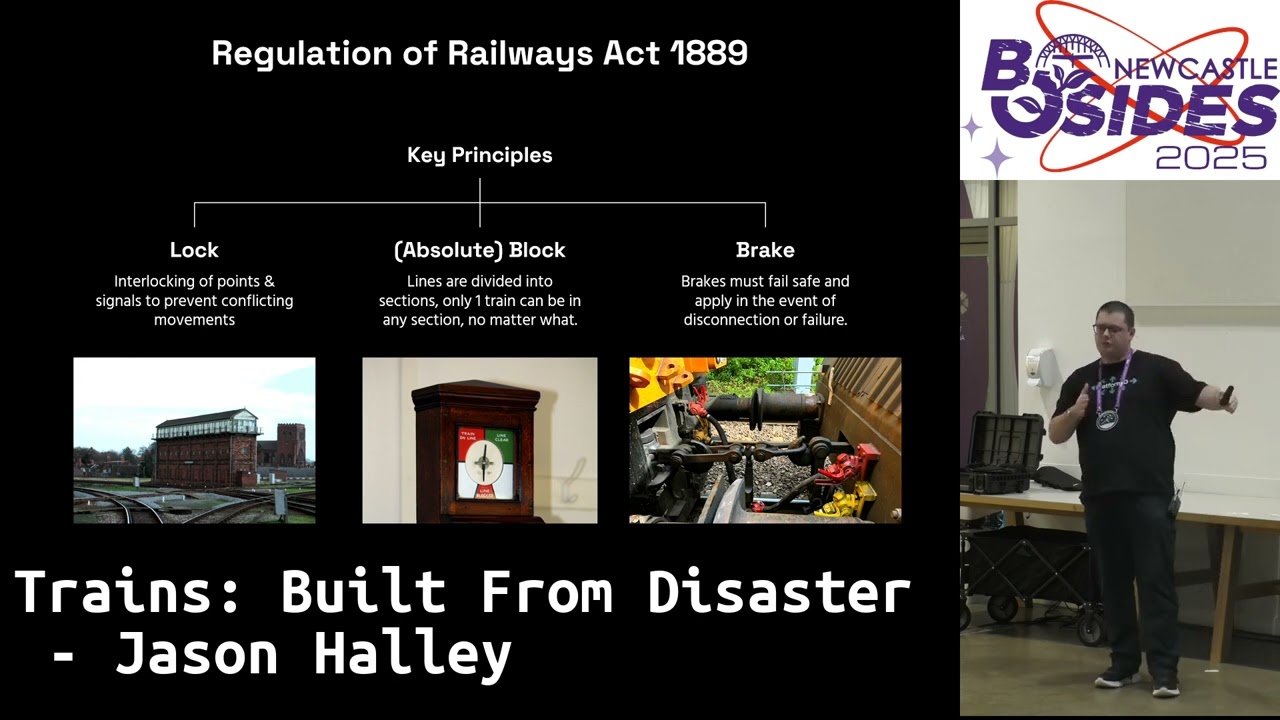
Armar the regulation of railways act of 1889 was introduced to parliament. This gave them the power to require three things. lock, block and break. Each of those in turn lock refers to the interlocking of signals and points. So for example, this is signal box just outside Shriby station. As you can see, big three threetory structure only. This top one is where the signal works with all the big levers you see in the old films. These other two stories here made out of uh brick uh red brick are purely there for all the mechanical interlocking that would make it physically impossible to pull the levers that cause a conflicting movement to happen. For example, to allow a train to
cross a line where you've cleared the signal for a particular other train to come in. Uh the next one was the change of how signaling worked. We move from time separated block to what's called an absolute block. The way that works is that you divide your railway or your running line into different sections called section blocks and then only one train be in any of those blocks at any time. Uh so that's why you would have in the past uh large numbers of signal boxes and they would pass each train forward and not until the signal box at the front had told the signaler behind them that the train had left the section would the signal in the
rear be allowed to let a new train in. And there was also a requirement for what they call an automatic brake. uh what we might consider a fail safe brake. Essentially uh where the braking system was operated by air pressure or by vacuum the system has to be designed such that the presence of the air pressure or vacuum is used to release the brake rather than to apply it. This means that if they're dis the the brakes are disconnected from their source of pressure or vacuum such as locomotive the brakes would fully apply. All three of these principles are still used today. Yes, in signaling they've evolved and we've gone for electronic interlock and now program uh
interlocking in signal computers. Absolute blockers are evolved from sorts of telegrams uh units that were fitted in signal boxes to use things like a track circuit which is just a small electrical current that you pass the rails. So enables you to detect if there's a train on the line. That means you can have essentially automatic signaling and braking systems have evolved to be more reliable using more air pressure these days. Generally you don't see any sort of human brake trains but they still required to be fail safe. So these three principles still in use today because we haven't come up with anything better. Haron Wheelstone 1952. So jumping quite a lot forward in time. Firstly a little bit of context. This is
a modern map of Haron Wheels station. Uh these are the DC lines for under underground and overground run. Don't need to worry about those. We don't really need to worry about the fast lines cuz in our scenario they blocked by um empty trains being shunted around. We're only really concerned with fast lines and with two trains specifically the 731 training to Ethan which was a stopping service taking commuters into London and the 2015 Perth Houston which was a sleeper service basically running what we would call these days the Calonian sleeper excuse me. So what happened? The uh the 731 training to Houston which was running late uh pulled into Harren W station on the fast line heading towards London.
They weren't able to use the slow line because like I said they were blocked for uh moving around empty trains where it normally would have gone. the 2015 the the Perth sleeper uh passed a a signal at caution which is a yellow basically yellow signal saying slow down be prepared to stop and two D signals which is your red light you must stop this signal or your your red indication uh because uh semol still in common use back in those days and they collided with the stationary train at approximately 60 mph. Unfortunately, the situation developed and another express train leaving Houston heading towards Liverpool passed through the fast lines at about 60 mph and ended up in the wreckage of the
previous collision. Obviously, a lot of questions were asked primarily why didn't the sleeper train stop and this is this is paragraph where that was covered in the report. It's all very detailed. Main thing is uh he must have relaxed his concentration on the signals for some unexplained reason. Uh during where at any rate for a few seconds which is signal could have been seen he was in a deceptive patch of fog. Basically happen stance of losing attention at the wrong moment with the signal being fog and by the time the driver realized that he passed it it was too late. There was nothing on the train that could remind him that signal was supposed to be there. The driver was
expected from their own knowledge to know 112 people were killed and 340 were injured. But we got but from this we got roll out of the automatic warning system. Now what is this? This is a fails safe system that will remind the or warn the driver automatically if you like of any uh on the approach any signal that isn't green. It also indicates that signal is green but the primary thing is the warning actually. It is fail safe. How it works is in between the ring lines we have two magnets. One of them which is permanent and the other one which is of the opposite polarity which is an electromagnet. When the signal is green
the electromagnets turned on. If the train passes over and it detects both polarities within a set amount of time. The uh the first one would arm the per magnet would arm the system and the electromagnet would tell it all is well. and the driver gets a little bad to tell them that everything's working fine. However, if electromagnet is missed, that electromagnet polarity is not detected, then the train the on board the train there is a warning in the form of a horn that driver must cancel by pressing a button in the gap. If they don't do that within 3 seconds, the train will bring itself to an automatic stop. It's a it's a it's very advanced system for the time
that it was brought in. and in fact is still in common use today. These are the two indications you would see. It's often called the sunflower for obvious reasons. This one here where it's not illuminated or is hidden would indicate the ball is well and it would be illuminated or revealed to remind the driver that they had passed over a warning. Had this been in place at Harold Wheelstone driver would have been reminded of the signal that he could not see for the fog and if he had ignored it the train would have stopped itself. live demonstration time or pre-recorded demonstration time because uh there is no way I'm running any sort of train simulator of 14inch Dell latitude.
So we are just north of Haron Wheelstone uh in the modern train Pendolino that runs the coast mainline route doing about 120 and you're going to see my audio is not working. [Music]
>> What? Oh, turn it on. There we go. I don't think this the important bit yet. So, we're approaching a signal of caution. In fact, there's two. The first one, I'm going to intentionally acknowledge it as normal. And then for the second one, I'm going to ignore it and you'll see what happens. So, there's it in the for now. The alarm goes press the big yellow button all we just pass another one and I'm intentionally going to not cancel it and it's that quick. We are already in emergency brake. All now is I've hit the button to acknowledge just so the whole stop sounding but as you can see we are now stuck with the emergency brakes app coming
down right quick and there's no way now to release the brake other than to wait for the train come to a complete stop and wait 1 to 2 minutes. And if this happens, you're going to have a very fun conversation with your supervisor when you get the train back to wherever it's supposed to be going.
might click a little bit.
Okay. Right. We'll do it the old fashioned way. Sorry, cameraman. You're going to have to adjust yourself slightly.
Did I just need to click? Ah, that's better. Got a little technical difficulties. So, uh, next we're going to look at from the 1990s. South Hole and Labour Grove. Uh, both of these are somewhat similar, although different in well, you'll see. So, quick background on South Hole. Um this was great western train service running from Swansea into London Paddington along Great Western mainline which some of you may know may have traveled before. The AWS system that I just demonstrated for you had been isolated earlier in the day because apparently it was malfunctional. No one had told the signal about this despite the fact that there was a rule which required the signal to give a priority
to any train on which the AWS equipment had been isolated. That was a safety measure. automatic train protection, which is a system I'm not going to go into because it was never widely adopted. Uh, which was a system that provided full constant speed monitoring um based off what the signals were and what the speed limits were. Uh, had not been enabled on the train despite being fitted due to the fact that the driver had not trained on how to drive it. And the driver was distracted because they were putting things away in their back on the approach to Paddington because they were looking forward to getting in and getting to go home. So what happened? Well,
the driver missed the two signals telling him he had to slow down because he was busy packing back. He passed the danger signal at 125 mph. That's as fast as you can go anywhere other than highspeed one on UK railways. So literally as fast as he could possibly go. He applied his emergency brakes obviously. However, there was a freight train signal to cross a mile ahead. A mile ahead and he was still doing 80 mph at the point of the collision. That that's how slowly trains stop. Now technologies improved. However, these types of trains the uh the in city 5s are still running in parts of this country. Labrook Grove. So this involved two trains again a uh a great western train
service uh Chelton from Chelton's Paddington uh and a local commuter service a train service from Paddington heading Bedwin. Now ATD had not been fitted to the trains, not the service, not because of the fact that the drivers weren't trained, but because by this point a decision had been taken that uh automatic train protection or ATP was not going to be rolled out nationally because this is the era of privatization and somebody had decided that it was going to cost too much money. It should be noted driver of the temp's train service was new and he had not been briefed on high-risk signals such as the one that he passed in this case SN 109 or in November 109. He passed
this signal when it was red and he should have stopped. The points were set to route him across the up main and onto a a down line. Uh that's be heading out of London, but he c had to get there. They had crossed the line that the uh Great Western Train Service was approaching on. The driver was sadly killed in the incident and it was never established why past the red signal. Uh here's diagram that explains things slightly better than I can. So as you can see the intended route was come across here which still would fouled the great western service and onto this line and instead of passing the signal the routting took them this way instead of
ideally up here which would mitigated the uh mitigated the situation. There there is a there's a BBC reconstruction available on YouTube based off of witness testimony and um some CCTV mixed with graph effects. I'm not going to show it because it looks very realistic. If you want to look it up, please feel free to do so yourself. Now, what was missing? Well, this is what was missing in both cases. A system that in the last resort could stop the train. AWS is all very well and good, but no matter what happened, the driver could always press the cancel button and and avoid any action being taken. They weren't going to go with TP uh they
weren't going to go with ATP. They decided that was too expensive. So, they went with this, the train protection warning system or TPWS. Quickly, uh TPWS, your track side equipment consists of these two um grids. They are actually low frequency radio emitters. One's an one answer the system and the other one triggers it. So they're slightly different frequencies. If you put them together, then it means if the train passes it, it stop immediately. If you spread them out, you can actually use the distance between them to determine if a train is approaching a red signal too quickly and stop it before it gets there with any luck. The equipment that the driver sees is this. There's a button so they can go
past the signal they're being given permission to. and this one which is the you've had a very bad day because it means the system has intervened. Quickly a couple of demos. So if you attempt against the signal this being in a letter on the middle of the main line uh I will point out the uh the brake commands up here. You can see as soon as I pass it flashes and the brakes come on. Unfortunately the game immediately fails you as it should because you've done something wrong. Alternatively, you're drawing speed.
Actually, I am running up time slightly, so I'm going to skip that one. Basically, the same thing would have happened. The only difference is you'd be traveling at uh a lot faster at the time. The warning light would have come on. The brakes would have intervened just like they did in the previous case. Cowen 1994. This diagram is probably the easiest way to explain it. You have a single line service going up here to Cowad from Asher station. Obviously, one train goes in, runs the service up, turns around, comes back, and then when it gets to Hashur, the next one can go in. The driver here of this train to E27 went past this signal and entered the
signal line session when he shouldn't have. One thing to note, the signalman alerted the emergency services while the trains were still a mile apart from colliding. The problem was the signalman had no way to inform either of the drivers that the situation had occurred and they needed to stop. That's the same thing again. So what could have been done? Well, one of the trains had AWS isolated, which again we know is a problem. The signal was dirty and there were no track points to send the train away elsewhere. If they'd had one of these abscure radio, which is an analog radio system, the signaler would have been able to use the emergency function to reach the
drive in time and get the train stopped. The roll out of cab secure radio began in earnest immediately afterwards. CSR uh evolved and became GSM railway or GSMR as it's now referred to. This is a digital solution. So, if you've ever seen one of these next to the train train lines and wondered why the heck can't I get any 4G signal, it's cuz it's not for your 4G signal. If you've ever wondered why your train has a shark fin top, it's because it's got fitted. GSMR even use direction antennas like this to work in a tunnel, which is something that was previously thought impossible. The control unit in a trend looks something like this. And the main one I
want going point out is the emergency call button or the big red button. Drivers have this signal have this. Anyone presses and every train in the immediate area is brought to is ordered to stop. Had this been fitted, the collision at Ken could have been avoided and indeed it has been used drivers in the past to prevent what could be potentially fatal accidents. This one involving people trespassing and uh sitting on the platform edge which you shouldn't do. Rail track and those of you a certain of age have already gone oh god I remember those people. Yes we will briefly talk about them. Rail track was the company that during privatization of railways in the 1990s
uh got given the responsibility for managing all the tracks all the signals everything like that what's called the permanent way. Other companies took control of the trains. Other companies took control of the rolling stock. How did it work? Well, briefly, it didn't. They got rid of a lot of the engineers to save money. They sent put a lot of the track work out to contractors. Didn't really know what they were doing. They had other contractors who recruited recruitment agencies. There was even one time of night shift workers on the railway being recruited out of a pub, although there's no primary source for that. So, that's uh allegedly And yes, there was a lack of effective
supervision or enforcement of standards. This led to an incident at Hatfield. GNR service heading cross to leads uh suffered a track failure underneath the train doing 115 mph. Seven of the carriages on that train were delayed. Why did they fail? Something called rolling contact fatigue. Basically, heavy weight, small pressure pushing down constantly over and over and over again. Eventually, your track is going to break. Why didn't they fix in time? The line spec wasn't uh tight enough. Tolerances, um the maintenance requirement, etc. weren't good enough. Replacement rails were made available. Nobody ever bothered to fit them. This is a quote from the person responsible for the standard of the track in that area. I do not have knowledge of railway
engineering nor railway safety. Those are arguably the two things you should have if you're going to run a bloody railway. Sorry, this one gets me angry. And naturally, a willingness to save or a want rather to save money because any sort of loss of performance had to be paid out of tracks profits. 1,800 emergency speed restrictions introduced after Hatfield while upgrades and repairs took place. The train operators, they lost 19% revenue that year. The UK economy as a whole was6 million pounds worse off per day that year because of the impact of those late running trains and rail track they were reationalized in 2002. This a little more light-hearted operation smash hit. Essentially nuclear fuel uh spent nuclear fuel rather is
carried in these flasks uh from across the country. All the nuclear power stations are to their to cellfield for reprocessing and uh safe disposal. Operation was launched called smash hit in the 80s uh 1984 specifically to prove that these flasks were a safe. They did a lot of things. In fact, if you remember this picture from the start, that's what it that's what it was. They derailed one. First of all, they dropped it. They crashed it into a toe and they engulfed it in full it survived all that. But then they finally decided to do this.
And watched for safe distance by some,500 invited guests, it plowed headlong into the derailed flask wagon.
32 different cameras captured the scene from many different angles. You'll be pleased to know that atlast survived the impact such that had it been carrying spent nuclear fuel, there would have been no radiological impact. So there's your timeline from the 1880s through to the modern day and even beyond. We're getting safer. We're getting better naturally. Now I would just like to point out in the world of modern computing and cyber, we're not even here yet. So imagine what we have to come and what new systems, procedures, processes are going to come into place that are going to change the way that we do things and be ready because it's going to happen. As for trains, these are some of the
things that are coming in. Automated operation, signaling in cab, even just trying to improve the infrastructure like getting rid of things like level crossings. The future is coming. Be ready. Thank you very much for your time. I hope that wasn't too boring. Jason everybody. [Applause] >> Do we have time for questions? Do we have any questions? >> I have. >> You have a question? >> Yeah. Do you want the ball? Welcome. Remember to turn it on. >> Thank you. Right. So what I've noticed when you describe all those accidents is that the common denominator is lack of attention when it comes to drivers. And I was wondering well obviously for cars it is planned that every car produced
after 2020 2026 I think I don't want I well two anyway uh is going to fit it with uh attention awareness systems so that if we drive a car and we don't pay attention we will be either nudged or the car will be stopped. Now is something like that planned for the trains? So, funnily enough, something like that already exists. It's called the DSD or the drive surveillance device. And essentially, it's dead man's pedal that the driver has to keep their foot down on. However, if they don't move any of the controls for a length of time, I get off the top of my head exactly say 30 seconds. The system will beep. The driver has to
release the pedal and push it down and to confirm that they're still there and attentive. And if they don't do so, just like in the AWS demonstration, train would stop itself. >> Yeah. But then well the systems that are going to introduce in our cars rely on tracking the eye movements and if the driver is looking directly at the road or if the driver perhaps moved head in the wrong direction and for example like you mentioned one case when the driver was going through his bag is something like that also present in train cabins. So I'm not aware of anything like that being present in British trains at the minute. There may be plans to introduce
something like that in the future. I I wouldn't see why they wouldn't even that those are in being induced on cars, but I'm not aware of anything specifically myself. >> Okay. Thank you. [Music] >> Yeah. I'm going to be very careful with this cuz I don't want to break the camera. [Music] >> There's nobody driving that train, right? >> No. No. To clarify, no, there's no one driving that train. That was positioned uh nearly about 9 milesi from the point of impact. Um a modification were made to allow it to be set in motion without the driver being present uh and bypass all the safe systems so that it wouldn't stop itself on the way there. I was
going to say it don't look like this uh at that speed. Yeah, that that was bought by the uh electricity generation board uh from British Rail as it was at the time and he knew it wasn't coming back. [Music] >> Any more questions? Or is somebody just I'm going to lob the dog bowl at the head? No. Cool. Fantastic. Thank you very much. Enjoy the rest of the show.
Related talks
 19:16
19:16 31:12
31:12 1:13:10
 39:36
39:36 9:18:01
 8:14:55