Sharing Vulnerabilities
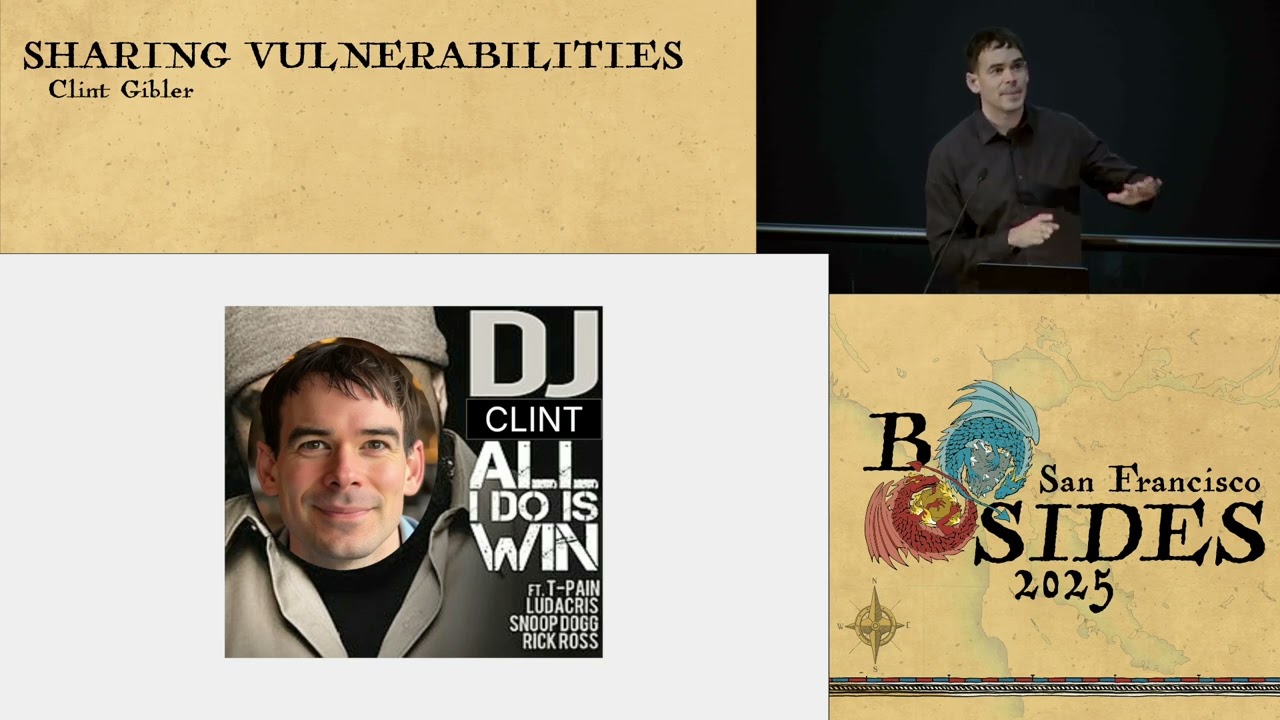
Show original YouTube description
Show transcript [en]
Hey everyone, thank you so much for coming and thank you to the organizers for having me. Uh I'm absolutely thrilled to be here. Uh so over the next two days, there's going to be so many amazing talks. Uh you're going to hopefully make some new friends, meet some cool people, and yeah, make some professional connections as well. So my talk today is called sharing vulnerabilities or subtitle emotional intelligence isn't just a coping strategy for the logically impaired and other lessons uh that I should have learned earlier. So, I've actually spoken at Besides SF four times before, uh, which I believe if this was Saturday Night Live, uh, today, I would be getting some sort of
smoking jacket, a five-timer smoking jacket, uh, after this. So, I'm, you know, looking to the corners to see if, uh, that the organizers agree. So, we'll see. Um, okay. So I'm just going to sort of break the fourth wall for a second and just sort of directly state sort of my thesis and the overall structure of the talk and we'll get into more details soon. Um so basically uh I'm going to argue that interpersonal skills can meaningfully improve your career and relationships whether that's uh professional, romantic, or with friends and family. Uh I haven't always thought that way and I'm going to explain why my opinions on this have changed over time. I'm going to share some concrete stories
about why this stuff is important and some lessons learned. I'll have some exercises you can do if you want to and uh the appendix there will be a whole bunch of resources as well. So this is a security talk about security people but really the focus is on people. So, I'm going to tell a ton of stories about uh some failures I've had, some times when I was really embarrassed, uh some deepening of friendships, some people finding love, uh and also death because as the first talk of the day, I thought we would start light. Um and also, of course, plenty of memes and uh some embarrassing photos of young me. Uh and I just wanted to uh share up front
that uh I am going to share a story towards the end of someone close to me uh battling with cancer. So if that is currently something very sensitive for you, I just wanted to tell you up front so it's not a surprise later. Okay. So we talk about vulnerabilities all the time in security obviously uh often how to you know eradicate cross-ite scripting and things like that. So in this talk I mean vulnerability more in a interpersonal context. So uh Bnee Brown who is a very well-known uh author and speaker defines it as uh uncertainty, risk and emotional exposure which uh to be honest I felt a lot of uh both in the creation of this
talk as well as uh sharing it today with you all. So I know that uh some of you may be thinking you know I came here to hack not to feel and uh listen I totally get it like most of my life most of my career uh I felt exactly the same way. uh in fact if you went back uh more than uh just a few years ago uh I and you told me that I would be speaking about this topic today uh I wouldn't believe you uh and I might even like laugh at you uh but I'm going to explain a little bit about why my opinions on this uh have changed over time. So when the
organizers came to me and said you know Clint give a talk on whatever you want uh I part of me was like okay well I could do like a TLDDR AI 2.0 or some sort of technical talk that I'm like, well, you know, this is in my wheelhouse. Uh, people will find it useful. Um but when I took a step back and thought you know what is the impact uh that I want to have on the world and the security community uh ultimately I thought you know this is really the talk that I wish I had uh 5 to 10 years ago because I think that it would have uh meaningfully improved my life uh both in
terms of career uh having deeper uh friendships uh having better closeness and intimacy with romantic partner and just overall like being happier to be honest. So my goal in this talk is to you know hopefully uh help you in some of those things as well or at least give you some perspective uh or phrased another way like how can I help you speedrun some of the places I've sort of face planted or various heartaches uh I've had okay so just like super quickly a little bit about me so I work at SERP we do application security stuff so like SAS SCA secrets blah blah blah stuff like that uh so I also write the TLDDRS
newsletter So if you want to keep up with the latest security tools, research uh and things like that, you know, it's totally free. Feel free to check it out. But really, my goal in this talk is to share a bunch of personal stories so that uh you can start seeing me as, you know, more than just professional resume and more as a whole person. And I hope that that uh I hope that this storytelling also encourages you uh to do the same over the course of this conference and uh going forward. Uh okay. So this is uh sort of the overall big picture agenda. So I'm going to tell you stories in each of these. Um so
first I'm going to share uh a number of failures I've had. I'm going to talk about how uh encouragement can be really powerful and cause people to rise to the occasion. I'll talk a bit about how showing yourself can help you find your people. I'll talk about the power of having a non-traditional background. Uh I'll discuss how um you can deepen friendships through sort of sharing vulnerably and then I'll finish with some stories about family. So I'm going to name some specific names uh in these stories and I'm doing that for two reasons. So one is that a number of these people have meaningfully improved my life and just uh I want to give them like a shout out
and thanks and show them that I appreciate them. Uh some of them are in the audience today. Uh and also I I wanted to make it real, right? Like I could describe some e abstract uh academic situations and I think intellectually you could be like uh yeah like that makes sense but I think it lands differently at least to me when it's like oh this specific person in this time did this thing. Um so I think it lands more to me when it's more concrete and also just to be clear I have permission uh from everyone mentioned in this talk that I can use their name and likeness so I'm not like surprising anybody. Okay. Okay. So, one theme
that's going to come up a few times in this talk is the finitness of life. So, there's a great uh blog post by wait called your life in weeks, which basically um sort of maps out both by year and by week like different phases of life uh sort of nicely visually and ultimately, you know, there's just not a lot of time. Sort of makes very nicely visually clear. So, I'm bringing this up now because it's going to uh be relevant later. And um like one term for that sort of device uh if this was a play is called uh Czechov's gun which is sort of a narrative principle where you're like okay if in the first act you have hung
uh a loaded pistol on the wall then in act two or act three you have to scan your infrastructures code uh with a security scanning tool. Okay so this is actually so much more laughter than I thought I was going to get. Um because you know this this sort of like you're a security nerd, you're a theater nerd and uh you know there's this very narrow overlap. So um yeah, I was thinking about having a comment or a slide that was like you know I expect five laughs here. Um but oh man, we did so well. I'm so pleased. Uh yeah. So [Applause] um yeah, and so I think one of the reasons I was thinking about cutting
this joke because I was like I don't know if anyone will like it. But I think really one of the themes of this talk is like putting yourself out there, leaning into what makes you unique and uh I really love uh theater and improv and things like that. So you know this is very truthful to me. So, I wanted to keep this in even though, you know, maybe there's not many of us, but I would argue at least uh dozens. Uh, okay. So, just like before I get into it, over the past couple of years, I've been thinking a little bit to myself like why did it take me so long to uh prioritize or recognize the
um importance of emotional intelligence. And I think there's many reasons. Um so, for example, in school, especially in math and science, you know, it really encourages us to focus on analytical thinking. Obviously in our field uh in security analytical thinking is king. Um but I think also it's useful to go deeper. So if we take a step back and think like what made you you um obviously uh parents both in terms of nature and nurture had a big impact and I think at least like reflecting on my own life and I'll share you uh share with you some concrete stories uh right after this um really shapes like what we value or what we think is not as important and really
how we see the world. So I'm going to share some stories about me but really the point here like that doesn't matter. It's more I want to encourage you to think like how how did your childhood uh affect what you feel and believe now and you know maybe some of those beliefs are great and some of them you might be like oh maybe I want to update that mental model a little bit. Um, okay. So, this is a picture of me in second or third grade, and from a young age, my parents said, "You know, Clint, we um we expect you to get A's in all your classes." And you know, if it's not an A, I guess
that's okay, but we're going to need you to try a little bit harder. Um, and you know, it's it's either you're getting an A or you're trying as hard as you can in a class. Um, so if it's not an A, you should be trying uh very hard. Uh, and so this is a picture of me in high school and there was a specific time uh that I remember I think it was junior year I was having a parent teacher conference with uh my guidance counselor at the time and he asked me uh you know how would you describe your parents parenting style uh to which 16-year-old Clint responded resultsoriented uh and uh so so he was a gasast but My
parents looked to each other and then looked to me uh and they they were so happy. They were like uh they were like he gets us like yes. And uh and it it seemed very logical to me. I was like yeah like I get it. And um and when you when you think of someone like me in this example uh was raised with both those type of parents and that sort of uh worldview. it makes a lot of sense why I would focus on academics uh focus on career and ultimately I think it's a big contributor to why I'm standing here in front of you all right now right and so I'm very grateful to them for their
uh love and affection and also encouraging me to try to be the best I can be um you know without that I I probably wouldn't have done many of the things that I have done um but it also makes sense why like oh someone raised like that it would make sense why they would maybe not focus as much on more the intell uh emotional intelligence side of things uh until perhaps later. So, you know, it just sort of like makes sense, I think. So, I share this to be like, oh, maybe what are some things for you that are like that? Obviously, all of our stories are different. Okay. So, that was a little bit of like sort of uh
backstory, but let's get into um some additional stories. So, I'm going to share a bunch of failures I've had. And the reason I did that is because I think it's easy to, you know, see someone speaking in front of you, and you're going to see many great talks today. And it's easy to think, and I fall into this trap, too, like, oh, all this person probably does is win, right? Like, everything they do probably succeeds. Uh, but I've actually failed a lot, both interpersonally and uh, professionally. Really, a lot of my life has been eating humble pie or if I were to do it to scale, it would look more like this. Uh, so out of undergrad, I applied
to a bunch of PhD programs. I was rejected by most of them. When I was a grad student, I submitted a bunch of papers to conferences. Most of them were rejected. Uh I think the first time I submitted basically every paper uh it was rejected and some were rejected many times. Uh so I think over the course of my career I've applied to Google three times and I was rejected all three times which you can check my math but I believe is a 0% success rate. Uh my friend Louisa was writing an article for Forbes. uh this is in 2020 and uh I'm quoted as saying yeah like machine learning and security or security vendors I I don't think that's a big
thing. Um obviously a few things have happened since then uh and then last year I gave a talk at besides SF about applying uh AI to security so sort of 2020 Clint eating his words and the reason I wanted to share this is because I think the most successful people also fail a ton and failure is not permanent. So I want to share these stories about me so that you know when something happens to you you're like oh yeah this is this is just part of it this is fine uh yeah and I wanted to say that you are enough you know wherever you are right now whatever you know um you know that's totally fine and uh we're all in this
process and learning and growing together so you know don't don't stress about it okay let's talk about the power of encouragement so I spend a lot of time reading um blog posts and other sort of security research things. And one of my favorite things to see is someone tackling an area and then sort of doing this awesome tear and like breaking a bunch of things in uh this ecosystem. And so I'm going to share one of those examples uh specifically in the supply chain security space with uh GitHub actions and also like how our words can make a big difference uh even when we're not aware of it. Okay, so this is a uh blog post by Adnan
Khan and basically he found a vulnerability such that um he was able to uh back door GitHub's uh base runner images would would then have allowed him to um conduct a supply chain attack on any GitHub customer that used uh hosted runners. So when I saw that right I was like yikes uh what what a high impact finding. Uh so then uh Adnan, John Stwinsky and others then uh sort of went on a tear and broke a whole bunch of other things. Uh meanwhile I'm just sort of in the corner enjoying it, you know, eating popcorn uh watching them do amazing work and also I think make uh security better for uh like the broader
world ecosystem. They then went on to speak about it at Black Hat and Defcon. And actually that summer Adnan reached out to me and said, you know, hey Clint, if you are uh going to be in Vegas, let's hang out. And I was like, "Yeah, that'd be great." So, we met up and uh basically I said, "Hey, man. It's super cool to see what you're doing. Uh I love your work. Uh you're making, you know, a huge impact and you know, keep it up. Uh this is super exciting to see." And what he said uh actually surprised me. He was like, "One of our earlier blog posts you actually called out in TLDDRS and you
know, it really encouraged us and sort of motivated us uh to keep going uh on this journey." And when I uh later connected with John Stwinsky who was also involved in a lot of this work, he was like, "Yeah, having the broader community security community uh be like, "Yeah, this is good impactful work really motivated us to do this this arc and convinced Pritorian to give us more research time so we could build tools and and find more bugs." And I was like, "Wow, that that's so great. I I had no idea. I was just, you know, admiring you from a corner and cheering you on for like a year and I had no idea about
this." Um, so yeah, the whole time I was just like, yeah, like the these people are doing amazing work. I'm so happy for them. Uh, and I I had no idea that um just sort of like an off-hand uh encouragement could uh be obviously a small part, but did help a little bit in terms of motivating them to uh keep going. So I have sort of two ideas here. So one is this is more like on the professional side. I think an effective way to do security research is to choose an area and then go very deep and then apply that uh tooling or domain expertise uh sort of at a ecosystem level sort of apply that hammer
everywhere and at a more interpersonal level I think you know it's really powerful uh telling people when they're doing great that encouragement can go very far uh even when you're not aware of it and I think all of us have one probably more people in our lives that you know a kind word uh of encouragement here or there could make a very meaningful difference in what they choose to pursue or how they believe in themselves. Uh so this is a picture of a sort of stereotypical San Francisco hipster and um yeah actually I think the prompt was like San Francisco hipster or something. Um but yeah I think there in some cultures or in some perspectives
there is like a coolness to being aloof and not too excited about things but personally I think being earnest is very cool. Uh, and I think, you know, I love uh when someone's doing cool work being like, "Hey, man, like keep it up. This is awesome. Like I I believe in you." And so I think I would encourage you all uh to do that as well. Um, so this is a tweet from Dan Kaminsky that I thought was very nice. Basically like you don't need permission to be awesome, but if you think you do, this is me giving you permission. So what I would say to Adnan and John and what I would say to all of you is
that I can't wait to see all the great things you'll do. I think everyone in this room and at this conference or who's watching later uh absolutely has the skill uh and motivation to do world class work. So and me selfishly, I like reading about it. So I can't wait to see it. Okay, I want to tell a story about how showing yourself can help you find your people. But before I do that, a quick backstory on my friend Tanya. So this is how she and I met. So we were at Absac California a number of years ago. Uh rest in peace, no longer a conference. Um and basically what happened is she came up and said, you know, "Hey, I'm
Tanya. I'm also into AppSc like uh let's be friends." And we immediately hit it off and have since then uh hung out at conferences all over the world. And uh yeah, whenever she's in town, we always try to catch up. And this was just because she randomly came up and said hi. And the reason I'm sharing this is that a random chat you have today or tomorrow uh at Bides SF, like that person could be your good friend in 5 years, just like a random uh one-off conversation in line or when you're sitting in a talk or yeah over lunch or at a party tonight, for example. And I know it can be kind of scary to meet new
people. I know I feel that. So feel free to steal this line. uh which I like to use is just hey what's something cool you've been working on recently um and then they can talk a bit about their work you can talk about your work and yeah all of a sudden bam you're in a conversation and this is going to tie into a quest I will give you all later okay so back to Tanya um so this is a few years into us being friends and she said to me one day you know Clint I um I'm having a little bit of trouble finding a life partner because I feel like I'm intimidating to a lot of
people. Um, and I thought about it for a second and I was like, well, I mean, Tanya, let's be honest, like, you're a badass. Uh, you know, you give keynotes, uh, all over the world. You've got multiple best-selling books, so like, yeah, I get it. But I think that rather than trying to dim your light or pretend to be less than you are. I think you should lean into that, right? You should be like, "Yeah, I am uh a hardworking person as well as being very loving and kind as well." And I think that the right person for you will, you know, care for you not in despite of these things, but because of these things,
right? Like leaning into who you are. I think uh hopefully you'll find someone who loves that about you. And she did actually lean into this advice and really leaned into who she was. And not too long after that, she actually found um someone that she's been very happy with. They've been uh dating for years and I think they recently uh were engaged. So uh yeah. Yeah. And then she wrote uh she created a YouTube video about this story as well. So it's linked in the in the show notes if you want to check it out. But it's very sweet. So my point here is that by being yourself can help you find your people. And sort of
conversely, if you don't show yourself, how will the how will your ideal person or company know when they found you? Right? If you're just this sort of bland generic version of yourself, uh they won't see that in you. So a book uh I really like about this is called uh scary close by Donald Miller. Um it has many good quotes. One of them is you know if we live behind a mask we can impress but we can't connect or you know what if the people we consider to be great are actually the most broken which uh obviously has no relevance uh to this media talk or moment. So, uh, the point here is I would encourage you
to let yourself, uh, be seen. Okay, let's talk about the, uh, awesomeness of having a non-traditional background. So, uh, this is my friend Rachel. Uh, so, actually, fun fact, she and I were friends from the improv comedy scene before she got, uh, into security. But what I think is really cool, uh, about her background is, so she has a degree in neur neuroscience. She then spent uh a number of years doing uh customer experience research and then from there she went to uh Defcon and got I believe second place in the social engineering CTF uh two years in a row or sorry three years in a row uh and then sort of pivoted her career
more into security where you know now she is uh recording videos of social engineering and hacking billionaires and uh CNN correspondents right so what what a career journey. And she actually talked about this uh in her Besides SF keynote uh a couple years ago. And so what I would argue is that uh Rachel's so good at social engineering, not in despite of her background, but because of her background, right? the fact that she uh has a degree in neuroscience and uh spent so many years doing user research like those skills actually make her great at what she does today and makes the security community better I think for her having a diverse background and skill
set. So the point I wanted to convey here is that just because you don't have a specific background whether that's engineering, computer science or something like that uh doesn't mean you can't excel in security. So, here are some people uh backgrounds of people that I personally know. Like I could name a name for for each of these people who are crushing it in security even if they have uh you know degrees in physics or English or theater or music or they used to be an eco pirate or they uh dropped out of college, didn't go to college. Um yeah, so really uh I think with the right amount of uh focus and effort, anyone and everyone can be
successful here. And so what I wanted to say is regardless of what you look like or what your background is, you belong here both at Bides SF and in the security community as a whole. Okay. So uh we're going into uh a bit more personal section now. So these are um going to be some stories about uh deepening friendship through vulnerability. Okay. So, I don't know. I'm going to speak for myself for a second. Um, you know, I think for most of my life, I try to uh, you know, be upbeat and positive and I try to lift up the people around me. And I think uh there's a a fear I have or a
story I tell myself that if I were to express negative emotions like uh sadness, grief or like oh I feel like I'm behind uh either in life or in this area. I think my fear is that expressing these things will drive people away and that they may uh consider me a burden or that I will feel like a burden. Um so it can make it scary to express these sort of negative feelings. Uh but what I found and I'm going to give you two examples of right now is how sharing some of these personal challenges can actually uh not just uh not drive people away but can actually uh bring people closer. Okay, so example number one. So
uh this was a number of years ago. I was uh several years into a uh relationship and my uh romantic partner and I were trying to decide like okay are we moving forward and uh getting married or not and uh it was a very uh stressful time and what I realized is that I wasn't as um effective as I wanted to be at like honestly just understanding uh how I felt and being able to communicate that uh effectively to her. And to be honest, it was very surprising to me, right? Because I was like, okay, you know, at work, I can uh understand abstract concepts and break problems down into component pieces and solve them. I'm
like, easy, you know, no problem. Uh but understanding uh myself and like my own feelings and being able to communicate that was like surprisingly much harder, which I was like, this doesn't make any sense. I have like firsthand knowledge of this, right? Like I should be I should be good at this. Um versus like understanding some abstract concept like same origin policy or or something like that. Um but uh so basically this uh kicked off um so some personal growth for me and really in some ways was the catalyst that led to me uh giving you this talk today. So I started uh doing a lot of journaling uh going to therapy and reading a bunch of books on like
communication and uh interpersonal dynamics and like vulnerability, relationships, marriage like all these sorts of things. um just to be like, you know, I feel like I'm, you know, level one out of a hundred in this and maybe like at least if I'm like two or five, uh would be great. And so another thing I did is that I reached out to a bunch of friends as well as professional colleagues. Um and a number of these professional colleagues to be honest like I didn't know very well at the time. Um so I I kind of really felt like I was going out on a limb there. And uh basically what I said is like hey this
is super awkward but uh I feel like I'm really struggling in my relationship right now and I'd really appreciate your feedback. Like do you mind if I ask you some questions? Um and to my surprise uh pretty much all of them uh everyone that I asked were like yeah sure I I would be happy to even though that I wasn't really that close to them. We just knew each other from like conferences and things. Um so they were very very kind in sharing stories about like how they met their partner, what sort of challenges they had, how they overcame them. uh and giving me feedback as well. And uh what I realized is that well
first I felt less alone because there was like my peers and other people I I trusted and respected that they had also gone through similar challenges and I wasn't alone in this. And also uh instead of driving people away uh I think that again it actually brought us all closer such that even though this was years ago I feel like I'm closer with all of these people uh because we talked about more than just work things and because they were there for me in a time of need. Um, yeah. So, I was I mean it's easy it's easy to like intellectually understand this, but I think actually doing it, at least to me, uh, is scarier, but but also like feels
meaningfully different. So, uh, what I would encourage you all to do is to think of someone in your life, uh, maybe a couple people that you're like, "Oh, I like these people, but we're maybe not that close yet." And next time you hang out with them, consider sharing something a little bit more personal. maybe not the most personal thing, but open up a little bit and and see how it goes. Uh, also my friend uh, Jacob is involved in two other talks, I believe, today. So, feel free to check those out. I'm sure they're going to be awesome. Okay, so, uh, this next story also about, uh, deepening friendships through vulnerability, um, takes place, this is a few years later than, uh,
after the previous story. So, I was at my friend uh Daniel Mesler's house and obviously his uh house looks like some sort of wizard cave. Um and um uh basically at some point I said, "Okay, listen. Um this this is going to sound really awkward and I feel very embarrassed to say this. Uh I'm going to be honest with you, but I have to get something off my chest. If I'm honest, I'm a little bit jealous of your relationship with Jason Hadex. like you guys uh have been friends uh for you know like a decade and uh I really appreciate your guys' uh closeness and I feel weird saying this because I love Jason. I've been a huge fan of his work
for like years and years. Um and you know I just I feel bad saying this because it's like I feel kind of uh embarrassed and ashamed. Uh I feel kind of like a like a baby like some toddler that doesn't want to share toys. And um yeah, I guess part of me is also like very concerned about like are you going to judge me for saying this? uh are you going to think less of me? Um so if I were to visually represent this dynamic uh of what I was feeling, I think that it um would look uh something like this. Um or if I were to pull from uh one of the great novels of our time, Twilight,
uh it might it might look like this. Um you know, Team Jacob, baby. Um so yeah, I was actually very surprised by what happened next. So, so I'm like I'm like feeling a lot of anxiety about sharing this. Um, but then what Daniel actually said is he was like, "Oh, thanks. Thanks so much for telling me. Um, you know, that means a lot that you trust me uh to communicate that to me, but you know, if I'm being honest, uh, I really appreciate these vulnerable chats that we have, but I know that Clint, you have other people in your life that you also have some of these vulnerable chats with, and I'm kind of jealous about that." So, uh,
unbeknownst to me, while I was feeling the one way, Daniel was actually, uh, feeling sort of the same way, uh, about someone else. And, yeah, I I was like, "Oh, wow. I had no idea that you felt that way." And I think that we, uh, both felt better sort of getting this off our chest. And I think that it really built some closeness or additional closeness between us because we're like, "Oh, this person can hold space for me." uh sharing something that you know feels embarrassing and is uh not something we would normally admit especially about uh again like a very good mutual friend uh of ours because yeah it's kind of weird to say but uh yeah we became closer
friends after that uh still to this day and I think after that we uh hugged it out and then went on to do what one always does when hanging out with Daniel which is uh writing AI prompts and uh you know watching speed chess on YouTube. So, it was uh excellent uh after. So, yeah, the lesson here is I would encourage you to do the things that scare you. Whether that's taking a risk professionally or perhaps opening up about something uh personal and meaningful to you uh interpersonally. Okay. So, one metaphor I like to think about, this is going to make sense in a second. Um, you may have heard of the TCP 3-way handshake. So, I
would like to propose the uh vulnerable CP 3-way handshake, which looks kind of like this. So, first you share something vulnerable about yourself, something that you feel is a little bit sensitive or you're a little bit uncomfortable to share. And the other person can choose to mirror that and also share something vulnerable or sort of acknowledge what you've said. And then now you've established a deeper level of trust and connection. And so going forward you can communicate sort of about a broader swath of things and have a deeper connection. And sort of the the thing I want to call out here is that it takes someone initiating, right? Someone needs to take the lead in uh yeah sharing
something a bit personal such that uh the other person maybe feels a bit safer to uh open up as well. Of course, uh not everyone may be comfortable uh with that, which is totally fine. Uh I think it's still valuable to have people uh who are friends at like different levels of depth. Um or perhaps if there's a relationship that you feel like you uh can let go of, you know, that is also fine because um you know, sometimes letting things go is for the best. Okay, so last stories. poignant pause to drink water. Okay, so I'm going to tell you some stories uh about my dad. Um and to be honest, I didn't originally plan to
include any of these stories. Um it's going to be clear that he's he's a a very wonderful person. Uh it's not representative. I just really liked this meme. Um but yeah so when I was conceiving of this talk I didn't actually plan to include any of these stories but as I was reflecting on my life and thinking about like what are the sort of keystone moments in my life that have formed who I am today uh and sort of how I see the world. Um, I realized that really a number of these things that I'm about to share with you right now, uh, were some of these defining moments that I, uh, still look back on, uh, fondly. And also, I think I
could have easily sort of taken a different path. Uh, but I'm really glad that I did what I did. So, I'm going to share these so that hopefully um, it can influence how you all see the world and maybe some decisions you make. Um, okay. So the first of these uh not all time is created equal. So this is um the summer before my last year of grad school. I was interning at Lookout which is a mobile security company and then was about to go back to grad school. And uh that's when I heard that my dad's lymphoma had come back. So he had been battling cancer on and off from when I was in high school and then undergrad
and then now grad school. Um, and the thing about long-term illnesses is you kind of don't know how much time you have, right? You don't know like, oh, is this going to be is he going to get better soon? Is it going to be like a multi-year fight or is it only going to be maybe a few weeks and then escalate uh drastically? And so, uh, I obviously very stressful time, but also I didn't know what to do because I was like, well, I'm kind of in the middle of a couple different work things and I I'm stressed about telling my boss. I don't know if there's going to be professional repercussions. I don't know how they'll
handle it. Um, and what I ended up doing is I told my lookout manager like, "Hey, I need to end the internship early so I can be with my family." And I told my grad school adviser that uh, I'll be back uh, or I'll come back, but like just in a in a few weeks. And uh, I was very fortunate in that they were both very understanding and were like, "Oh yeah, um, you know, family is important. You you should do that." And uh the reason I share this is because I almost uh didn't do that, but when I look back on my life and I'm like, "Oh, what are the decisions I'm most happy that I
made?" Uh this is one of them. So uh hopefully this is obvious to many of you. Um but I just wanted to really emphasize that medical emergencies, whether it's you, family or friends, is just much more important than work. And again, it is definitely being in a position of privilege to not or to have the uh economic flexibility to be able to be a little bit flexible with some of these things. Um, but if you can, I think that it's important. Uh, and then also, you know, there's going to be uh moments in life where either that time or your presence uh is just much more important than other times. So, what I would encourage you to think about is
periodically ask yourself like, is now uh one of those times? whether um sort of uh you know illness, death, wedding, birth like all these sorts of things uh are some examples. Um and also yeah like is this a keystone moment in my or someone else's life? And um yeah, would I really regret uh if I didn't do this? Okay, so one thing that I did in this time uh is I actually interviewed my dad over dozens of hours over a couple of weeks. Um, so I was uh actually 26 at the time, but I thought that uh this photo was sort of emotionally uh relevant. Um, so I'm actually 96 now. Uh, but I have a a
really great skincare routine, so that that's why I look like this. So, uh, I realized that despite knowing him for my entire life, there was a lot about his life that I didn't know, right? like what was his childhood childhood like and and things like that. And I realized that if I didn't ask him now, there's a lot of details that I would never know. Uh and at least for me, it's easy to uh put off uh sort of awkward or sensitive conversations cuz you're like, "Ah, we'll we'll talk about it later." But when you don't know if there's going to be a later, I think for me, it helps me sort of push through uh some of that
awkwardness. So when I told him that I wanted to interview him about his life, he was like, "Okay, yeah, let me um let me type up a few notes and and send them to you." So he then uh sends me a very dense like two-page Excel document uh where each line is like, "Okay, from year to year I was here doing this. From year to year your mom and I were doing this." Um yeah, and I had to laugh like who uh you know when someone says I want to interview you about your life is like yeah I should create a super dense uh two-page Excel doc and send that almost like a meeting agenda uh of like talking
about your own life. Um and you know that and many other moments I was like okay definitely uh my dad uh yeah no no paternity test needed I am definitely sure that uh this man is my father. So yeah, and I think it was um a very special few weeks. I think that we grew closer in those few weeks than we had in the prior say like 25 years uh of me knowing him. And I think what what's nice about it is it's not just getting to see and know him better, but to also uh again sort of see myself better as well. So, uh, I don't know, maybe this is a vibe kill, but what I would
encourage you to do is, uh, and again, maybe you have a bad relationship with your parents or they're not around, so maybe there's other loved ones in your life. Um, but I I would encourage you to, um, interview them or at least talk to them and try to get to know them a little bit better. Um, and I think it's nice not just knowing the logistical like where were they and what did they do, but also like why, like how were they thinking, what was their motivation, like how do they see the world? Um, and there's many good questions and maybe like I'll write a blog post that has like more of these things because I've actually mentioned
this to a few people who've done it and they've said it was really gratifying. Um, and so I would encourage you to record it if you and the other person feel uh comfortable uh both so that you have like something to reflect on or listen to later. Um, and also because it's 2025 and uh, you know, you can clone their voice and uh, talk to them forever. What a what a time to be alive. Um, but yeah, maybe nice, maybe dark. Um and yeah and again I think this helps um uh them feel seen and witnessed and and also you can help see yourself better. Uh again sort of the theme of finitness of life. Okay. So this is a last story
about this topic. Um I think it's easy to intellectually understand the idea of like what do you want written on your tombstone or what will people say when you're gone? But I think it's very different if you're like actually at someone's wake or funeral and hearing what their workmates and their friends say about them like, "Oh, he helped mentor me about this or he was my friend and helped me navigate this relationship challenge or things like that." And I think that it made me think about how do I want to show up in the world? What sort of legacy do I want to have? And what impact do I want to have on the world? And to be honest, like part of
that is what made me give this talk today instead of just a technical talk because I think that uh not a lot of people think about this. And so my hope is to plant a little seed that maybe you can think of later. So yeah, I would encourage you to think like what do you want to you know everyone is unique and they have their own unique backgrounds and skills. So what can you uniquely bring to the world and you know what is your gift and what do you want to share and what impact are you going to make because I think it's going to be very special. Um, okay. This is a little bit corny.
Um, but I want you to think about someone in your life you want to get to know a little bit better. Um, based on either the stories about the friendship or this story and think uh and promise to yourself or me if you want external accountability uh that in the next week or say month be like this person you you can think of a specific name. I'm going to have a conversation where I get to know this person a little bit better. Doesn't have to be super deep. It could just be a little bit. Um but yeah, think of that person and then I will, you know, make eye contact with every single individual person in this
room. Okay, good. We did it. We did it. Um cool. Okay, so when I created this talk, uh I actually created like two to three times as much uh content and I had to cut like so much. Um but I just wanted to share some things that didn't make the cut. There's also a number of things in the appendix, but I just wanted to give you uh a preview of some of those things because they were too delightful to me. um to not share. So, this is quick preview of the director's cut. Um, and again, I'm just going to sort of blaze through a few things, not spend a ton of time on it on it. Um, because
yeah, uh, condensing things down and going through through them quickly is, uh, you know, something that's very special to me. Okay. So, uh, one idea that I think is cool, um, I think relationships, whether they be good friends or romantic partners, can help you see yourself better. And also, this meme was too good for me to cut. Uh, I originally had a uh section on therapy, and one of those uh parts was like, you know, just like uh hiring a gym trainer doesn't immediately make you swole, going to therapy, like you still need to put in the work, and you know, never skip emotional leg day. Uh there was going to be a section on how parental dynamics influence
partner choices. And um you know, have you ever thought of a meme or uh sorry, a pun that you were like so happy with and you were like, "Oh my god, I'm so pleased." Um and then you find out that Saturday Night Live already did a sketch with that exact pun. Um so happy Mother's Day and Valentine's Day if you're familiar with your um Greek mythology, which will be explained more in a second. I'm not hearing a lot of So So this is uh OpenAI's new image gen when I was like, "Hey, yeah, uh Edipus giving flowers to his mom." I was like, "Whoa, whoa, whoa." Um, you know, let's keep things respectful with no uh
inappropriate implications. Um, which I thought was such a delightful refusal. Um, okay. So, um, basically for each of these topics here, I have like three or more book recommendations that are in the appendix. There will be a list or a link to the slides in a second. Uh, also um, if you want, uh, I'm hereby giving you permission. If you see me here at this conference, feel free to come up and give me a hug. Or if this talk made you think about something or you have a story you want to share with me, uh I hereby give you permission uh to share that. So obviously no pressure, but if you want to, this is me
giving you permission to do so. And I wanted to close with uh your work matters, right? So we uh are helping secure the systems used by our friends, family, loved ones, and billions of other people. Right? And so this work matters and this stuff we're going to be learning over the next few days uh you know is making a meaningful difference in the world. Uh and also you matter. Uh so there were a bunch of people who had a huge role in making this talk better. So I just wanted to thank them. You can go to it later. And uh so here is a uh link to the slides. I've tried to have a lot of the sort of
lessons all uh condensed into one place here. Um but yeah, I'll also post this on I don't know uh LinkedIn and and other things as well. Okay. And before I close, one more thing. So my dad had a card that said, you know, what's the best use of my time, my life right now? And I have this card now. And this is actually a photo of my bookshelf in my apartment. And what I like about it is that it's sort of a constant reminder to me to like am I you know making the most of my time and spending my time in a meaningful way and I just sort of like this this reminder and it really ties me to a
specific place and time and you know besides SF uh is a very special place to me and also giving this talk and sharing it with you all uh is also very special. So what I decided to do is uh basically take so again Czechov's gun this has been seated the whole talk you've been watching it so a bunch of those slides I have printed out on individual little cards so uh you know you belong you are enough things like that so there's five different cards and there's uh supposedly should be volunteers on the side who will be passing out these cards so I printed out a whole bunch of them um and I actually uh signed uh pretty much all of them
just to tie it more to like a specific time and place. [Applause] Um yeah, so I um only partially have uh arthritis now. Um but yeah, so um so in theory, uh there's a bunch of these cards that are maybe being passed out. Oh, being passed out now. Um, yeah. So, uh, there's five different cards. Uh, so if you want another one, so my, um, quest for you is if you meet someone new, uh, and then come up to me or go to the, uh, info desk uh, and say, "Hey, I met someone new at this conference." Uh, they'll give you another one or just find me uh, and I'll have a bunch of extra ones. Um, but yeah, so right after
this, uh, if you want to, um, come share your story or ask me some questions, I'm going to be in the City View tent, so I would love to, uh, meet you and talk with you further. Uh, but really just, uh, thank you so much for your time and thank you to the Besides SF organizers for having me. Uh, it's been a pleasure and have a wonderful rest of your conference and take care. Let's hear it for Clint. Yes.
Related talks
 43:40
43:40 26:11
26:11 28:20
28:20 25:36
25:36 24:32
24:32 52:05
52:05