Applying Cybersecurity To Cognitive Defense - Winn Schwartau
Show transcript [en]
I've had introductions that have gone 30 minutes. Thank you for making that short. I appreciate it. Thank you all for coming. I'm going to promise you that this is not going to be about AI. It It'll get mentioned of course, but and it is not about quantum because I know nothing about either one of those. >> Blockchain. >> Yeah, blockchain. Blockchain. [ __ ] blockchain. And we're going to talk about something else I know very little about uh which is defending the mind. And it is the area where you guys, the hacker community, the cyber security community such as it is left in the United States and in Europe right now has the best hopes of doing things. And it's called
cognitive defense. Why do we care? Uh 35 years ago, I tested testified before the US Congress and I said, "We have a thing called a computer. We have a thing called dialup modems. The world's going to go to hell in a hand basket if we don't get it under control." So they called me Chicken Little. And one of the congressmen there says, "Mr. Schwartow, why would the bad guys ever want to use the internet?" And that was my introduction to it all. My question to you is why does anybody want to mess with your mind? Why does anybody want to mess with the cultural mind of your organization? Private bank, insurance manufacturing education, it doesn't matter. Why does
anybody want to mess with your mind? And it's about survival. And what we first have to do is go back 50,000 years. And 50,000 years ago, there were six types of hominids on the planet. How many of them have survived till today? >> Oh, you guys are good. How many of them have survived until today? >> Zero. Zero may be a good answer considering it. The answer is one. and homo sapi hobo hobo homo sapiens sapiens in the middle. And the reason is we adapted. We were able to get away from just being able to defend ourselves against lions and bears and dirty water and and poisonous mushrooms through experimentation, through some degree of such as the scientific method was 50,000
years ago. But we survived through adaptation to our environment. What we have never learned is how do we survive with the adaptation to technology and this is where we're going to be going. Cuz humans, this is our survival. This is how we have survived. These are our primal instincts, primal gut reaction behaviors that guide us. Our emotions and our intellect are two different operating systems and they don't talk together very well as you're going to see. So the ones up here, the four are pretty obvious. But we have two more evolutionary primal needs for our survival. And this is why it's called the 6Fs. So we got flea, fry, fries, face fawn. But then evolutionary, what
do we got? We got to feed. Just got to feed. So what's the sixth F? >> Be very friendly. >> You guys are terrified of me already. What's the sixth F? >> Be very friendly to each other. >> Mate got out of that one. All of these are our primal survival mechanisms. And then technology. And how do we get along with technology? Well, it sort of depends. I know that I occasionally love it, occasionally hate it. I think I quit 10 times today talking to a couple friends. I'm not doing this [ __ ] anymore. I just I can't do it. But now I'm up on stage again. Now I got to really explain why it is so
important. And all of these are pieces of how civilization, whether they're geeks or mom and pops or kids, this is all about our relationship with technology and our view of technology. We tend to believe an awful lot of things that are marginally true. Not so much conspiracy theories, but things that we've experienced and well, if the computer says it's right, it must be right. Right. Well, what does 7 billion people on the planet tend to believe? So, our view of technology is not one that sets up well for adaptation and coexistence with it. So we were built as human beings that homo sapiens and the various other flavors of hominids we were designed to survive nature
and we did it to varying degrees of strength until finally we're the ones that are left. But in order for us to really survive what we're seeing now, AI, quantum, I said them, but all of the evolving technologies, we're going to have to learn how to adapt to a brand new system of coexistence that we do not have right now because we're not doing terribly well. And we haven't even measured it as much as we really should cuz we are stressed as [ __ ] over technology. Your friends who are not geeks, your parents who are not geeks, family members in kid in school who are not geeks, who look at the surface of what
will Facebook do for me today? And this is part of where this lack of adaptation and the lack of coexistence is coming to manifest itself. In just a few years ago, the amount of digital imprinting of information available to our minds crossed the analog threshold. Analog, I still love analog. I still read. There's a thing called books. I don't know if any of you have heard of them, but I still read a lot of books cuz I like them. I use Kindle on airplanes for obvious reasons, but we did okay consuming analog information because the filter was that book in front of us. The book in front of us was the filter and many of us can turn off the rest of the
world. But with the onslaught of digital now being the predominant form of communication, things are going wrong. And so we have to ask ourselves, WTF, cognitive defense. What is it? How many of you believe you have strong mental immune systems? All right. There's one person in this audience who I happen to know, and that was cheating. What is cognitive defense? It's protecting your mind. Lots of different ways to say it, and we'll all argue about the the semantics of it, but it's protecting your mind because ultimately there's a thing called the metawar thesis. And it's he who controls the technology. And how many what are there 10 of them now? 12 of them are in the
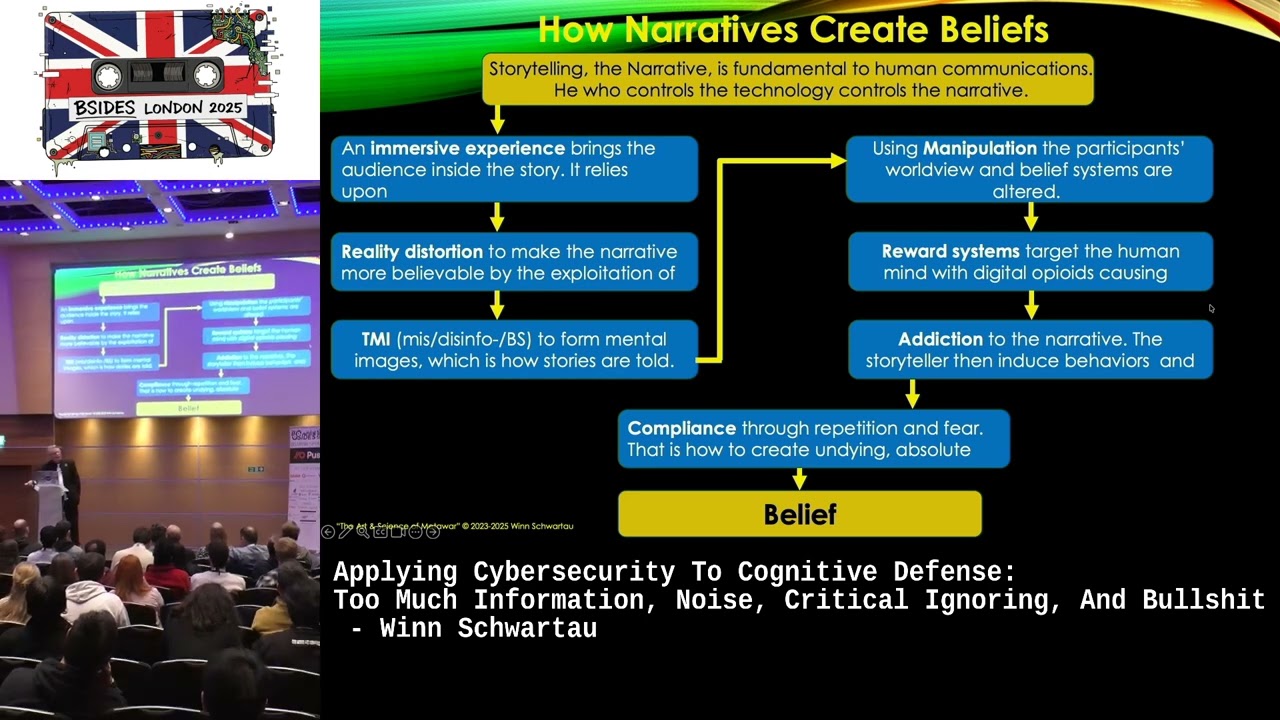
world that control the technology. He who controls the technology controls the narrative. He who controls the narrative controls your belief. And this is the nature of that system that is being built around us as we terraform the planet for web 3 plus on with more digital, more automation, yes, more AI, more quantum. All of these things are coinciding at the same time. Some people call them a perfect storm. So, how do narratives create beliefs? Well, you got to first understand the entire history of mankind going back 50,000 years is about narrative. That's what the caves are about. Those beautiful cave arts that we find in France and Spain, those are narratives that are telling a story.
When Homer is sitting around a Greek fire with a bunch of his toga clad friends and he's talking about the tales of brave Ulisses, it's a story. It's a narrative into which depending upon the strength of the storyteller, the power of the storyteller consumes you. You are nowhere else except inside of that story. And the only time that you know you have left this reality for the storyteller's reality in his narrative is when you get out of it. You don't know it when you're in it. This whole process goes through reality distortion. Too much information. And ultimately, as we've added more and more technology, how about manipulation by if you do this really fast in 4 seconds, your life will
improve and you're going to win the Peruvian lottery. depending upon how well you have reacted to the other steps of getting you to become a believer. Manipulation. Very, very simple. Are there any rewards on the internet for pushing a button? Are there any rewards on the internet for pushing a button faster than the next guy? Well, Southwest Airlines has made an industry out of that, haven't they? How fast can I get something done? That's all part of the manipulation. Getting the timebased reaction of your cogn cognitive system, your sensory system to work. And what does that all that create? By definition, addiction. That is what gaming is. Gaming is I I'm addicted to now playing spelling bees
because of my wife. I admit it. I really try not to use my phone, but then I get in trouble for not. It's about addiction because then you're going to go back to square one and do it all over again with whoever is giving the narrative, whatever tech is behind the narrative and the quality of the storytellers gets better. And then finally, compliance. You sign up for that thing. And just one example, you've complied and now you're a believer. You're a believer in that system. This could be about politics. It could be about religion. It could be about corporate culture, education, family relations. It really doesn't matter. It's all about the narrative and the ability to convincingly create a
story that will influence you as an individual, make you a believer, make the corporate entity and its employees and its staff and consultants part of that same believing set by using this exact technique. And I'll show you where the technique was developed in a little while. But finally, the core of what we're seeing everywhere right now with the use, some people use say the word abuse of technology, the ultimate goal is compliance and belief. And to some extent, we are all falling into it because of a very very simple thing called an udaloop. And an udaloop came about in the 1980s in order to enhance uh war fighting. Uh if people are interested in slides by the way I
will be happy to send them all out otherwise you can just take pictures of me. Okay. The udaloop was designed initially to keep fighters air fighters ahead of each other. How can I outmaneuver the other guy in very simple terms? And it comes down to observe your environment. Orient yourself in that environment. Make a decision based upon those prior two steps and then take an action. Now do it all over again. He who does it the fastest wins. Simple. Now in our world of merging technology and humans, we're doing exactly the same thing. And it's through content. Content orchestration. The world is full of content. Content is king. Content is king and it's addictive and
it's attention getting and it wants you all of the time and all of the storytellers, all of the narrative givers are trying to consume your time. And more and more and more they're doing it now through the additional layer of feedback of your reaction. how fast you react to the information that you have been given. Whether it's on social media, whether it's on an internal test, whether it's on behaviors or security awareness programs in the enterprise. Think of any application at all. And they all function the same because it's the same kind of system. And they all can be tweaked from good to bad depending upon the application, depending upon the goals. So I said
we're digitally transforming this whole planet right now. And there's what 10 companies doing it. Maybe I'm wrong, maybe 20. I don't know the number. But it is a very very small number of companies who are dominating the technology who then dominate the narrative and dominate the path and the route to your belief systems. Now take a little bit of look at a great philosopher Daniel Conman. And I'm oversimplifying this and you know I am but it is roughly close enough. If you're on the street outside and you hear a horn blaring, what do you do? What do you do? If you sit there like that, you're dead. What do you do? You do something. You react
quickly. That is your system one primal survival mechanism that works automatically. That is a very fast efficient system of survival that we've had for 50,000 years. System two takes some time. System two requires a little cogitation, uh, a little perhaps critical thinking. It is slower and it's painful to the brain. It eats up energy. It takes up cycles. And how many people do we know that really love deep thinking? Unfortunately, not enough. And this is the world that we are presented with right now and our human senses. And I have a whole book if you're interested in the math on it of the bandwidth we receive sensory. The maximum capacity of the human sensory system is 11.1
megabits per second. Our brain processes depending upon the study you listen to and the way it's measured somewhere between 10 bits per second and 2 kilobits depending upon depending upon science is still learning what happens to the rest of it where does it all go one of the things that I've been trying to tell people is when you're listening to a story not when watching TV when you're listening to a story or you're just trying to do some a think have a have a quick think, close your eyes. Why? 85% of your sensory input is now shut off. So the old calm down, some of those eastern things start to make sense even looking at it through the technological
view. So this whole process we've got to get in the mid middle of that udal loop in the middle of that udal loop in order to get system one to be able to react high speed automatically to this world of technology that we've got around us. So there's three things that I've been looking at trying to reduce it from so much of the [ __ ] that's out there. There's a lot of competing terminologies, lot of arguments about it. And so I've created my own. And first one is TMI, critical ignoring, and then [ __ ] So we all know before the internet came around, we needed the internet so we could get more information because
without information, people are stupid. But now that they have all this information, they're not stupid anymore, are they? Anybody anybody agree with that statement? No. Not one. So it wasn't that problem. And what ultimately I came to was all the discussion on misinformation, disinformation, and all of the arguments we've heard for the last several years. I'm no, they're wrong. They're missing the highest level abstract component, which is too much information. too much of it is being demanded of us and we have a history of it and we can see these numbers very very easily. Maybe in the back row you won't be able to see them in clearly but this is the growth of information across
society over the last 50,000 years and it is a logarithmic increase roughly. The numbers are close enough for argument's sake here, but look at what is happening with the vast amount of information that is being produced and made available to us. Is it too much? I argue it is too much by orders of magnitude because we're up to what approaching now uh 2 * 10 the 26 bits of information that is available to it. And that's going to go up by a factor of three orders of magnitude in another 5 years. It's not comforting cuz we're already messing it up when you look at it in a traditional way. Well, there's another curve shows what humanity is facing
compared to what has faced for the last in this case uh 7,000 years since the traditional archaeologist view of when writing was invented. Too much information, it messes with us. It really messes with us. One of the highest level things that we see at uh in the corporate world is too much information makes people unable to make a decision. There is just too much. Several years ago, my wife complained. She goes, "I only can get three kinds of peanut butter at Walmart now. There used to be seven." And I said, "Why are you bitching? You only eat the one. No, I'm just saying. And I So I looked into it. Walmart's sale of peanut butter went up 30% by making the
decision process easier by limiting the number of choices that the consumer had. The amount of stress that this has for us. What do I pay attention to? What should I pay attention to? What does my BFF think I should pay attention to? What? What am I supposed to do? What is and the stressor that's why some of those photos of using uh we've all used phones in very private places. We've all used them. I I notice it more and more at restaurants when people there's a couple there and the first thing they do is whip out the two phones. And I am so tempted for my New York mouth to want to say something, but
I don't. But we do it everywhere. When I grew up, I read the New York Times paper analog and chatted with my seatmate when I took the train into the city. Do we do that anymore? Are there papers in London? I don't even think I've seen many paper stands anymore. The stress and anxiety of what to do. And then of course back to the addiction component. If I don't do it, I'm a loser. If I do do it, I get addicted. What's wrong with being addicted? But no, I'm not addicted. I can stay away from my phone. Of course I am. I'm down to checking it 312 times a day. I am not addicted. This is part of this evolution of just
what too much information is doing to us. Uh the algorithms. How many of you believe that none of your life is controlled by an algorithm? How much choice do you have in that algorithm? He who creates the technology creates the narrative who creates your belief. That's where the algorithms lie. No matter what they are, lie lay not lie in that in that case. And what does a lot of this turn into now with they started with Zuckerberg. What did he do? He spent $10 billion to give his avatar legs. Okay, kind of cool. But now with the VR helmet, you're getting more interactive eyetracking, retina, and now with the Apple, the new Apple, have you read the Apple patent on
the new headphones? 28 bio sensors are going into that. When you look at something, Apple's going to know exactly how you react to that visual stimulus. If they provide you with the visual stimulus or the auditory stimulus that is that udaloop in high-speed operation roughly operating at 250 millisecond delay which is our shift from now from reality to what we perceive as being reality. It's about 250 milliseconds and tech is always on. It's always on. We're battling this technology. So, from an old analog, I used to be a recording engineer and we cared about uh anybody remember vinyl and you can hear the needle, you hear the noises on that's called signal to noise ratio. But we could
filter it out if it was a really good piece of music. We could hear some of the hiss in the background. But that was part of the beauty of analog. But this is what it really means today is how do I parse out? How do I decide what information gives me a higher signal to noise ratio? And a higher signal to noise ratio allows you to make better decisions. It allows corporations to make better decisions about what goes on within their internal communication, external communication, or when somebody is trying to screw with them either from the inside or the outside. The modality is the same as it is with cyber is just using a separate attack vector.
And the more noise that's out there, the worse we are able as humans to discriminate what we should be paying attention to. So tmi lot of noise. What do we do? Well, critical ignoring is where I am headed. They talk about critical thinking. Critical thinking takes energy, takes concentration. It takes a willingness to play the game to understand the scientific method or any part of it. It requires effort and it can make you tired. Thinking hard thinking can make people tired. A lot of people don't like doing that kind of thinking. So critical ignoring uh actually I've been giving this is for an academic thing uh some of the original sightings on it but this is
only going back three or four years this is how new this type of work is that what we're going to have to be defending now too much information get it critical ignoring how do we make it part of system one make it part of that automatic and I'll use the word habituation of survival. Well, when we're driving around picking all right, we're in London. It can get noisier and [ __ ] downtown, but you can still have a conversation with somebody because of the ability to focus. You're critically ignoring certain of your external sensory stimulus for the sake of communicating. If you're at a cocktail bar or here at the con and you suddenly hear your name, you're going to
turn. It's an habituation that is all automatically part of the way that we grow up. We get used to it because we are exposed to the ramifications of what happens sleeping. We had a a roof done on our house uh after some storms about 6 months ago. My wife was furious. They had taken off the roof. They're hammering. They're stomping. And I'm sleeping. She goes, "How the hell do you I grew up in New York. It is meaningless noise." And somehow I have translated over the years. I have habituated the auditory sensory input to ignore pretty much of everything. It I unless it's really in my face, I don't pay a lot of attention to it. Uh, the guy on the right in New
York is trying to determine if the food in there is edible or it has gone rotten. Habituation to the smells in there versus the overall odor of New York. How is that filtered automatically habituated over time? And these are ones that we all live with all the time. Um, piano players, they can play real, okay? They don't have to think. It's not a system too. They're they're learning something new it is. But as soon as that system too and it gets habituated, what happens? Oh, then they're a magical piano player. Typing touch typist. So, we all touch type to a certain degree. I type 82 words uh mistakes a minute. So, I'm kind of I
know where the delete button is a lot. Driving. We are all so completely habituated to driving that we believe we can multitask and text and talk on the phone and there will be no degradation in performance because too much of society still believes that there is such a thing as multitasking and there is in science period no such thing as multitasking. The brain functions and processes linearly. All you are doing if you think you are multitasking is doing a shitload of different things very slowly and poorly. Focus, focus, focus. So what do we do in cyber? I just wanted to take a look about what we're doing for too much information. So way at the
top there is the internet. Whatever that means and that means everything. And then the first section is the tier one, two, three, the big big hubs. And they have a system in there, multiple systems to get rid of a lot of the we'll just say crap. Whatever they've decided is crap. Fine. Means it doesn't get further down the stack. And hopefully between tier one, tier two, and three, you are relieved of the numbers we're working on. But 10 to the 6th we're hoping we're looking then you get your enterprise your enterprise now is plugging into the end of that first set of critical ignoring and you've got all sorts of stuff. I'm not an operational network
guy. So, I had a friend give me give me some terminology here. But this is all a type of filtering for your networks that determines what information you want to get rid of. It's just garbage. It's gone. No. No. No way. Uh, no. That could be interesting. Maybe I'll look at it a little bit later. I'm not in a panic. But this is what all of the training that occurs through the SIMs and the uh detection reaction mechanisms that you've got at various layers throughout your network. This is where they get trained to operate faster and more efficiently. And finally, there's that last piece, the endpoint. Endpoint uh is becoming more and more important finally after 35 years of
this. And we have additional layers of it whether it's Google doing something as a client uh a vast as an additional or whatever technology we're using in order to keep the noise away from us before I get a notification that I have to pay attention. And this notification point is where there is still TMI for the human being. We've taken down roughly 18 orders of magnitude of information left for us somewhere in the 10 to the 9th 10 the 12th. The numbers are not out yet. People have not really looked at it this way yet. But this is critical ignoring in the world that we're very familiar with. Well, how do we adapt this into
another world? Our bodies, biological systems, we do it automatically. Our mucous systems is a critical ignoring mechanism to filter out pathogens. Sometimes some of the cells on our skin, various levels of deterrence of get rid of it, I don't like you. Identification of pathogens is a filter before it gets to where it could actually do some damage. Then you've got the immune system, which is absolutely critical. We hear all the time about the immune system deficiencies going on. And it's because the immune system is so incredibly important to filtering out and getting rid of stuff, the pathogens that would actually make us ill regardless of the type of that of what they may be. And
then this one, next one gets into uh where a lot of people are not happy. uh inoculation, vaccination where there are various mechanisms for doing it biologically from a direct input of the uh path of the pathogen itself and letting the body learn how to react to it. The new technology, if you're not up on it, mRNA is amazing. It doesn't introduce pathologies. What it does is it teaches the immune system to defend itself with information it has been told about, not the actual pathogen itself. And it's getting better and better and better. And this cover month's cover of Scientific American is an entire issue on mRNA for specific cancer treatments designed for individual people delivered without
the cancer pathogen. So we have another model that shows critical ignoring does in fact work otherwise we wouldn't be here. Every one of these activities, these cognitive activities that are ending up to at us after our end point, they all take time. They all take time. They all take a certain amount of bandwidth. Just like our networks take a certain amount of bandwidth, we're overloaded. Too much information is DDoS of the brain. Yet we are still doing it and still allowing it. So we have all of these models. We know a huge amount of this. And so from here on in is going to get my hypothesis as a one way to take a look at it. And the goal here is to use
these udal loops to get the critical ignoring system up one. really really fast one that wants to be habituated very very quickly against whatever it is we hopefully choose. But you got to make some decisions. Got to make some decisions. And part of these are critical thinking decisions that you need to implant into the process, the udaloop process in order to make it work. And the first one that I use is I just don't care. How many people care about the Kardashians? That was almost a hand up, sir. Yeah. How many things you just don't care about? And no matter how good that clickbait is, we've all done it. We've all done it and come to hate ourselves
for doing it at the same time. When you get enough of the I don't care back into system one, it's going to start disappearing. The next one is I just don't have the time. We all have that. And I don't know about you, but I've got several folders full of stuff. I'll read it. I'll read it later. I'll save it for later. I'll save it for later. Just don't have time for it now cuz that's a rabbit hole I really like. But no, I can't do it right now. Again, this can be habituated through various types of training that I'll show you about. I don't want to be affected by the algorithm. I see what's happening. I
know how to travel hack. I know how to get discounts. I know the algorithms or some of the algorithms that they're using for repeat customers or I come back 3 minutes later and well no welcome back when would you like an additional 10%. Now these are all part of the metawar thesis the loop for the addiction and the compliance and the belief in that recognizing that you are being influenced by an algorithm. some stuff we already know it if it's going to be uh CPUs 101, but I'm probably going to ignore it unless it's a good old collector's item. We all know what we know. If you don't, okay, I I don't need that stuff. I don't need to save it, and
if I do later on, I'll go ask my AI about it. And then bespoke choices, making your own lists consciously, taking the time to build the lists of things that you do care about because that helps system one when you're going through the zudal loop training process to recognize what you really like, what you don't like. The algorithms claim they do this. If they did it, we wouldn't get all the crack that we get right now and all of the noise that is still coming down into us. And finally, we've heard over the years uh of the words a misinformation, disinformation. They became highly politicized, became uh if you followed any of the stuff in the US about CTI, what did that
stand for? >> Oh, you're not going to look it up now. Cyber threat intelligence. >> What? >> Cyber threat intelligence. >> Cyber threat intelligence, which became a a right-wing way of saying uh everything you say is misinformation and disinformation and it's all [ __ ] And they're trying to change the narrative of what is real, not real. And I said, "No, this doesn't really make sense. I'm still going to stick with tmi all the way at the top. But I looked a little more carefully at uh the sixth category and all I'm doing is calling it BS. BS. Now, we are all, I hope, better than the average bear at BS detection. Society isn't. The majority of people
suck at BS detection. I have done this live on radio, on TV. I have told stories that I've had scientists believe were true. And a germ of truth can create a great lie. And that was how many political cycles ago in Europe did that occur and maybe occurring in the US now. A strong mental immune system learns to detect and recognize. And I'm using these six categories arbitrarily. I made them up. Um open to any good academic work to make this improve and get it better because we've got to get system one working cuz right now this is about all we got. We don't have a whole heck of a lot of research into this. We don't
have um the clinical studies, the millionperson test beds. We haven't done it yet for a reason I will show you in a minute. But without some serious science behind this, how are we going to be able to get people to really understand getting rid of the BS is going to get rid of a vast amount? Some people I've argued with say it'll take uh 70% of the mental load off of us. Other people have said 95%. Uh this gets into real discussions of what you consider BS and what have you, but add some categories, take away some categories, and just so you don't think I'm completely full of [ __ ] [ __ ] is
now and has been for I think three years a legitimate academic topic of study. There are books out on it. It has been legitimized because the word fits so well. No matter what we're talking, misinformation, disinformation, lies, fake news, whatever term it is, they all fit under the single rubric of BS. And it works exactly like the other udaloops work. There is no difference whatsoever. The process is the same. Everything in the universe, any system that survives and thrives uses an udaloop process. If it doesn't, it dies. Which is why we've got to stay on top of this. And you guys got to help figure out what we're going to do about it. TMI, AI, bots. When you have more of it,
you get more BS. The numbers are there. the studies that have been done out of Indiana University at um OEM I for the OA awesome the awesome unit independent uh at Indiana University some incredible work has been done on proving what happens when BS is multiplied either through humans AI or machines but now we hit critical thinking this is hard it's Easy conceptually. You say, "Yeah, I'm going to go learn all this stuff." But it takes a while. How do you How many fallacies? Does everybody know all 23 top logical fallacies? No. I think I'm good with nine of them, but I've been studying this stuff. Logical dichotoies that make an argument false by the very
nature of its question. Anytime you see lawyers asking questions on TV, the vast majority of the questions they ask are logical dichotoies that the witness could legitimately say there's no way to answer that question cuz you have not framed it correctly. This is critical thinking. It's tough and it's an ongoing lifelong learning cycle. One of the best examples of critical learning in practice is in the country of Finland. They're teaching critical thinking to toddlers. How are they doing it? Using fairy tales and then just talking about how bad was the big bad wolf? Nah, he was just and having a bad day. Whatever. But the discussion occurred where and I'm doing it with my grandson.
How scary are you the monsters on the bed? Nah, that's not real. I he and I are arguing because I'm trying to convince him birds aren't real and he is trying to convince me they are. So, we're having a lot of fun with this issue back and forth of whether it's reality non-reality truth non-truth doesn't matter cuz all of those are going to be divvied up. But it does matter to be able to go through the process. Part of the process does give false hopes. have to be very careful about self-reinforcing uh arguments. There's a lot of good research in this that I'd be happy to share with folks. But confirmation bias is something that we are emotionally
tied to. It gives us comfort, easy answers make us feel good. How are we getting around it? out of Cambridge University, uh, a group of people decided they were wanted to try a game and it was aimed at misinformation, disinformation, and it, uh, it's online. You can play it anytime you want and it goes into these kinds of questions and it's one of the games out there uh, is the misinformation, the Misti test, is um, misinformation susceptibility test. Take it online. There's probably 50 others out there that I can get you the links to that do this. And part of this is a training called pre-bunking. In other words, you don't debunk. Debunking somebody's belief system
almost impossible. But by pre-bunking and getting them to question a piece of the process that gets embedded into a belief system in system one is going to be we believe and that's why I'm talking all these places one of the ways that we could deal with it here. We're working with cognitive cyber ranges and taking the same thing, same concept of doing that on mass instead of in the cyber world, doing it in the psychological realm realm. Uh pre-bunking. Take a look at the work out of Cambridge University by Sander Van Lindon. Again, I'll make the slides all available. The references are all in here. It goes back to pre-bunking as part of an udaloop where the udaloop is
teaching the system one to habituate to recognize whether it's BS whatever the topic is because it doesn't matter it is subject and topic independent it is process critical we go through pause cycles and how to do that and I'm getting the end sign the uh again this models very much what we do inside of cyber. Absolutely. Sometimes we take stuff off to the side for further analysis. Sometimes we let it through based upon the habituation and the training of the filtering in the systems that are going through that thought process. Your job is changing because this is the new attack surface folks. This is what you guys are going to have to start learning how to defend
yourselves, your companies, and your countries. society from these types of attacks on this type of attack surface. I try to keep it simple. One of the things that bothers the hell out of me is that right now uh the majority well majority right now at the EU horizon and uh some of the British efforts have put forth and uh committed $140 billion euros dollars pounds into cognitive defense efforts. Some of it is military oriented, some of it is not. Uh our our um defense secretary Hexwitz said yesterday, I want every soldier, every soldier will learn AI and use it to make decisions. So we have a huge disconnect between there and here. I want you to read this
book. It's a pamphlet, 80 pages long. Love letter to America. It will. It was written in ' 84, oddly enough, and it will scare the living [ __ ] out of you because it is the playbook for what we're seeing on the planet today when it comes to the metawar thesis, creating belief systems. It is what was written. And so, I'm getting thrown out of here. I know these are the things that we have to do. Yeah. Yeah. I I get it. I'm out of here. But for the hacking world, this is your new world. It's not just social engineering. Yeah, we got to do social, but it is so much more more powerful than social engineering. You
got to get your psych hat on. You got to learn some psych. You got to learn a little bit of neuroscience, little bit of physiology. You got there's a bunch of books to read to start seeing how all of this actually ties together from the world that you are familiar with. That's some other books I've written which are great and all of that. There it is. And he has shut me up successfully in the rear. I apologize for going so fast. You guys have been amazing. And if anybody wants slides, please just uh contact I don't know who the hell to contact me and I'll send off the slides. But thank you very much. I hope I've messed with
you. >> Thank you very much.
Related talks
 47:41
47:41 28:37
28:37 47:15
47:15 33:48
33:48 49:41
49:41 34:45
34:45