Cyber Defenders Turning Skills Into Lifesaving Action
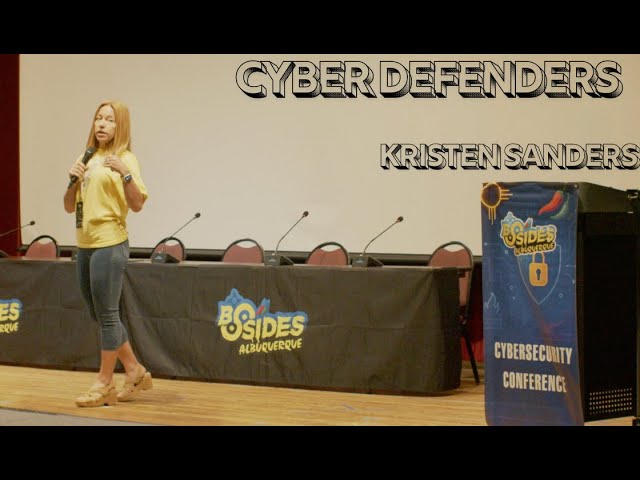
Show transcript [en]
You had me a documentation. >> I I like it. Yeah, me too. Uh diagrams, written, all of it. Uh we have a break schedule, but we're going to roll right into Kristen and as she gets hooked up here. So, just go ahead and unplug my laptop.
I'm going to brag about Kristen for a minute because I've known Kristen for a long time. 15, 16, 17 years now, pretty much my entire career. Uh, she was at the city of Albuquerque working there as a network engineer and we had a very crazy incident that had to do with Anonymous. Anonymous was pointing their lower orbit ion beam, if you know what that is, they were pointing it right at the city's network. And we had other folks in the room at that time from two, three, four letter agencies and and that's how we met, right? And then over the years, I've seen Kristen uh grow and and become the vice president. Can you believe that? I can
believe that actually I can believe that she's the vice president of Loyal. She is the president of Infregard New Mexico. She is the co-founder of Chile, along with me and a few others. She is the uh up andcoming board member of New Mexico Citra, right? Uh what else is on there? We have a bunch of other things on there. There's a list of like 35 things that Kristen does, which I uh am constantly blown away about how much you get done. So, um oh, besides organizer, I mean, if you want to thank somebody for doing all the work, this is one of couple people other people. Anybody wearing a yellow shirt saw didn't get the memo about the
uniform, but um there are a lot there are a lot of people wearing these yellow shirts and just go by and thank them, introduce yourself to them, thank them for putting all of this together and doing all of the work. I was uh I was able to kind of contribute along the way a little bit, but with my bandwidth was just so crazy. But I got to observe and witness firsthand the amount of work that these people are putting into running this event to make it as successful as it is or has been today and it will be tomorrow. So, you know, thank you to the organizers. I scared S off. He just he just left. But, um,
thank you to the organizers and, uh, and all the volunteers for this would not be possible without you. So, with that, I'm going to give it to Kristen to talk about a very interesting topic. Thank you. Now, Chris Perkins is also a co-organizer. Yeah. So, he should have had a yellow shirt on. That's okay. He wanted to dress it up. It's all good.
There we go. Sorry, I timed out too long. Dear Lord, the whole thing has to come up now. >> Sorry.
>> Okay. So, yes, I'm Kristen Sanders and yes, you had the introduction. You left off propagonstructor. That's okay, though. >> Oh, okay. Thank you. >> What is that? This is really fighting technique. It's not a martial art. Okay. Anyway, if you were in the healthcare track this morning, we had the guys from Global One who were instructing on self-defense and some different I think situational awareness things like that. So, those are the guys that I teach with. So, if anyone was in the healthcare track this morning, they're part of global one, just so you know. Okay. Does anybody recognize the cow symbol up here and who that is? Yes. All right. Who is it? >> CDC.
>> Thank you. Now, another question. Are you over the age of 30? >> Oh, yeah. >> 40. >> Keep going. >> Okay. Okay. Well, we we'll stop. Okay. So, we want to go into a little bit of hacker history lesson here because I grew up knowing all about cold dead cow. My dad talked about them all the time and I didn't realize it until rather recently that most people in my age group have no idea who called the dead cow is because apparently having conversations about borfus with your middle schooler is not normal, but it was normal in our household. My dad was very excited about these groups. Loft. We talked about a lot about loft.
These groups were really fundamental uh chaos computer club in a lot of the legislation that you see today, regulations around internet privacy, anti-censorship, just ethics and technology, human rights. There has been a history of hackers really trying to fight for good and to make things better. Not like other groups who shall remain anonymous, no pun intended, who, yes, I'm still a little salty against them after the whole city of Albuquerque ordeal, but no, we don't just do activist stuff and start taking crap down because we're upset at somebody. Not condoning that behavior whatsoever, but these groups actually were, you know, taking part in making legislation and meeting with Congress and testifying like they were really
trying to do good things. So there's a history here and we want to continue this history and be the ones that do the positive change. So what's the current threat landscape? Well, now we deal with child sexual abuse material. So previously it was called child porn. We no longer use that term anymore. It's cam just so you know. Human trafficking and that could be sex trafficking. It could be labor trafficking. extortion, which really kind of scares me because of course, you know, you're extorting somebody saying like, I've got these photos and I'll tell everybody about it, but holy cow has AI come a long way now. I mean, you can really just create whatever you want. And when
you're dealing with somebody who has a lack of frontal lobe development and some crazy hormones, do we really think that the teens that have this AI produced material and somebody saying that it was them, are they going to handle that? Well, no. I mean, we're already seeing cases of where people are committing suicide over this stuff. This is serious and I think it's going to get worse with AI, unfortunately. Cyberstalking, that's another huge one. We've got a lot of the social influencers nowadays. There's a lot of money in it. A big one that I've been hearing about a lot too is back when I was in college, you heard a lot about, you know, oh, there was people who were
stripping to pay for college. The new thing now is Only Fans. And unfortunately, we've got a lot of these young girls who have these men who really take to them on their Only Fan site and begin to become stalkers. And then how did they deal with that situation? And okay, now I no longer want to do my Only fan site. I'm ready to move on to my career, but I've got all this baggage where I've got this crazy person that will not leave me alone. And again, these are decisions that are being made at a very young age that are impacting them for the rest of their lives now that we have to be concerned about.
We also have the online scams and financial abuse. Um there's so much information out there right now. One thing that recently at Loyal we ended up making an employee benefit is the delete me service because of the amount of information that is out there from these data brokers. And it is so easy for these scammers to get a hold of this data and then start getting a hold of your you know different uh your grandparents right and then I'm going to call your grandparents. I know they're your grandparents. I'm going to give all your information. I can use if I want to to start spoofing the voice, whatever I need to do, scam them into giving over
the money. There's so many different aspects of this that and that's just one example, but these are all things that we're facing now and they're going to just continue getting worse and worse.
And the thing that Denise was talking about this morning is these nonprofits that are popping up everywhere that are helping out um she was talking about arts with this. It's more of the groups that are fighting against the the evil that's out there on the internet, the the human trafficking. These groups are doing a lot of really great work, but one of the big issues is that they cannot afford to have good security in place. So what happens when you have a nonprofit that has saved a woman who was a victim of sex trafficking and then they get compromised and now that woman's information is out there and that woman can now be targeted. We're
talking about yes a breach where this information gets out there now could actually be life-threatening for this individual who has already went through some horrible horrific things and They got their information out there and the person knows where they're at and they have all this. We have got to help these organizations out because these nonprofits, they're doing great work, but they need to share information with law enforcement and they need to do it in a way that is secure and they need to do it in a way that's protecting the victim, but also allowing law enforcement to do their part. You can donate your talent. Students A big thing I know that's really hard is if you are graduating
from school, you've got your education, you're trying to break in the field, you're like, "Hey, I've got my degree. I am going to immediately get a six-digit cyber security job." Yeah, right. How do I get that expertise? How do I get the work experience? How do I get somebody to hire me? And I think a really good way of doing this is to help out some of these nonprofits. Donate your time. help them out. You're going to improve the nonprofit cyber security and then now you've got something on your resume and you'll also be networking at the same time. You're going to start meeting other people. Then you're going to start getting some job offers out of this
hopefully. But I think if we really start thinking about how can we donate our talents to help these organizations out, whether you're a professional and you're just passionate about this and you want to get involved or you're a student and you seriously need to get some sort of work experience so you can land that job, I think this is a great opportunity and a way to do it. Of course, there's always money, right? I mean, get to the end of the year and everyone's like, "Please make your charitable donations." Yes, you can always do that. But outside of money, I was a little surprised to hear that some of these organizations would really love to have AWS credits. They were like, "If
someone could like donate us some AWS credits, that would be super helpful." I was like, "I've never even thought about that. That's kind of cool." Uh, access to Microsoft products. Didn't realize this, but I guess the Microsoft licensing's not the easiest for nonprofits to hook them up. Didn't know that either. So they said that if somebody could hook them up with Microsoft licensing, that is super helpful for these nonprofits. Slack, they like to use Slack. That's another way they said you can help them out by paying because Slack can get kind of expensive if you are actually paying for Slack and not just using for free. API development. This is a huge one because we need to securely share the
information between the nonprofit and law enforcement. So, you've got sensitive information, but you need to get it over law enforcement because they're the ones that are actually going to kick down the doors and get something done. And web hosting was another thing they said would be very helpful whether you're the person that's designing the website or if you're somebody that can host it for them, give them some server space. These are all different ways to start thinking about of how you can help out with these nonprofits.
Now, this one's kind of cool. The school games. This one you have to have a little bit of like you already are doing OSENT for your job to be able to get in with this group, but they actually will do these tactical weekend events going after the sex trafficking and victim identification. But you do have to do a volunteer assessment and they'll check to make sure like, do you actually know what you're doing? Do you have a good track record? like you're not looking for people to traffic, right? Like you need to be a good person. And then once you've been vetted, then if you're selected, you get to hang out and do this, which is super cool. But again,
you need to already be kind of involved in OSENT in your professional life to do that one. Trace Labs, however, not so much. You can join the Discord and participate in a search party CTF. And with these, they were looking for missing persons and it's a live oent CTF. So you're like, "Yeah, but that's a missing person, not a trafficked person." A lot of these people that are victims of human trafficking are missing persons that were reported by their families because they disappeared. So by helping out with trace labs, you could actually identify somebody that is being trafficked and help to recover that person. Now, if you're like, I would love to do OSENT, not really sure how to do it.
Chris is going to be doing a presentation tomorrow at one over in the knowledge hub. It is back behind where the soldering villages. Keep going back there down the hallway and you'll find it. He is going to do a deep dive on how to do OSET. And if you are interested at all in how to get involved with either becoming an OSET professional or working with trace labs and doing missing person, CTFs, things like that. You start getting involved with it. Talk to Chris. He is a great resource. He will get you plugged in. He'll be able to tell you all about this stuff and how you can actually help out. Okay. Online safety. So,
this is something. Sorry, honey. My daughter's in the back. She hates this. She doesn't get to use social media. We were bashing it earlier. Social media, there has been so many besides the risks associated here. We're talking about so many bad things associated to it with the constant I need the likes. I'm going to post all the things and have all my personal information out there for everyone to see 247 so that maybe I can't get a cyber stalker or maybe somebody picks up all my information and starts scamming and using all that. I It's all right. It's all open. Especially if we start having these influence accounts where it's like, well, everyone needs to see
exactly what I ate for breakfast, lunch, and dinner today. This is huge. I mean, we live in a day and age where when I was growing up, you got home from school, you know, you have to dial up on your modem so that you can then connect to AOL, start chatting with your friends on instant messenger. No, now we've got cell phones that keep us connected 247. It never ends. We get addicted to them. It was mentioned earlier about the screen time. Dear Lord, where our kids are on the screens all the time. And I love what Mark was talking about earlier of how they've got these kids that don't have the cell phones, so they're
actually outside playing. They're socializing. They're hanging out with their friends in real life. It's amazing. He said it was like the 1980s right now. I mean, this is really scary because we've got this day and age where we are constantly constantly on these devices and no one thinks anything of it. Do we really know who our kids are talking to? Do we really know what's being said in the chat rooms in Roblox? Do we really know if the person that they're talking to is a real friend or is this somebody that was introduced to them by a friend of a friend of a friend? That's how this all starts. Real life story. My daughter was doing a field trip and I
get a phone call from one of her friends mothers and I'm like that's kind of weird. Why is she calling me? I'm like a I should probably answer this and make sure everything's on the up and up. Answer the phone. She believes that her daughter was being groomed for trafficking. And I'm like, whoa, okay, why do we think this? Let's go through it. And she starts talking to me about it. Long story short, they had this girl convinced that this was her friend. literally to the point where they were having phone conversations for almost 24 hours at a time, constantly on the phone. And I'm going, how on earth can you be on the phone
with somebody for that long and nobody notices? But it's really easy. The earbuds, I've got my earbuds in. How often do you see kids running all the airbuds in all the time? It's normal. It's normal. And the you can put in one earbud and then okay, cool. I'm going to let the other one charge. Oh, it's dying. Okay, I'll just swap them out. I'll put in the other one. So, there was these times where this girl wasn't even talking to anybody, but she had them on the phone just throughout the entire day. Even during the school Christmas musical performance, they had her convinced that they were her friend. When this was all found out and law
enforcement confiscated her cell phone, she was extremely upset because they had just taken away her friend, she was just so convinced that this everything was falling apart to the point where she then was asking the other kids, "Hey, I got to log in on your phone. I got to talk to them real quick. I just need can I just use your phone?" And thankfully, my daughter, she made me very proud. She was No, something's up. This doesn't sound right. And she goes, "No, no, I can't let you because my mom is like super strict and if you log into that on my phone, like no, no way. I'll get in trouble. Okay." And I told her, I was
like, "Honey, that's fine. You throw me under the bus as many times as you want. You can always blame mom. It's cool. No problems with that." But this was scary. And thank God her mom just happened to get a different device and the messaging that was happening was tied to her email address. So she just happened to accidentally come upon those messages and discovered this was going on. Otherwise, her daughter may not be here today. But they nipped it. Now I talked to my daughter about this and I thought it was great because I did Yes, I do monitor my daughter's devices. There was conversations where she was actually telling her friend like, "Hey, don't give any personal information out.
Don't don't don't tell them what your real name is. Don't tell them where you live. Don't give them any of this." And I'm like, "Yes." Again, we tell our kids this stuff all the time and we're like, "Are they really listening?" She was listening because there she was repeating it to her friend. And I was like, "Thank you." Now, did her friend hate her device? No. But that's okay. I mean, she tried. She did her best. So, it's really important that we have these conversations. And is it going to be awkward having these conversations? Absolutely. But we need to. Are your kids going to get mad at you when you say, "No, we don't do social media. Yes,
I'm going to have a app on your phone that's going to keep track of what you're doing. Yes, there's going to be parental controls. Yes, I get it that none of your friends have to do this, but sorry, that's just how it's going to be. because I love my daughters too much to allow something to happen. And unfortunately in this day and age with constantly being connected, anybody and everyone is talking to your kids and you have to know who they're talking to. This is critical. So now I just want to open it up for any questions, comments, conversation. of any good resources you might know about that I have not mentioned or anything that comes to mind because to me this is
not usually one of my normal presentations that I would give definitely not technical about it. Oh, thank you. But to me, it's really important because when I got that phone call saying that they thought their their kid was being groomed, that is not a phone call you ever want to receive. That is extremely scary and I think we just need to talk about this more. It's Yes, we need to be up in our kids business. >> I'd like to say that the New Mexico Cyber Security Center of Excellence is here, has been here all day. Um, we have a foundation grant from Albuquerque Foundation for doing cyber hygiene training in the schools. And so if your
school, your class, your group wants cyber security training, stop and see Jess or any one of the students out there, get the school on our list and we will provide free of charge cyber hygiene training for the and the students do it. So, it's studentto student closer connection. They listen. They get to play some games and explore cyber hygiene. >> Thank you for what you're doing. >> Thank you. >> I just wonder how we get that as a policy from the Department of Education into all of our schools. Maybe figure that out because it doesn't seem like this should be an option. Just my two cents. Hey Kristen, how are you? >> I'm doing well. Dell, how are you
>> doing? Good. >> You know, I have to ask you a question every single year. All right, so let me get serious here. Um, so recently there was a law signed um I believe in May called the take it down law. Um, have you seen anything where that law was actually enacted where um companies were forced to take down uh deep or or you know anything dealing with revenge porn or anything like that. >> Have I heard of it? Yes. Have I seen it in action? No. >> Oh, okay. Fine. Even the FBI. All right. Fine. >> Two sources of intelligence.
Okay. So, I have a question. Um, you know, hearing you talk about talking with your kids and stuff, you know, but that's the issue a lot of us are facing is instead of kids where you could take their cell phone away or control more of their communications, we have aging adults in our families that we maybe need to have conversations about cyber security with. And do you have any tips for having those conversations? >> Oh, yes. So, I think a lot of this has to do with is it a parent that you're talking to because that's a whole another level. It is difficult to give advice to the person that changed your diapers. Just going to say that.
I think, oh man, if you're dealing with aging adults, a lot of it, uh, I saw it with my grandfather. He he was very techsavvy when he was younger, and as he got older, uh, he ended up having, uh, Louis Body dementia, so he wasn't thinking things through. And there were several times when he was falling for these scam websites that I know he never would have done that just a few years prior and having those conversations was very difficult because he was just like no this is totally on the up and up. So, I mean, some of it could be, I hate to say it, but even doing like the the shared accounts where you're kind of monitoring
as your parents get elderly could be helpful so you can kind of just have some insight. But, yeah, I mean, that's kind of hard to sit there and be like, "No, we're going to limit your screen time, sorry, to a grown adult." definitely difficult, but it seems like having those shared accounts can be kind of helpful. That way you can at least see what they're doing. Um, and then of course, you know, as as they get older, there's always the the power of attorneys and stuff, but before you get to that point, you know, it's like, how do you sit there and go, "Hey, so I know that they have this great investment opportunity. Not a good idea because
they're going to wipe out all of your savings and yeah, how are you going to for retirement >> wasn't super helpful. D, did you have something you want to add? >> I was say that was a great question. Um, a close friend of mine had the same situation where his mom got money. It was absolutely horrible. So, sorry man. Uh Kristen actually got but anyway uh yeah, so she um she was getting scammed the whole time and you know definitely Kristen mentioned the power of attorney. That's really the only way uh getting on the alerts uh for for their banking stuff. U and I'm not sure if you can uh if at banks you can
put certain limits on it. You know, a lot of a lot of uh elderly people they have fixed incomes. Sovious obviously they're pulling out they're buying uh you know Apple cards, they're buying uh Green Dot cards and things like that. It's very important that that those things get monitored. Uh but you know, like Kristen said, it's a very tough conversation. The person that raised you, now you have to go and protect them. But it's important that we do that. We step in. Uh the FBI, you know, Ryan over there, they won't get involved unless it's over uh correct me if I'm wrong, Ryan, unless it's over $100,000, something like that. Uh yeah, it's got to be combined. So, you know, again, you
know, fixed incomes and, you know, know can't afford, you know, prescriptions and things like that. That that really makes it tough. So, yeah, anybody out there wants to get involved with the stuff and track these guys down and stop these guys, hey, let's get involved. Let's make that happen. >> Thanks, D. >> You're welcome. So you guys leave leave me off the panel and then you just cut me in the questions. I might resend my thank you. Um no, but in in all seriousness, Kristen, thank you for presenting on this topic because it it is a rough rough one. Um, and I don't know if anything ever made it to you, but we I actually referred
some folks from our women's resource center over over to you because I didn't I didn't know. >> Um, you know, we have a a great program with our women's resource center at UN M and the people over there are great and they're one of the groups I hate whenever they reach out to me at UN M um because I know I'm going to get involved in something heinous. So that's why I say thank you for for bringing this up because I think it gets overlooked too much. Um, but my question for you is kind of in this cyber security data privacy space, right? It's very male male-dominated and I get reminded a lot that I'm a large white man and don't
always have the correct perspective. Um, so in dealing with these types of situations, um, what would be like the like two or three pieces of advice you would give to somebody like me to be able to then pass on to like a young college female who's dealing with some type of cyber sacking um or abusive ex-boyfriend who is not quite risen to the level of law enforcement intervention but is using these various cyber tools to create havoc in their life. Yeah, that's a good question. So, yes, the person that you talked to did reach out to me and we had conversations. Yeah, it's I the thing that I ended up doing was making a few phone calls and
asking if any of my friends that worked in law enforcement would be interested in helping out because the sometimes local law enforcement doesn't always handle situations the best. Uh but if you can frame it the right way, then you can get it picked up on. So, it's really having that relationship with law enforcement where you can kind of talk to them and be like, "Here's the situation. How could we frame this, reward it, report it in such a way that is going to now be of interest and get picked up on and they'll take the case. It really comes down to I mean, either you go old school mafia and go hire somebody to take the guy out or you just
go work with law enforcement, >> you know? Yeah. [Laughter]
So what can I do from my position?
>> Yeah. I mean really it's it's dealing with the different resources that are out there. So you have like the family advocacy center. That's a huge one for the city of Albuquerque. They've got a lot of really resources and obviously they work very closely too with law enforcement. So they can also kind of help assist those conversations on like well maybe the reason why it's been being ignored is because of the way that it's being stated. And if we are to, you know, tell the story a little bit like, hey, really key in on these details over here and not so much of, you know, the drama, personal details and all that, like get straight to the stuff that is
actual criminal offenses and let's go after that. Then law enforcement is like, "Oh, cool." Like, we've got an actual crime. This isn't just a thing of, you know, okay, this just sounds like a dispute. like this person's actually doing something that's criminal that you can go after them because the big part here too is we have some major issues going after people here in New Mexico for crimes anyway. I mean, it has to be pretty cut and dry for them to go like, "Yes, we're actually going to issue a warrant. We're going to take this through the court process. We're going to get this done." Uh, just because a lot of that stuff here, it just I don't know. I guess it falls
on deaf ears. I don't want to talk smack, but there's a lot of stuff that could be approved on when it comes to that. >> So, thank you for the conversation and I think this has been, you know, a wonderful talk and opening it up to everybody. Um, I wanted to get back to the the topic about talking to your kids and talking to your parents and uh I've also been talking to my kids about these kind of topics as well as other things, right? wonder, do they get it? And they are. As as you have that communication with them, they do pick up on it. And it's wonderful when you see that. And when we're talking about talking to our
parents, the people who have changed their diapers, again, it's a matter of that constant communication. When I was talking to my kids, I was reminding them also that, you know what, I'm I'm going to get older and I'm I already what's happening to the older generation and I'm telling them I'm going to eventually have to trust you with these kind of decisions and so establishing with them and telling them you know what you have to trust me now I'm going to have to trust you later and having those conversations across the generations just talking with people especially our families but other other people across the community and like the the program the kids talking to other kids as far as
these type of topics. Again, what we're seeing in communities is the loneliness factor, right? And these kind of uh communications is going to be the only thing that is going to get us through this. And we're going to have to get out of our comfort zones talking to people about things that are uncomfortable. But the more we do it, the easier it gets and the easier it is for the other people to accept that feedback and that help. So again, thank you. >> Thank you. Yes, I that the important part too you just brought up it's the the continued conversations. It's not just a we're going to talk about it once and then we're done. Like this is
constant talking about it. And really with me, it's about being just brutally honest. And yeah, it gets kind of awkward, but I would rather have my daughters be extremely street smart where when someone sits there and starts feeding them a line, they're just like, "No, you're full of it." And they can call them out on immediately. That is what I want. I don't want my daughters taking anybody's bull crap. Like just be able to call it out, be like, "Nope, you were lying because this and have those critical thinking skills. And I think that's key and that's what we need to really just be brutally honest. And I'm all about keeping kids innocent, but at
the same time, like they're going to learn about this stuff one way or another, from school, from friends. We've got to be educating them before they start learning it from somebody else. >> Yeah. So, I have two things I want to say. So, the first thing is whether it's your kids or your parents, I find that trying to treat them like I used to treat my employees helped. And what I mean by that is when I was the cyber person at accounting, I didn't make it to where, oh, you clicked on a fishing link, your head's getting chopped off, right? I tried to have an open conversation of, okay, why did you do that? Let's these are the things you
should have seen. Okay, it's not going to be a severe punishment, but let's not let this happen again. And with my own kid, I've had that same conversation. If you do something, it's better that you let me know now than trying to hide it from me. And the same thing with my own grandparents, right? They've had Microsoft call them before, right? And the first thing they said is, "Well, let me let my granddaughter get on the phone. She's a cyber security expert." Click. >> That works. >> So, it helps. I mean part of it just having being open, letting them make mistakes, but also just helping them and guiding them. And the second thing I
wanted to say too is when it comes to giving back your time, another thing that is a valuable resource is elderly homes don't usually have family members who are coming to visit to educate these people about cyber security and they are looking for people who want to come and guest speak all the time. I mean, I'm in the retirement state of Florida, so they're everywhere, but I know here you guys have some Yes, if you want to give some time and go and talk to the elderlys over in the retirement homes about cyber security because they might have cell phones still and computers still and that's a good way to get that service out there while also saying,
"Hey, I've done public, you know, presentations before, too." >> That is awesome. No, you're absolutely right because yeah, we should be in there talking to them because they do they still have smartphones and everything else even though they are in a retirement home. Any other questions, comments, ideas?
>> I'm glad that you brought up the um discussion about seniors especially that's being important and I can definitely attest it was my parents compared to the other the other one's a little more confused about how things were so fast and even I could attest to that. But um this parent was willing to listen whereas the other one because he had dementia had a stroke and he was a lawyer he always thought that his way was the right way no matter what. So you got to make sure each situation is handled differently. I love what his doctor said to him when he was kind of being stubborn about health. You're a JD, not an MD. Listen to your wife.
>> He should just always listen to his wife. >> We're always right. >> Yeah, you are. >> We got one over here.
What advice would you give younger parents um who have have social media themselves and they're raising, you know, young kids, but they have pictures of their kids on their own social media. So, I have pictures of my kids on my Facebook because that's how I keep in contact with all of my friends and family back from Indiana. So, we all share stuff. Uh, I definitely have my social media accounts locked down so that if you are not my friend, you're not going to see the photos. And I'm not going to accept a friend request unless I absolutely know who you are. Um, I don't put anything, you know, personal up that's could be publicly viewable.
And then, like I said, I'm a big fan of like the delete me services to go out there and scrape any data that has made it out there about me and my kids names and my husband's name and anything like that. Uh, because yeah, you can either get that from data broker websites or you could get it from somebody's social media. So, just you want to lock it down at both sides.
I'd just like to add to that as a parent of a small child myself and a wife who streams on Twitch all the time, what I would say is don't post any pictures online of your kid until they're old enough to know what is happening and have the ability to say yes, that's Okay, because all of these kids who were in uh YouTube at age five and now they're 30 and that's all they're known for and they're having trouble finding jobs because they're David the dentist, right? It's best to just hold on to that stuff until your kid has the ability to say yes or no because those pictures aren't going away anytime soon, right?
But if you post it on now, they're never going away either. So my choice is to wait until he has the ability to understand and say yes, I want that picture on and I will let him post it rather than posting it myself. If I need it to go to a family member or something, there are uh family sharing picture apps that you can do that and you can choose exactly which pictures can go to what person and If they're young enough to not make that decision, just wait till they can. >> You probably just ticked off all the social media influencers. Dude, >> TJ made me think of a distinction between posting and sharing because what
Kristen describes with her Facebook is sharing photos with her family. What you're describing is posting, right? So, I think there's some for this conversation there might be a good distinction between those two terms that we use. Question from Michael. I was recently charged with securing a high-risk teenage girl's devices so that she would not be able to traffic herself after like an incident. Right. And even as a cyber security professional, I found it incredibly challenging to lock down the devices enough to where that was no longer a potential. And so I was just wondering if you could speak to best practices in regards to parental controls. >> So I am a huge Apple fan. So, that's what I use. I
can't really speak much to Droid. Apple has some pretty good parental controls where you can really lock down the ability to delete apps, to download apps, to do all that. I think the big thing is is if you're going to load, for example, like Bark to monitor the devices, you also have to make sure that you're going in there and disable the ability to uninstall it. So, you just have to sit there and really when you it. And what I did is I'm just like, "Okay, cool. Now I've just locked down this device. Now I'm going to try everything I can think of to try to bypass all the controls that I put in desktop.
Yeah, I mean desktop is Yeah, that's a little trickier. Um, there are where you could sit there and watch it, but I would say like have it in a shared location. Maybe not have like the computer in bedrooms. I've always been a big fan of that of like, hey, let's, for example, when you go to bed at night, the cell phone is going to go on the charger out in the living room or in the kitchen, someplace that is a shared space. We do not go to bed at night with our cell phones in our bedroom. Even though it's locked down, even though it's just we don't even want to put the opportunity there. Just take
it away. I think that's huge. Um but the same thing with like the desktops, laptops, whatever. Keep them in a a space where everyone's observing what's going on on it. You can lock them down, but it's a lot easier for me to get around controls on a Windows box than it is on like an iOS device. >> This is John. Um, I think the key is looking at things from a different direction. Um, when my friends walk up to me and tell me, "Look how cool it is. I can control my garage door from my phone." I make it a point to tell them, "No, you seated all control of your garage door to somebody
else's computer. across the country and every once in a while they allow you to give them an input to say please open or close it and we need to look at it that way. the kids. Um, my Facebook account, my son didn't have one. My son's 24 years old. He's only recently told me, "Dad, you don't have to ask me if you can put a picture of me on in Facebook anymore. It's okay. Go ahead and do it." But, um, as he was growing up, I had all of our family asking, "Why do we only see the back of your son's head?" Because I was showing people, we're doing things as a family. We're out doing things, but you
don't need to see his face. No one needs to do that. when you when you're 18, you decide what you're going to do. So, I'm trying to ask people to do those types of things. Just look at everything 45 degrees off that everybody else is doing. >> Absolutely. And I think that's important too to every everybody has a different risk profile, right? I mean, some people are much more concerned about this than other people and it just depends on the individual. So, it's going to be a little bit different for everybody's households. But I think burying our head in the sand and being like, "Hey, this won't happen to me is not going to work.
We just need to have the communication and then you decide in your household what's appropriate." Some people might be like, "I'm completely fine with my kid being on social media." And if that's okay, that that's cool. But my household, I'm not okay with that. Not till my daughter's older. But again, no judgment. Every household is different. But you need to really have these open conversations. That way you're not dealing with these issues later on when you're getting a knock on the door. >> Okay. >> Okay. So, I'm gonna be really quick. Uh, so the first part is I watched a documentary a couple months back and it's about uh how Roblox is being used to exploit children.
>> Uh, and along with that, there are predators who will go and try and groom children there. And so, this is more of just a comment. is just for both children and you know senior citizens try and make sure they're extra cautious in the spaces that someone targeting them will try to meet them at. Um and the other thing is more of kind just a quick question of just how are you preparing your kids uh to deal with AI generated material that is getting better and better every day. >> I want to play with the dream man. No, I mean we we seriously will we have these conversations. We'll play with AI. We'll sit there and like, hey, look at
all the stuff you can generate. Like we do that stuff at home. Uh I I like to educate them on how things are going. Um but yeah, I think the big thing too as far as like roadblocks is I will play with the kids as well. So, mom also gets into the game and starts playing and kind of like, "Oh, well, what's this new game we're playing? Let's kind of see what this is about and scope it out a little bit." And there's also again uh like Bark will let you know if it sees anything that is uh questionable within the chats and will alert you of it. So, also helpful because yeah, Roblox there's a huge issue with predators
going in there and talking to the kids, especially in all these role playing games. Well, Kristen, that was a fascinating conversation and presentation. Thank you very much. Outstanding ovation for sure. Absolutely. Hi, >> it's pretty obvious that we can continue having this conversation for many more hours and I think it's uh kind of taking a mental note that we should maybe conclude some structured and facilitated conversations as part of Chile sack or Citra or something like that or besides just continue this some other time because it is an important uh element of our of our culture and our society to take care of our our young ones and our old older ones. So, Thank you for bringing this to the to
the Bside stage, Kristen. Another round of applause, please. And keep it going for yourselves because you lasted all day. And we are at the end. We will see you bright and early at 8:00 a.m. tomorrow.
Related talks
 28:10
28:10 22:31
22:31 31:40
31:40 17:57
17:57 28:08
28:08 47:24
47:24