In Space, Everyone Can Hear Your Downlink
Show transcript [en]
um so thanks everyone uh I'm James I'm engineering student at the University of Sor and I'm here to do a talk on uh satellite Communications really so this is kind of a what I've learned in the last kind of year and a half of uh amateur radio and um my course content as well on um radio and kind of the interesting things I found out that so in orbit there's a lot of satellites um which do all sorts of things ranging from weather communication geolocation scientific purposes a lot of Defense as well uh International Space Station um and uh Pirates which uh you may or may not know so which actually falls under the defense because the US government um
released a lot of uh satellites in the in the' 60s and' 70s which were just analog with kind of no authentication and now they're used by Brazilian cartels to uh communicate um uh freely and uh um bouncing things on satellites and there's nothing they can do to stop them which is pretty interesting if you ask me um so I'm going to jump right into um uh digital video broadcast which is a protocol that um so it was designed for when you need to forward a video signal over a much larger area um so obviously digital TV came around in the in the 80s we needed a way to to get things through and um it's a it's
really a set of frequencies and ways to manipulate a signal kind of uh FM AM um things like that and what you can do at different levels of noise
um um and over the over the years it's been extended many times um uh in in the '90s it was extended to allow for audio calls news bulletins um which were a thing apparently um facts and then eventually Internet Protocol in 2003 um and uh there's quite a lot of issues with uh having a Internet Protocol over um satellites in kind of deep orbit because it takes a takes quite a long time for signals to get out there and get back so you'd be looking at about 160 milliseconds of latency um just to Traverse that which is uh ungame um uh even uh on some of the most dated titles
um so uh and so many uh what we say vat um which is um uh kind of a mar Maritime and remote devices where you need a you need a connection to the internet and there's no real way to get it there across land so use satellite H it is a very high latency very low bit rate and um when you add encryption it has a lot more latency and there's not much you can do about that so it's often disabled intentionally um or simply not built into modem's the system um so anyone who can receive the signals can view the traffic um one part I missed out there was um the extensions for um the extensions to the digital video
broadcast protocol so it all uses the original video heading it has a a lot of uh uh I guess You' say Tech debt I don't know
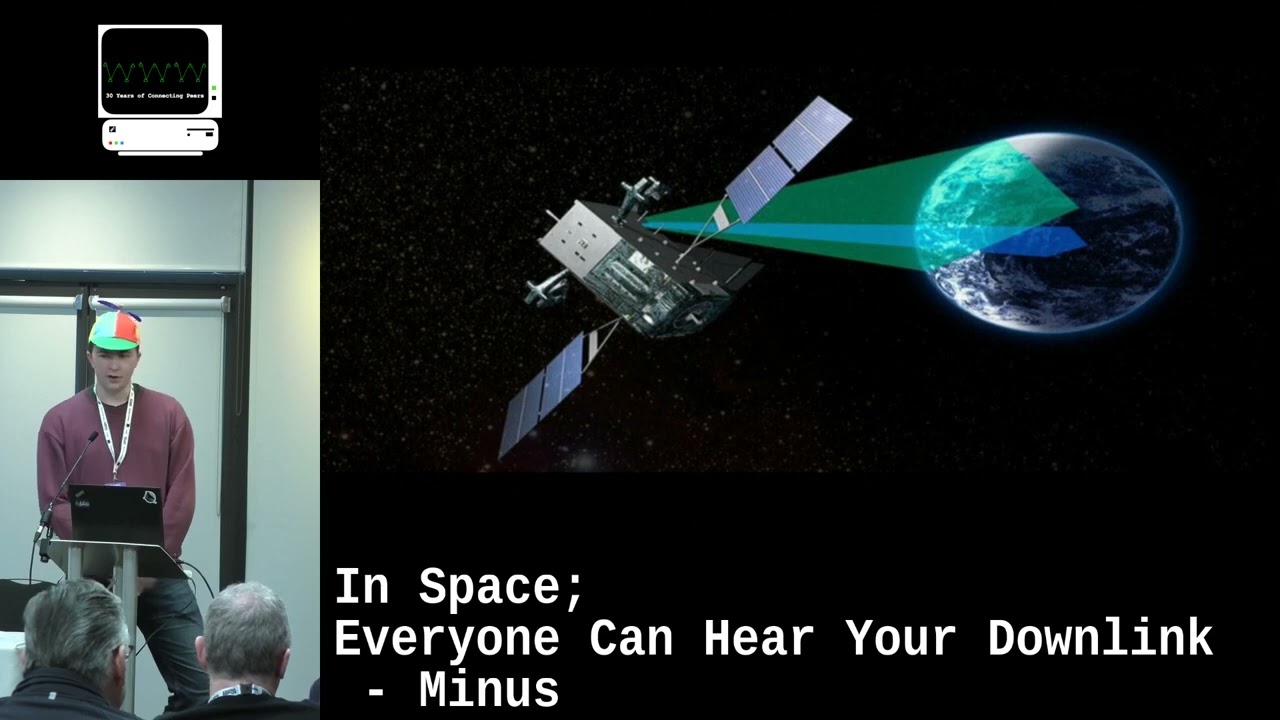
um anyway anyone who can receive the signals can view your internet traffic which is not ideal so this is a this picture of um what a geostationary satellite would look like and it's view of Earth so it has a very large antenna pointing at a very large um geographical region um on the earth and and on and it will have lot from the earth you'll have your users with uh very small points of presence with a tiny rotating dish pointing right back at it and um what you'll notice is that it's a really wide beam it it's uh it's not focused in any way and um it's not going to um and it's not going to going to
discriminate against where where information goes so when it sends information back down to devices over the entire coverage area which can sometimes be multiple consonants um everyone gets the signal and as we said if you get the signal um you have the traffic and there's a lot of interesting traffic you can find coming down from Maritime ships um because they often run email servers um unencrypted web portals you can see a lot of um a lot of requests going into those systems but you can't see them coming back because if you remember the signals going back are very narrow and they're just coming straight back from the Earth to the satellite cuz they're all directed um so um as promised um these
are the the things which you need to understand on building a ground station so uh satellite dishes they are parabolic dishes which are um magnify signal to a point um and that point um which is uh usually a spherical sperical thing the thing on the front of the dish with the arm hanging in front of it um it's what we call a down converter which will take the the very high frequency that's been focused and centered on the uh on the down converter and convert it to a frequency which can actually move through the wire otherwise you'd face uh what we call very high reactive losses um uh the the caveat of having that down
conversion is it needs power though so we have a thing which we call a bias T which um uh enables the down conversion to take place um and then you will have the that part of radio spectrum coming through your Cox Cable um or whatever setup you have to receive that um and Cox cable is another word for wire but um not sure why I put that in um so SDR um I'm sure some people will be familiar with it is a software defined radio and um what it um What it lets you do is it takes a an analog signal radio frequency signal and translates it into the digital domain so if you have any
experience with a kind of electronics it would be like a it's basically a soup toop analog to digital converter because you're taking a input signal and converting into a known number of bits and then obviously software which uh kind of uh uh just zeros and ones is uh pretty comprehensive um and there's some brilliant software out there for dealing with radio signals uh for for finding things and yeah so those are those are kind of the key elements you need to make a ground station and so onto to some options for sdrs so there's the there's the budget Choice which is rtlsdr and I'm sure quite a few people would have used that before it's uh it's very cheap you can
get one for about 25 25 quids I know they released a new generation recently which is a at least a bit better um but it has a quite narrow bandwidth so if you imagine you're looking at every possible signal which you could see on the radio spectrum so you see kind of broadcast radio like Radio 4 you see some airband traffic after that and going all the way up to kind of seeing your your car keys send data um at about 400 MHz you'd only be able to see very small slices of that with an rtlsdr um a big step up is a hacker F which I know a lot of people have heard of it's
uh mentioned a lot at a talks in um uh black hat and such like um and it's used extensively for research uh it is quite expensive it's uh the cheapest knockoff you can get is about £60 and um but it has uh the advantages of being quite high bandwidth so you can see a really large chunk of radius spec from out the time um quite a low noise Flor which uh means that you can um pick out weaker signals which you couldn't do on rtlsdr and then uh uh finally the Pluto which you can get for about 300 um it has reasonable bandwidth but the most important thing about it is that it can receive and transmit at the
same time so if you wanted to kind of a prototype a communication system um do kind of a meaningful work on um uh um with satellites so sending and receiving data um um especially with more modern systems um you'd already want one of those so that takes uh us back to kind of spying on the Marine uh Maritime internet so you can you can see all of the traffic coming back on a satellite to ships all AC um all across uh kind of your Continental area and um one interesting thing which you can do is they often have um quite poorly configured routers on them and it's uh usually very old equipment um and sometimes you'll find that they po
that they use uh globally rootable IP addresses um directly um so you'll just see traffic going um addressed to a globally root IP address that is destined for a ship and they do this mostly because they think that putting mail servers on ships is a brilliant idea um uh which uh I mean it has a a few advantages but um it is one of the main reasons which that the post office protocol exists if anyone remembers that uh which is the alternative to IMAP um and so uh one one one interesting thing which you can do with that is once you find an IP address which is of a ship um if you send any data to that you
will um you can then receive that anywhere in that area so it's a it's kind of like a you could have a information leak that you're just collecting with a satellite dish in your back Garden and if it was traced back to the IP Source all you'd be able to say is that it was somewhere in Europe or North America which um isn't quite a large search area um um yeah so that's uh that's kind of the the summary and what I wanted to move into on this was uh uh kind of the amateur satellite radio which is uh um so you're legally able to transmit to satellites using it um on on things like the ISS they
actually have a amateur radio repeater and um there is no better place to learn information about uh antennas propagation signal hunting and every part of making a radio system which you could could imagine um so in in these images this is the satellite uh which uh which we built um with the ear Society at University um we commanded a roof and built it there you can see guilted cathedral in the background um which has blocked our view to satellites numerous times um and on on the right there um on the left in the right picture is our Radio Shack so that's our very big antenna that's for kind of terrestrial use and then on the
other side of that image you see a massive satellite dish which uh is not ours um it belongs to the Space Center and they won't let us use it which is uh why we built uh our own dish there um but uh anyway thank you very much for listening to my talk and I hope you learn something and uh uh potentially continue your interest in satellite internet
Related talks
 44:52
44:52 14:53
14:53 24:07
24:07 38:58
38:58 26:01
26:01 45:19
45:19