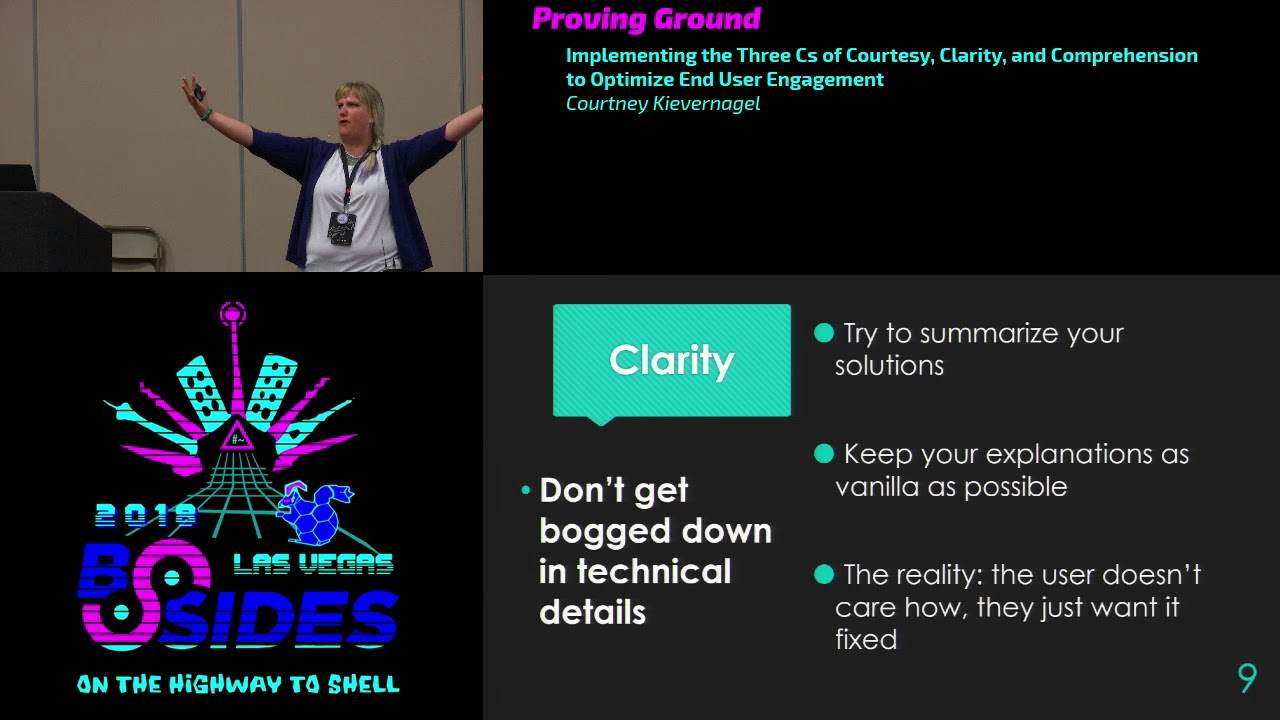
Implementing the Three Cs of Courtesy, Clarity, and Comprehension to Optimize End User Engagement
Show original YouTube description
Show transcript [en]
let's get started please welcome Courtney Kay thank you so much welcome everybody so interacting with customers can be extremely brutal sometimes and it feels like in tech there's no position that is immune from working with customers when I talk about customers I don't mean the public facing type I'm talking about our end users I mean our boss our co-workers that one department down the hall that nobody quite knows what they do they're all people who we support and in order to support them you have to communicate with them if you have a policy that you need to push or if there's a patch that needs to be run or even something as simple as your
co-worker coming to you with a question about their email it all requires you to communicate with them and when that communication starts to break down things start to get ugly real fast the customer becomes dissatisfied they're unwilling to adopt changes that your will that you're suggesting frustrations mounts and in the end zero headway is made now when I was doing some research for this talk I found some interesting parallels between the relationships of doctors and their patients and IT professionals with their users now studies found that doctors when they interacted with their patients and practiced good communication skills that they had a better outcome in their interactions with them especially in the areas of adherence and in compliance now
those two words right there for any tech is music and definitely something we want our own users to do so it's easy to extrapolate that the user just like the patient's willingness and satisfaction to it to what you're suggesting with them is going to increase especially when you use good communications first a little bit about me I am Courtney I have eight years experience in the technical field eight of which were I'm sorry six of which were spent served in the United States Air Force I currently work at a university in California providing desktop administration and also desktop support you can find me at Twitter at oh three awesomesauce courtesy so it can be really hard to be
the level-headed and empathetic tech working with a customer day in and day out but a good tool to use is and to remember is the Golden Rule treat others how you would want to be treated think about it we were all noobs once and we all started from somewhere and we had to go to somebody for help or ask for guidance think about how did they treat you when you went to them for help were they kind and compassionate or were they rude and dismissive and more importantly how did that make you feel don't be that rude and dismissive tech when a customer comes to you for questions and be willing to offer support when they need
it to and it by doing this it really helps put things on a positive spin and speaking of positivity be their cheerleader it is important to realize that they are trying that they are starting from scratch and that if they come to you with a bad situation there's always a nugget of goodness in there how you respond to a customer is going to dictate the frequency and the expediency in which they have future problems now some of you might be thinking right now like yes Courtney just said if I am a complete jerk to the customer they will leave me alone and I won't have to worry about them forever which is great until the customer has something go wrong and
now their computer is sitting there vulnerable on your network I had one customer once who fell susceptible to one of those Apple scams you know where they call you up and they say that your computer's riddled with viruses and this customer was so far gone that he not only had access to his computer but he had also given them his credit card information as well and it until he hung up the phone did the alarm bells start going off into his head and he realized oh no so when he called me I made sure that one of the first things to tell him was that he had done a good job in notifying me as soon as he did
I took a negative situation and found a positive and focused on that also don't be afraid to give praise when praises do this really helps especially with needy customers and I'll be honest with you guys right now I've got some super needy customers like we're talking needing to hold their hand as they open their email kind of needy so what I try to do is I try to use words of affirmation and try to use uplifting phrases things like you're doing a great job or keep it up this is awesome giving them that kind of affirmation really helps empower them and also gives them that self-confidence and over time those super needy customers I've had are less and less
needy so never tell the customer no this was this was a phrase that I had learned when I worked retail in a big-box tech store and looking back I can totally see that it was a sales technique than anything else but I found that that logic could be applied throughout my whole career when working with customers and the basic premise is when a user comes to you with an issue never just flat-out tell them no even if the answer is I can't do this because of policy or you have to shut them down always try to put a positive spin on to it give them options it may not be options that they're realizing or had anticipated but it's
better than just flat-out saying no and then walking away also don't um don't talk over their heads or as we move into clarity it's important to know who you're talking to as far as your customer and what their level of technical savviness is sometimes it can be really easy to get into the technical minutiae of things and get into the weeds and the customer has no idea what you're talking about also I noticed a interesting thing about IT is there's a lot of abstract concepts that are really for non technically savvy customers to understand and so when I try to talk to these types of customers I use examples like metaphors and real world examples I had one
customer who she was a little apprehensive on switching over to a cloud-based filing plan that I had recommended to her so I took that opportunity to use the example of a filing cabinet as the cloud and I explained to that customer and said to them well think about that you can put all of your documents into this filing cabinet and access the filing cabinet from anywhere in the world from your home from your library on your phone when you're on vacation and by taking that very abstract concept of the cloud and solidifying it into something more concrete it was I was able to help the customer wrap their mind around it and in the end them complying another thing
that's really good to use for customers and their acting is to help reiterate their concerns a lot of times customers will come to you and it feels like they're just repeating the same things over and over again and you just you want to say no I've got this I've got this but a good tool to use is reflective listening and reflective listening is that where you just simply regurgitate exactly what the customer has said to you back to them so when Pam comes to me completely stressed out because she can't access her website that she needs to upload important documents to I'll use reflective listening and tell her Pam I totally understand that you have a deadline you
have documents you need to submit and you can't access this website so let me get on it by telling Pam exactly what she was saying what she was telling me assure her that I'm on it and then also gives me that wiggle room so she's not constantly pestering me when I work with customers day in and day out I get to have a bird's-eye view on how they use their can I get to see things like how they access the Internet I get to see things how complex their passwords are I even get to see Tim and his Excel document sitting on the desktop filled with every username and password he's ever created for the
internet so when I get those moments I don't use for your tactics and trying to change Tim's ways I try to take that moment and make it teachable I'll tell Tim hey I noticed that you're working really hard on keeping track of all of your usernames and passwords did you know that you could change over to a password manager and would make your life a lot easier so by using that and spinning it into a more positive outcome its Tim is not only more likely to stick with it but I can also make him more secure by selling those advantage points also don't be afraid to use yourself as an example I am the first person to
admit that I just jumped on the password manager bandwagon and when you use yourself as an example that tells the custom that lets the customer know two things it lets them know that they're not in this alone that oh hey Courtney just started doing password things so it's not too late for me to do it either and also it lets them know that they're not alone in that somebody has already blazed the trail that there's somebody that they can go to for help or questions or tips and that they don't have to go it alone now don't get bogged down in the technical details this a level with you guys this is something that I struggle with today on
a daily basis especially if the problem that I'm trying to solve is really hard and complex and I figure it out I get super super excited and it's bad guys I'll have you know like Pam will come up to me and be like hey did you figure out the website issue and then I instantly turn into Tom Hanks from the scene and cast away you know when he's created fire for the first time and I'm like yes yes I have created a firewall except and meanwhile Pam is just waiting for me to finish so she can turn in her reports the customer doesn't really care how you figured it out they just want to know if
it's done and if they can finish their own tasks so realize when it's time to keep it brief and when it's time to go into those the technical details of things so as we move into comprehension I want to preface and say that I'm not talking about the customer comprehending what you have to say I mean the IT professional comprehending what the customer has to say and the very first step into doing this is using active listening so active listening is slightly different in that it is slightly different than reflective listening and that it's more participatory it involves the the listener so you as the IT person saying concentrating understanding responding and remembering to what's being told to
you and also don't jump ahead of the customer it can be super easy to jump ahead and start problem solving as the customer sitting there describing their issues so try not to jump ahead into that also don't be afraid to figure out what the best mode of communication is for your customer and sometimes that means you have to circumvent normal communicate modes of communication a good example of this is a story that my coworker had and this was many years back and he got a trouble ticket and through email and it was from a customer who was hearing voices in her office and she was pretty sure it was coming from her computer so my coworker was
completely skeptical at this and just what the heck and so instead of emailing her back like he normally would correspond with his customers he decided to get up and talk to her and see her in person and when he got there sure enough her Macintosh was infected with one of the first viruses the env IR that utilized the text-to-speech function of the machine and in random intervals would spit don't panic don't panic so the customer was absolutely right she was fearing voices and had my coworker not changed up his method of communication that process of troubleshooting would have taken a lot longer and could have caused a lot of frustration both on his part and on the customers part also when a
customer comes to you with a problem it's really important to try and remember that what they present to you might not just be the only thing that it could be the tip of the iceberg and that there are underlying issues underneath I had one customer come to me and it she brought me a laptop that just had anything and everything that you could think of wrong Under the Sun was going wrong with it the sound wouldn't work she couldn't connect to Wi-Fi it was randomly rebooting everything so instead of getting distracted by all the different details or all the different symptoms I took a second back one second back and looked and thought okay asked
questions for her and said well how long has it's been on the network when is this last rebooted trying to understand and get a better fuller picture of what the problem was I also went to my co-workers and asked them if they had seen these issues and if they've run into any other similar problems as well by getting that broader picture it really helps you not get distracted and really peel back the layers and get to the root of the problem in this laptops instance it just needed to have the drivers updated updates pad pushed and then rebooted something as simple as that had I been distracted it would have caused a lot of heartache both on my
part and a lot of time on the customers part so finally you need to figure out what's best for the customer and your company and part of doing that is finding out more about what your company's policies are asking questions about it how long has this policy been put into place when was it started how long ago is it outdated how does it affect the customer and how does it affect me when you understand those overarching I'd policies of your company it will better help you when that customer comes to you looking for a solution you'll be able to create one that's both harmonious with the company and with the user and also don't be afraid to get their feedback
include them in the process have surveys at the end of your work tickets or get their feedback after you roll out a new program it helps them feel more invested in the program and so later on when you need to have them change to different policies or things like that they'll be more likely to stick with it because feel like they're part of the team also it helps you as a tech because they will point out to you small problems that maybe later down the road could have turned into bigger problems so you can mitigate that and then finally document your solutions please help a techie out in your work notes create well-defined notation so that way when a tech comes
back they can look at it create a knowledge base or a wiki page for your shop or even something as simple as shared during an all-call a time or a situation that you had and how you solved it that kind of communication with your own co-workers is extremely helpful because nine times out of ten there's gonna be a co-worker who's gonna run into the same exact problem as you did or one similar and by sharing they'll be able to take those those steps that you took and solutions and be able to help their own customers so in conclusion working with customers can be extremely brutal but your communication doesn't have to suffer and by practicing the three C's you will
have a successful interactions with your customers every time thank you very much I'd like to give a huge shout-out to Chris my mentor and thank you all for coming [Applause]
Related talks
 25:40
25:40 51:33
51:33 51:54
51:54 5:33:20
 2:11:51
 7:38:49