Want To Speak At BSides? How To Write Your CfP - Illyana Mullins
Show transcript [en]
hello um if you didn't catch the last talk my name is Iana uh and I am here to talk to you I've changed the title they they asked me to do this and I uh threw a spanner in the works but it is pretty much uh do you want to give a keynote and just in case you're wondering there is an entire version of that that goes to Do You Want to Build a Snowman um it works it's really good yes I created it but no one wants to hear me sing um no um but this is really how to speak at a cyber security conference so I decided to go a little bit off brief and talk a
little bit wider uh not just the call for papers don't worry we will cover that uh but a little bit of why you probably may not be talking and why you should be talking so who the heck am I to tell you to come up here and talk so um my name is Elana I am the founder of two not for profits witch and uh besid telam uh so I put on one of these just Slightly North and earlier in the year and I also run a consultancy called Tech forward so I collect jobs like their Pokemon I'm up to five at the moment um I run uh in the last 24 months I've run over 30 events
most of them probably 95% have had at least one speaker if not multiple I have given more public talks uh pretty much in the last two years than I can count on fingers and toes um I host a monthly podcast it launched yesterday very proud of that uh and the reason I like talking about it is because as much as I obviously love talking I'm actually an introvert this didn't come naturally to me um and speaking especially in cyber security especially around diversity of speakers in cyber security is something that I'm really passionate about so uh I'm really lucky you obviously heard that I get to run the Bristol and bath UK cyber cluster as part of that uh I
was really lucky that earlier in this year I got to run a nice government funded program um called uh confidently cyber where I got to sit 10 to 12 women uh in a room and give them the confidence to speak at conferences like this and that is how you solve the problem of getting more diverse speakers uh you haven't done everything I promise um so why aren't you speaking and who in this room and this is actually a really biased room because we're at a bsides and it's probably one of the best places to start who here hasn't given a talk you just talked um and I think um I'm going to ask you to admit
something really personal now who here has a fear of public speaking yeah you're not alone so over three4 of the population do not like public speaking have a fear of public speaking over a quarter okay that's fine there we go we'll go back to that over a quarter of those have glossophobia which is the extreme fear it is the phobia version of that only 10% of people like public speaking and it's something that over 30% of people have had absolutely no training so you are asked to do it a lot with work whether it's a presentation you're asked to do it a lot by me cuz I need lots and lots of speakers uh and I will bully you about
it until do um so you're not alone this fear of public speaking is natural people don't want to get up here and there's a whole host of reasons I'm already assuming that you're judging me and you should but actually that's one of the reasons that people won't come up and start talking um the best one that I love and I'm going to tell you right now people are like oh I'm not experienced enough I don't have anything that people will want to hear me talk about which I called BS because if I picked anything right now I could pick you all for random and ask you to talk about something for 5 minutes and you would
have something that you could comfortably tell me you could talk for 5 minutes on whether that was I'm going to say Pokemon because I already used it although I couldn't um ask me about neurodiversity I'll talk your ear off uh but the thing is is I can almost guarantee that that will have some basis in your career there will be something in cyber that makes you excited and when people go well how do you know what to talk about well I don't pick the most technical talks I could give a technical talk you guys would hate it because I would be really really boring I would um but I pick what I'm passionate about and
people who are passionate about and I've got to see it and it's the best thing about bides is we've watched people all day who are passionate about giving technical talks and they do an amazing job of it so what I will say is you need to pick something that you're passionate about it doesn't matter if you've just started your career there have been a couple amazing talks specifically today about how people have gotten started in cyber security so you can't tell me you don't have enough experience I don't care about your experience what I care about is your passion for sharing information and if you're at a b-sides you've already taken a really good first
step to proving that you want to do that so why should you care about public speaking because you're going to get really really tired of hearing me talk case in point um but that's not the only reason you should care it is great for your career it builds communication and I have a lovely statistic and I actually want to get this right although it really doesn't like scrolling when you have notes but it's something like 64% of companies will rate communication skills higher than technical skills especially when looking at promotion time it will help you create a personal brand and I know that's really cringey and we're all like oh you're using marketing terms why are you doing that
naturally the next time you go for that promotion or that new job I guarantee that doing something like this will stand out to people in this industry it is vital there is so much happening in cyber security that we cannot possibly as an individual keep up with every new exploit so things like this and information sharing and people who do amazing things like security Queens um that information sharing is key to what we can do in cyber security that puts us at an advantage because we want to talk to each other we want to share that knowledge and that is why it's so important that we do talk that you come up here and you do share what you're
passionate about because someone will listen I can guarantee that because you guys are in listening to me talk about talking and finally it can build your confidence it sounds really silly to say that because you're like well don't I have to be confident to talk in the first place and the answer is no like any skill this comes with practice I didn't wake up one day and go oo I really like standing up in front of people and I still really don't but it is something that I've made myself comfortable with I still get nervous I think that shocks people when I admit that I talked in stage one earlier and I had a nightmare about it like that is
how much this will stress me out but I love when I'm up here and I've learned a long time to kind of embrace that fear it's a great adrenaline rush so your number one task as a speaker so if I've convinced you that you should probably be talking your your number one task as a speaker is to transfer your listeners Minds an extraordinary gift a strange and beautiful object that we call an idea that is from Chris Anderson he's the creator of tedex the most formula talk Stones man um there are literally spoofs about these talks and there is a reason there is a spoof about these talks how the delivery happens is formulaic it
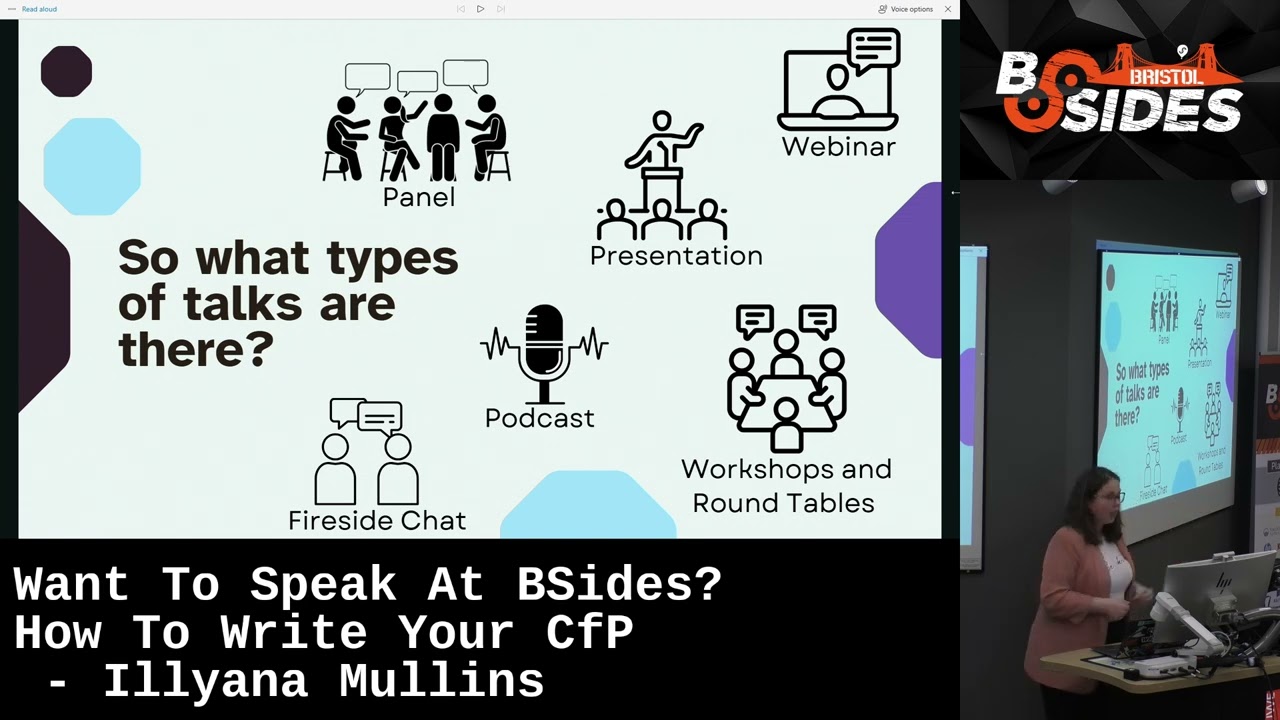
shows that it can be taught if you've never noticed that all tedex talks sound the same there's a reason they are coached into doing that and they're good they give that idea to you on a platter and what I want you to do is in your own way and not the um Ted xway now that I realize I'm being recorded on this um deliver your message deliver your passion deliver what you're excited about in cyber security so what types of talks are there uh what you will seen 99% of today is presentations it's what I'm doing now it is probably the most amiliar type of talk you that you'll be most familiar with I should say there's webinars the
online version of a presentation you have panel sessions and the reason I put panel sessions on is these are a great way to get an introduction to speaking if you are not comfortable sitting on a stage talking by yourself get some friends talk about it together one of the best ways that you can start speaking is actually by hosting the panel cuz not only have you taken you know you you're up there with friends you also suddenly took control you don't have to think of those answers on the spot you know exactly what you're going to say and then you let other people you know fill in the blanks and it's great because guess what they you get the same
amount of credit for it when you do it uh you can do podcasting so I found my comfort speaking in front of people when I used to stream on Twitch it was so much easier for me to comfortable speaking to people behind a screen um and that has definitely kind of brought into to regular life so same why I recommend webinars workshops and round taes are very similar they tend to be very small amounts of people um around a certain subject whether that Workshop the only difference is is that at a round table hopefully they're providing food and you're all talking together and it's just a really casual conversation normally led by someone in a workshop
normally it's an interactive activity and you're expected to be Hands-On or leading someone through that and you also have a fireside chat um very close to what Hazel and Colette just did it is a more informal conversation between two people you might have someone who takes the lead on that like hazel did asking the questions yes she did and that is uh kind of the main types of talks and when you talk at a conference uh it doesn't really matter the what type of conference it's normally going to fall into one of these so you might think that I would start by saying so I've convinced you that you want to talk hopefully if not I
will bully you later um I told you what types of talks there are you would think that my next thing was going to be okay go write your talk and I'm going to tell you no the next thing that you want to do is find a call for papers so call for papers especially around community events are the way that you're going to submit your idea for a talk you do not have to have a presentation done in fact deadlines and you know a conference that on Friday and Saturday is a great way to give you motivation to write that uh presentation on Thursday um but it really is I think a lot of people get hung up because
they're like oh well I kind of have this idea but I don't have the full paper fleshed out you absolutely don't have to so if you've decided that you want to talk I would 100% recommend starting with Sheamus plug for bite-size cyber which is our Tuesday networking their 8 minute or their eight slide 16-minute very short presentation come join the rookie track you have mentors at your ready to help you run through your presentation give you tricks and that starts with submitting a call for papers you can literally Google call for papers and insert the city and you'll probably find an event that has one open this is not how you are going to give a keynote on a London stage that
is not where you are at yet if you are still worried about giving your first talk don't worry about the keynote that will come with becoming that subject matter expert that comes with someone coming to see you talk and going I want to hear that talk that comes later a lot of conferences that I would consider more professional and I don't mean that it's the sales-driven conferences that's the better way to put them those will be very handpicked normally around um sponsorship I'm looking at you ice um and infos saac there are opportunities to speak there those will be literally emailing the person in charge and you have to have a little bit of guts and
you will probably be able to talk um but after all their sponsors and people who have bought a booth and given them lots and lots of money get it and that's why you get sales pitches um so once you find the call for papers that you actually want to submit you'll need to put a few bits of information uh most of them are fairly standard and there won't be a lot of difference between a standard call for papers the differences between chams and Bristol is minute you're going to start with your name please put your name we have to put you on a program you'd be surprised how many times people leave it off and your your paper's probably not
going to be picked you're going to put your email I need to be able to contact you if if I want you to speak I actually need to be able to tell you that I want you to speak um and then it will ask it may ask for a head shot it might ask for a a LinkedIn link if you're trying to create that and then it will ask for a speaker bio Don't Panic AI is your friend and we have a slide here in another screen that I'll kind of walk through that process hopefully very quickly a little bit later then comes the meaty part this is where you would expect that you would need to have your
entire process your paper done and sitting in front of you and if you do hey this next part is going to be really easy if you don't you kind of have to have an idea that you're going to be passionate about literally do set a 15 minute timer and start writing and write for 15 minutes that should give you about two paragraphs you're going to take that two paragraphs and you're going to read it to make sure that it has a little bit of sense and what you have now is a summary of what your talk is going to be and a lot of times you will have an area that asks for a summary but what you're going to go do
is make a summary of that summary now and what you need to do um and this is really for the people who are picking your talk so that summary is a little bit more information you can always flesh it out don't make them too long you will notice my very contradictory statements up there thank you Hazel those are hers and we'll get into why I say don't add too much or too little but you'll then take that summary and combine it into two to three sentences you will want to tell me what you're talking about you will want to do it where you are explaining it to me like I'm 5 years old you will want to tell me as an
audience what I am walking away from your conversation with so if you read my description you should know that you're going to walk away with kind of the knowledge about what you need to put on a call for papers think we're covering that one pretty well but you need to know what to expect and then you're going to write a conclusion whatever that conclusion is up to you this is what we will use to put in the program it will be used if your paper is selected for marketing purposes it will be used a lot of times and that will be literally a summary and that's what the Lash ke for on the form you'll then need
a title because who would have thought I you need to know what you're getting you will notice my title did not match the title that I gave them yay for last minute changes you're welcome um and that if you've gotten through all of that I think a lot of people get very very hung up on it needs to be witty it needs to be funny it doesn't it needs to tell me what you're doing on a tin I have like 3 seconds to make an impression on you when I'm standing up in the in front of you I have even less time for you to read the title of my talk and decide that you don't want to
come to it and that is all you need to know to submit your call for papers it's not hard it's hard if you don't have the motivation but for me it's it's not something that's overly technical you don't have to have every slide done you don't have to even have your entire idea flushed out it just has to give me something about what you're talking about now I've asked a lot of conference organizers other than myself because I might know it all but I love getting other people's information and ideas and one of the things that I asked uh like Hazel and Chris who's here and we'll see his slide in a second is what are you looking for
when you're submitting a paper like when you're reading a paper that's been submitted to you what is it don't put too little information I've literally had applications for beside shelham that say I want to talk about cyber security oh do you that's that's not really helpful also don't give me your entire paper even if you have it entirely written do not just copy and paste it into that little box because like I said I have finite resources you will be one of I think we had around 70 for chelton and B sides last year you've had how many applications this year Hazel 50 you are one of 50 so if you put entire block of text the fact that I am
not going to spend as much time means that if what is really interesting is in the last paragraph there's a good chance that we're not getting to it it's just not which is why I say to really make sure that you have that summary also I know we all love hearing about AI use it if you are not sure how to condense that down into something that sells literally say I'm submitting this for a paper submission what are key points that people need to know about this document and then of course let's let's do the main main point that people sometimes forget don't just copy and paste what chat GPT told you make it your own take
what it said and then put it back into your own words and that is literally all it takes to submit and be up here talking instead of me so what next oh tips for the other organization I did say I had this I thought this was a little bit later um so Chris who is sitting over in the orange shirt up there he actually handles all the call for papers for bides chelam he's the one who gets them he gets it and organizes we actually have a volunteer-based panel from across industry that will go through and anonymously read all of these and pretty much judge them and we take the best of the best that
everybody's voted on and that is how we get to the majority of our content his his tips are really handy you can obviously see we've done this quite a bit uh make the submissions short and concise if you hadn't gotten that from me and Hazel saying it already uh it really does make a difference explain the talk in detail and in simple language like I said make sure that anybody at any technical level can understand your talk even though it may not be or even if it is a technical talk because we specifically get non-technical people to read it and make sure that the application comes across as professional it is so easy to slip into
unprofessional especially for community events like bides but I'm pretty sure we even had one this year that said something along the lines of f Microsoft and if you think that I am going to put you on a stage on something that my name is attached to with that in your subject yeah the answer is no I'm not afraid of talking about things that are controversial but it still needs to be put in away that as an organization uh and an organizer that I'm not going to find you as a liability um so crafting your presentation so you've submitted it you've been accepted you'll normally get an email they may ask you from some additional information
but if you've been accepted you now actually probably have to write that presentation that you've been avoiding and you may be writing at the week of the conference um that's common you are not the only one when I told them I was still writing my presentations they're like yeah don't worry Ken Monroe is too and I'm like oh great he's the keynote that makes me feel a lot better um you need structure structure is how this flows you don't have to give me a map of that structure before we get into it but when you're doing a presentation it still needs to have some sort of flow you need to provide the framework for your presentation also just as a
hint do not put your entire presentation on the screen behind you in little bitty words um there's actually some really interesting um science you cannot really read and pay attention to someone speaking at the same time so if you put too many words on the screen you are fundamentally going to distract your audience from listening to the whole point that you're there and that is for you talking um and that's going to be around the structure storytelling you are 70% more likely to remember someone's talk if they have done it with an element of Storytelling uh it is just more memorable and that is not just an immediate thing if you ask a week later
it's something like 64% if it had story ing will be remembered where 15% a week later if you don't storytelling adds a personal touch whether that's doing War Stories of a you know social engineer which is a great talk um or if you went and saw my neurodiversity talk this morning I talk a lot from a personal level if you don't want to be personal that storytelling doesn't have to be personal but what you do need to do is take your audience on a journey and it will make it more rememberable and style this comes back to Colors um there is a reason why you should use colors it's also one thing that were really bad in cyber security
about using we're really scared of colors but actually there is a lot of science behind education there is a reason why in Primary School everything has bright colors your brain is more likely going to pick up information that is served with color and excitement than if it's on a black background with you know a slight red every once in a while or blue oh no we're in cyber those are the two colors sorry um and you need to make sure that it's accessible the amount of slides that I have seen where it's like blue text on like blue background or red text uh please remember that there will be people in your audience who are dyslexic
there will be people who are colorblind you need to make sure uh audio processing disorders is really common in neurodiversity but you do need to make sure that you are when you're thinking about about this looking at your presentation from a mindset that may not be your own to make sure that everybody in the audience can participate and it's something that I am incredibly passionate about so I said we need a speakers bio oh Jack hemman because why else this is the hardest part for a lot of people when it comes to speaking this one's crap this one's mine um it is one of mine uh what I will say is if you become a more prolific speaker
you'll notice this one is probably my neurodiversity one it is if I am talking to someone about neurodiversity if I'm giving a talk on neurodiversity I want to explain why I am an expert about talking at neurodiversity if I am giving something like this one I probably should have mentioned that you know I was the founder of bsides in it I didn't I just used this one uh and that I run community events here is where you're selling your yourself most people won't read this but this is where you have to sell yourself and part of this will be very cringe um I hate these with a passion I really do um most people are not
comfortable about talking about themselves or their achievements um and this is where you kind of have to let this show you're going I'm speaking and I'm up here because or I want to speak because uh and it gives your audience the first little hint about who's giving the talk I'm going to said say the dreaded AI word again AI is going to do a much better job about talking about you than you are so what you need to do is put a couple of your achievements you have them I know you have them even if you tell me you don't you have them some of you will be one of the most inspiring women in cyber with an award to prove it
and never say it yeah Hazel everybody um I as well we weren't talking about that um but there is a reason that you do that and it is a credibility thing and it is annoying I really wish you didn't have to do these but if you list those achievements if you list why you're a professional if you list your experience and then tell chat GPT to dress it up really nicely it doesn't matter if it sounds like it's from chat GPT because even if you write it from scratch it's going to sound like it was written by AI anyways um but you have to have one we have to have something to put when you
go look at the pre-talk stuff we have to have something from an organizational point of view that tells people who is talking um so you have to do it sorry um overcoming nervousness you're never going to fully overcome the nervousness you're not it is a kind of built-in fact if you are nervous about speaking that doesn't go away it might get less I've given a lot of talks I just admitted that never ever goes away from me but there are ways to kind of go around this now the first one that I'm going to say is practice and this is going to be a bit controversial because if you heard me practicing this talk two days ago it is the most stilted
unenjoyable thing to literally listen to ever because I don't do well with practice I like the audience I like interacting with you guys I like being a part of a room I need social cues um but you can still practice start small do five bsides talks even on a track as small as this and get used to being in front of people that's the same amount of practice I will give a couple tools of how you can kind of practice by yourself here in a second um and a lot of what we have is coming a long ways from a technology point of view get feedback go out and find someone you trust sign up
to be a mentee in the mentorship schemes with bsides go find someone who you value their opinion on and go hey I have a presentation and I need to give it to someone can you give me some honest feedback I love hearing feedback after my talks even if it sucks in fact actually if you don't like my talk I'd much rather you tell me that because then I know how to improve the next time breathing techniques I know this sounds a bit cringe but there is a reason that deep breathing exercises are a thing there is a whole art around the actual science of speaking that the whole point that you do is take a deep breath it
keeps you from saying um it also helps you settle your nerves and let you reset where you're thinking about and start small start with podcast start with an online thing where you can hide behind a screen if you have to if it's the commu the community I almost said the c word uh if it's the audience that makes you nervous that's a really good way of getting rid of the audience I promise it's a lot more less personal to see chat scrolling through because you also won't be paying attention to it or start with community events host a panel start small your first one does not have to be a keynote and I know I put as the title
of this so you want to give a keynote Keynotes are not always the most important Talk of the event oftentimes there's a reason that they're picked I know for bsides we tend uh chelum I should say we specifically pick a very accessible keynote because it's going to be the one that we're going to make the majority of the people watch accessible is not the same thing as the best talk of the day I've really enjoyed the two Keynotes and I'm going to say that because I respect both of them very much was it my favorite Talk of the day absolutely not I saw the first one on the rookie track whose speakers in the room was the most moving talk that I've
been to because it was really personal for me and that's why giving a keynote is not the end all and be all uh and I would say I've given a keynote back to like g off white and I never want to do that again because you were not here to talk to me you weren't you weren't here to listen to me there were aund like you really wanted to get to that talk he's an author I get it so don't hang up if you're not starting with that keynote it's not the end all and be all I promise how to improve your speaking seek feedback there is a trick in public speaking that if you really want to make
an impact you say something three times so if you hear me say you know seek feedback one more time uh Community it really does put an emphas on this but you won't get that unless you ask please if you guys hated this let me know bring it on um to the community uh the community so I fell for that I didn't I was like a I'm ashamed of myself now the um the worst thing that I'm going to tell you to do all day isn't to come speak in fact I really really want you to come talk to me I want you to come talk for um Bristol and Hazel I want you to be up on the stage so you
guys can stop listening to me I really do the worst thing I'm going to tell you to do all day is to record yourself this will be the most uncomfortable thing that you do because it's what I'm going to tell you after everybody's like yeah I can put my phone up there and record myself that's fine it's the watching it and you actually have to watch it or else there's no point in actually doing the recording no one likes hearing uh oh if you ever want a rabbit hole go look up the science of why you don't like hearing your own voice um but it will give you a lot of information about what you're doing you'll notice pacing you'll
notice tone you'll notice where you probably speed through some things because you're running short on time and you're purposely ignoring the people who are timing you you will find the ability to do what you want so my cheating is is I have had training I went to school in America and I was lucky to be part of the debate team in fact I got one of those cool letterman jackets uh with my little debate logo on it um and the first thing he did when he went into that class was you had to record yourself turns out you might have heard that I have neurodiversity uh I have ADHD my the biggest thing that I do when
I'm speaking is if you haven't noticed I've been pacing up here here this is hard I like much bigger stages where I can walk around because it's a lot less noticeable but I sped up look like this and you realize how distracting it is uh and you can work on that I obviously haven't gotten rid of it completely but that is the importance of recording yourself you can see how it flows you can see where things may not fit in your talk and get rid of them or work them in later attend workshops participate in public speaking workshops and seminars they're um one of the tools that I'll point out in a minute is a
thing called Toast Masters there is a charge for them but they are literally the ogs and have been around for ages it's painful to say that but they are specifically allaround speaking they have so many workshops and help and guidance on there even just in free materials on there um also attend talks come to a talk figure out what you like about it go watch those TED Talks figure out what you don't like about it showing up and doing is important but also there is an art of learning that you can do around public speaking and that led me on to read and learn there are so so many resources I mean we're in cyber security so I'm assuming that
everybody's heard Dale Carnes you know how to win friends and influence people that is the basics for most of public speaking um the same traits the same tools um how to own the room is a great one especially for women but there are so many of those there's a reason why there are Ted X's with Millions upon millions of views because there is a formula and you can learn how to do it some tools to help just because I don't want to you know walk you and leave you with nothing I do want you to come talk to me uh and talk for me I should say canva um except for make sure you put it in PDF and then
make sure it or not PDF um PowerPoint and then make sure it still works because you have to be connected and if you saw my talk earlier you can see where that goes horribly wrong uh Toast Masters which I mentioned PowerPoint also has an amazing tool so in PowerPoint that's why I have a snippet if you go to slideshow you will notice that you can start presenting that's great that's what we're doing now but you can also see that there are quite a fewel tools that use analysis and you can have an AI Mentor well I don't think they call it an AI Mentor but they use it so they will notice if you say um
they will highlight if you are going too fast they'll tell you words per minute down at the bottom and flag if you are like me talking about 40 words per minute too fast for people to be able to understand and this is a way to do it without fear of that feedback you can get it it's robotic it's very measurable it will tell you if you curse I actually have um had to very consciously train myself not to curse when I'm giving talks um that might be a me problem but it is something that we use it in everyday life it is so easy to do when you're up on stage it will flag that
until you uh it will actually non-inclusive words so if I'm up here saying guys a lot it will actually tell you that you probably want to address the audience in a more broad manner um to make it more accessible to people your phone to record it um I will say that there is one on here it is a costed one and I will tell you that if you ever want to be a speaker with an agent if you ever want to be a you know one of those people it's like contact my agents and go through the speaking bureaus in order to join the speaking bureau there is an incredibly hard process that you have to do speaking at bsides is a great
first step for that because one of the things that bsides allows you to do is record your talk a lot of times your talks will not be recorded or if they are they are not given to you and one of the things that you will have to do if you would like to be a very very paid public speaking because we are not talking about paid opportunities these are come volunteer your times and your topic uh is what we're talking about right now author gives you a platform to create a personal portfolio of public speaking you can track how many you've done I don't even have one so do as I say not as I do but it is a very
interesting tool you can upload your talks and put them all in one place uh if you doubted me that um you could have the entire Do You Want to Build a Snowman as a cover and it would make sense uh here you go I will not sing it I think my favorite part is the go away I'm coding okay bye um yeah I'll keep knocking I'm really annoying you will come talk um but that is it thank you guys so much I think we actually have a few minutes for questions so are there any [Music]
[Music]
[Music] questions it is something that they can kind of do with the PowerPoint tool um I everybody has their own issues with Microsoft one of the things that I can actually say that they're doing with some of the co-pilot Integrations that they're doing into things like uh PowerPoint are making more of that type of um tools that are available kind of like that it will kind of flag if you've used the wrong language it will tell you if it's too wordy ask someone um the best place it it sounds really funny so it's one of the things I had a m here who talked a couple hours ago get a mentor for your first talk and Bristol has done
it so amazingly well and to Russ isn't in here but he was the one who put most of that together did a fabulous job but get a mentor that's exactly what we were here for I told him to chop and change that you don't want to put that there you need to actually have a slide that introduces yourself you do and that's the best way to get that specific type of feedback for your first talk you're worried about having stuff which slightly too wory my trick is to write everything in 20.1 may not be 20.1 when it goes there but I can't fit a lot of words if I'm writing in 20.1 on a PowerPoint presentation so it forces me
to be very selective of the words and what data I'm put in on the screen oh very mindful very demure which by the way I have a fundamental hatred for um probably cuz I am not my nor deir I think we've learned that in the last hour uh there were some other questions yeah this is more on a personal I mean when you're do the talk how do you deal if you see some people living while doation because maybe they find Notting or whatever I'm glad you asked so um I am going to give you a little B too much personal information uh I've made it very clear I have neurodiversity I because of that deal with rejection
sensitivity disorder someone walking out of my talk would be well and has been something that for me creates an intense reaction of oh my God they hate it probably not they probably needed to pee it's quite funny of you can't take it personally it your talk my talk no matter who's giving the talk is not going to be everybody's cup of tea most people won't leave if they're not enjoying the talk sorry to give you another fear but most people uh will not get up it's too awkward for them if they're leaving it is likely because they don't want to sit still they have another talk to be at especially at a conference like this and I would just
say ignore them a lot of times you will not see them uh especially on like track one where they there's an entire door up above I couldn't tell you who walked in and out and I know Ahmed literally was like yeah I had to walk out 20 minutes cuz I had to go be on the I was like I didn't see you leave sorry because I look at you guys while I'm talking but my brain is so focused on getting my message out there to make sure that my pacing is right that after a few talks that's not something that you'll really notice or something that will really matter to you I think it's just the getting the
experience and understanding that even if they left because they don't like your content not everybody's going to like your content and at least unlike social media they're probably not going to tell you to your face in very loud Angry Words that they don't like it yeah
it's a practice thing so um I've mentioned I have ADHD I also have autism making eye contact for me is really uncomfortable and I've literally had to train myself so uh luckily I have a brain that's constantly going so while I'm giving a talk most of the time you will notice that I will pick a person and you will always find a couple people in the audience who you really realize are engaged and they will be the ones that you pick on so if you thought that I was staring at you it's just that I thought you were relatively not hating what I was saying but I will literally like Sophie sorry I'm going to use it as
an example I will literally look at you and um and I'll like give 30 seconds of my talk and normally I have a little voice in my head that says oh yeah I'm staring too long I probably need to change that and it is just something that comes with a little bit of confidence it comes with knowing your content so I don't have to always be focused on what the next thing my slide says is um and it is just something that honestly practice and even if it's you're practicing to an empty room and you are like there's a chair there's a chair that is fundamentally and you can do that when you come up and stand just
literally go okay I'm up here and I'm going to put my attention there's an empty chair there is there's an empty chair there it will still look like you're doing that and it is just something that with practice will then start happening a little bit more naturally like I said I still very often think about it um but yeah it's it's a practice thing and um honestly uh at a cyber security conference if eye contact is what you're worried about you're not the only one in the room any other questions uh yeah so um you have a 50-50 chance that this is my LinkedIn or malware uh but don't hesitate it is actually my LinkedIn uh I'm I really
would like to come back to this conference um but feel free to connect with me and I will gladly send you these through along with uh you'll see some of my notes for the statistics that I didn't give you anything else yes how do you with the let's call nasty question or happened in the past that someone tried to go f against HP some question and it was a bit anward situation so I think this is I'm going to call out the industry actually a fairly Prem thing in cyber security talks people love being the smartest person in the room uh especially in cyber security um and there I have absolutely seen not really here because
these are more Community focused events we genuinely most of the audience wants to see you succeed they wouldn't be here if they didn't um you can always say we can take this question offline or I hear what you say or that was a really interesting question you know why don't you you talk to me about it outside you can absolutely and you can do that if you don't know the answer too as well but you can absolutely diffuse them and take away their platform because what they want when they're doing something like that and it's a personal attack against you or your idea on there and I'm not saying someone's challenged you on the technical abilities of your your paper
I'm saying if they've obviously made it personal you can simply say thank you that was a great question you know hey um just because of time why don't we take this offline um and can discuss it you know I'll be outside in the hall and I can almost guarantee that they won't because what they want is an audience yes you don't want to engage what you're saying is deflect so grab the attention take it away from them put it down in a box and move on and maybe kick that box on the way out yeah absolutely that that's the best way and actually if they continue to make you feel uncomfortable we actually had this
at one of the events where I did where one of the speakers was accosted by someone who did not like the company they're no longer invited to my events Point Blank a lot of these we have code of conduct there is an entire reason why they say the orange shirts are here to help it's because we are and we will remove people who are just being hostile that is our job we want you to feel comfortable here and honestly yeah there's always going to be bad apples I talk about it all the time sometimes an is just an um but it's okay because I realized that at some point A kid had actually walked in here here and I just got really
worried that they were still in here uh they are not but I checked too late um any other questions what what's the worst talk that you've experienced that I've given or that I've experienced that you've experienced can I be really honest can we cut the recording
Related talks
 32:46
32:46 29:58
29:58 40:39
40:39 38:31
38:31 36:39
36:39 42:55
42:55