Decoding Neurodiversity - Illyana Mullins
Show transcript [en]
so yeah he kind of beat me to what I'm talking about today which is actually a great thing so um I will go ahead and Skip straight to the who am I stage of this so my name is Ilana I am a community specialist in cyber security so if you don't know I run two not for profits besides shelham and witch and I also work locally with the Bristol and bath cyber community um I collect jobs like their Pokémon so if you follow me on LinkedIn you'll probably go she's doing what now and when you learn that I have ADHD I think that makes a little bit more sense I think I am probably The
Shining Beacon of ADHD and having 100 tasks and 100 jobs all at once I've actually reskilled and kind of gotten into cyber security later in life my background is finance turns out Finance is really bad for people who want to be stimulated constantly I'm not saying it's boring but it's boring so I think understanding why I'm talking about this and why I am so loud and proud about what I do I actually have to tell you a bit about my story and for me I was misdiagnosed very very young so I was told at the nice age of 13 that I had bipolar disorder if you don't know what bipolar disorder is it's marked by Massive mood
swings and the treatment especially back then was anti-depressants turns out that's not what was wrong with me however it would take another 20 years before I would get the correct diagnosis and kind of get started in my advocacy so it says up there I struggled through my 20s what did that struggle look like uh it looked like doing really really well through High School P.S I'm American uh not sure my accent gave that away um but I did really really well through high school because it was incredibly structured could go into class I would do my homework while the teacher was talking and I did and had good grades that didn't translate when I moved over to college and university
turns out I failed it twice and then eventually gave up and settled in finance yeah a Dropout who worked in finance that's scary um and that continued I never stayed at one job for very long two to three years was about my Max I wasn't really ever happy I am about as stereotypical as it can get with my crafting projects uh I have about you know copious amounts of lie under my kitchen sink from when I thought I was going to make soap uh turns out it's really hard to dispose of uh so yes I I have pretty much every stereotype and it wasn't until lockdown and social media and Instagram that I kind of had my Epiphany moment so during
lockdown I was scrolling through and I love a good web comic and my Instagram algorithm was like like hey I think you might like this one and it was the tiny ADHD coach and I will give her a lot of credit uh she was also an older woman who had been diagnosed later and she had this web comic and I can't even remember what it was uh but it was talking about some of the main symptoms sensitivity uh prone to outbursts um but it was talking about the things that probably helped get me that misdiagnosis a lot earlier and I turned to my partner crying because For the first time in my entire life I had felt seen and I felt heard
and I finally kind of had an idea of what was wrong with me and that started my diagnosis Journey my diagnosis Journey took me about 2 years right now the average weight time is between four and five within some areas of the country up to 8 and a half years so I was lucky I recognized I needed help and I got that fairly quickly in the grand scheme of what neurodiversity and getting a diagnosis is now and turns out once you have my ADHD under control I was like I'm not quite sure that covers at all and I am now going through my autism diagnosis uh it started because I live with a partner who would probably say that he's
autistic uh he wouldn't ever get diagnosed and I can understand why and we did one of those you know tests that was like hey this is kind of what they're going to ask you and I got really upset because he was answering the question is wrong turns out I I I scored higher than him not sure that was a test I wanted to score that high on but since then it's been a journey I'm also dyspraxic and we'll talk about what that means in a minute but the reason I can't crochet is because my fingers won't let me it's pretty much what that means and um why do I talk about it and why do I
talk about it in cyber security specifically 19% of cyber Security Professionals consider themselves neurodivergent 17% in a study uh and if you saw James B you'll see why I say a study and I'm taking no responsibility for these facts I found them online uh but about 177% have disclosed um that is low I would almost guarantee that in this field we're looking closer to 30 to 40% this is my own feeling but it comes from me talking a lot about this and talking to a lot of people it is a field that naturally fits neurodiversity and the characteristics of traits that we'll talk about very very well according to the U UCLA health uh re uh Recent research suggest that
nearly 80% of autistic women are undiagnosed by the time that they hit 18 which means they're going to hit adulthood not understanding why they don't fit in according to cipd survey only 37% of neurod Divergent employees feel that their organization can provide meaningful support which means even if I come out and I disclose and I am brave that there is you know over a 60% chance that my organization has no idea how to help me or even how to help myself so let's talk terminology because I've thrown a lot of words at you really really fast so you have neurodiverse neurodiverse is simply that everybody sat in this room thinks a little bit differently kind of like a thumb print
or a fingerprint brains work differently and it is just the spectrum of how all of those brains work neurotypical I like bringing up neurotypical uh because I just said everybody's brains Works a little bit differently so how I'm going to say that there's a typical way that a brain works it is an average it is also considered what is the socially accepted Norm so what we consider as a society is normal behavior and someone who fits most of those patterns will be considered neurotypical you then have neurodiversity because we really like terminology that sounds similar and does different things neurodiversity talks about the umbrella of conditions that fall under being netive orent or having a very different or atypical way of
thinking now other terminology we really really like neuros spicy neuros sparkly uh actually I hated them when they came out they're very much out of social media until I realized that I was talking to my mother and just in case you're not aware it is highly genetic IC so when I was talking to my mom if I went to her and said oh uh I think you have ADHD that was never going to go well I I can guarantee it but she kind of took to this term neuros spicy because it was a safe language to use it's not as blunt is saying I have this neurod Divergence or I have this specific thing and it makes it a lot
more accessible especially to people who are starting on their Journey so what do I mean by an umbrella term it means that neurod divergent or neurodiversity covers quite a few common diagnosis or conditions or disorders we don't really like using the disorder word however what I can say is that you know the last D in the ADHD stands for disordered it used to be ASD which was autism spectrum disorder but just in case you don't know what they are I will go through a very very very quick uh run through of these just so you're kind of aware of what's going on dyslexia you mix letters around they see backwards they have a really cool trait
though that they can see most things in 3D um because that's why they struggle with the letters because actually 3D modeling makes a lot more sense for them disc calcula uh which I can finely say after like two years of giving talks about this uh it is dyslexia but for numbers so if you've ever thought that you were just bad at math uh turns out there's probably a reason why an underlying Foundation that numbers flip themselves around don't make sense to you you have dyspraxia dyspraxia is one that is incredibly hard to get diagnosed on its own and it has everything to do with coordination so how do your fine motor skills work it tends to be very
much more commonly diagnosed with other um conditions because it's that clumsy bit of a lot of the other uh if you see the amount of bruises I have it makes a lot of sense you have ASC or the autism spectrum condition that's autism um ADHD you then have the gold standard which is my favorite joke to make which is audhd and that is the more prevailing common diagnosis that is suddenly becoming um I think much more prevailing because like me you find out that you have one you are about 30% more likely to also have the other and that is having ADHD and autism you have acquired neurodiversity um some people really don't like putting this one under the
cover and it comes with brain injury I am very very fortunate to know someone who talks very passionate about this um because she has fundamentally she was in a car accident and after her car accident has all the traits of ADHD she loves talking about it and she very much sees it differently because she has a very blunt before and after and you also have Tourette Syndrome so we know Tourette Syndrome from the lovely cursing Trope and stereotype actually that is probably the worst of the worst Spectrum what that actually normally means if you would to see it on the street is ticks and by tick I mean a muscle spasm normally repetitive there are other things that can go under this
umbrella and there are other things that are caused by this umbrella depression anxxiety other mental health disorders are often very comorbid with these and what we mean is that they show up sure there we go um will show up and can be considered under this umbrella but for the purpose of the talk these are kind of the Main's ones that we're talking about but aren't we all a little so help me if I hear this one more time but aren't we all a little bit ADHD or I think my favorite one is yeah but I'm just going non-verbal for a bit that's not how that works just in case you're wondering now there is a little bit of truth that we
might all be a little I've already said that our brains work very differently and what these conditions are made up of is a bunch of traits and each one of these traits lives on a spectrum so you may be slightly inattentive you might be easily distractable that does not mean that you have ADHD and my difference in this is that I equate this to if someone marched a brass band down the middle of your office that's going to be distracting I love the one about a squirrel but if I walk a dog through the middle of your office I don't care if you have ADHD or not you want to pet that dog that's not
an abnormal or an extreme trait that is something standard being distracted is a trait we all have that's not a bad thing the problem with the traits when it comes to say ADHD is that my traits are so severe that they interfere with my life and we'll talk a little bit about why this becomes a disability but what you don't understand and my extreme level of distractability means that I could sit in this room you could turn everything down and I can tell you that I've been listening to the air conditioning the entire time I've been talking and that I find it very very loud or that I will pick my fingers until they bleed because my brain has to
have a distraction I would rather not hang nails are really painful but if I'm bored my brain has to have that stimulation it is not an option for me it's not a dog that I want to pet and all of these will create a condition now there will be people who have ADHD who their level of distractability isn't what creates an issue it could be their hyperfixation so I was talking to my mom about that my diagnosis after and she was like yeah we did think that you got tested but but the doctor said that you could sit down and read a book so obviously you couldn't have ADHD so yes I can sit down and read a
book I hyperfixate on books it's a really handy trait to have it made it really easy for school I could read it regurgitate it my problem is especially with fiction if I'm really enjoying the book if it's 2 a.m. and I have half a book to go I'm not putting it down those neurotypicals will be able to set that book aside and go I can finish that in the morning my brain does not do that my brain can I can logically tell myself that I'm going to stay up until 6: am reading and I have work tomorrow and this is really detrimental to me but I'm not going to put it down also if it's
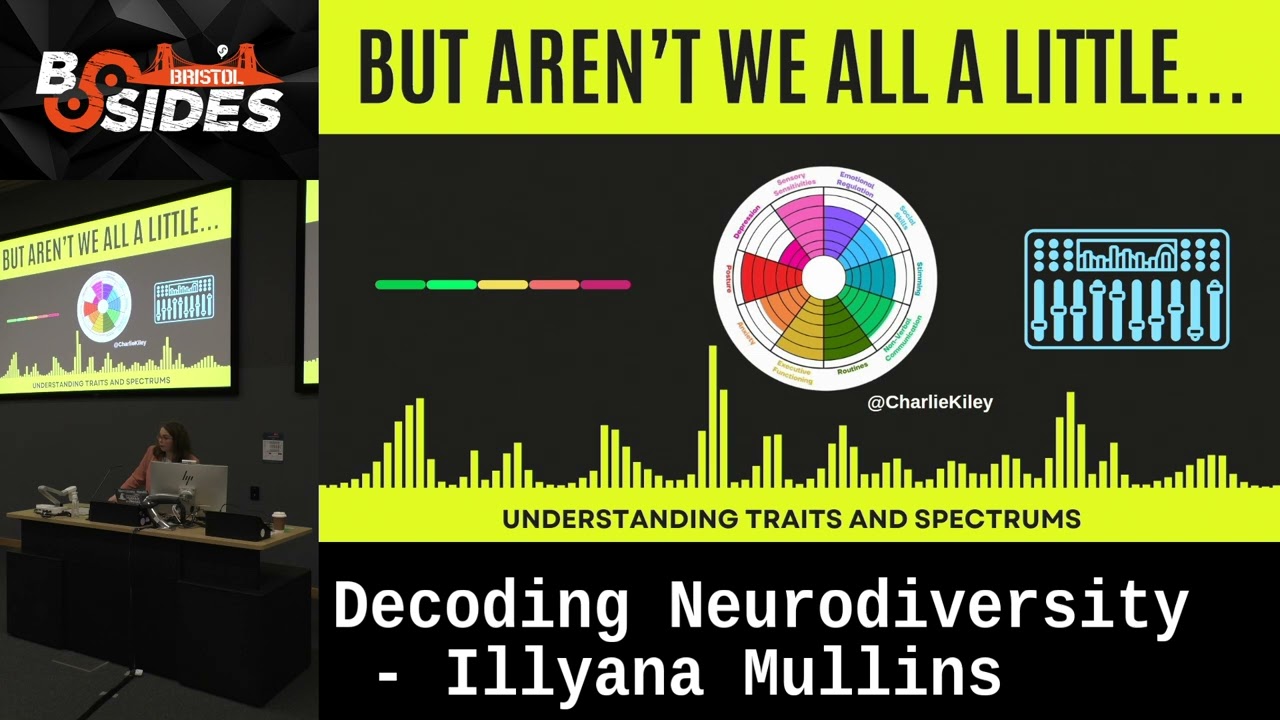
part of a series I'm probably going to start the other book and that's going to be really bad decision-making and this is what we mean by everything sits on this so that middle picture is a a lovely graphic illustration of what's called a spiky profile it's used a lot in autism and what you can see there is kind of the standard diagnosis traits of what is considered when someone is getting an Autism diagnosis and you can see that everyone ranks higher or lower and it's a very handy way of showing this I gave this talk a version of it back in Wales and actually someone in the audience gave me the Perfect Analogy it's like having a sound mixer
board so I can put everything down and I can change the dials and you want to know the best part depending on my mood uh if you're a woman and I'm sorry to say this if you're on your cycle if you are going through menopause those can still change it doesn't change my diagnosis but it can definitely change what trait is affecting me more which can make it really hard so and each one of these lives on a spectrum so you have everything from sensory avoidant to sensory seeking and you can be anywhere on that trait and I am both depends on if I've been overstimulated you can also have non-verbal to hyperverbal I'll let you
take a guess about which one I am so my my favorite but you don't look autistic and other misguided stereotypes these are what hurt people especially in the workforce these are those either conscious or unconscious biases that we live with we are just lazy that's my favorite I've been called lazy a lot in my life it's not that I don't want to pick up that hanger that I've walked past on the floor every day for you know about six months I can look at it I can see it I can stand next to it I can beat myself up for it I can get increasingly frustrated for myself and it does not matter I will still not pick it up until the
one day that suddenly I can and I don't get to choose that day oh no I would love to be able to choose my hyperfixations I would love to choose when my executive function well functioned uh I don't get that choice and the people that you're working with because we talked about the statistics that probably one in five of the people in this room have some sort of spectrum or condition that's on this list they don't either it doesn't make us less I have have five jobs I would not say I'm lazy I run three of my own companies don't think I'm lazy but what's perceived as lazy and what people can visually see tends to be really
detrimental to us what are other things oh we're less intelligent or we're rainmen there are no inet it's our job to fix it so I have to be fixed in order to fit in it's not a company's job to provide me you know accessibility options it's not them to make adjustments it's not their responsibility to help me find what adjustments I need no I can either know what adjustments I need or well that's not our problem we can't handle the stress ADHD is actually incredibly good at stress it's why we're really good at cyber security and incident response it's why there are an abnormal amount of people who uh have ADHD who work as paramedics
we thrive on it that's literally giving me all the dop mean that I would I handle emergency situations so well give me a boring situation yeah that's not going to handle so well we can't communicate I love this one no we just don't communicate like you want us to I do tend to be too blunt um I'm probably going to offend someone at some point I mean that with the best of my intentions I work a lot with small businesses and if I'm giving you really blunt advice it's because I care it has nothing to do with me not caring I don't hate you actually the best thing I can do for you in my mind is give you that
blunt feedback because I want you to succeed and I can very painfully obvious see why you're not succeeding we just want attention no no I don't I would rather sit in the back and not be seen um and we can't be empathetic in fact empathy is one of those that sits on that scale so you can either have very low empathy or you can have empathy like mine where if I see a hurt snail that I'm probably going to feel bad for it I genuinely go past a crash on the highway and I will literally go I really hope everybody is okay not because it's the right thing to do it's because physically I feel their
pain it's kind of sucky we are all alike what I show as how my symptoms show especially publicly are very different it's also very different of what I look like publicly versus the person who got to my hotel last night at 9:00 p.m. and crashed and probably didn't say more than two words because I used up my energy and we aren't listening if we aren't making eye contact if I'm making eye contact I am physically thinking about making eye contact and I'm not listening to anything that you're saying just just in case you're wondering right now I am literally as I give this talk going I need to change who I'm looking at oh I've looked at that person too
long I'm going to look at this side of the room and it is something I have fundamentally trained myself to do this isn't something that came naturally and how these appear aren't and how these stereotyp types are is kind of one of the reasons that girls especially aren't getting diagnosed so there's a lovely lovely stereotype of the little boy with the train and being obsessed with trains and tractors so one of my best friends has an obsession with Taylor Swift it's her thing just like that little boy with the train is her thing she can tell you pretty much where every song topped on the chart she can tell you when it came out she can tell you her entire set list
for most of her aerators because that is her thing and that is much more acceptable because it's be it's a it's considered a fandom you're just a Super Fan You couldn't possibly be autistic being a fan is normal not at that level so well actually it's not all bad so I love the Burke backck 2023 University port and I will give a lot of credit to Lucy who was over here she gave a talk about this yesterday for putting me on to this report uh and this is what the shrinks that people said so I know I just spent a long time about saying what I feel is wrong with ADHD and autism but actually
we have a lot of strengths and these are not what is being used in industry and this is what we could be doing so so so much better ever wonder why someone who has ADH year autism might have really good research skills because if I'm interested in it I will spend every waking moment finding every single detail that could ever possibly be known creativity what box we like thinking outside of the box because we fundamentally just don't understand what the box is um Innovative thinking this comes with entrepreneurialism and entrepreneurialism doesn't necessarily have to be starting your own company if you put them in teams to help innovate the way that you work there are so many
strengths that we talk we don't talk about enough if you long-term memory although not mine like I said this is I talk very much from a a personal perspective what is true for me is not true for everybody else and what is true for everybody else is not true for me my long-term memory short-term memory what memory visual spatial skills I mentioned this with the disc calcula the dyslexia they can see that modeling makes perfect sense but don't take our word on it so you're sitting here listening to me say yeah we have great skills I mean that's me being biased I'm going to say I have great skills I would like to come still
talk with you guys but actually this is what employer said so the Maro number up there is going to be what the employer said and the gray is what the employee said so you absolutely can see that one of the best skills that these employers who are ask on the it's the same report as I was just talking about is the creativity it is their hyperfocus or their ability to work so employers can start to see the benefits which is great that's probably the first step this is the step that we were on a couple years ago and things are moving fast the problem is is so you finally recognize that I have worth that's great we hit step one I feel like
that's kind of basic but now you don't know how to support me you don't know how to keep me in the role you will hire me you will let me burn out and you will discard me because that is so much easier than actually putting in the effort to make sure that I'm comfortable which is great because you know especially for autism one of the best and most powerful traits that we have is being loyal we don't like change if I don't have to change what job I'm doing I will stay there for like 60 years that would make me comfortable I I really don't want to have to go interview I don't want to have to you know learn a
new way to an office I know I like patterns I like as much as my ADHD brain hates routine I I need it um and we're not making sure that things are being done in a way to keep us going there are real challenges I like pointing out the positives but there are the negative traits there are negative traits it wouldn't be considered a disability if it wasn't um by the way just my my little soap box if you think you have any sort of neurodiversity and your company isn't supporting you because you don't have a diagnosis Under Disability law you do not have to have a diagnosis especially with those those wait times at the moment you're not going to be
getting one for a while you still have the legal right to have the support of the company and that support is what will help kind of work with those negative traits understanding that a flexible schedule is the best schedule there's a reason I work for myself the lack of adjustments and support and knowledge we're getting we're starting to get there with knowledge I've been lucky enough to do some amazing training with the University of Bristol with Lucy you guys are sitting in the room now we're getting to that knowledge stage the problem is it's the support and the adjustments that come after and the fact that workplaces workplace culture are not neurod Divergent friendly especially
in cyber security the After parties not really autistic friendly just going to throw that out there lots of drinking lots of loud noise not going to be for me team team building days same thing meetings I'll I'm lucky I have the ADHD so I will talk through the whole thing but if I'm there I will not let other people talk I know my own weaknesses um but there are some real negatives here and it is a disability you wouldn't it sounds really bad it's not considered a disability unless it's impacting you every day and I know people really don't like using that disability word it makes me sad that has a lot of stigma behind
it especially with invisible disabilities but it's something that we we need to normalize talking about because yes I have ADHD and it is a disability because every day every minute there is not something in my life that's being impacted by my ADHD so what should we be doing because I'm not going to leave it on a downer I'm not um in the workplace it's easy and for me it makes sense I do community I do culture i people and I can almost guarantee that any of the things that are up here as an idea of what you need to work on as an organization even as an individual because change doesn't have to start at
the top it really doesn't being understanding giving someone the room to be themselves starts at an individual level and I guarantee that if you do that it will help everybody on your team who would have thought more flexible uh arrangements for coming in later might also help carers and parents who would have thought that more accessible information means that policies and procedures that are easy to read and easy access will cut down on mistakes made by your company uh it does there's there's some proof about that um who would have thought that mentorship and coaching that's available to everybody will help your company do better so it really frustrates me when people say it's too hard to start because it's
not I don't think most of the things on the the screen behind me are actually that hard to implement some times uh you will notice that I haven't exactly put things like quiet spaces I know for a fact there are some businesses that have offices that will never be able to fit a dedicated quiet area that's not their fault it's really not it's you know how historic English houses are built um make disclosing a benefit we're still not disclosing and I don't blame people I want to sit up here and say be brave disclose it'll help I showed you a statistic earlier that it says 60% of the time it won't so why put your neck on the line why
potentially prevent yourself from getting that diagnosis or from not getting that promotion because you've disclosed I want to get us to a place where we're much more comfortable and I can come to a talk in like four years and we're like yeah everybody's disclosed this is great we're I haven't had any bad repercussions and that is why I talk about it because that's where we need to get to because we need to be embracing the different ways of thinking we need to have the diversity of thought behind teams any questions no questions but my goodness you com of course I think we are that I think I know that we people are more susceptible to significant bullying and
abuse and not just in the workplace and not just in in cyber which by the way I've had in Spates but in every other area as well oh absolutely I also think that we have higher levels of impost syndrome and if we've been brought up by narcissistic parents then I think we're also we also more susceptible to that anxiety because my parents did not accept my diagnosis at all my dad had it in his hands of paper threw it down on the floor and went no you're not you you definitely are not autistic and when I asked why it was because when you were at school the teachers never said you were autistic so therefore you can't
possibly be autistic I went to school in the 70s I love that so I will touch base on a couple things you said absolutely that we are more prone to imposter syndrome there was an amazing study by done by a psychologist that between like up until the age of 10 to 13 that we'll hear about 30,000 times more negative reinforcements it's about four every day when you do the math if you discount the fact that they're probably not going to be you know when you're one or 2-year-old quite yet uh that's still normal toddler um so absolutely we've been taught that we need to fit in for most of our Lives we've told that we're
not and that is where unfortunately either a lot of the unconscious bias comes in or where the conscious bias come comes in is that people like sameness it's how we connect as a community there's some sociology literally there's an entire study about how people interact together and it's a lot of them will come down to we like people who are similar to us which is why if you're my friend I have some really bad news about your neurodiversity just just throwing that out there um but it means that in areas where people who are more neurotypical are we are Oddities we're considered a danger because their brain recognizes that we don't act like them and it Flags
a historic danger response because I suddenly don't know how your inter acting with me that's terrifying um and it's something that we should be good enough to be preventing now and that's where the change really does need to happen Matt yeah a comment really absolutely love that
[Laughter] pleas um I just wanted to say I'm with fer Brady on this one I don't know if anyone seen the video which she's done but do look up on on YouTube cu don't think we talk about how weird neurotypical and how much they want to smoo things over you tell them neers you autism or ADHD whatever um and the thing they always say that reallys me up is oh but it's a super power and what Fern said was is it is it really you know instead of having superhuman strength and flying around the world what would it be like if like Superman monologue to you at length about poet still will be B for hours without any ability to
register your disinterest in it you know so I think it's time to change the conversation and start looking at it the difference I mean again it is a disability but in some respects but you know let's recognize difference here it is I was about to say go watch F Brady's uh if you don't know who F Brady is she was on Taskmaster she's also an amazing comedian besides that definitely go see her take on autism it's amazing there's also an amazing Australian comedian who's on the Instagrams um Joe Who funny enough does an entire series about how neurotypical sound to neurodiverse and how absurd it can be so I 100% do that uh I'm not going to apologize for
putting a QR code I'll let you scan it at your own risk uh it could be malware or it just could be a link to my LinkedIn I'll let you guess um but actually please if you do want any more information I'll be outside and also Shameless plug is there I am doing a second talk later this afternoon in track two about actually public speaking so if you want to come talk at a bides please come to that um because eventually and I'm going to say the same joke so you have a heads up uh you're going to get tired of hearing me I promise so you guys need to come up here and speak but thank you very much
Related talks
 45:19
45:19 29:58
29:58 40:39
40:39 38:31
38:31 36:39
36:39 42:55
42:55