I Won't Allow My Child to Have a Smartphone: Why Smart Parents Make Not-So-Smart Children
Show original YouTube description
Show transcript [en]
all right well um the last talk of bides I'm presuming um it literally tells us the status of cyber security and our interest in children right in in in in many ways it's indicative of where we are when it comes to how we we come to this idea of security children parenting um I just want to give you a little bit of a background uh talk a little bit about who I am um some of you know me many others don't um I'm a cognitive behavioral Scientist by training okay I spent um close to a decade and a half of my life in cognitive behavioral science I was a 10year professor I wrote tons of
papers um on security on children on the human factors of security nobody read them um it's the Lisa thank you and this is Lisa Lisa Lisa's read it so that's one um I wrote a book which is available at blackhe hat right now at the blackhe Hat bookstore called The Weakest Link U some people read that U I did a lot of that for 15 years of my career you know I spent a lot of my time doing fundamental research switched from there in between to a little bit more of what I like to think of as being a technologist in the public interest okay uh what I basically did was I wrote in the media to draw attention to problems
in security and to Solutions um Roden CNN rod and Washington Post wrote tons of it starting 2014 I still do it I just wrote something about crowd strike um on dark reading last week um a lot of advocacy right a lot of problematizing providing Solutions I was very early on in 2014 I talked about how we have to orient towards securing the nation right very often when we think of cyber security I I speak at blackhe hat I've spoken at Defcon our focus in all of this tends to be on the organization seldom do we think about it as the family or the societal problems that are happening at the parent level right and cyber security if you think
about it almost a decade later from my original pieces is a bigger problem and it's not just an organizational problem if you have kids and I do uh that brings me to you know the third part of what I did right and that is I have kids those aren't my kids okay that's a stock picture that's not my wife it's live streamed I can't put up pictures but what that got me to realizing I have two kids I have a son and a daughter um one's um Jen Alpha she's 15 uh I mean he's eight and my daughter is 15 so she's jenzy and that's when I eventually realized there was nothing to guide parents when it comes to how how you
secure stuff around your kids how do you introduce technology to them when do you introduce technology to them so I founded a company called the Cyber hygiene Academy meant to basically Advocate cyber security training for children and for parents basically coming up with best practices because there really isn't much out there it's surprising how confusing the landscape is when the stakes are really high this brings us to some of the stakes right uh when it comes to genz and gen Alpha right now they're using technology more than Millennials did more than gen xers did more than every generation before that they're using technology for Education they're using it for training they're using it for entertainment but
there's something very interesting that's going on right with these groups and that is there is a convergence of technology and a increase in agency that's happening what do I mean by that what I mean is the so-called boundaries of platforms have all converged what used to be social media an entity in of itself is very hard to discern from YouTube when it's streaming content so there's a lot of this convergence that we're starting to see across platforms right uh YouTube is almost no different than a with with ads today if you look at YouTube it's no different than you know a a network a television network but then it's also a social media and it's also entertainment
and it's also gaming it's it's everything it's music it's the everything into this and the agency that these kids have today's kids have these Generations especially are higher than the previous generation part of it is thin infrastructure right we have wireless Technologies we have battery operated phones you know things that My Generation Um didn't have as much we still had computers that were Wireline we had networks that were you know dial ups that we needed these kids are growing up with it so the amount of agency that they are used to is way higher and we see some of the down the the downsides of it the stakes have gotten higher for the first time
Millennials have been reporting more data breaches than older Generations this was this year the second interesting Trend which is kind of really bizarre there is more personal information like compromising if you want to call it for my generation on devices that Millennials have which means a data breach becomes extortion very quickly because there is that much image in there that you can use because it's become routine in many ways to have data that might be compromising in some way and not even think about it and this particular orientation is something parents are having a hard time dealing with so what parents are doing though is you know we have data now um and we got this data just to give you an
idea of of where we're getting all this data from for one there isn't a lot of good data on parents and on children the best data we have found comes from Studies by nist by nice National Institute of cyber security education they're using samples of 20 parents diets of 20 parents and 20 children that's the extent of the data that they have good data nevertheless but very limited so part of what we did is you know we did a thousand adult study so we did thousand parents Across the Nation um you know we did two different surveys one we used prolific the other we did you know we also did about 100 one-on-one interviews with parents we
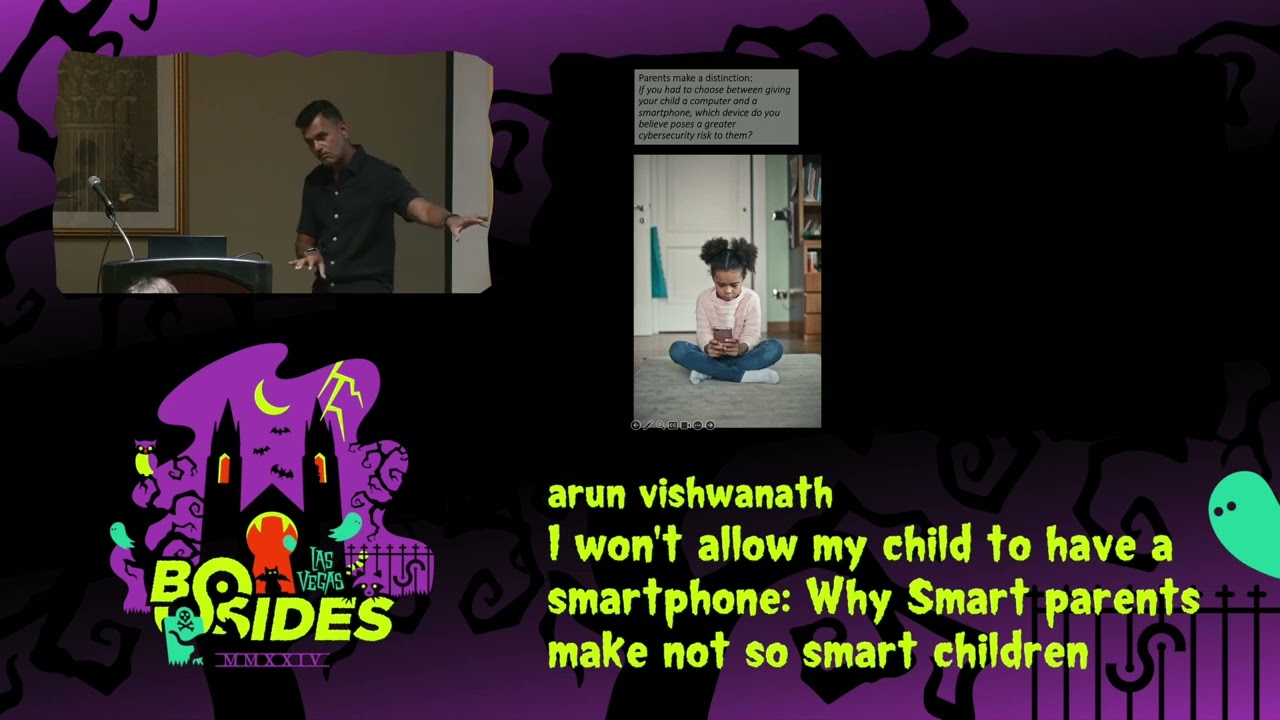
talk to school counselors we talk to psychologists we talk to teachers we talk to school districts it's an ongoing process that we've been doing to try to understand what is going on with this access that parents are giving or how do they oriented and one thing that became very clear is that parents make a distinction between Computing technology like a computer and a smartphone right and it makes sense right and why does it make sense because smartphone basically gives the child more agency they're by themselves they can use it they can move around it reduces the amount of control the parent has and it increases cyber security risk all right so in the surveys that we did
when we asked parents about you know what do they think is a greater risk it's no surprise that almost 40% % felt the smartphone was kind of like that primary risk compared to a computer okay and this has an implication as we go forward right this is the generation that's growing up with this technology that's basically what it does is it influences when that parent gives the child a phone so are there any parents in this room everybody oh my gosh what is the right age to give your child a smartphone why don't we ask the child in the room what's the right age what is the right age to get you your smartphone like an
iPhone 12 123 what do you think parents anybody higher 16 what else that's okay we got time it depends on the child what they're going to use it for what kind of monitoring you have in place place on the phone I there's so many factors that play my kids got their phones at very different ages what did they what are the oldest kid get the phone what age um I don't recall but my oldest child has hearing loss and has hearing aids that can only be controlled from uh mobile devices that have the correct app stores mhm so the oldest got a smartphone at a younger age than the younger one because um it was gave her agency over her
assist of technology which is U which is important I'm going to come back to that that's a good point yes what age do you think is the right age I saying same thing depends on the kid okay right so when we ask parents this very question a lot of people resonated exactly what you're saying here right which is the older the better the median age is usually they want them to be at least a freshman okay or higher 20% of the population said 20% of the sample of respondant said never College they don't think they're ready so this is a question that's really important right it gives you a glimpse of how parents think but then there's
another question we asked which is the question I asked you which is when did you give your child a phone and it's at fourth grade and at fifth grade so notice that disconnect that's there between what a parent really wants to do and what most of them end up doing so why did they end up doing this this is a question we've been we try to answer right and the answers for this one of it is peer pressure right the child wants the phone because all their friends do and that track phone the gab phone the restricted devices that the parent gives them no longer makes them connect with others but the second thing that's
happening is children become more active at Middle School um after school activities sporting events group activity and the teachers very importantly in our system stop communicating with the parents directly and start communicating with the child or online and expect you to go look at your scores so almost that phone becomes a NE necessary device for the child and so by by fifth grade and by sixth grade when you look at National statistics right now by 8th grade 7th and e8th grade 86 % of all kids have an iPhone or an Android phone have a smartphone with them by high school it's 98% in the country right now that's the beginning of high school they a freshman
year okay so when parents don't have much in terms of choice when they have to capitulate and lose that control that they have the next thing they do is they become protective right so they start saying let's locked down this device so let's figure out a way to control usage okay and this is something that we wanted to exper explore further and said okay what is this control because we're trying to get to this understanding of how are parents protecting kids what are they doing and what's that right thing to do is there a Best practice that we can talk about and and how do we invol ourselves parents don't allow children to use new apps 80% of them most believe
that limiting exposure screen time anything that they can do protects them from cyber protects the child from cyber threats but really interesting here which is something we never thought would happen we would see is there is a socioeconomic divide that happens here more educated H income parents more educated many of us in this room tend to be more protective than parents who are lower income lower sces it makes sense right why they're more aware correct I mean it makes sense they know know they hear they read they they see what's going on you know they're more queued onto you know what's happening in the media the stories that you read and this particular issue bleeds
into a lot of other things so one of the things we asked parents is what's your perception of your knowledge how well do you understand cyber security how would you rate your cyber security your ability to respond to attacks right this is a question that's very critical it's an efficacy question we're trying to understand what does a parent think of their abilities parents rate their abilities very high okay and this particular question comes back in a couple of different ways how do you rate your ability to educate your child again very high and here again we see a socioeconomic divide we see parents who are educated parents who have higher income who are way higher when it comes
to this particular perception right makes sense parents who are more queued on they're more educated they think they know but then do do they really know is the question you got to ask right you're helping your child do you know what you're helping them do how well do we understand security this is an issue that if you read my book we've been dealing with this for a long time we have a measurement called the Cyber Risk Index I mean I'm sorry uh the the Cyber risk belief measure this is a measure it's got about eight questions it's available online the questions you can go to my website it's there on we measured actual knowledge and when we measured the so
there questions is a true or false question so simple question would be you know what's more secure um SMS or Whatsapp right it's a question everybody should know the answer to what is more secure SMS or Whatsapp what is the answer anyone WhatsApp right why it's encrypted right uh another question right what does SSL indicate does it mean a website is authentic no right most parents think it is nobody is the test thousand people took this nobody got 100 the modal was the mode was 17 177% was the average the midpoint around 30% was the average 67 being the highest and there was no socioeconomic difference so I'm sorry that knowledge across the board is very low but the
perception of knowledge is very high in one group and so one of the things we see here is what we call as a classic Dunning Kruger effect right for those of you who know what this is It's overconfidence or over representation of self- knowledge right and when you have an over representation of self- knowledge you're overprotective because you think you know what you're doing right so people with high self- knowledge which tends to be high SCS parents are more protective and overprotective than the parents who are low SCS known who have a lower self-concept in general and this perception is not driven by actual knowledge it's driven by perceived knowledge okay and this is really
important this we can package unpack this for hours but the point of this is smart parents are not that smart when it comes to cyber security but they think they are and that drives a level of protection almost over protection so what do they know where is this information coming from right most of us are missing it so when we looked to see the drivers of protective where are these parents getting so I don't know if you guys have read this book by Jonathan haate called the anxious generation it's a new book that just came out um New York Times did a very raving review of this and the entire book's premise is that children should not have technology
with them and some of the things that some of the reasons are things like cyber bullying and predation because it exposes them to cyber bullying it exposes them pration now I've looked at we've looked at research going back to even 2014 all the way to now Sonia Livingston's work as a prime example of that the incidence of cyber bullying is actually very low however the perception that it is very rampant is very high and it's awful when it happens there's no question about it but the overall representation is actually way lower than it looks the same goes for predation it's it's rarer than it looks and predation and we'll talk about that in a little bit happens
more when parents overprotect their kids and don't give them devices because the child sneaks behind their back and starts using a phone it's unsupervised so it's almost having the opposite effect so the cases when we talk to counselors they're always talking about girls in this particular case being overprotected using devices with their friends and then then becoming victims of something going down that road right so this is a something we see quite often other things that seem to be happening is ideas like digital dementia that you know anxious generation is the name of that book there have been large scale studies of 350,000 students and there's no evidence of digital Dementia in fact we see the
opposite and we'll talk about the the positive effects of technology which nobody seems to be talking about right U other things children being more sedentary sure there are some children who become more sedentary if you're playing your PlayStation all day but your smartphone can be a conduit for activity too and the results of research that we have seen is pretty mixed it's very low effect sizes fourth thing parents said children become antisocial there's absolutely no evidence for it Fifth thing parents did damage to brains damage to the mind I don't know if you you know I I grew up when when I was doing my dissertation and we were still looking at research on television
effects and if you looked at original you know ' 80s and '90s television St they said the same thing they were just parents like me at that time so I guess every parent goes through this Evolution thinking it's going to damage their child's brain and it's not it's not rewiring anybody but that seems to be the governing principle and so what we what we're looking at is balancing the positive right um creativity Innovation problem solving I'll give you a very simple example I talked to a child um a school counselor who's telling me how this young kid who's 9 years old collects Pokemon cards and the cards are written many of those I don't know if
you know enough about Pokemon I know just enough apparently the Japanese cards have a lot of value and he uses his phone to translate it I wouldn't have thought of that it's just creative problem solving one of our advisers in cyber hygiene Academy she's a 21-year old girl whose parents allowed her to learn coding very permissive parenting she has a business that sells digital art on social media something she was using since she was like 14 so none of that effect is ever considered when everything is framed on the negative second thing cognitive development right uh TV improves you know Sesame Street today uh my son when I was teaching him Believe It or Not
mathematical multiplication tables I put them in front of YouTube because I was like I can't do this watch this repeatedly it works it worked we never talk about it because a lot of the framing is again negative social skills a lot of dating happens online with school coun with psychologists what we some of the evidence that we're seeing again anecdotal data boys who are not socialized on technology I have a harder time they're more maladaptive they have adjustment issues when they go to college they have dating issues when they go to college and not having a device early on whatever that early on phase is restricts all of that stress reduction anxiety reduction Health requirements right if you have a
learning dis ility if you have a hearing requirement if you have health issues Health monitoring all I'm sorry all of these things from physical activity mapping your R working out happens on devices so one of the things that we're talked about we're talking about is that this idea of banning phones which is what Jonathan herit talks about doesn't make any sense if anything there's no research that suggests you should do it and if anything doing it has a counterproductive effect on the development of the child and yet if you go online this is what people are talking about there are long form pieces advocating this principle and I don't know if you recently followed you know um I think
the Viv MTI the the guy who's the Surgeon General of the United States asked to put warning labels on social media uh for one warning la on social media are going to make people more maladaptive in their use and unlike cigarettes which has a clear negative impact there are positive impacts to social media and a warning label takes the agency away from the parent and throws it on back to the social media company okay and so we think that the the the solution to this is building a healthier relationship right which is cyber hygiene development this is something you know I wrote about advocated starting in 2014 and to date the only state in the entire United States that's
got any level of mandated cyber security education on children where they introduce technology and security to them and an young age is not Dakota and next year apparently in not Dakota now they wanted such that every child who graduates has to have taken at least one cyber security class now I don't know if you know this but up until 1960 if you graduated from Harvard you needed to know how to swim swimming was a requirement I don't know if anybody knew that and it stopped after you know the Ada came out back in the 1970s and ' 80s but this is cyber security today it's an essential skill it's a requirement it's something we all live with and that
these kids are going to all live in and so when we talk about permissive parenting parents need evidence-based education right parents don't have any evidence me as a parent I'm still looking for evidence to say what's the best thing to do and the easy thing to do is to stop and pull back on the technology the easy thing to do is to frame it on the negative and scare them out of it and then they go around our back and start using technology okay so that's all I got questions [Applause] anybody has a question Lisa microphone coming around if you raise your hand I'll bring you the mic and okay thanks Arun you know I'm a big fan
um what do you think CCSD the fifth largest District I know you've done some research and some writing about them so I'm sure you know they're going back to school next week and they will have all of their cell phones in um RFI pouches right um these are not locking and the students will have them on their person but I'm wondering what your thoughts are on that and as parents um who may be in this community or one that that does that like you know what do we do I know and and just to you know frame that in a bigger way uh Florida has banned smartphones in CL in schools um New York has New York the New
York Senate has a bill right now the governor's got a bill where she wants to do the exact same thing kids need phones some kids need them other kids should have them and the reason for it is today the phone is the the parent connects with the child purely on the phone if you have a school shooting rarely enough when it does happen though that's the only conduit for calling them putting phones in RFID and putting them away basically takes away any connection the parent has with the child right so I think the the entire thing we're taking the easy way out and the easy way is to just ban everything and if you ban it if you've seen what
prohibition does everything just goes on theg ground it's worse it's going to make this situation worse because we need to embrace the technology as against trying to restrict parents from using it or children from using it and parents then say well you know you can't use a phone anyway so let's not give them a phone
yeah to com I I don't know the debate is over restricting Tech to kids I think it's more about what's the right age to give technology to kids um and when you talk about schools and banning it in schools I you know there have you seen evidence one way or another of test scores going up in schools when they ban it um and I guess if you that's that's a great question yeah if you could tease out maybe more reasons why you think kids need School phones in schools right I to date I this Banning is a new phenomenon that's happening right there is nothing to say that it's more intrusive yet so the school districts I
have spoken to nobody is finding it incredibly intrusive they just don't want the kid to be in the classroom using the phone they want it to be in you know put away that's about what the teachers are asking for but the school districts are making this decision saying well it's you know we can't just do it for some kids and allow others we just going to ban the whole thing to the other question which is what's the right age the right age is actually middle Middle School okay all the data points to middle school as being the right age and and the reason Middle School is the right age it's when they're also starting to break out of M into multiple
social networks and one of the fears that that all of us myself including as a parent has is a lot of the middle school kids if you don't train them into using the phone smartly wisely they start creating social media accounts because they go behind your back and start making them and those social media accounts are on the phones of friends of theirs it's the worst case scenario so giving them phones and not having them learn the blind learning from the blind is the best way to do it and so Middle School is the appropriate age and if you notice the data tends towards that that's basically when most parents do it what's missing though and the big gap
there is there's no fundamental education of any form yet in the school level that's approaching it the other issue with Banning phones and this is a critical issue that nobody thinks about the schools don't want to deal with phones they hand your child a a Chromebook and they say well that's my responsibility that phone is your responsibility so by Banning it it's now the parents problem so all they're doing is they're locking down that Chromebook and they're teaching them everything on the Chromebook there's really nothing on that phone that's you as a parent and as you can tell most parents don't know how to deal with it they don't have the knowledge to be able to effectively
teach safe use this is where the schools have to step in and this is what we're pushing for which is don't ban the phone instead be more permissive and train them how to use it because they're going to spend their life using it there's no way you're not yes uh I'm curious on your thoughts on the idea of restricting screen time so if you give a child in Middle School access to a phone um are they using it as much as uh like a graduate or something like that or is there an idea of like structuring the time in a particular way or what's your opinion on that what again this is based on the data we have right this is coming
from school counselors and psychologists screen time is something a parent needs to negotiate with a child it's it's an important part of that cyber hygiene training you know what I mean as against having a parent mandate and dictated based on their perception of screen time having a a defined best practice for a parent to follow makes it easy right now when we talk to parents everybody has a different idea of how much screen time is permissible some say well 4 hours well what's screen time if you're learning multiplication tables on YouTube on your phone is one hour enough right and so that negotiation becomes very tricky because we have no best practice out there to give to parents
and this is one of those areas where there is by Banning it and putting our hands up and saying it's not our problem we we just punted that problem to a parent and everybody's trying to figure it out themselves so part of what we're trying to push for is this is this understanding that cyber security is not just an organizational problem parents are dealing with it too and our job is to not just educate employees so they secure the organization's perimeter better but it's to help the parent because that's that next generation of your employee coming in there don't forget most of the kids right now have already been subject to some data breach all my kids have been subject to
multiple data breaches the difference is they're clueless about it so they're walking out into college with all their data compromise whether they like it or not and with no training with no education with nothing protecting them or preparing them that's we just punted that to an organization say well go take care of it we know how well security awareness Education Works so I think you know fixing this and I've been talking about this since 2014 fixing this at the societal level is more important it's it's kind of like a primary Duty that we have because technology is not going away it's just getting bigger any other thoughts any other questions yes Lisa so switching out of our parents hat
and putting our cyber Security Professionals hat back on just back to the school thing it's curious to me um you know cyber bullying is a massive issue and there's you know it's against the rules and some cases it's against the law but there's nobody to enforce it there's nobody to investigate it there so it's just not happening and it's occurred to me that by locking the phone devices that that puts the cyber bullying back on the people and the parents and away from the school that's right is that and the incidence of cyber bullying you know there's there are gender breakouts there's a lot of data that we have that we can talk about but
it just basically pushes it on to the parent and the school says well it's not our problem it's not our device so it's back to you as a parent and the same thing happens with you know sex tortion issues remember you know there's a thin line between sexually explicit image sharing and sextortion kids who are sharing sexually expit images on a phone they need to know what the best pract what they need to do to stop that from happening because you go to your teacher she's a mandated reporter you're going to start a chain reaction that the parent is now going to have to come to deal with because it was on their device parents who have talked who have
faced this have gone through hell and there's nothing out there in data terms that tells us anything about how they're dealing with it so so when you start talking to parents and actually kind of untangling what they're going through with cyber bullying with extortion with just being and and boys with sexually explicit image sharing which they think is very funny because four kids are starting to share images there are consequences to it and there's nobody teaching people what kids what to do at an at any educational system private schools are not doing it public schools don't have the resources to do it okay and so what we're trying to advocate for is very important you know
and when you start speaking to parents you see you see everybody says well it's not my child it's not my child it's like the Mike Tyson rule right everybody says it's someone else's kid till you get punched in your face then you realize what it's what how how crazy it can get any other thoughts all right take it away thank you so much guys thank you for coming it's the last talk of bite so thank you for coming
Related talks
 51:51
51:51 32:48
32:48 33:48
33:48 54:33
54:33 31:06
31:06 20:51
20:51