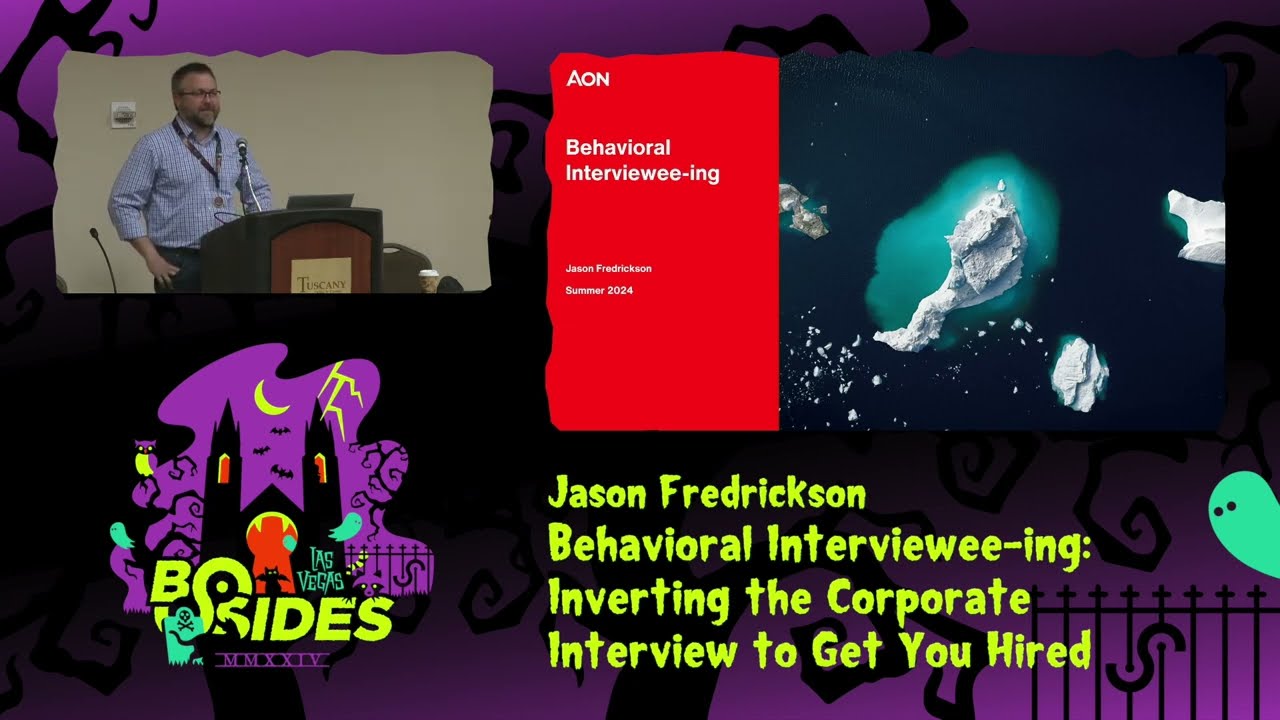
Behavioral Interviewing: Inverting the Corporate Interview to Get You Hired
Show original YouTube description
Show transcript [en]
hi guys welcome to my talk oh good you're all paying attention awesome my name is Jason Frederickson I am the managing director of solutions development for Aon Cyber Solutions which is the arm of Aon dedicated to solving our client cyber security needs that's not what I'm here to talk about today what I'm here to talk about today is the fact that I have spent the last 26 years hiring trying to hire sometimes failing to hire software developers and other technical people and that means that I've spent the last 26 years working with a technique that we call behavioral interviewing and as I was thinking it through last year I realized that's kind of unfair somebody needs to come and tell
you guys all the secrets that I know so that you know how to act in the same context and so that's what we're going to talk about today
but before we talk about behavioral interviewing we're just going to talk about interviewing yes sir better better now my voice is going to drop now like the movie announcer first we're going to talk about interviewing and in particular we're g to talk about one really core thing which is that interviewing sucks we all know this why does it suck 94% of all corporations in America pursue an explicit business strategy a primary business strategy of operational efficiency what does that mean it means that their stated strategic objective is to make it more efficient for dollars to come in and presumably dollars to go out but ideally not so many of those right that's where the profit comes in if you
get a chance to look into the bordered and where the sausage is made even the companies that we think of as Innovative companies aren't pursuing strategies of innovation they're using innovation in their pursuit of operational excellence what's the number one way to control costs for a technical or organization pay less salary guaranteed right because the salary offer you make today is not only a cost you have today it's the cost you have next year and the year after that and the year after that raises or generally calculated as a percentage value and in all snowballs so what do you have to do if you're pursuing operational excellence as a strategic objective you have to pay less salary
how do you pay less salary you establish a dramatically Superior bargaining position in the salary negotiation when the applicant comes to you and says yes I got your job offer yes I'm excited to work for you we're all excited about you coming on board they're excited about coming on board the company the corporation it does not matter what the recruiter says it does not matter how nice of people they want to be their strategic objective is to lowball you and the way they get you to accept a low in any negotiation is to have a dramatic power imbalance to have a superior negotiating position now how do you do that in a situation where you're meeting someone for the very
first time it's a short negotiation cycle you've got a defined range of dollar values to operate in how do you establish a superior negotiating position you make them uncomfortable you make them feel lucky to be able to do business with you all right the hiring manager might be the most awesome hiring manager in the world but I guarantee you that that recruitment team at its core is operating under a series of principles designed to make the interviewing process uncomfortable for you to put you off guard to make you nervous so that you do not handle the negotiation part well the problem is that would be one thing if we were just limiting that discomfort to the negotiation part if we
could have the interview process be fantastic and then you get into the negotiation process and all of a sudden they're like bam now now now we're getting to it right that'd be great that's really hard to do we're not going to do that as a company so what are we going to do instead we're just going to make the whole thing uncomfortable that's not up to the hiring manager guys that's not the hiring manager doesn't want to do it they want you to have a great experience because they want you to be excited to come work for their team the people on their team who are interviewing for technical skills same thing they want you to be
excited but strategically at a financial engineering level the comper has incentive to make the interview process
suck so that's the first reason I'm going tell you the second reason here's the second reason what's the other thing companies are really really bad at yeah there's a lot of things training companies are really bad at training right because if they were good at training we wouldn't have fishing but they're bad at training and the reason that they're bad at training is again it's Financial why would they spend time training when they could instead spend that time making money that's what they're designed to do what that means is that the hiring manager who is interviewing you probably does doesn't know what they're doing they've gotten a 30-minute course it's a seminar they were one of 100 people on
the call where they got walked through a practice given some questions that they had to ask they walked away saying I don't get any of that I'm just going to go do some interviewing the people on their team that got invited to sit in on the interview didn't even get the 30-minute webinar they got a 14-page PowerPoint attached to an email alongside your resume four pages of that PowerPoint are instructions to make sure you delete the resume after after the interview so you don't compromise that poor candidate's pii you suck at interviewing and that means successful interview successful interviewing from the candidate perspective is to large degree a game of first impressions
so why did I start there behavioral interviewing in the 1960s and the 1970s we realized something as a society we realized that we as human beings are really really bad at assessing skill uh if you've ever heard of the dun and Krueger effect that's about assessing your own skill it turns out we're just as bad at assessing other people's skill we don't know how to do it which means that all of these interview techniques that people had up until then were basically just seeing like do we like you do you look like me do you sound like me and we all know that that's wrong that's not a good approach so in the 1970s and the 1980s a
bunch of psychologists got together and basically invented an industry they invented a better mouse trap and that better mouse trap is something we call behavioral interviewing don't scroll okay and here's behavioral interviewing theory in a nutshell the first thing you have to understand about behavioral interviewing inter nutshell is that it assumes that people's core competencies do not change now if you're thinking about core competency I'm really good at python hey I know networking like the B these are not core competencies these are learned skills all right your core competencies are are you good at analytical problem solving are you good at coping do you influence others particularly well that kind of a thing are you good at
making decisions do you write really well these behavioral core competencies they don't change very fast and when I say they don't change very fast I mean they either don't change at all that's what half the psychologists in the world believe or they change on a time frame of about 10 years that's what the other half of the psychologists in the world believe all right either way it's not something that's going to change in a 3 to 5e period the second thing that we believe with Behavioral interviewing is that skills technical skills learned skills can always be taught if you show me somebody who doesn't know a single thing about software development but is really good at analytical problem solving I
will take them away and I will bring them back in three months and we will have a software developer because you can teach them C++ you can teach them python you can teach them web Frameworks but you cannot teach someone how to do analytical problem solving the third thing that we believe in behavioral interviewing is that behavioral skills these these these innate strengths always manifest themselves when I say they always manifest themselves here's what I mean someone who has an analytical problem solving skill in any given conversation when presented with a problem will be itching to solve it in an analytical fashion they'll be the person who's always like hey can I ask a question and they're
asking that question designed to see whether or not the problem's on the left side or the right side of the diagram right someone with a leadership core competency is someone who may not be talking a whole lot but I guarantee you every time they go out for a team lunch they're eating at the restaurant that that person wants to eat at because behavioral skills always manifest the fourth thing is that past Behavior demonstrates likely future Behavior you guys have all heard past performance is no guarantee of future results right this is absolutely true okay it's absolutely true even when it comes to people past performance is no guarantee of future results but you show me someone who got
into a stressful situation and had a total meltdown I'm going to bet real money that you can take to the casino right now that that person in a similar situation in the future will probably also have a very similar meltdown that's not a pretty idea it feels kind of lame feels like you can't get away from your past if you're embarrassed of things in your past right all that means by the way guys is if you are embarrassed about things in your past don't trust yourself to change the next time that situation comes up figure out ways to not be in that situation next time but what does that mean that means that as a behavioral interviewer if I want to
assess someone's analytical problem solving skills what do I need to do I need to find out whether or not they had those skills in the last 10 years right 20 many years ago half the psychologists in the world will tell you it's no good so let's ignore that but in the past five let's say five years ago if I can figure out whether or not they had analytical problem solving skills 5 years ago then all the science tells me that they will have analytical problem solving skills today as someone who hires software developers that's really exciting I like analytical problem solving skills it's the it's the foundation of writing code so what do I need to
do I need to find some way of determining whether or not they had those skills 5 years ago and so what I'm going to do is I'm going to start asking some questions that are designed to gather evidence of those skills five years ago note that I can't just ask them hey uh Maria do you have analytical problem solving skills and Maria will say analytical problem solving skills are really really important in a software job job we all know that and and I have exceptional analytical problem solving skills because they're foundational that's not a useful answer it's also not a useful question so instead we have to ask questions that say Hey can you tell me a time he told
me a story about your analytical problem solving skills and this is where the fifth Lynch pin of Behavioral interviewing lies because what's your immediate thought your immediate this is a security conference our immediate thought is that the person is untrustworthy they will lie to us they will make up a story about their amazing analytical problem solving skills the fifth pillar of Behavioral interviewing is the concept that lies require cognitive overhead lies take effort telling the truth is easy so what do you do you want someone to tell a story you want them to tell a story with detail because detail makes the lies multiply
exponentially so we're going to behavioral interviewing we're going to bring the candidate in and we're going to ask them we're going to figure out what the skills we need first by the way guys right because there are hundreds of skills out there at least dozens okay if I'm hiring a software developer do I need someone who's really good at uh uh adding up numbers for spreadsheet like like bookkeeping that kind of a thing that's arguably a similar sort of skill but do I need somebody who's really really good at making sales really good at making friends much as it pains me to admit it a good software developer does not need to be good at making
friends I like to think of myself as a very good software developer I am not particularly good at making friends so we're going to figure out the skills that we need for this role and we're going to ask questions we're going to ask those irritating questions we've all heard in the interviews and hopefully now you've got the context a little bit of context to understand why they're asking them right because they're asking them to try to figure out whether or not five years ago you had analytical problem solving five years ago whether or not you had team management skills whether or not five years ago you had coping skills did you were you that unfortunate person 5 years
ago who got really mad at their boss we don't want to hire that person right and that's not from a theory perspective that's not because you're being punished for something you did five years ago it's because what you did five years ago is a reflection of what you will do in the future under similar
circumstances you can also directly observe those skills but I recommend against it because how do you it how do you directly observe somebody's coping skill you throw your drink in their face not good in an interview context that's top tip for you who are G to don't do that okay now let's take those two talks together put them together on the one hand I have the evil corporate Empire of Wall Street which has direct Financial incentive to make the situation high stress and is not training its interviewers on the other hand I have an interviewing technique that requires its interviewers to ask some very specific questions and to drill down in a very controlled way to get to details and to
assess whether or not your story is evidence of a behavioral characteristic can you already see the problems and these are the problems your stories might be amazing but there's all number of ways why it can go wrong maybe you're not a good Storyteller maybe you never tell stories I tell a story to my seven-year-old daughter every night at bedtime all right I got to tell you the stories that I tell now way better than the stories that I started telling when she was three those were not good stories the stories I tell now are great great stories they got dragons and spaceships and magic spells and all kinds of adventure and a little squirrel that is really a blacksmith that runs to
the forest and all that kind of thing stories now are great but stories when I first started were not good nobody starts out telling great stories and if this is your first time going into an interview in a while chances are you're not great at telling stories maybe the interviewer is bad at asking the question you didn't realize what you were being asked about maybe you can't think of exactly the right story maybe you're really nervous behavioral interviewing analysis the results of Behavioral interviewing are responsible for more of what we might call the soft rejection instances in applications than anything other part of the process okay those bits where you you come out of the
interview and you follow up and they're like they're still discussing maybe they say well they'd like they already had two more interviews on the on the Slate they want to finish those first right chances are at that moment you didn't get that because you failed something on the technical side of the interview chances are you got that because the assessment of your behavioral responses were
fuzzy now let's fix that shall we I can't fix Wall Street I cannot change the financial incentives to make the recruiters want to force interviewing to suck that is a different talk which we will do next year I cannot fix the training cycle I try I've been trying for 20 years and it's like boiling the ocean what can we fix we can fix you all right let's flip the interview plan on its head our objective is to create moments during the behavioral interview process that makes those interviewers say not oh maybe but to say wow I was looking for this skill and that person's got it all over how are we going to do that we're
going to give them instances where you are describing past behavior that supports that gives evidence of having those skills you're going to be giving details about using those behavioral characteristics that they cannot ignore your stories are going to be memorable in a perfect behavioral interview the interviewer walks out of the room and doesn't even look at their notes they say would you believe that Aaron once kept a 747 in the air and you're going to be like what right like like this is the kind of memory you want them to have and it's going to show all that competency because you're going to be the ideal candidate the ideal candidate makes a strong first impression and backs that impression up
with hard evidence of what they're looking
for and the way we're going to do that is we're going to give you some homework I know this is where I just lost you all because homework sucks too but it doesn't suck as much as the interview process so let me walk you through there are three types of homework that I want you guys to do as you start going into your next interview cycle and then there's some tools that I want you to adopt as you're doing it okay let's go over the tools first as you're doing the homework I want you to create an environment in your study area that mimics or mirrors the interview environment I want you to be sitting in
a real chair I want you to be sitting at a desk or a table I want you not to be wearing pajamas I do not want you to have your earphones in listening to music because none of these things are going to be true in the interview and we need to mirror the environment so that the spatial recognition part of your brain helps to stitch the memories together the second thing I want you to do is I want you to get a really good legal pad and I want you to get some really good pins because this is going to suck guys I don't want you taking notes on your computer I need you to take notes long
hand and you're going to say why Jason why do I need to take notes long hand that just sounds like an an old person idea when you write long hand you activate processing parts of your brain that are not activated when you type we have medical proof of this over the last 20 years we can look at your brain as people they run tests we look at their brains when you run long hand it is forcing your brain to process the knowledge when you type it is not so I want you to write long hand I want you to use a Pomodoro Timer I want you to set it for 10 minutes sometimes I want to set it for five minutes because
every one of your stories needs to be Punchy it needs to be five minutes long your interviewer is in the year 2024 they chances are do not have the patience to listen to a 10-minute story you need a five minutes store you need a Pomodoro Timer I want you when you're working through the exercises when you're doing the leak code problems online I want you to narrate them out loud and in fact I want you to record yourself narrating them out loud and play it back I want you to get used to talking out loud because that is what you will be doing in the interview environment and finally and maybe the most importantly guys I want you to turn your phone off
having your phone on having your phone on is more than a 20% reduction in your cognitive ability and you're going to say but Jason I put it in the other room and I'm going to tell you that the researchers who have been doing this work tested that and it's better in the other room than it is in your pocket but it's still only like a two or three point drop you know how you really free your mind free that extra 20% you turn the phone off by the way I'm going to tell you when you go in the interview to leave your phone in your car so this is just like the first speed bump
guys okay there's your tools let's talk about the homework you're going to do we're making memorable stories right how do you know what makes you memorable ask your friends I don't mean your college friends don't ask your mom those are not the stories you want to tell ask your co-worker friends why do you like working with me write it down where are you going to write it down right write it down go around do that think about the role you're applying for what are the types of Behavioral characteristics what are the strengths they're going to be interviewing for I got a cheat sheet a little later on it is not a comprehensive cheat sheet but just to
give you a springboard okay think about the kinds of things that if you were hiring for that job what kinds of strengths would you like to see is it analytical problem solving is it sort of a focus on the client is it a commitment to task and getting things done is it spoken communication is it verbal communication write all of those down and then put those two lists together brainstorm with your friends think back over the past 10 years find stories I'm not giving you guys a silver bullet that destroys behavioral interviewing here there is no silver gold that destroys behavioral interviewing what I'm doing is trying to get you ready so that when you deliver
that answer it's crisp and confident and they love it so you're going to find some stories where you're awwesome because the last thing you want to do is you want to be in a situation where somebody says can you give me an example of a time when you had a disagreement with your boss and you don't want to tell them you definitely don't want to tell them the story by the time you threw the Eraser at your boss that's not good but you also don't want to tell them the story about the kind of like the uh uh moment were you disagree with the boss and they're like so what happened next you're like well then then
then I left the room like great good job you didn't blow up right because what do they want to hear they want to hear about the story where you disagree with your boss boss and then you say well sort of took a deep breath I sat down and I said okay boss what is it that you want and here's what I'm trying to do and we work through the options and that that interviewer goes yeah that's awesome let's that check big big check right and it's better if the story is memorable what were you disagreeing about what were the details and once you go through all of that process you're going to write them out you're going to write drafts out
you're going to practice telling these stories and finally you're going to write out answers to the dreaded questions we'll get to this I have a slide about this but you're going to write out answers to the two worst questions in interview tell me about yourself what is your greatest weakness okay then we're going to do some technical homework you're going to do what you're already doing you're going to be going to the to the code websites the technical websites you're going to be researching and boning up on all this stuff but when you're boning up on the latest on the latest uh uh firewalls you're bing up on the latest algorithms or that kind of a thing where
are you're writing your notes don't make me do it guys yeah okay good thank you right you're writing it out long hand to engage all of those memories you're going to remember Neil's bore Neil's bore physicist Infamous one of the greatest physicists of all time was asked as as a graduate student to estimate the height of a building using a barometer what they wanted him to do was to say something like I'll drop it and time it and use D equal 12 a^2 to figure out the height of the building the force of gravity or they wanted him to do something like a pendulum drop or that kind of a thing you know what Neil bour
did he said I will walk to the superintendent's office I will knock on the door and I will say Mr superintendent if you tell me the height of this building I will give you this shiny new barometer there are always multiple answers to technical problems don't get hung up on it have a couple in your back pocket okay and you're going to prepare some pivot questions and pivot questions are things where when somebody's asking you technical questions you're ready to Pivot into a conversation you're not trying to change it into a place where they're answering your questions you're just trying to get it into a dialogue right somebody's coming in and saying hey like like explain to me how you
would secure uh a servoless deployment on AWS using ECS fargate etc etc etc and of course you're going to know the answer to that I can tell just looking at you you all know the answer to that but you're not only going to tell them the answer you're not going to tell them the answer to sit back and be like yes how is my answer right because they're not going to tell you you're going to tell them the answer and then you're going to say is that the stack you're using well well yeah why why did you choose that instant dialogue and you only need a couple minutes of dialog for them to really Elevate their first impression of
you and then human stuff okay guys I don't mean to be that person I'm going to be that person find your style this one you can't ask your mom does do this look good on me get a haircut fix your Zoom lighting don't use a digital background I know there's other people saying like use a digital background what they mean is if you have a zoom camera pointing at your pile of unwashed dishes use a digital background what I'm telling you is turn off the digital background and point your zoom camera at your bookcase or a wall that has one picture on it or something like that it's a job interview you can rearrange your house a
little bit research the interview team when you get the interview scheduled you're going to ask the recruiter who am I going to be meeting with what is the name of the hiring manager do you know what team members they're bringing in do can you give me their job titles chances are the recruiter will tell you you will look them up on LinkedIn you will take notes about the kinds of things they like to do this is going to feel creepy it's a good idea you can do it anyway and finally you're going to learn one skill that comes to us from the FBI it's called mirroring and mirroring simply means repeating the end of their
question before you answered it you're going to say but Jason why do I have to repeat the end of the question before answering it and I'm going to say why do you have to repeat the end of their question before answering it think on that all right our homework is done go to sleep and now the day has arrived it is time for the interview nothing new on game day don't say it's an interview I'm going to go try that new thing in McDonald's not a good idea don't change your coffee don't change the route you drive I mean change the route you drive because you're driving to a new place but nothing new on game day guys and it
should be nothing new on game day because you've done all the homework so you're going to eat wake up you're going to eat a normal breakfast you're going to pack your bag you know what you're going to put in your bag you're to put in a notepad new notepad don't take the one with all your notes that's not a good idea new note bag two pits two copies of your resume a bottle of water probably a protein bar in case you get stuck on the highway I spend a lot of time in Los Angeles that happens you're going to show up you're going to plan your route to the interview site such that you will arrive at least 10 minutes
early and some of you will say I cannot believe you you are saying that the rest of your talk is junk because you're asking me to show up early because you're the kind of person who shows up on time or late everywhere and I'm saying get over it because in this instance you need to show up early because you need to know all the names in your head you're going to turn your phone off you're going to put it in your car you're going to lock it you're going to walk away from that prized possession the thing that tethers you to the cloud you will not have your phone and you will now be operating pure from
memory but you're ready for this you've been practicing you're going to walk in you're going to say following magic sentence hi I'm Jason Frederickson and I'm here for an 11 a. interview with Maria card use your own names please unless it's a really good job in which case yeah okay you're going to know the names you're going to take note of the receptionist name the moment you get the moment the receptionist turns away you're going to be like right because you need to know that name for the end when you meet the hiring manager and the other people you're going to shake their hands you're going to engage them in small talk you're going to use their
names at least once in the small talk this is why we looked them up on LinkedIn because not only are we going to use their names we're going to know something about them again it's feeling creepy but it's the best way to make sure that they think you did your homework you're going to go into the interview room you're going to sit down at the table you're going to take your legal pad out of your bag you're going to put it in front of you on the table you're going to take your pins you're going to put them on the table I don't really care where you put the pins you can do sort of the on
the top thing you can do on the side thing don't make a little like abstract sculpture but this is really where you can like like flex your style a little bit it's okay also it doesn't have to be a cool pin like this it can be a long pin it can be anything but you're going to have your pad out you're going to have your pins out top tip when other people sit down if you don't remember their names scribble their names on the top of your legal pad with arrows pointing to where they are because you're going to want use their names in conversation and now the interview begins now you are just on fire because
you've done your homework you're going to be getting these questions and you are looking now for signs of the poorly trained interviewer you're looking for these questions where people are saying like hey yeah um uh you know it's uh it's always really U so client focus is key
right so client focus is key and what I think you're asking is have I ever had a situation where I had to exhibit real levels of client Focus despite opposition is that what you're asking they're going to be so grateful to you who who saw the mirror there raise your hand did you see the mirror okay it works guys but before you answer it when they say yes you know what you're going to do you're going to write the question down then you're going to answer the question you're going to tell the story you're going to go into details when they ask follow-up questions you're going to Pivot a couple of times over the space of the the interview we talked
about pivots a few minutes ago and this is going to start feeling good it's going to start feeling really good for you you know why because it is really good for you it feels really good because you are showing off you're showing off what you actually are inside the skills that you have built over months and years and Decades of professional experience are now shining through and the interviewer is seeing them you're taking away the fuzziness of their interview technique you're taking away their ability to misinterpret a bad answer to a bad question and you're giving them stories stories are the oldest building blocks of human human communication you may have heard of someone named
Homer the other Homer the word prehistory means literally the history that came to us before we wrote things down how did history get transmitted before we wrote things down stories you're telling stories which you're engaging a part of their brain those poor interviewers didn't know they had and finally you're going to get to the end of the interview and someone's going to say thanks for coming in this has been really great LED your stories love the experience everything's fantastic hope you're excited do you have any questions for us I hope you have some questions for them I'll show you a couple you will not Pitch you will not say what does the definition of success look
like for you Mr hiring manager or Miss hiring manager and the hiring manager will say well the definition of success looks for me like like having our uh uh having our ECS farg jobs just like running like clockwork and you do not turn around and say I'm really good at ECS forging you don't do that instead you go that's awesome I feel very confident about that thank you very much you're going to exit quickly and gracefully a couple of notes you're going to say goodbye to the reception on the way out you're going to use their name because you have it written down you're not going to ask to use the restroom in the office if there
is a restroom on the ground floor of the building you will prefer that one you will go back to your car you'll think I should turn my phone on now don't leave the premises drive away from the building and then you turn on your phone maybe you pull over you pull over into a 711 you pull over into a Park parking lot you pull it over and you you turn on your phone and that's when you send the the triumphant text message the selfie what have you but you don't do it from their parking lot cuz why would you mess up a good thing at the last moment you can get home you're going to
run an email to the recruiter you're going to run an email to the hiring manager you're going to say thank you very much if there was one question the hiring manager had that you bombed this is your one opportunity to write a one short paragraph update clarifying your answer you should not need to because you should not have bombed any question but you never know they might have gotten you on a wild card and to the recruiter you will say in your email excited to follow up can I propose 11:00 a.m. on Tuesday for a phone
call you do all of that only total incompetence will keep you from getting an offer can't help you on that one or I mean the reality is it is a numbers game guys right but you will have dramatically improved your chances you will have left those interviewers with stories and memories of a personable interesting skilled candidate with very very few
weaknesses so we got about uh 10 minutes left and so let's run through some resources for you some questions you might expect I'm not going to read all of these there are a ton of Behavioral skills out there guys uh analytical problem solving is one it's near and dear to my heart I run a software development team we that is our bread and butter Believe It or Not also bread and butter for us is spoken Communications and coping because software developers often disagree about how to build things and you want those disagreements to be very cordial um but there's a lot of stuff here there's there's being focused on task being focused on client being focused on
customer support there's being detail oriented there's being like like um uh there's a there's a flavor of detail orientation around basically Wells down to accountancy like not just being detailed oriented in terms of managing details but system detail oriented in terms of making sure the numbers add up there's system reading which is the ability to to look at an organization understand the the guy who is up here in front of me uh before me talked a little he's got a workshop at 2 o'clock apparently about reading organizations from the outside I think I might go sit in on that because that sounds like a really fascinating topic okay um and these are some sample questions that you
might see and what you want to do is you want to internalize these questions enough you want to be thinking about these questions enough that you learn to re recognize again not only the question as it was meant to be asked but the question that was actually asked by the person who just got the Powerpoint deck and skimmed it 15 minutes before the interview they don't know how to ask the question all they know is that one of the three pillars of their firm success is client something so they better interview for it and you want to be able to recognize that you want to know that you're going in with probably into what may be like a
20% client facing role that's probably one of the things they're going to interview you on you want to have a story for it the two worst questions here's your cheat sheet okay this is a beginning cheat sheet you can go all over from here tell me about yourself this one is easy you are going to do your behavioral homework you're going to get all of your stories you're going to get all of your achievements for each achievement you're going to write out a 10w summary make it eight if you can keep it small you're going to map your achievements against your resume so that every significant work experience you have has an achievement or a thing you learned that
was of Earth shattering import you're going to write all that down in a
it's going to look like this yeah uh tell you about myself uh okay well I started out I have a a degree in computational physics from Harvey mud College I was afraid of interviewing so I started a company in the.com bubble actually started three companies in a row I'm a Serial entrepreneur I then shut down three companies in a row so you know where that went and I moved over to liberman software corporation liberman software corporation I worked on mass management utilities and built the uh built an exception handling tool that reduced our bug rate in the field and our support load by 30% from leverman software I jumped over to run software development team for Guidance Software specializing
in computer forensics a Guidance Software we launched the was I was instrumental and led the team that launch the incase analytics project super cool seeing your project on the Marquee in Times Square that's pretty awesome right super cool about that but that was our attempt to take the concepts behind uh anomaly analysis and connect it to uh connected to computer digital forensics data and from there I jumped to dream host I did a couple of years doing web hosting in the WordPress space and finally wound up uh where I am now at Aon Cyber Solutions where I run a software team uh and responsible for psyq our award-winning uh brokerage esubmission platform and now I'm sitting here in
front of you today hoping to talk about another role that's going to be just as exciting how much better is that than the old way and you've got it already and then you're going to get to the end of the interview and they're going to ask you the other worst question what is your greatest weakness and this one guys you know what they're looking for they looking for somebody who's introspective enough to realize that you have a weakness so you better not respond with some something that's a strength we all know what that answer looks like my greatest weakness is I care too much I I don't know how to admit this but I just I make too much money for the
company it's not a strength it has to be a real weakness it has to be something that they you recognize and that you are trying to address these are the things they want to see and then it better not be any of the things they're interviewing for so here's what you're going to do you're going to go through your Technic remember we spend this all this time on behavioral interviewing you're going to make a list of technical strengths and then you're going to find a weakness which is in between the technical strengths it's going to be a technical weakness I don't have a lot of experience with rust web Frameworks that's a little niche you
want it to be a little bigger you don't want to say I don't know how to code not good somewhere in between right you say I don't have a whole lot of experience with the Google Cloud it's something I've really been interested in I've only done work with one type of AWS serverless capabilities but I've never really gotten any experience with lambdas and then you're going to have a two-minute story about a time that that hurt you when you really wished you had experience with AWS lambdas and then you're going to have a couple of bullet points about what you're doing to fix it and that's your answer to your greatest
weakness and that's it guys that's the whole thing that's why we're here that's what the interviewers are trying to do what they're probably actually doing what they're looking for a cookbook for how you're going to deliver to them what they're looking for and answers to the two worst questions anyone ever thought of asking in interviews ever I hope you enjoyed it we got 10 minutes left and I am at your disposal thank you very much [Applause] sir so you mentioned there power dynamics right process usually the companies hire position right um and like everything you've explained it's how to be a good candidate but you're still kind of coming from a defense of like I'm justifying my value like least
thicky kind of thing right so like would it make sense to kind of go maybe more on like an offens and like ask them a tons of questions and kind of really criticize and have a more like 5050 kind communication like criticize like their process and communication because then the attitude should be why should you why should I look for you and then the other way around no it's it's a great it's a great question so the question is uh we talked a lot about the power imbalance and everything I've talked about has been from the sort of this this you know concept of I'm coming to prove my worth to the company as a
candidate and should I go on the offensive should I Instead try to come in and say uh let me let me ask a lot of questions instead of pivoting two or three times maybe I'm I'm asking a ton of questions why are you doing that wouldn't this be better and and demonstrating that in effect you know better and so you're a more desirable candidate um no and and I'll tell you why and I'll tell you why there are two reasons there's the good reason and the bad reason okay the the bad reason is that you have an ego but so does the hiring manager the hiring manager is actually probably pretty proud of their team they
like their team they know their team and when you come in if you start going on the offensive one question two questions that's sort of like okay we cut you a little bit of slack if you start going on the offensive heavy-handedly you're going to trigger all the ego defense on the hiring manager the hiring manager is going to shut you down cold they might not shut you down in the call in the in the actual interview you walk out the door you're going to be like I showed them the H's like well they showed us what they were made of right and Bam you are out the good reason is also you're wrong and the reason
you're wrong is that you're thinking that you know better about how to solve a problem domain that you've had 30 minutes of experience to like yes you might have a greater knowledge of AWS lambdas but you do not know their business problems you do not know their environment you do not know their security controls you do know the actual usage loads you don't and the people in that room know it and have been living it for years and so instead of coming off as a very desirable candidate what you actually will come off as is someone who is incapable of learning from others yes want them yeah AB so I suspect I know the answer to this but I want to
follow up that question um from your expertise is it better to come in and be seen as maybe not the Rockstar candidate but as somebody who will be accepted and welcomed into the team environment uh easier than to be the Rockstar candidate that the hiring manager May question and say you know what this one's super talented but I just don't know if this person's a fit for my team is it better to be a rockar technical candidate who might not be the perfect fit or is it better to dial back the Rockstar nness and fit a little better into the intervie like a lawyer I will tell you the answer is that it depends but I would say the majority of
the time you will be better served dialing back the Rockstar nness a little bit to achieve a better fit a little bit guys you don't want to you don't want to subsume yourself into it you don't want to be a Wallflower you don't want to be a pushover but if there's a situation where you're sitting there saying like I could make a point that would show how smart and how much I know or I could not make that point and I could let the the [Music] interviewers keep going and I would say if you haven't made any of those points during the interview yeah find a good place to get one in but if you've already made it once
don't do it again um you know if you have the opportunity to trade 5% of your technical rep with that firm for like 20% on on the the team Dynamic that is always a good one more question one more question I saw this gentleman back here with the hand up so it took me 20 years of long painful experience to learn which you just stated today and many botched interviews so I'm a gs15 with the government and I am now a hiring manager I've actually elevated to my level of incompetence and all this is correct and I will also offer that technical skills can be taught you got to be hungry and curious that can't be
taught and that's what I look for and I've come in and interviews thinking I was really hot stuff and I was not selected it's to come in confident but not cocky and that is the fine balance so kudos to you sir this was absolutely brilliant Maria he's a rockstar to your team for sure thank you very much well thank you guys thank you guys for the opportunity to talk to you today uh you've been a great audience thank you to my company for letting me do this and for my teammates for showing up thank you all and I will be uh out there if you got questions look me up happy to help
Related talks
 25:40
25:40 51:33
51:33 51:54
51:54 5:33:20
 2:11:51
 7:38:49