Keeping Our History Alive: The Hacker’s Guide to Sticker Preservation
Show original YouTube description
Show transcript [en]
Thank you all for coming six o'clock in the afternoon. Uh so fun actually talkers. >> Yes, if you want to hand out stickers, please. >> So yeah, pass around. There's a book of stickers going around. Um I will have more up here at the very end as well for people just to grab. >> Yes, let's do it. Let's share. Uh, it's all about sticker swap community. So, this is going to be a fun graphical, very fast-paced talk. So, look at the screen, don't look at me. All right, 60 slides in 20 minutes. Uh, the idea here, just to give you a little bit about my own background and like where I fit into this and how this brings out the talk.
Um, I am first a real ginger. This is not coloring. This is my actual hair. Uh, 15 or so different years as a defense contractor, what's called the DoD cyber crime center. a lot of working for the forensics and computer intrusions lab there as a reverse engineer malware person. Uh went to Carbon Black, started up their threat analysis unit for about eight years and ran that and I'm now at Sublime Security running their threat research uh work there. Uh also many years in the back into the war where's courier scene a lot of different scenes I won't really call out but they do are applicable to what I'm going to present here later on. So
what is the ultimate crux of this issue? one stickers, right? So very prevalent not just in our community but just overall as a means of communication, rallying together, sharing a common message and also sharing descent. You know these are our ways of communicating with each other in anonymously as we go through the world and they apply to just about everything, right? So, every industry, every community, every culture, uh, every person with a Cricut machine at home, like this is the, you know, where this comes out to, I don't want to focus on that. I want to focus on this. This is part of the Defcon sticker wall from a few years ago. This is our community's set of stickers. This
is what we use to display who we are and express our culture and express our wants, our needs, who we are as a person and where we can find other people with like um you know like beliefs and like uh skill sets. So we also have a tendency to throw stickers up and everything walls payones Matt Damon uh that goes around to where we want to actually use these to show off our sets. And I guess the ultimate crux of this, finding your tribe in this community. And how can we use stickers to do just that? When you come to Besides Vegas, 3,000 plus people, Defcon, 30,000 plus people, RSA, who cares, Black Hat, really, who cares? But lots of thousands
of people, right? So, how do you in a group that size actually find someone that you know ahead of time that you can actually communicate with and you have a shared interest just by looking at their laptop screen? This is what I really want to focus on for this talk and beyond just the infosc industry right so the uh abilities of people doing this for just crafts right this is obviously someone who's doing this but in a very different realm that we care about there are ones on the just the edge of what we do very technical based we see the stickers that say okay these are technical companies I'm familiar with these half of these I really don't care
about but okay there's some shared interests there but not really are seen. Get a little closer. Uh, we see the encryption. We see the call outs to this technology. However, very likely this is a crypto pro. So, do not approach. Don't care about these people. All right? Instead, when you get down to something like this, right, this is a crux of this. This is uh hidden symbols in here of old specific CTFs, old specific challenges, old versions of Defcon and the and the branding that were associated with each of those. So very strong messaging here of not only is this person within my scene, but they're also within a skill set that might align to what I do.
Therefore, I already have a conversation in place. I can actually discuss with this person and know that we're one of alike. Now, where these start off is at a very basic level. You have these very generic ones as technical-minded people, hackers, hardware hackers, of just little ones that we kind of like throw out there to say like, okay, I'm within this realm of computer hacking, some sort of hacking, or at least doing weird and bad stuff to also my favorite, you know, safety third, which is I think important to all of us here that safety should not be first because that's where fun comes in, right? But safety should be in there somewhere. So this also
plays in again uh sticker planet sticker all you know hands out the safety third to the community during this week RTFM okay yes maybe it also calls into the IT side the master operate from hell side okay maybe maybe not really don't care but these are kind of like leading into the culture that we're building now you might have some that come in who just know of it from the outside they know of it through popular culture they know of it through media right they know of it because they saw Mr. Robot. Is this someone you can actually relate to and talk about actual attacks and and vulnerabilities right now? Likely not. However, they do have a shared interest
and say like, "Oh, they were probably willing to at least discuss with you and hear what you're talking about." Or you have someone that just saw a lot of Baby Shark and just wanted something of that theme on their laptop, right? Still lines of work we do, but also a cultural influence or just the movie Hackers, right? So people who fall in love with a scene, a movie, a a trend, uh they want something to showcase that. Doesn't mean they're not part of our group, but it could be a sign that they're, you know, just really interested in the work we do. Now, beyond those, let's actually call out like the sites, the tools, the
protocols we use, things that we are actually highly interested in. Pirate Bay and a lot of sort sites like that where this is not your common person who is going to these sites and downloading stuff. Uh Keeun's cracks is not your common person who's on tour. However, that is becoming much more common now. A lot of people are using tour and tour browser. So it's you know maybe a so a small resemblance there. Maybe a small relationship. I would love to call out Kali Linux. However, it's so generic and everyone knows it and everyone's got the stimp, you know, I'm sorry if I'm fitting anyone, but that doesn't care anymore. Like everyone just has that. So, it
really doesn't mean a thing anymore. Uh, but you also have like newer technology like Veil who's here. Like if you see something like this, like all right, this is someone who's actually into this newer version of encryption technology. Maybe they run a node, maybe they have a setup here. Like this is new and cutting edge tech. I probably have a relationship with this person because I'm also interested in what that means. Without even saying the word of what some of these stickers are, just looking at the symbol alone carries a lot of meaning with it. And I I just love say like, okay, Cali, I love it, but where's the backtrack? Like, we can go back to get some of the
really nice ones up there. Show your history there, right? Don't show the new stuff. Now, EFF is out here. This also falls in the realm of like your personal beliefs, your motivations, your political realms of things, right? So EFF is really well known and regarded, right? So people who tend to have EFF around have a personal mission of encryption of security of privacy uh and what we can do in the community from that side as well as the idea of you know obviously encryption like crime to the political side of do birds actually exist right I'm still not convinced and if you remember way back in the day uh title 42 section 2000A was this whole idea that I'm a journalist I
have unpublished lish research on this laptop. Therefore, you cannot search and seizure this machine. It doesn't work. But everyone loved to put that sticker on all their stuff to maybe in hopes that one that anyone even cared about them to search and seizure the equipment. They never did. Beyond the technology, right, let's find other ways we can connect with people. The events that we go to, our shared experiences, right? So besides Vegas here, 3,000 other people to say that I was here along with you at this year at this event or 24 23 at Defcon. Obviously there's a very generic one. Defcon's going back almost 35 years now. Um I would love to say like Defcon with the
actual hotel it was hosted at to really date yourself. Uh but still it gives a glimmer that hey we're have a shared interest here into some of the more other generic regional uh bides and so forth. B/Sharm that's mine Baltimore and some of the more obscure very specific uh conferences also exist out there reverse LabsCon and so forth to the groups that we know and love. They're very well regarded. This is typically not us showing that we are a member of the group more that we hold that person in esteem that we like this group and we appreciate the work we do. So from Loft Industries to CDC woou and to hackerstown like these are groups
that we can say I'm a member of this group or I love the work this group does and I appreciate them and I respect them and knowing that a lot of people in this scene didn't come directly into hacking. They came from a similar scene and crossed over. So old school freaking old school means of coming into here. There was no direct line that I'm a hacker. It was you came from something else. If you came from the old wares community, everyone knows Razer 1911. Uh when you start bringing out like Fairlight, some of these other obscure groups mask where if you see that you're like, "Okay, that's very niche wears." That's all OS2 wears, by the way. If you see that,
that's a very weird connection that you have now made with someone. uh seeing groups that you actually like and enjoy or that you love to see them being taken down like lack you know tango down love it to the fact that we went as newbies in this field to season kmagins who just say okay I've had enough of this this is BS it's the same thing year after year just leave us be I am sick of this like I've been in this field for so long I want to start an emu farm and get out of it but I'm stuck to our own personal progression in our careers, right? So, student hagger uh to our personal pre or our personal, you
know, identities, who we are. We're in the scene, but we also have this other shared trait that makes us a person. Uh I am this person, I am, she hacks, I have this, you know, I am this person and I'm in this field. And I would love to discuss that with other people like me. We have the shared jokes. We have the shared events. If you survive crowd strike in 2024, that's a smaller group of people. Yes, it was well-known global event, but the people who actually know the core of it was a very much smaller set. People who remember the pew pew maps uh from RSA and the company who I won't name who's
now gone out of business who really relied on those. Right? So this idea that this was protection rout was a really big thing for a while the real Kali Linux users this is their logo right this is what they use to actually show off that they actually use Cali and know what they're doing right not the other one uh and we cannot do anything without hailing out to thread butt who we highly rever in this industry so again these are things that pop out to us all right this is now someone who I really know who's actually in a scene like me who comes to these events and knows what threat butt is that's a big sign that we have a lot in
common as well as the individual skill sets, right? So, you want to knopsled out of something, you're like, "Nope, nope, nope, nope." This means nothing to 99% of the world. They have no idea what you're talking about. And that's why we care. We want that 1% who actually does understand it. the 1% who knows what an attack tactic ID is and have lists of their favorites and they can use it as like a dating across the room to see who has the best attack tactic that they love or the actual industry that they're actually part of being the malware side, being the attack side, being the vulnerability research side. There's typically a joke trend that goes along
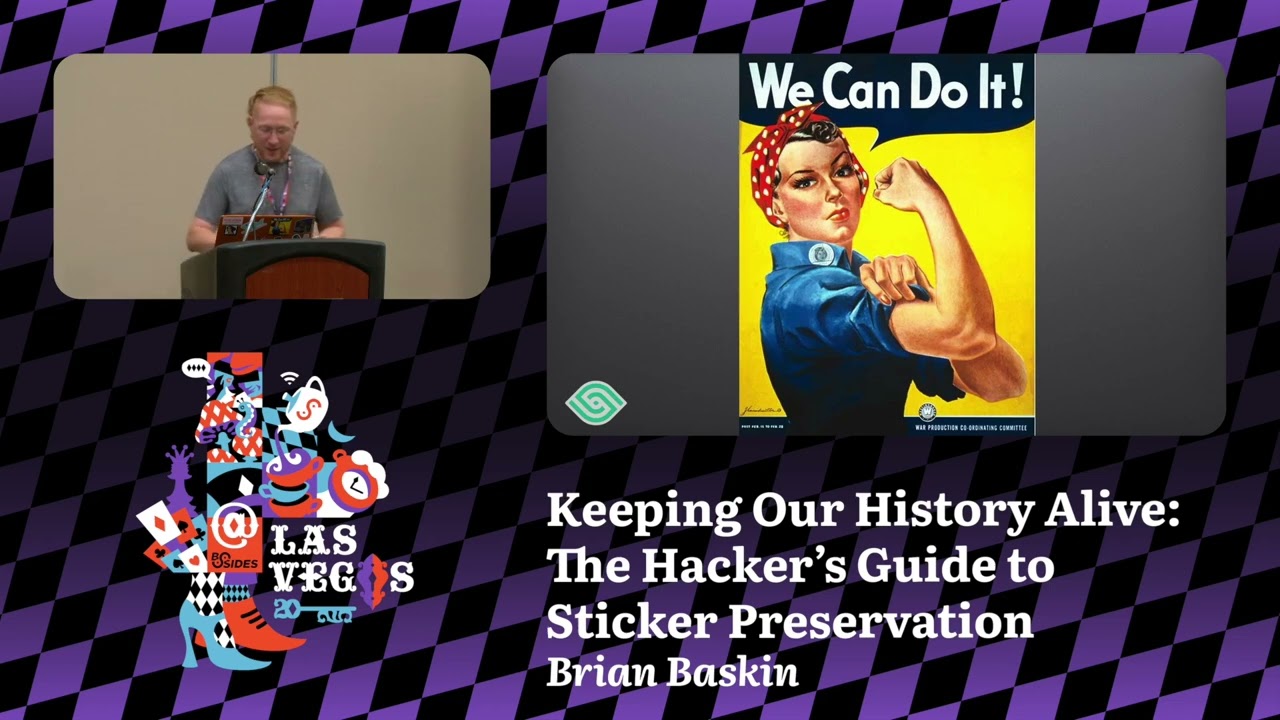
with that for each side. Rosie Riveter, everyone's familiar with her and the work we do, I'm sorry, the work she does and what she represent from World War II. We can do lots of spins on that of St. Ida during not only can we do it but we can re it reverse engineer more specifically Gedra the reversator we can re it on the GIRA side. So not only you know the the idea of a reverse engineering but the actual skill sets and tools used by these people uh who you can immediately relate with as well as you know from the IDA pro side right so everyone who's a reverse engineer either vulnerability research exploit development malware
analysis knows IDA pro and st IDA not IDA lovely by the way so Staint Ida in a very cool form as well as back in the day can you name very certain events that happened in a specific software. No undo, no surrender, dates back to 2019 when every competition to IDA had an undo feature they're coming out with. IDA did not. You made a mistake. You're stuck with that. You're screwed. Hopefully, you had a backup. Uh, which was great. People rallied around it. This was their, you know, rally call. This, we're sticking with IDA. And then they added undo. So, they had to change the sticker up the next year. So, we're going really fast on time. Uh, so
I'm going to move a little fast here. Done with the culture side. I really want to talk about the technical side now. And I apologize. I'm going to rush through some of this. Make sure we're not too far late over on time. The idea, we have these stickers now. We want to preserve these. We have these 20-year-old stickers. We want to make sure that we retain them, take off old equipment, reuse it as much as possible. To do that, let's think about the hamburger. This is our sticker, right? From the very top down. Your meat is your actual vinyl material. Your cheese is the printing on top of that vinyl. Your laminate on the top. And what we're
really focusing on is that secret sauce adhesive. That's going to be the structure to everything we have here. Now, it might seem simple. You take a sticker, you take a razor underneath it, or what's called a spudger, and you just pry it up, right? No. Because nine times out of 10, there's actually different layers on that sticker, and you're very much likely to catch the laminate layer and pull that off than you are actually catching the adhesive layer and pulling that off. Lots of testing I've done on this. If that happens, you know, laminate actually just makes things shiny. That's actually the point for that. Half of this on the left is actually the laminate removed. Half on
the right on is actually laminate. And actually, not much of a difference. So, worst case, as you're doing this work and you pull the laminate off, oh well, you lost some protection. But let's assume using plastic razors, not metal that scour your laptop lid, you are able to get under the pry, lift the edge, pull it off, you get something like this, where as you ran the razor underneath, you still separated out between adhesive. You left adhesive behind and adhesive with the sticker, the sheer force of pulling the sticker off pulled adhesive with it, but wherever you actually cut in, left adhesive behind. So, you stuck with this massive mess that you have to clean up.
Not only that, this is adhesive that did not carry over to the sticker. So when you try to reapply it, you now have massive gaps that you now have to somehow fill and reglue to make sure that they actually still work in the future. Cover that in a second. Beyond the physical side, let's talk about chemicals. Uh the actual methodology of what we can use to also pull these stickers off and clean up the adhesive. And this is where science comes into play. So acetone top right hand corner everyone's familiar with that uh isopropyl alcohol at top left hand corner bottom ones most people are not familiar with these are heptine based solutions called undo the one right is a
heptane based solvent the one left is a VOC compliant California compliant heptine and this is my test bed the result afterwards you see acetone on the top right hand corner did a great job just wiping all this adhesive out dissolves the adhesive and melts it away alcohol as well it dissolves it leaves very little traces behind fine bottom right hand corner and the bottom left hand corner. Very weird. Uh you'll see that the heptine actually lifts it off the material, bundles it together, does not dissolve it. It just groups it and clumps it into a gel that you can scrape off. One thing we'll call it here, California version sucks. Doesn't actually work. Takes a lot of work to
make that in place. As well as the damage they can do to the stickers themselves. Acetone destroys. Acetone does a lot of damage where heptine does not. Uh, and even on high quality vinyl, acetone will just even still just discolor the printing on it. So, let's add fire. This is the last section I want to talk about here. Uh, what is the methodology of let's heat stickers off. All right. So, last few slides here, I'll talk about the method here. Regular hair dryer 200 degrees actually doesn't do much. kind of lifts the effort off the side. Lifts the edges up. Good enough to maybe get underneath, but not really much than that. So, take out
a professional heat gun. And I got this up to 300 degrees, 6 in away, which about 150 degrees CC, which was great. However, that's now went a little bit too far. Start bubbling up the vinyl, causing some damage. Great. Let's go further. Let's just have fun with this. What can I do? Just go high speed, close up, how fast I can go. uh got the laptop up to 500 degrees Fahrenheit, 260 degrees Celsius. That is too far just by the way. So that was a little bit too much for this. And even though at that heat, it still left adhesive behind. It didn't actually help to burn the stuff off. So the fun side of that, however, is do you want to
apply heat to your laptop? Are you afraid of doing that? You should be afraid of doing that. Uh because it it will melt your screen. So, at 400 degrees Fahrenheit, it starts melting the screen and burning inside of it. However, cool it back down, you actually get a lot of that back. It's still permanently damaged, but it's still good. So, what about this last method? Steam. Great. Yes. However, very quickly, the method of actually using steam, unless it's very tightly controlled, will physically warp the vinyl as you're applying. Especially if you're using a steam gun, it will warp in different lines as it pulls it off. So, taking these off, reapplying it, readhering it. This is a very quick section of what can
we actually use to put this back onto the onto the uh the new material. 3M75. Excellent. Best thing ever. Impossible to find. No one uses it. You have to go to drug market to find this stuff. Super 77. What you can find in typical stores is a spray adhesive. This is the recommended solution for this. Or my true favorite is just a a double-sided adhesive transfer tape gun there, cut out, transfer to a new one. If it's so destroyed, you can't do anything else with it. You get a flatbed scanner. You literally take your your your stickers, scan them in, which is literally what I've done to most of my set. Works out well. You get a lot of
specs in it. And then you get a vinyl cutter to cut them out and make your own from there. Last two slides here. Uh the one thing I want to call out for going into future laptops is having a clam cell case makes it very easy to put stickers on, remove them off. You can apply heat to that. You can apply chemicals. Who cares? It's not your actual laptop. Or a silicone skin like Dbrand makes. Same idea. Apply stickers to that and use that for future work. Now I know that was a very quick uh presentation. I want to give my shout outs to people here. Too many to name. I do want to call out to one dark one hot
and creative for also doing all the creative work for besides Vegas. And come out to the info booth outside for the sticker swap as well as to the El DC sticker swap. And with that very fast, but thank you so much for having me. >> Thank you so much. Oh, I knew this. I am a ginger. So, yes, [laughter] for gingers. Yes, >> we had we had a request for minimized sunlight. So, >> yeah. Oh, it is. I need as minimal sunlight as I could. So, uh I have stickers up here if you guys would love to come grab some. Thank you to the BS size team for letting me come here and show off some of the fun and greatly
appreciate this. So, thank you.
Related talks
 25:40
25:40 51:33
51:33 51:54
51:54 5:33:20
 2:11:51
 7:38:49