Kenneth Peeples - Zero Trust Architecture in Service Mesh
Show transcript [en]
is a red hat principle architect thank you [Applause] all right we'll go ahead and make sure this works go ahead and get started if I can get this going right there we go uh so I'm going to give you a short link where you can download the PDF you can see everything on the slides and and one of the reasons I want to share that short link there will be some graphics that come up and I'm going to ask a question at the end of what is zero trust and you can rent when a hacking kubernetes threat analysis book so if you're familiar with container platforms familiar with kubernetes this is a hacking kubernetes book
and so when I get to that link you can pull it up on your phone or laptop and when I ask the question you should have the answer and I the other prizes are the network switch right Wi-Fi adapter and lock pick so this was the abstract that was put up and so I wanted to make sure it was in the PDF because there's a couple of read ahead links and I'll be walking around some just for a minute and then I'll have to sit I had knee surgery so um I don't have meds now because it's been about four weeks so I may be walking around and sitting so excuse me if if I'm around too much but the agenda today
I'll talk about the topics we'll go into zero trust service mesh I'm going to talk about red hat openshift and service mesh but keep in mind the service mesh and based on istio and kubernetes those are vendor agnostic so everything that I go over you should be able to install on your own and try service mesh and try some of the references that I'll give you for the workshop and I'll show you how to do that so hopefully you're able to use that Public Presentation link I have there and pull it up and uh when you see me get to the disa reference architecture diagram that's the one that you want to pay close attention to when I ask the
question for the book giveaway so um I'll have to get used to to looking down there instead of looking up at the screen or my laptop so I am a principal architect for Red Hat I've been with them I actually left and went back total of 10 years and I focus on Department of Defense projects but security related initiatives I spend a couple of days a week doing internal Red Hat initiatives and billable to the Department of Defense and I went to University of South Carolina and University of Phoenix for bachelor's and Master's in computer science and working on my Doctorate of engineering now at Colorado State University so the online programs that a lot of the universities are getting
a lot better and helpful for those that are still work and one of the things that I would like to say if anybody in here is still in the service or planning on going into the service I wanted to thank you for uh your service and any of the dod agencies I spend uh have spent a good bit of time on different DOD agencies but Army and at Fort Gordon I've spent a good bit of time lately so what we're going to cover today uh the first topic will be zero trust and we could spend a lot of time on each of these topics but we will hit some Concepts on zero trust then we'll hit
some Concepts on service mesh and some examples of service mesh and then we will talk about specific implementation example around Red Hat open shift and red hat service mesh so what is zero trust uh there are a couple of things I want to uh note on what is zero trust and that is it is a security framework when you talk to folks who say they have a solution for zero trust or a product the solution you can get toward the zero trust framework but getting a specific product that covers everything in the framework that is more difficult and we'll go through some of that but the main Concepts around zero trust are getting away from Castle and moat and
making the perimeter more important than assuming there's a breach or a possible issue internally so when we go through some of the other references we always want to make sure from end to end that there's encryption that you have multi-factor authentication that you're looking at least privilege and that's all the way through Network and up the stack now we can't look at Perimeter and say that um we have a firewall or we have disconnected Ops we have to assume that there is a breach inside the network at all times and we also need to be able to analyze within anything going on on the network so now we want to make sure that with no
traditional Network Edge and we're going into more iot there are more Edge devices that we're looking at dads which is the data assets applications and services
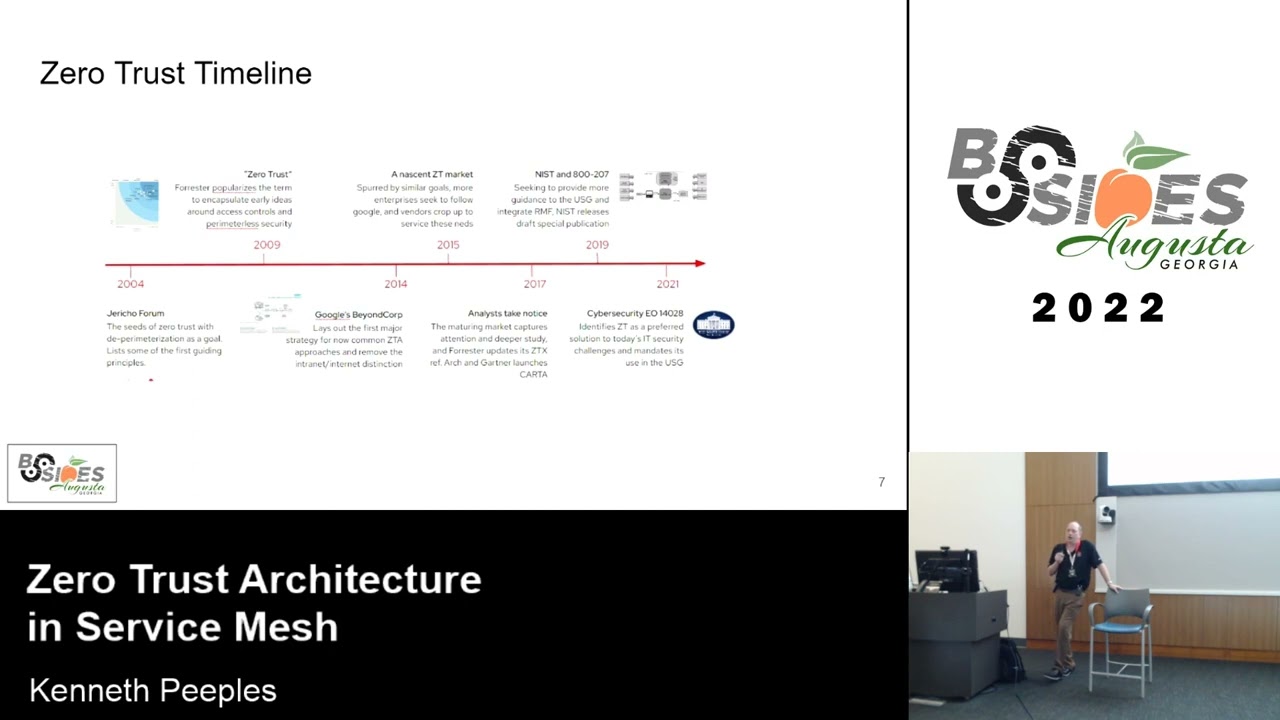
so a couple of things on the timeline for zero zero trust is not new uh people have been talking about uh the parameters perimeterization removing castle and moat concentrating on encryption and identity for a long time and you'll notice this timeline talks about in 2004 when there was a Jericho forum that talked about the parameterization and then went on to Forester which is an industry analyst talking more about their thoughts on um zero trust and then going into Gartner with their Carta and Google with a Beyond core and Foresters was ztx so you have all these different concepts previously from different industry analysts and organizations but why is it important today if we go over to
2019 into 2021 2022 there's the nist special publication that defines core components of zero trust deployment models and then the executive order from President Biden came out that there are certain things that you you have to do certain actions that the agencies have to adhere to and I think in that executive order it mentions zero trust like 14 times something of that nature but the key is the modernization and moving to the cloud and then the 2022 memorandum from OMB is not on this timeline that was uh earlier this year but it talks about specific actions that are required within the different pillars by the end of 2024 so what this talk focuses on a service mesh and
some zero trust aspects but there are specific mandates for DOD agencies and across the government to complete certain tasks within certain time frames so I'm not going to read all these but I did want to include it in the PDF so you can reference them it's the executive order that I mentioned from President Biden I put the OMB memorandum in there because in the appendix it lists all the uh actions that are required with the different pillars and specific time frames and you can find different documentation from nist NSA sysa so forth and get more of an understanding of the different aspects from what you need to to build in your Enterprise for zero trust I went ahead
and put some links to some of the global agencies because it's not just the US that has said oh now I need to make sure everything internally is just a secure coming into my network now I have to make sure I am assuming that there is a breach internally that I always uh verify and I never trust so now it's more about granularity and making sure that you're validating on every transaction especially in microservices which is what we're talking about with service mesh so some of the core components and principles that are in the niss special publication and this diagrams so you'll see this throughout the talk and the different diagrams where we have the control plane that manages
configuration and for the proxies and then you'll notice the policy enforcement points which are the proxies for the the microservices that we're going to talk about but the important thing to to note on this diagram is I'm splitting Network traffic on the uh to the policy enforcement point that is what is going to enable access to the Enterprise resources so as this says the important thing is the all the data sources and all communication is secured on the network and everything is considered a um a resource and then when we look at the core components we also we have the enforcement Point you're going to see in service mesh you're going to see the decision point and
those should be thought about in everything not just service mesh where am I enforcing policies and where am I building the policies and making them available to make a decision for the enforcement point so if you'll notice this this is what I was mentioning a minute ago that this is zero trust reference architecture so if if you can take a note of this diagram that's what we're going to talk about on the book giveaway in a minute but you'll notice that there are seven main pillars five of which are the user device Network application and data but you'll notice over on the right hand side there are different color for Automation and visibility some of these go across a
couple of pillars and some go across all and the key here is looking at this diagram it is a security model right and it is holistic security it's not I take authentication for a user and I'm done it is a maturity model that you have to think about for customers to go from a basic to Advanced or basic to an optimal maturity a model on capabilities that are deployed so one of the things that I like with this graphic at home with the systems the multi-factor authentication while my son asked me something said well we need to do the multi-factor go ask your mom too and my wife just looks at me like I'm a
nerd so I like that picture a lot so as I talked about there's a zero trust maturity model that sisa put out and this helps identify the traditional down to the optimal so not just service mesh that we're going to be talking about here in a minute but the different pillars and what you should look for in traditional Advanced optimal I I look at this like devsecops and your pipelines that you're building you're never going to be finished if somebody says I'm done I put a product in for zero trust it's not accurate because it's a complex solution with many capabilities that have to be installed and one of the things that you note here
would transition to zero trust is identifying the actors the assets looking at policies and you'll notice identify candidate Solutions so what technology isn't products should I be using so that I can get to deployment and monitoring which is the very last thing and this is just another view another input on a maturity model that's in the just a reference architecture the other one was oops this one's sisa this one has traditional Advanced optimal this one in the disa reference architecture has Baseline intermediate Advanced but you'll notice they're similar and what they're looking for but what I like in this one is the discussion on Discovery and assessment so if I were to go into a project for
DOD I would want to ask these questions and ask you know how can I apply all those Concepts on the project and look at a higher level program what is the program doing for zero trust and with this these are red hat products when you look at open shift you look at Advanced cluster security IDM staff and so forth I like to be vendor agnostic even though I work for Red Hat I like to talk about open source Technologies so the key is not a red hat product although I know everyone in here loves red hat and wants Red Hat products the key is looking at the capabilities and how am I fulfilling that need or requirement
so I don't want to go too deep into this but there are the old layer three rules that a lot of folks use and some of the firewall companies are putting out next generation and this is an example of a Kipling method that Palo Alto uses and you'll notice it goes not just Source destination Port protocol but it goes from who what when so forth across and the middle one is around the Enterprise guide which is a book but it goes into the subject the target the action the condition and then on the right it goes into the zachmore standard which is fine grained authorization so the key here that I wanted to show is that
um we want the fine-grained authorization we want to know more uh than just a couple of specifics about who's accessing a resource we want to get down into the granularity all right so we're going to go ahead and give away the book so please just trace your hand who can give me the capabilities how many and the exact ones that are in the data pillar up somebody has their end up back there
okay so look at this closely this is not the pillars but the capabilities in the data pillar
there's so who sees something else
so does anyone see that some go across pillars go ahead correct I hate to ask you but I can't walk that out there so everybody had good answers but machine learning is part of the data as well and that's where I was trying to go that's why I put spans two or less pillars to give a hint there that there's actually the machine learning that's included as well so good but I'm glad everybody was able to pull that up so let's start going into service mesh so um this concept or service mesh and within openshift the off service mesh operator is based on istio and that's one of the more popular um service meshes and we'll see additional
examples the VMware AWS so forth not just red hat but just as we talked about with the nist special publication there's a control plane there's a data plane East-West traffic right and we have a sidecar that protects each micro service so why do we want to do that we want to control Network traffic and control the health we want to separate that from within the any additional logic within the microservice we also want to be able to observe and Trace so that's a lot of the benefits of the service mesh so these two examples the one on the left is AWS and you'll notice that they have the concept of envoy as well there are multiple components that work
within a service mesh for that Network control and the segmentation away from the microservice itself and then the right is tanzu so all these are around the kubernetes container platform okay so when we look at the service mesh data plane we're looking at as I mentioned the sidecar controlling the the networking and isolating those to the sidecar instead of being controlled by some other method and so what does that give us one of the things that the OMB memorandum indicated has to be done before physical year 2024 as end-to-end encryption so mtls multi-factor Authentication what the service mesh helps with is some of that security with mtls and service to service with certificates so I know what service say
and service B are and that they are authorized and can authenticate between Services also the observability circuit breaking load balance Etc so the data plane focuses on the network portion then when we look at the control plane as I mentioned this doesn't look at the data packets but this does make sure that policies and configurations are updated in the proxies as needed on the data plane all right so as I mentioned istio is one of the popular service meshes and we have our service A and B with our sidecar or our proxy and we have the control plane with istio and it has some components that control Discovery certificate management and so forth so that has been accepted even though it
started a while back I can't remember the exact year but it was a started a while back and the cloud native Foundation recently in the cloud native Foundation even though it's been around a little bit uh what I wanted to show on the right hand side and we won't dive deeply into this because a lot of folks are still focused on sidecar or proxy but when you look on the right hand side there's something called ambient mesh an ambient mesh just came out recently and istio there was at least one guy that used to work at red hat that went to solo.io and within that ambient mesh they are trying to give the ability instead of
using a sidecar to have a z tunnel so it's a mixture of being able to use layer seven and and layer four within this model and so I have the links there that you can look at in the future so as we talked about with service mesh I have advantages and disadvantages I feel like there should be music or something because it's so quiet in here um so with some of the advantages and disadvantages we talked about the security observability that's a big one the um reliability is another and product productivity and efficiency and I don't know if everybody remembers the pizza as a service diagram that went all over LinkedIn and so forth but now with
service mesh Cloud native or service serviceless on that far right hand diagram you'll see service mesh in there and I need to change that pizza as a service to show that um and I don't remember who originally did that but a disadvantage is some of the possible delayed communication now we have the proxies in front of the microservices that are intercepting and deciding what should go to the microservices so depending on Hardware depending on configuration that can be a delayed communication so again this is the this is a different link but it's ambient security and what they're trying to do they're not trying to completely get rid of sidecars but they're trying to build this ambient
service mesh in istio so we have the pp with layer 7 and the security secure overlay and to me when I look at this the biggest thing or two big things in here one is the separation of the application from the data plane which we talked about the proxy and application being in a data plane but also avoiding the multi-tenancy that may happen with your proxies so it's a good read to see what's going on in the future and I don't know when that will get into the service mesh operator for openshift or the other vendors so just to I like this image too with our service person protecting us the zero trust model but the three things to
note here as I was talking about a minute ago was the certificate management between services and the mtls so those three really apply to authentication authorization of services communication between them and the mutual TLS so that's the two-way encryption
so I threw this out here just to uh everyone I assume knows IBM bought red hat and red hat is still continuing its open source and open shift is one of their big products that we work on different Cloud providers and different verticals but what I wanted to note here when we get into openshift and service mesh the service mesh we're talking about istio traffic control kiali which is some of the traffic visualization and Jaeger which is that tracing and I'm going to show that just briefly and give you links that you can try this in your own environment but some of the use cases are listed here that you can go back and look at
but the Z zero trust aspects you can see that in the different use cases for service mesh and I know this is going to hopefully this won't confuse everybody give me just a second so when we go back to uh technology focus and how we can do segmentation and other things you can see that service mesh can fall into this capab different capabilities but it wouldn't solve everything that you need to solve for service mesh I mean zero trust all right so where was I so you'll notice looking at this diagram and looking at um how we've overlaid the ZTA core components that are in the reference architecture from disa I'm sorry from nist the nist special
publication as core components this has our data plane with the proxy and we have our control plane that has istio and it has the different components of istio for Discovery configuration and certificate management and of course we consider the proxy as the enforcement point we consider the control plane and istio Demon as the decision point and you can refer back to uh some of what I was talking about with the right hand side there for some of the bullet points so I wanted to throw this in as well and talk about API gateways so I make the assumption that if you've worked in microservices you've started working in API gateways as well so North South traffic coming in through an API
Gateway Red Hat has three scale which is one of their products and when we look at service mesh we're going to see an sdo Ingress Gateway for monitoring security policies so forth but in the demo links that I'm going to give you and show you just briefly the three scale so API Gateway and service mesh can work together on North southbound traffic and then our service mesh really does a lot with the East-West traffic right between services and the proxies and the traffic and routing and so forth so as you see on the left hand side it's traffic into open shift within services and then egress or external which is on this diagram as well
so I wanted to show in this diagram on the left hand side if we didn't have service mesh and I wanted to control routing I wanted to control certificates I wanted to control what's going into my microservices like a front end and back-end what would I have to do I would have to do a lot of hard coding to make sure what's going on if I was going to adhere to zero trust on the right hand side you can see with service mesh now I'm protecting my microservices and I can do a little more with network policies certificate management so forth segmentation and the router the traffic goes into the control plane and then goes through the
proxies so I'm gonna hop over to the commute computer here in just a second and do a brief demo just to show you where you can grab some links to do a deployment on your own and have a similar environment um and but just talk about a couple of these slides real quick if you go to cloud.redhat.com one of the things that I've liked recently that they've made available I can do it in assisted installer for a single node openshift if I have enough resources in a VM or a single piece of Hardware I can go there and give it some specific settings configuration it will build a ISO you put that on a USB
drive stick it into your hardware and it'll create a single node openshift which is the Enterprise kubernetes so I can have a complainer container platform built pretty easily just by going to cloud.redhat.com and then on the bottom right that should be showing the cluster that I created at home and what I'm working on now is the demo I'm going to show you is in something called demo.redat.com so it's a cloud demo system that you can show Red Hat products and it has different demos but you have to have certain access to it so on this hybrid Cloud patterns if you're interested in different architecture like software supply chain so one of the other zero trust Concepts
that have come out as secure supply chain the software bill of materials and so with this hybrid Cloud patterns I'm trying to get a zero trust pattern in there as well to have advanced cluster security to have service mesh to have some sample applications so you can easily go in and uh deploy not just openshift this assumes that your cluster's already there but it can install specific operators like service mesh and do some setup with some applications so I can just go look at the concepts and do some testing on my own use the book that we gave away and try and hack kubernetes or openshift so that's currently in progress but why is available that I think is a good
reference the demo itself on demo.redhat.com you have to have certain access but these three links there's a demo walkthrough the install from scratch allows you to install the different components and in this case it's single sign-on service mesh and three scale and there's an e-book that goes into deep depth on the service mesh versus API management or how they complement each other so those are three really good references and you'll notice on the top left that diagram talks about service mesh but in that demo it goes into API management single sign up more so that's just the initial diagram and then on the right that's chiali for some visualization and I'll show you some of
that here in just a second so let me walk or hobble over to my computer and when we look at this walkthrough
so it shows the different components or demo assets
and we're going to go into the instance I created So within openshift you can see different routes and this is a Cali route that I mentioned a minute ago
um going in there if we go back to here and go to the one above the second link if you have a kubernetes instance you can really go into the install from scratch although it describes deploying to openshift you could install these istio and these other pieces key cloak so forth on kubernetes but in this case since we love red hat we're going to go in here and look real quick uh let's see
and I know everybody and the video is seeing this but this cluster is going to go away anyway so that's okay so don't do that at home that's not very secure I don't show everybody on YouTube your password and so forth um but what I wanted to show in here is going into our book info and going into our graph and it's probably because I'm just going to go ahead and select a lot of these
things oh that looks pretty not foreign so this should be that other diagram within that slide but you can see the services the Ingress and so forth so you can go back and and look at that further but what is nice um is I can go in here and I can run a curl I can hit my API if I do this a whole bunch of times and all of this is within and all of this is within this document to like walk through it so if you wanted to look at your you know what's going on yourself and you went through the install from scratch you could run through this demo and see how your
service meshes is behaving but the key here is if I go into distributed tracing and I go into trace this I should be able to drill down into well what's going on when I hit my uh product page when I hit my micro services so again if we and this is using uh Rec then I don't know if anybody's used that there's some other tools out there too
so in closing and uh I know what what we start at 3 45 so about 45 minutes so uh in closing and then we'll do the gifts if that's okay and closing there are just a couple of things that whoops
camo they're just a couple of things that I wanted to close with and that is we talked about no more castle and moat the Assumption of once you get inside a network you're safe and the bad actor if he's kept out you're good you have to assume there's a breach inside your network at all times so there is no more perimeter doesn't mean you won't have a firewall doesn't mean you won't have some of the things that you already have but you won't depend on that you'll make sure that all the security capabilities are there and it goes into end and it goes up the full stack and so multi-factor authentication and encryption like I said that's a part of
what agencies have to make sure of by 2024 is done and service mesh helps with encryption helps authentication authorization between Services of course here for multi of factor authentication for users there's different Technologies for it one of those is the red hat single sign-on plus others and then the other two things to note is when you look at all of this information on zero trust there's a big emphasis on us assess and design and reviewing what you have and the use cases so that you can make sure all those capabilities and all those pillars that you're making your security posture better you're going through the maturity model that we described so I'm going to go ahead and stop they are in this
presentation um there are some references and I tried to make sure all the links were in there and they were valid so you can always email me if we go back to
oops if we go back to here if you scan that that's my LinkedIn profile and please connect with me on LinkedIn I'll be able to be glad to answer any questions that you have and if I don't know the answer I'll get somebody involved that that you know has the answer for you and I know we're getting late in the day and there's still football games going on so thanks for everybody for staying with me hopefully a lot all of it made sense so let's go down here for we want to do our giveaway so um go ahead and we'll open up the floor ask me any questions if I don't know the answer I will be glad to
to find out if it's really deep then they have to get back to you on it yes yes yeah so are the the mics working is there is there one over there you can turn on if not so it just to make sure so the question was can I automate deployment
yes so I I will go back and update the presentation there's a good Workshop that one of the essays did um with service mesh and what I was trying to do on the hybrid Cloud that has some ansible in it and some of it she's seeing kicks off with make install so I need to change that to all ansible but that's a very good question with ansible because when we look at those zero trust pillars and capabilities automation spans the whole of the pillars it's a very good question so not only deployment but you have your infrastructures code your compliances code everything is code and ansible as a good way to have your Automation and plus it's a red hat product so I
love even if it was so even if it wasn't red hat I love ansible but Chef puppet salt the others those are good automation products too yes yes you had to have them that didn't work
so um so your question was my experiences with service mesh and when you ask hybrid do you are you referring to hybrid cloud or use okay so that's one of the big things red hat is so I give a company explanation I know you might want to turn a recording off no I'm just kidding so uh there's uh what red hat is doing and my opinion and they do a line up well is red hat is pushing on a lot of their sales plays Going Back to Basics like Linux Rel automation which was asked about a minute ago and there and then their third one container platform I think was the third so it's like those fall into different
sales plays and so uh they are starting to do more zero trust within those and they're focusing not just private which can be openstack open shift bare metal or open shift whatever I'm private but they're also doing the hybrid model because um at times it's difficult with the disconnected environment of the government right well I have to get everything on something and get it internal because I don't have comms for the internet um so at times it's difficult although we have AWS and different classifications but generally the hybrid Cloud Model works well with certain data and certain things going on AWS or Azure or Google cloud or one of the cloud providers and a red hat has
some managed cloud services too but then with your private Cloud that definitely opens it up to having more control over security and what's coming into your network as far as service mesh itself goes I started with zero trust last year looking a little bit closer at it and talking to different customers like NASA and FAA and some others and everybody had what can I use what is the product I can use to implement zero trust and that's why I would say service mesh I like it a lot to abstract some plus one of the things I might have forgotten to say is you want your proxy and your sidecar where the application is not dependent on having it there I should be
able to change the setting on my side car gets deployed um but with um service mesh it fulfills some of those zero trust capabilities so when customers or talks take place around zero trust oh I can use service mesh then to solve a majority of the problems no like I said service mesh is a good Pro as a good technology not just istio but there's others right there's uh Linker and some others but it fulfills certain capabilities there like we talked about especially in TLS between services and that authentication authorization well we talked about it a minute ago ansible fulfills another part Advanced cluster security which is based on stack rocks and there's a just a Stig hopefully that
will come out soon on openshift hardening for the platform and the node but there's the compliance effort too so I like service mesh a lot especially when they talk about the ambient mesh that's not into open shift service mess yet so I I know I'm kind of going long-winded here but I like hybrid Cloud talk about use cases and which is part of that is better how to split those up and maybe it is just private Cloud that's needed but it's all use case based and that maturity model like we talked about so did we have another price
all right well feel free to say are there any other questions feel free to send me anything on LinkedIn if I can answer I will if not I'll find the answer and thanks for everybody staying late till or 440 right I enjoy you know grilling out football games whatever you're doing this evening
Related talks
 51:37
51:37 30:27
30:27 55:35
55:35 51:32
51:32 41:33
41:33 51:33
51:33