Rick & Morty Walk Across Mordor: A History of The World in 10 1/2 Chapters
Show transcript [en]
Let's see if this works. Hang on. I can't see the speaker notes. Just a second. How did I do this before you? Let me try this. Is Apple going to be a pain? Hang on. Sorry. How do I do this? Presenter notes. Okay. >> Good to go. I'm good to go. >> Thank you, Trey. Go ahead.
Yesterday, Pedro and I showed you what happens when time runs out layer by layer across the entire stack. Today, I'd like to show you why we keep running out of time in the first place. The problem isn't better code. It's not more compliance. It's not the protocols. It's not even the clocks. The issue is this. You can't buy coherence. You can't purchase coordination. You can't throw money at trust and expect it to appear. You build those things over time or you don't have them when 2038 arrives. See, our agency lies in understanding a pattern that's been playing out for thousands of years. From Iben Caldon's Damascus to Hitler's Eastern Front to the server room where I took down a
network at age 14. Every empire, every network, every system eventually grows until complexity itself becomes the enemy. Hang on. Why isn't it going forward? Excuse me. But there's a pattern. And once you see it, you can't unsee it. Here, Morty, let me show you. We live and die by and for metaphor. Everyone knows Godwin's law. The longer an online discussion goes on, the closer someone gets to Hitler. We laugh at this like it's a meme. But what Godwin really discovered wasn't about Hitler at all. It was about entropy, about what happens when coherence runs out. The second law of thermodynamics says that every closed system tends toward disorder and our conversations are no different. Without
new energy input in the form of moderation, shared community norms and trust, every discussion decays into noise. Eventually, all nuance collapses into inescapable gravity wells of outrage and certainty repeats. But once you see it coming, you can still do something about it. In machine learning, overfitting happens when a model learns the data too well, compresses noise into phantom signal, the fit becomes perfect and utterly useless. We humans do this too. When complexity spikes, our brains start drawing faces in the static. Pattern recognition mutates into superstition, conspiracy ideology. This isn't madness. It's math. The discipline is learning to travel light, holding our frameworks loosely enough to revise them when reality pushes back. But sometimes the noise does hide a
deeper symmetry. The line between madness and insight is only visible sometimes in hindsight. So, let's go back to the 1970s. Mathematician John McCay spots something impossible. The monster group, the largest symmetry ever found in mathematics, seemed to echo modular functions, the equations that describe vibrating strings in higher dimensions. Two completely different worlds. No reason why these areas should interact. But then John sees this one number 1 196884, but that's 1 19683 + 1. and he refuses to dismiss this as a coincidence. Everyone thought he'd overfit faces in the static. Decades later, the pattern still holds. The monster's hidden symmetries match the equations describing strings vibrating in dimensions we can't see. The biggest discrete structure in
mathematics, 8 * 10^ the 53rd, bigger than all the atoms in Jupiter, somehow fits inside a single vibrating string. Monstrous moonshine taught us that the universe is stranger than we know. And what looks like noise may be signal viewed from the wrong angle. Not every overfit is madness. Sometimes it's revelation. Sometimes the universe rewards those who see patterns others dismiss. The trick is staying humble, knowing you might be wrong while refusing to stop looking. Or as Rick would say, that's why we keep the portal gun charged. Mathematics shows a symmetry across universes. Militaries show a symmetry across humans. Offro's tactic is a concept born in the Prussian army. It's the art of leading by intent, not
orders. See, in complex systems, you can't transmit commands fast enough to keep up with reality. But you can transmit doctrine, intent, and trust. That's how you turn entropy into emergence. Now, here's the twist. Hitler inherited a vermock which was trained on offdrog tactic. Small autonomous units making fast decisions within shared intent. That trust made the blitz creek terrifyingly effective. But Hitler misunderstood the cause of his success. He thought it came from his genius and not the system he'd inherited. So as the tides turned, he micromanaged more, entering what we might call an uda doom loop. The tighter he gripped control, the slower and more brittle the system became. His overreach strangled that very agility that had won him
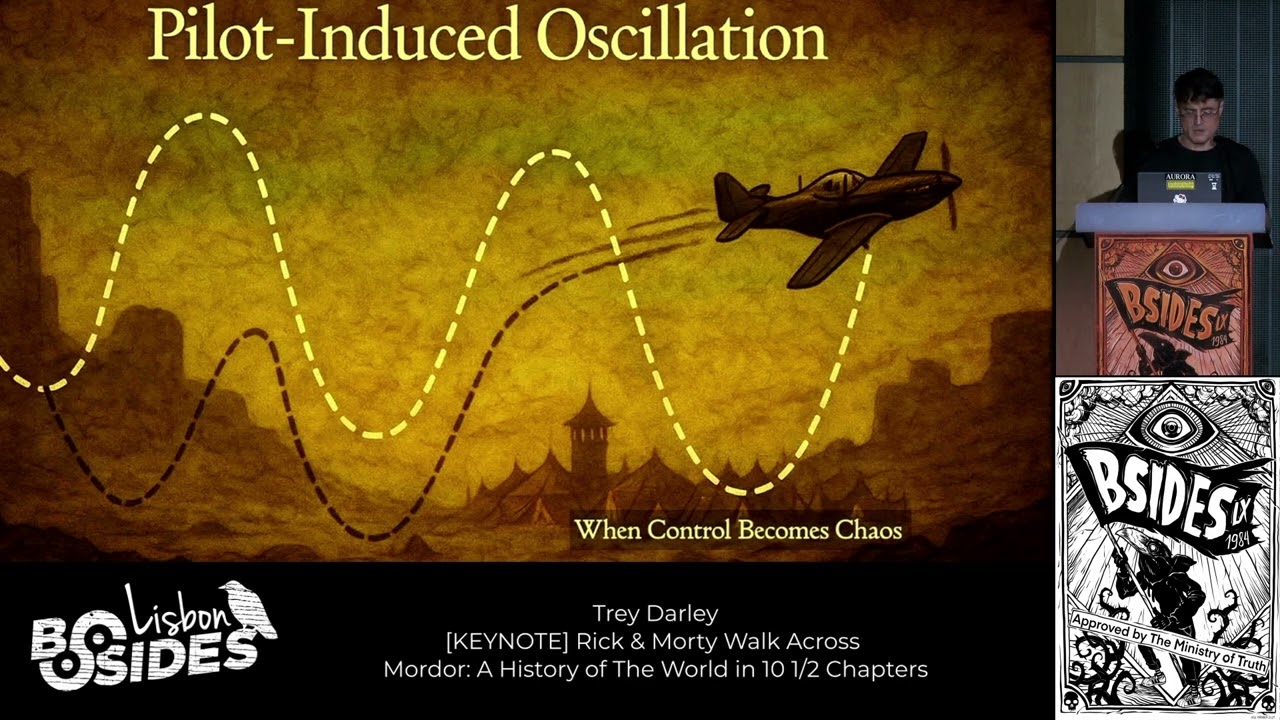
Europe. Ironically, had he kept trusting his field commanders, Germany might have won the war. Luckily for for us, Hitler was not a trusting man. Distributed systems fail when leaders mistake control for coherence. Trust, shared purpose, and local autonomy aren't soft skills. their structural requirements for resilience. Have you ever seen a pilot crash an otherwise perfectly good plane? This is called pilot induced oscillation. Here's the pattern. The plane drifts slightly off course. The pilot corrects, but the system lags. The correction hasn't taken effect yet. And so the pilot corrects again. Then both corrections stack and the plane swings the other direction. He overcorrects. He counterreors and the oscillation grows until crash. More control, less stability. The
tighter the grip, the faster the spiral. That's Hitler's uda doom loop. That's every project death spiral you've ever witnessed. It happens when you don't trust the people closest to the problem to fix it. Offrug tactic prevents this. By distributing trust, you remove the lag. Pilot induced oscillation effects always appear when we try to control complex systems. The question is can we design our systems to resist this effect? Yes. But first you need to understand why groups fragment as they grow. It's not about control only. It's also about shared meaning.
See every group has an Overton window. Two questions define it. What are we about? This is core identity. What are acceptable ways of being us? Behavioral boundaries. Think about high school. Some group of theater kids who say we're about performance and creativity. Drama is cool. Shakespeare is the greatest of all time. You got a group of jocks over here who say we're about sports and competition. We love rugby. Shakespeare sucks. The boundaries move between these groups. And that's fine when the overall group is small. If you have 10 theater kids, everyone knows everyone and they can talk directly. The window stays coherent. But scale changes things. When you have 200 theater kids across three schools, they can't all talk directly.
Messages get distorted and shared when windows fragment. School A thinks we're about immersive theater. School B thinks we're about the activism. Eventually, they stop recognizing each other as the same group. It's not because people are bad. It's because of basic human cognitive limits combined with the fact that communication latency grows as the group size increases. Distance becomes delay, delay becomes drift, drift becomes fragmentation. This is why empires fall, why acquired companies lose their culture, and why religions split. When the shared Overton window fragments, group cohesion frag collapses. And if you think that sounds abstract, remember this plays out every Friday family movie night. Whenever a group of hungry primates tries to decide what type of pizza to order, this is just
dinner. Whenever they must first decide how to decide what pizza to order, this becomes politics. Politics isn't disagreement about the pizza. It's disagreement about the process. how we decide.
Eden Calden was a 14th century North African historian who discovered the thermodynamics of civilization 600 years before thermodynamics was formalized properly. He noticed a pattern. Civilizations rise and fall according to their acabia. This comes from the Arabic root meaning to bind. That's the force that holds our societies together. This is social cohesion as physics. When group cohesion breaks, entropy takes over. Here's a cycle he saw. Hard tribes emerge from the desert with strong cohesion and shared bonds of hardship. They conquer soft fat cities. They settle. They grow rich. They grow complex. Their bonds fragment. Their acabia falls below critical mass. The new tribes, still hard, still bonded, sweep in from the desert to replace them. Iben Caldon
called this the cycle of civilizations. Today we might call it entropy. And in 1401 AD, he found himself living inside his own theory. Damascus was under siege. The Sultan had fled and Iben Calden had to make a choice. The year is 1401. Damascus, Syria. The city is under siege by Timmer or Tamarlain, one of history's most ruthless conquerors. A man who built pyramids from the skulls of his enemies. The Mamluk Sultan has fled. Damascus city's leadership has abandoned ship. An Iben Cauldron, 69 years old, a scholar, not a soldier, is trapped inside the city walls. So what does he do? He has himself lowered over the city walls in a basket, 69 years old, in a
wicker basket, down the stone walls of a besieged city into the camp of a man known for showing no mercy. Why? Because Iben Caldun understood something no one else did. He understood the pattern. He spent 35 days 35 days in Timmer's camp teaching and he explained to the conqueror using his own theory of acabia exactly why Timmer was winning. Your people possess strong Oabia. Ours has decayed through luxury and comfort. You will conquer us because cohesion defeats fragmentation. Because lean, hungry tribes defeat fat cities. because the thermodynamics of civilization favors you. Timmer understood. He spared Iban Caldon's life, gave him safe passage so he could finish writing his book. Damascus fell, but Iban Caldton survived. His book survived not
because of luck, not because of mercy, but because he understood the pattern and had the courage to explain it to the one man who embodied it. that basket, that wall, that choice. He bet his life that understanding Trump's power. And he was right. 600 years later, we have a formula for what he saw. Here, let me show you what you can do when Iben Caldin's pattern is rendered in the language of mathematics.
Here's Nomad's razor. The simplest system is usually the most resilient. See, in complex interdependent systems, advantage flows to those who can operate with less need for internal coordination. Mathematically, this is expressed as R equals CXM over S. R stands for resilience, the ability to survive and adapt. C is coherence, shared intent, trust, communication, bandwidth. M is mobility, how fast you can decide, how fast you can move. S is surplus. Complexity, territory, dependencies, everything you must maintain. When surplus grows faster than coherence or mobility, resilience collapses. That's why rejecting non-loadbearing complexity isn't minimalism. It's survival. You want to maximize your coherence in your mobility while minimizing non-loadbearing surplus. History keeps proving this equation. Nomads operate with high
resilience. Their coherence is high from shared hardship and tribal bonds. Their mobility is high. They're on horseback. They're mobile. They're fast. They're adaptive. And their surplus is low. They have little to defend, little to lose, and few dependencies. And hence, their resilience is high. They move. They thrive. Empires invert this equation. Coherence falls with growth as identity fragments. Mobility slows as bureaucracy replaces agility. And surplus explodes in the form of borders, colonies, and trade. Hence, resilience trends toward zero. This is why Timmer conquered from Mongolia to the Mediterranean and why Ben Calden knew he would. Iban Calden spent his entire life studying how civilizations rise and fall, how cohesion decays into entropy. In 1401, as the city walls of Damascus
were failing, he realized, "If I die, this idea dies. And this idea is too important to die. this idea could save future humanity as a species. And so Iban Calden, 69 years old, bravely climbed into that wicker basket and had himself lowered over the city walls of Damascus, not to save himself, but to save the theory of civilization itself. He was describing Nomad's razor 600 years before the mathematical language he needed existed. His gambit worked. His idea survived. And now I'm here with you today doing what he did because Timmer is coming again in 2038. And this time we have the language to understand it. So I'm entrusting this to you. You all be stewards and carry this idea
forward. Build systems that expect entropy. Design for resilience and not per for perfection. This is Nomad's razor. So Iban Calden figured out civilizational thermodynamics before we even had steam engines. Now you see it today. Damascus still felt knowing this pattern doesn't change the outcome by itself. It does inform how you react though. You can build systems that anticipate entropy that distribute trust before complexity kills you. Epin saw this pattern in civilizations. We're about to see it in networks, protocols, and time itself. Same math, different substrates. Here, let me show you how I learned this the hard way. A server room. Age 14. Imagine me in a neck tie. You're standing in a server room. Fluorescent lights humming. Fans
worrying like a hive of mildly annoyed bees. You see one innocent checkbox. Disable spanning tree. Looks harmless. Maybe it's slowing things down. You can always turn it back on later. Right. wrong. The network becomes self-aware and decides to eat itself. Switches melt down in a broadcast storm. Your console freezes. You can hear the packets colliding in the air, whispering, "You did this to yourself." That's what it feels like to disable spanning tree on a live network. It's the IT equivalent of dividing by zero in production. That invisible layer of trust holding everything together is just gone. This actually happened to me. I was 14, a junior CIS admin. 33 years ago, a standard metric Jesus of doing
it, fixing other people's broken computers. I learned the hard way that distributed systems require coordination or they devour themselves. Now, imagine that at planetary scale. That's 2038. That's what systemic risk feels like from the inside. So, what is spanning tree anyway? It's a protocol that prunes loops within a network so that only one active path exists between the nodes. If you kill it, the frames circle forever. Bandwidth becomes entropy and the network collapses. Spanning tree is also for networks. The invisible trust fabric that prevents entropy from eating everything. Now scale that trust fabric to markets to routing protocols to time itself. What happens when our invisible coordination layer fails? We're all about to find out.
So long as there remains a willingness to contemplate what is happening, there is no inevitability. Alfred Whitehead. Markets are networks of belief. Writing on a coordination back plane. Meetaf's law says that the value of a network grows with the square of the number of connections into the second. Each new node compounds the total potential value. That's what fueled the internet boom. That's what underwrites our digital economy today. But here's the snag. When a network decoheres, when time desyncts, when routing fails or DNS collapses, that same power law runs in reverse. Connections don't just lose value, they destroy one another. Each fail link cascades upward until consensus itself fragments. And so, you wouldn't see a market correction in
2038. You'd see market coordination collapsing at light speed. Crypto distributed finance and highfrequency trading all assume synchronized clocks when our shared assumptions fail. Smart contracts misfire. Blockchains fork value evaporates. And since code is law, there's no court, no circuit breaker, no market holiday, only fragmentation. The irony here is exquisite. a trillion dollar industry built on trustless systems still trusts the one thing we've never properly stress tested the coherence of the actual internet itself see me law made us rich but power laws also work in reverse and this could make us all very poor very very fast you think I'm exaggerating here let me show you what happens when supply networks collapse so military historian BH Liddell Hart
Art argued that the real asymmetry between the Axis and the Allies wasn't ideology. It was resource topology. The Axis entered the war structurally broke. Germany was coal rich but oil poor. Italy was short of almost everything. And Japan was dependent on imports for key things like iron, oil, and food. They expanded outward to convert their scarcity into surplus, seizing oil fields, mines, and colonies. But each fresh conquest added new perimeters. Every kilometer gained became another kilometer to defend and hold. At first, their expansion increased their cohesion as shared scarcity created common purpose, high acabia. But as occupation spread, their internal coordination costs grew faster than their returns. And by 1942, the system hit a tipping point. Surplus
became attack surface. Mobility became inertia. Cohesion decayed under logistical latency. You can model this using a single expression. Resilience equals coherence times mobility divided by surplus. As surplus rises faster than trust or agility, resilience collapses. When Germany and Italy fell, Japan's network cohesion collapsed as its industrial metabolism was cut off from key fuel, ore, and trade routes. An empire became an island again. Connectivity turned to constraint and surplus became entropy. That's not just history. That's physics. Our digital and economic networks obey the same law. When complexity outpaces cohesion, collapse is an ideological. It's inevitable. Surplus without trust becomes attack surface. Topology determines our fate. And that's for the general case. Scale is subsidized by coherence until it isn't.
See, coordination has a carrying capacity. Systems grow. Nations, networks, empires. surplus explodes. At first, this feels like triumph. We have more people, more capability, more power. But beneath that cost, that growth, another force awakens. The hidden cost of scale. Every added person isn't just another connection. Connections grow as n squared. A city of 10 million doesn't think 10 times faster than a city of 1 million. It thinks 10,000 times noisier. That's why empires eventually suffocate on their own complexity. At small scales, trust is personal. Everyone knows everyone. But as populations swell, identity becomes abstract. The center drifts from the periphery. Rome doesn't understand us. Mobility slows. Even as wealth increases, resilience decays. See, early Rome was small, coherent, and mobile
with high resilience. Citizen soldiers shared purpose. They conquered the Mediterranean and imposed a better operating model. But as the empire grew, Rome shoved everyone inside the same Overton window, same laws, same language, same governance. At first, this manufactured cohesion. This generated real value at scale. But as occupation spread, internal coordination costs within the empire grew faster than returns. Cohesion fell, mobility slowed, surplus exploded, and by AD400, resilience was approaching zero. The west collapsed and then Latin became a dozen different languages. So this equation predicts three possible outcomes in such situations. One, authoritarian control, attempt to force group cohesion through coercion. Two, fragmentation, uncontrolled collapse, desolation, destruction. Three, distributed governance, federation, networks delegation trust. Sometimes fragmentation isn't failure.
It's the immune response to excess scale. The east bzantium recoered after Rome's collapse. Smaller, denser, and more adaptive. A high resilience fragment from a low resilience decay. And Bzantium survived another thousand years. This is an example of fragmentation as continuity. We've done something similar with globalization in the internet. We shoved everyone into the same digital Overton window. Same protocols, same time systems, same infrastructure. same memes. And now we're approaching the same coordination carrying capacity limits that hit Rome in 400 AD. Empires die when they can no longer coordinate themselves. So do networks. So do civilizations. The question isn't if it fragments. The question is when and how. When coordination hits scale limits, even time itself forks.
So, here's a fun fact about coordination failures. Christianity, arguably the world's most successful coordination project and the official worldwide Jesus fan club, can't even agree on when to celebrate their founders resurrection. Eastern and Western churches forked the calendar name space in 1054 AD. They disagreed on two key dates, Christmas and Easter, a few other things as well. and they've been running separate calendars ever since. Two Easter dates down, 363 to go. That's how much namespace capacity remains for future calendar forks. You know, just in case. The church doesn't know when Jesus was born. They don't know exactly when he died. So, in 325 AD, they created an algorithm, the comput to calculate Easter. This algorithm assumed that the spring
equinox would fall on March 21st. But interestingly in 2038 it doesn't. It falls on March 20th. This one day off results in four weeks of divergence. For 2038 the astronomical calculation says Easter should be March 28th. The Western Ecclesiastical calendar says April 25th. That's four weeks apart. You know what date falls right in the middle? April Fool's Day. In 2038 Easter is just sort of undefined. Tiny error in assumptions, massive desynchronization in practice. Does this sound familiar? Now, I'm not here to pick on anyone's faith, at least of all my own. But I am here to point out a problem. We've built our entire digital civilization the same way. Fix assumptions, create algorithms, deploy at scale, and assume it will keep
working forever. The universe has a sense of humor, and apparently it schedules all its punchlines for 2038. So, when did we globalize everything? When did we shove everyone into the same digital Overton window? 1999. Seattle. World leaders bet that globalizing the economy through the internet would bring peace through commerce, connect everyone. Mutual dependency and trade prevents war. The internet made that dream plausible for the first time in history. But here's what we missed. One, pilot induced oscillation. Big inputs into complex systems like the world trigger backlash. Each correction then amplifies the next. Two, the internet is dual use. We assumed liberty, but we got weaponization. Three, you can't force planetary Overton window convergence. We shoved billions
of people with incompatible worldviews into sudden contact with no buffer. Surprise! Extremism has flourished. Conspiracy has normalized. And radicalization has accelerated. Now, authoritarian regimes looked on and said, "This freedom infrastructure, it's the best command and control we've ever had. It's ever been built, and they used it." Now, the global economy depends on a network whose trust is collapsing. The internet globalized entropy when it was meant to unify us. So, why are we surprised that one generation after globalizing the world's economy, there's backlash? We are living through that backlash now. Remember pilot induced oscillation, minimum safe altitude. This also applies to our political leadership. When ideologies, all ideologies fail for the same reason. They just optimize for one variable.
Capitalism optimizes for surplus, socialism for social cohesion, and anarchism for mobility. But the universe runs on all three. Leaders get into the spin when they overlook this. And when a system reaches spends below its minimum safety altitude, leaders reach for emergency powers. The first crisis is terrifying, but it seems to work. In the next crisis, they reach faster for control. Emergency powers normalize. It gets addictive. After many successive crises, dictatorial behavior becomes the default. This pattern produces every dictator we recognize, Timour, Stalin, Napoleon. Not because these people were born evil, but because the systems they were leading were spinning below minimum safety altitude. Power plus crisis plus repetition plus time equals dictatorial oification. Poly crisis lowers the minimum safety
altitude and accelerates the spin. We're caught in it right now. Political polarization, emergency powers normalizing, democratic backsliding globally. Our leaders instincts say centralize, control, fight harder. But you see, that's what kills you in the spin. Whoops, sorry. No one is born a tyrant, but every system spinning below minimum safety altitude will create one. And when dictatorial leaders run out of internal enemies, they find external ones. When resilience falls below minimum safety altitude, our leaders face a stark choice. Work gradually loses meaning within the system. People numb out by consuming their surplus. Resources drain. An economic crisis soon follows. The crowd shouts out, "Fix this now." Option one, tell the truth. You are part of the
problem. You burned your surplus. We all need to change. We all need to raise our resilience. Response: You're fired. Option two, name a villain. They are the problem. Eliminate them and prosperity surely returns. Response: Finally, someone gets it. Which option keeps the leader in power? Option two every time. That's how genocides begin, how wars start. Not from unique evil, but from the same feedback loop. Falling resilience, falling meaning, depression, crisis, blame, war. Rwanda in the 1930s, sorry, Rwanda in the 1990s, Germany in the 1930s, USSR purges. The pattern repeats throughout history, and we're in it now. Meaningless work, rising depression, crisis brewing, 2038 accelerating it all. Straw men already defined. The next step in that pattern, war, internal or
external, unless we break the pattern. See, James Baldwin, the writer, once said, "Not everything that is faced can be changed, but nothing can be changed until it is faced." Knowledge enables our agency, but only if we choose to use it. And if that feels abstract, here's how that same pattern almost killed me once. Years ago, I found myself in central Europe on a Friday night verun with a good friend. We passed a group of skin heads. They called out, they called us [ __ ] Stupidly, I laughed at them and I flipped them the bird from across a four-lane divided street, separating us. They were waiting when we came back. Someone grabbed my shoulder from behind,
spun me around, hit me square in the glasses. I loved those glasses. The lenses exploded, slicing my eyelid right open. Suddenly, I'm flat on the pavement, surrounded, vision blurred with blood. Their leaders said, "You can apologize all you want, but tonight you die." I ran for my life back to the gas station, screaming for help. The woman working there locked the doors behind me, called the police, and saved my life. It took 19 stitches to put my eyelids back together. And that's the night I learned fascism is not theoretical. It's the worship of power. Nothing more, nothing less. And that's why I actually care about diversity and inclusion, not as corporate buzzwords, but as canaries in the coal mine of
society. When diversity disappears, when difference stops feeling safe, fascism is already in the room. I walked away with 19 stitches. That night, a stranger chose empathy over indifference. Civilization begins there or ends when we see a stranger in need of help and decide what do we do next. Now I want you to hold on to how you feel in this moment while we zoom out to the species level. Hiroshima 140,000 dead. Nagasaki 70,000 dead mostly civilians. The Manhattan Project gave us the atomic age. They didn't ask if humanity was ready, only if the math worked. Here's the danger. When resilience is optimized for a project, but falls for the species. The Manhattan project had high
resilience, unity of purpose, speed of implementation, and seemingly unlimited resources. And the result, well, the math worked. 16th July 1945, first test, bomb succeeded. But resilience collapsed for humanity that day. This was a technical success and a moral failure. Take a breath. This moment is heavy and it should be. We built an existential threat that still overshadows us now. These people were exhausted and they were frightened and entirely human, trapped in their amydala, just like we are now. This is thermodynamics playing out at civilizational scale. We increased system entropy, disorder, danger, and existential risk faster than we could build the coordination cap cap capacity to manage it. We chose destruction in 1945. Are we choosing it again in 2025?
2038 approaches, poly crisis accelerates, and emergency powers normalize. Are we the baddies now? That depends on what we do next. I hope everyone here knows Vince Surf and John Postell. They built the internet. They didn't ask if it would underpin civilization. They asked whether the packets would survive a crash. And in that frame, Pastel's principle made complete sense. Be conservative in what you send and liberal in what you accept. That single sentence defined the internet's DNA. It bootstrapped connectivity, but it also baked in security into the foundations. The context was 1970s America. Interoperability was their goal. Getting packets to flow was the point, their assumption. Everyone on the network was basically friendly. And so they built
protocols that tolerated ambiguity, accepted malformed inputs, and trusted the next layer. Their design approach bootstrapped the internet, but it assumed trust as default. The internet wasn't designed to survive adversaries. It was designed to survive dropped packets. And now we're here. Global network, billions of users, many of them adversaries, running on protocols that assumed everyone was friendly. In nomad's razor terms, you might say that cohesion stayed linear because trust doesn't scale. While mobility, when exponential, was surplus, and as a result, resilience is collapsing. So, the internet optimized for interoperability. But interoperability at scale became vulnerability. They made the best choice they could with the information they had. just like we're doing today. That's the pattern and that's our warning.
Before we talk about what comes next, I need to introduce you to someone important. Her name was Charlotte Perin. In 1964 at Rand Corporation, she proved distributed networks could survive attack using Monte Carlo simulations and octal assembly on punch cards. And what she proved, if you distribute routing decisions and let each node decide locally, the network could still lose half its nodes and continue passing traffic. Lose half, still work. That proof convinced DARPA to fund ARPANET, which became the internet, which became everything. She passed in 2023. You know how I found out? They called her the grandmother of the internet in a real estate listing for her house. Charlotte Pere did the math. Her code
proved the internet would work. And we owe her. And we're going to honor her by understanding why her work matters now more than ever. Because she was thinking about surviving nuclear war. We inherited that network and use it to trade cat memes. But here's the question nobody seems to ask anymore. Can the internet still survive what it was designed to survive? When 2038 hits and time infrastructure breaks, will Charlotte's distributed routing still save us? That's what we're all about to test. Gentlemen, you can't fight in here. This is the war room. Stanley Kubri, Dr. Strange Love, 1964. The same year that Charlotte Perean proved that distributed networks could survive nuclear attack. Kubri showed us the absurdity of mutual assured
destruction. And Charlotte showed us how to survive it. We built the internet for World War II. The Charlotte Memorial Study will test if her 1964 proof still holds in 2038. Spoiler alert, it probably won't. But we need to know how network consensus fails so we can try to fix it before it does. And also, you have to ask the question, what happens in Rick and Morty world when everyone has a portal gun? So here's why just fix all the software bugs isn't a thing. The halting problem proven by Alan Turing in 1936. Can you write a program that tests whether other programs will exec and exit cleanly or loop forever? It seems like you should
be able to do this. Just analyze the code. This seems like basic ass static analysis capability. But what Turing proved is that no program can determine for the general case whether all programs halt. Which means no, you can't just fix all the bugs because determining whether something is a bug can be mathematically undecidable, effectively undefined. You can analyze specific programs. You can reduce complexity. You can test extensively and you should. But you cannot guarantee correctness for all your code. The mathematics forbids it. And so when security experts like ourselves say just fix the software, essentially we're demanding the impossible, which means you cannot design against failure. You must design for it. Except that your systems break, build resilience into
your designs, plan for entropy, plan for adaptation. That's not pessimism. That's math. And to understand why, we need to go visit Kurt Girdle.
Turing showed us the halting problem. Girdle showed us something more fundamental. The incompleteness theorems 1931. First theorem. Any formal system powerful enough to do arithmetic, for example, software, will always contain true statements it cannot prove. You cannot have a complex system that is both complete, proves all truths, and consistent, has no internal contradictions. You must choose one. You can't have both. Second theorem. No system can prove its own consistency. You cannot use mathematics to prove mathematics. You must assume your axioms. You must accept uncertainty. Which means there will always be edge cases, undefined behaviors, emergent failures. You cannot design for perfection. You must design for inevitable failure. And so Turring showed us we can't prove correctness.
Goal showed us we can't prove consistency. Together they prove that secure by design software rests on a logical contradiction. Provably complete as in all expected functionality works. Provably correct, no exploitable bugs. But you can't have both. This is why unit tests always miss something. Which means resilience isn't just a design pattern. It's a moral stance toward entropy. And that's not philosophy. There are hard empirical limits to how much complexity any system can coordinate precisely defined limits here. Let me show you. Turing and goal showed us forming limits formal limits. But there's an even deeper system constraint. In 2004, two network scientists Ricard Sole and Sergey Valverde discovered something remarkable. They measured hundreds of real world networks, metabolic pathways,
electronic circuits, software graphs, the internet. Every viable network clustered in a narrow band of the entropy noise space. Outside that boundary, no stable networks exist. Not rare, not difficult to build, thermodynamically impossible. See, there's a goldilock zone for coherence. Remember, resilience equals coherence times mobility over surplus. What Sole and Valver found echoes the same pattern. When system noise exceeds critical thresholds, networks don't degrade gradually. They phase transition out of viability. Real networks exist near this coherence boundary not by accident but by thermodynamic necessity. Now here's the problem. When time infrastructure fails, when NTP desyncs, when clocks diverge, system noise spikes, the network crosses a sole bal boundary. And on the other side, no stable structures can exist. This isn't about
better protocols or smarter engineers. It's about fundamental limits, thermodynamic constraints, the universe saying this far and no farther. So if you walked in here today feeling burned out, I would submit to you the definition of meaningless work is attempting sisophian tasks. rolling that stone up the hill only to have it roll back over you time and time again. Your instincts were correct. You have been trying to solve impossible problems. We grounded our entire world on literal sand. But we still have agency. We still have mobility. We still have coherence. We still have surplus. We still have each other. Which means we still have choices. So let's talk about where we go from here. We've been talking about
systems, but our systems are made up of people. So, let's zoom down a few orders of magnitude. Man prefers to be leave what he prefers to be true. Francis Bacon. So, what have we really been talking about? I've shown you civilizations, empires, and networks. But this formula isn't just about those. It's about how meaning emerges from chaos, how signal emerges from noise, and how anything becomes anything else. On a personal level, take your experiences, your drama, your trauma, your raw life input. This is your surplus. Mobility represents time for processing and space, space for reflection. Coherence is the story you tell yourself about yourself, the framework which you apply to make sense of it all. And resilience is the wisdom
that emerges over time. Given the same trauma, you can have radically different outcomes. Without processing, your mobility and coherence stay low and it leads to PTSD and burnout. With processing, your mobility and coherence increase with resilience and wisdom and growth as a result. This is why therapy works. This is why time heals. See, incoherence is incompressible. It's random. You literally cannot be as big of a person inside if you're not integrated. A house divided against itself cannot stand. Did you happen to notice though? I'm not just teaching you this formula. I'm using this formula to teach you this formula. Surplus is everything I've thrown at you. A lot of material. Mobility is the time we've spent
together. Coherence is this formula as a throughine. And resilience is this understanding perhaps emerging within you. You're perhaps experiencing this right now. So, please carry this tool with you. Remember, you can't always control your surplus, but you can increase your mobility and you can increase your coherence. And when you do, resilience and wisdom increase. This is what Iben Caldun understand understood. This is what you understand now. But remember, all tools are dual use. If applying this increases voluntary participation, transparency, and human dignity, it's high resilience use. If it's extractive, coercive, or concealing, it's low resilience misuse. This formula doesn't have ethics built in. You bring those yourself. Choose wisely. So, here's something which you might
have noticed. Good, fast, cheap. Pick two. The iron triangle of project management. Good is coherence, fast is mobility, and cheap is low surplus. Same pattern, different words. See, we've been talking about the iron triangle of project management this entire time. Except it's not just projects. It's also trauma processing, startup disruption. It's why empires fall. It's why the internet is fragile. It's why 2038 matters. The iron triangle isn't just project management advice. It's thermodynamics applied to human coordination. Which means every project manager who's ever said just pick two was actually teaching you physics without knowing it. The universe keeps showing us the same pattern in galaxies, networks, organizations, and your next sprint planning. Not because it's a
metaphor. It's just how reality works. When you try to maximize all three, good, fast, cheap, you're not just being unrealistic. You're trying to violate thermodynamics. And thermodynamics always wins. So the next time someone asks you to deliver something good, fast, and cheap, you tell them, "I'm sorry, that's against the law. The second law of thermodynamics, and you'll be right." So, everybody says attackers only have to get it right once, but that's not the real asymmetry. The real asymmetry is thermodynamic. The red team is a small crew with shared trust and high cohesion. They have freedom to maneuver inside your network. This is mobility. And they're running lean with discipline surplus. The blue team has fragmented
priorities and plus ones, low cohesion, change control, choke points, and ticketing systems. That's low mobility coordination overhead. this wasted surplus. It's not just that the attackers have it easier. No, it's that they're aligned with the physics and we defenders are aligned with the paperwork. You can't brute force bureaucracy into resilience. You have to rearchitect for coherence. Which means the blue team has to start thinking more like nomads and less like empires. And so we come to why you got to see Rick and Morty at all today. Here's something practical. I like a practical audience takeaway even in a keynote. Here's something you might start on Monday. During co my team at the Belgian national was kind of
burning out. Firefights, chaos, constant cortisol, stress. We needed a ritual that restored team coherence. I called it the Rick and Morty team ritual because why not? It's relatable. But in fact, this is the entire point of my talk. This is why you got to see Rick and Morty today. It was a leadup to this. So here's how it works. Every week, somebody is Rick, the anchor, the scribe, the decision keeper. This is the Rick role. Someone else is Morty, the first line shield for your team, who absorbs chaos, filters noise, and routes what matters internally. Rick stays Rick all week. Morty is Morty for short shifts, never more than a day, then rotates. But here's the key. You can't be Rick unless
you've been Morty. Keeps everyone grounded. Because in the bestrun restaurants, the owners and managers routinely schedule themselves for a busy Friday night dishwashing shift. And that way, the kitchen always stays well maintained. So then every Friday at 4:20, yes, 4:20, the most memorable time on the clock, there's a 10-minute meeting, no slides, no drama, just an email enumerating the wins, the lessons learned, expressing gratitude for those who helped us get here and next steps for the week to come. Morty writes it with input from the team and sends it to leadership. And the weekends with coherence, not cortisol. This works because it embodies the principle of offtruck tactic. Clarity of purpose, distributed trust, and minimal friction.
Rick protects deep work for the team. Morty learns to find their voice and speak up. Leadership sees momentum, not mayhem. And here's my favorite part. Instead of shipping code to production at 457 for a dopamine hit, don't do that on Friday. You drop an appreciation bomb instead at 437. See, by Friday, everybody already knows what matters. This is coherence in practice. It's high resilience for your team. Now, quick reality check. This ritual works beautifully for small high trust teams. But once you get above 12, 15 people, then coherence grows exponentially harder. The coordination overhead spikes. surplus starts eating your team alive. See, more small teams are better than fewer big teams. Even Jesus himself only tried to manage 12 and he still had
a Judas situation. So don't treat this as a mandatory template. Treat it as one example of a coherence building ritual which you can adapt. The deeper pattern is what matters. Structured rotation of responsibility, shared responsibility, and leadership by intent. a rhythm that lowers your stress each week and raises coherence just a bit with each repetition. Every team can create its own version of that.
So here's why time is the critical factor. Look at this stack. Political, financial application presentation session transport network link physical. Time coordinates every layer. When time breaks, everything breaks. But here's what this diagram really shows. R= CXM isn't just a formula. It's an altimeter for navigating inside complex systems. It doesn't tell you where to go. That's a compass. It tells you where you are in relation to the ground, how much coherence you have remaining, how much maneuvering room there is, how close you are to stall. But here's a funny thing about time. You can't buy coordination with money. You can't purchase coherence with money. You purchase them with time. You build them up with practice. You cannot skip over
time and hope to achieve coordination in 2038. We still have time remaining, but not much. The altimeter is bending. But maybe Bitcoin can help. And that's where the paradox gets interesting because we build finance on top of the very layer that breaks first. Remember that OSI stack, nine layers, and at the top finance. Finance is how we pay for the internet. Need more bandwidth? Pay for it. But finance itself was not supposed to be the technology. For millennia, money lived at the bottom of our stack down near culture and religion. Shared assumptions so deep that most people never examine them. Then we inverted it. We took that foundational layer that everything depends on and moved it to
the top of our stack running on the internet. Dependent on the internet. This is why we don't use DNS to resolve the DNS route. Do you see the contradiction? Cryptocurrencies require absolute serialization A before B. Global agreement on causal order. There's no error tolerance. Either the chain agrees or it forks into competing realities. That serialization requires time coordination. But when NTP fails, when clocks diverge, when 2038 hits, the blockchain won't just degrade gradually. able fragment instantly and irreconcilably. No court can adjudicate which fork is real. The split becomes permanent. We're taking the deepest layer of civilization, money, trust, and value, and making it dependent on the most fragile, fragile layer of technology, synchronized clocks, because we forgot
you can't buy coherence. There's no digital twin for causality. This is a face you make when you discover the procurement portal doesn't have a drop down for coherence. See, you can rent cloud. You can buy bandwidth. You can lease servers. Hell, you can even lease developers. But you cannot rent trust. You earn it by investing your surplus by raising your coherence and giving mobility room to breathe. Which means there's no shortcut. There's no vendor solution. There's no magic purchase order. Just putting in the work over time. Sorry procurement. We can't buy coherence. We can't purchase coordination. But we're not powerless. Before I close, let me show you what we can still build. But first, I need to show you what we've
lost and what we could still find again.
Before we talk about comes next, I need to tell you about two people. Two mathematicians separated by 17 centuries connected by a shared tragedy. 370 AD Alexandria Hipatia is teaching geometry at the great library. The last of the great ancient mathematicians preserving Uklid told me Deopontis when the mob comes when they burn down the library they brutally kill her as well. And with her dies, over a thousand years of accumulated human knowledge, the books, the theorems, the conversations between minds across centuries gone. 1913, Madress India. Stravasar Ramanujan, a clerk with no formal training, writing theorems and notebooks by candlelight. formulas that would take Western mathematicians decades to prove. Some they still can't prove. Completely isolated, no journals, no colleagues, no
way to know if his work even mattered. Until one day he wrote a letter to GH Hardy at Cambridge. Hardy opened it, saw theorems which blew his mind, some he couldn't even understand. He later wrote, "I had never seen anything in the least like them. They could only be written by a mathematician of the highest order." Hardy brought Rammenujan to Cambridge. They had five precious years of collaboration before Rammenujin's health failed before he died at age 32. Leaving behind work that mathematicians are still discovering implications of a century later. Do you remember monstrous moonshine? That impossible pattern we explored earlier between string super symmetry and number theory. Mathematicians trace that back to formulas found in Ramen's
notebooks. That bridge we found between the monster group and the J function. It existed because Hardy opened a letter from Mattress. And if he hadn't, we might still be searching. Hipatia's tragedy shows us what happens when coherence is destroyed. Rammenujan shows us what happens when coherence succeeds even against impossible odds. When the internet was born, we thought we'd solve this forever. No more Hipatas losing their lives in their libraries. No more Rammenujans laboring in isolation. We rebuilt Alexandria, but better distributed so no mob could ever burn it again. accessible so every clerk and madress could email with Cambridge. So every genius in Logos could collaborate with Sinua. So every autodidact in Nairobi could learn from
S. Paulo for free. The promise was simple. Never again would human brilliance be lost because geography separated minds that needed to meet. We would find every Rammenujan. We would save every Hipatia. We would discover every pattern the universe is trying to show us. That was the promise. But somewhere along the way, we traded the Library of Alexandria for a shopping mall. We traded connection for extraction. We traded collaboration for surveillance. We traded access to knowledge for algorithmic rage farming. The infrastructure that should have found the next Romanu instead force-feeds ads for things they can't afford. The network that should have saved the next Hipatia instead radicalizes the mob. But here's the thing. The promise isn't
dead. It's just forgotten and buried. Under complexity, we added. Under rent seeeking, we normalized. Under surveillance, we accepted. The infrastructure for human connection still exists. The Rammenujans are still out there waiting to be discovered. The Hipatas are still teaching. The patterns are still waiting to be uncovered. The question is, will we clear away the croft and remember what we were even building? Or will we let the next century of human genius labor in isolation, not because their letters can't reach Cambridge, but because their signal drowned in our noise. Here, let me show you what we could build instead. Here's what history teaches us. All ideologies fail for the same reason. They optimize for one variable.
Capitalism optimizes for surplus, efficiency, and extraction. Socialism optimizes for coherence, solidarity, and collective good. Anarchism optimizes for mobility, autonomy, and individual freedom. But renaissance, true human flourishing at scale, requires all three. R= CXM over S. You need coherence and mobility plus managed surplus. Not just optimized for one, but balanced across all three. And here's what biology teaches us. The raw material for human genius and for human atrocity is latent within our genome. Which one expresses depends on epigenetic conditions. Not race, not language, not nation, but environment and opportunity. Stress versus support. We create the conditions. The conditions create the genetic expression. Historically, we've created these conditions at times by serendipity, by luck. But now, we have mathematical
language to appreciate what we're actually doing. So, let me show you a choice we're making right now. Between now and 2030, we're planning to spend at least three to five trillion dollar on data centers, AI training, cloud computing, cryptocurrency mining, all optimizing for surplus. Now, these are five-year assets with centralized control and rapid obsolescence, high system complexity, and low resilience. They may not even be worth the sand in their silicone come 2038. That's path A. Here's path B. If we took some of that 3 to 5 trillion and invested it in civil infrastructure across the African continent, we could create conditions. We could give 600 million people energy access in the form of distributed solar
local power generation and crossber grid interconnects. Increasing mobility so people can move, thrive, work and create. We could give access to some 400 million people to clean water so communities can coordinate and children can survive and thrive. We could give transport access to 800 million people in the form of roads, rails, and ports. increasing mobility, making trade possible and linking markets. We could give education access to 300 million children, increasing mobility, populations would be allowed to adapt, innovate, and discover. See, fertilizing a garden of possible futures is not charity. This is investment creating the essential conditions for human potential to express itself. And come 2038 when time infrastructure fragments those data centers they may be
expensive paper weights but that African civil infrastructure would still be working in 2040. See roads don't need NTP solar panels don't need synchronized clocks. Schools keep teaching. Wells keep pumping. Farms keep producing and shipping to market because they were built for resilience not optimized for value extraction for efficient resource distribution not centralization and control. for conditions that create renaissance, not extraction that creates collapse. That clean water, it enables the next Rammenujan to live long enough to write the letter. We should not just survive. We should thrive, to discover the pattern, to bridge the impossible gap, to show us what the universe is trying to tell us, to learn why monstrous moonshine. Perhaps we're not choosing whether to spend 3 to 5
trillion. We're choosing what conditions to create for our grandchildren. For renaissance or collapse, for genius or waste, for human potential or human tragedy. This equation is the same everywhere. The choice is ours, and we're making it right now. One investment at a time. What conditions will we create? Will we be able to look our grandchildren in the face and say, "We chose well."
So, here's what we've learned. Every system from a human life to a civilization seems to rise and fall by a shared pattern. Resilience equals coherence times mobility over surplus. We've been optimizing for infinite surplus complexity extraction and growth. But infinite surplus starves our coherence. And when coherence dies, meaning dies, our systems soon follow. We don't have a snowballs chance in hell of keeping AI aligned with humanity if humanity isn't aligned with itself. The only clear path to survival as a species, as a civilization, as a network of hearts, is to broaden our definition of neighbor. Not just those who look like us, think like us, or pray like us, but everyone whose well-being is entangled with our own. Which is to say,
everyone. Hope isn't naive. Hope is what emerges when coherence is practiced over time. So whatever you build next, build like your grandkids will inherit your blast radius because they will. Optimize for coherence. Give the future a fighting chance. That's the work. Now go do it. Now go make your life more meaningful starting Monday. Tolken told us, "The world is indeed full of peril. And in it there is much that is fair." Humility is the mother of science. Whether you call it God or the order of the cosmos, you cannot claim to seek truth without acknowledging something greater than yourself. Blessed are those who know their limits, who don't inflate ego, illusion, or self-importance, and yet keep the fire of curiosity burning.
You may have noticed a tiny spider following us through our talk. Two spiders actually, the little one, a companion, reminding us to pause, to reflect, to stay present. and Sheilob, the monstrous one that Rick and Morty are running from. She represents time. She represents entropy. Sometimes gentle, sometimes terrifying, but always there. The question isn't how do we escape her, it's how do we move with her before she moves through us. Because time creates adaptation pressure and our systems accumulate entropy. We can't escape it. We can only manage it. This is what resilience means. And I want to give you something. If you'd like the full speaker notes and sketches of the research projects hidden inside this talk, scan this, take it and
use it and build with it. If there's one thing we've learned today, it's that coherence grows when knowledge is shared rather than hoarded. So, I don't know if we have any time for questions, but if there are any, I would entertain them. Otherwise, I thank you very much for your time. [Applause]
Thanks. Thanks. >> Thank you very much, Trey. Uh, >> if you have any questions, please go speak to Trey. We'll need to move forward.
Related talks
 58:25
58:25 37:53
37:53 46:55
46:55 35:41
35:41 1:01:58
 36:51
36:51