The Shadow Job Market - Social Engineering Your Next Job
Show transcript [en]
Well, thank you uh everyone for joining today. Hope your first session went well. Um I have the uh pleasure of introducing Rowan here. Uh so Rowan's going to be talking about the shadow job market and social engineering, her next job. So Rowan's been a in the IT industry for over 30 years. We had to adjust it before. Um he is a freelance field engineer. Uh gets sent out to businesses to be let into their data centers or wiring closets quite often. And I have to add uh Ruin's a jack of all trades. So if you need anything about IT consulting, freelancing, training, GRC, disaster recovery, wiring, how to get the best spot for cell service from a tower, radio
frequencies, war driving, soldering, and even postal regulations. Um if you're in our Discord, there's quite often everyone's like, I'm waiting for Rowan to chime in. Rowan's got to know this. Good advice. Um, with that, I'm going to give a quick round of applause for Rowan and let him get started. Okay. So, my goal in this talk is to help you get through the hiring process a little bit easier. And I hope to be able to give you some information that you might not know about how the hiring process works. um or some and some information about how the whole dynamic of getting hired works. Um as it says, I'm a field engineer. Um I'm security adjacent. Most
of the work that I do isn't directly security focused, although I'm trying to transition that way a little bit more. Um, and so I do a lot of speaking or a lot of thinking about problems in security. Um, so who are social engineers? Like what types of people are social engineers? Anyone want to just shout dumb things out? Sales people. Okay. Sales people are um, anyone else? That's further down the list. Scammers. Okay. Scammers. Okay. Um, pentesters. Yeah, pentesters are going to be social engineers. Um, um, not used to um, and you said scammers, criminals, um, lawyers. Um, I'm going to throw this out there kind of for that. Uh, government, police are constantly trying
to get you to admit to some thing that they might think you've done. And that's a form of social engineering. Um, I have a really broad belief in social engineering. Um, I think it's more relevant in more places than we just talked about. Um, and then so you said business people, sales and marketing. Um, I'm going to throw one other possible option out here for you. Uh, children are like the best social engineers. This was pointed out to me in another person's talk and I was like, okay, this this gets added. So when we're talking about social engineering in an IT security perspective, a lot of people are thinking about it as offensive in the
red teaming or pentesting environment. And in that scenario, you're given a target company that you have to go out and try to find information on, maybe get some credentials from, maybe get some piece of information specific to the business. Um, this is just a basic overview. I'm not going in deep on this. Um, so the first thing you're going to do is you're going to start out doing some information gathering. Uh, you're going to go to social media. You're going to look for prominent people in the business to find out information about them. Um, anything that you can find out relating to the business could be used as a vector to get in. Um once
you have the list of people that you've built up about this target company, you're going to um build up a scenario for why you're why you're uh going why you're approaching the company. So it may be that you're looking for work. It may be that you're needing to fix their elevator. Make sure they have an elevator first. Um that that helps. And then you take the information that you've built up through your pre-texting and your contact with them and you try to get some information. You elicit some information from them and you want to use that information to um you you usually you don't directly ask for it. You might be trying to get information
from some business about some product they haven't released yet. Um could be a corporate espionage like task that you've been given. Um, and then you want to use that information to further your attack. Um, so you you're going to manipulate those people into giving you some additional information and then you're going to use that to further your attack and you might loop back into the beginning of the circle to, you know, get further into the business. It's not necessarily a oneshot one deal thing. get in a little bit through one method, you go back through, build everything, go back in over and over and over again. And the one thing that I didn't put on here that occurred to me
afterwards is when you're doing this environment, you're documenting everything that you're doing because when you go to the business after the fact, you need to be able to say to them, I did this and I got this result and I did this and this person didn't give me this. like you need to be able to say this is what worked, this is what didn't work. That's just like an overview for social engineering as as we currently do it now in the industry. So, I want to take a step back and talk about where jobs come from. So, jobs come from businesses needing a resource for something. Um, they may have fired somebody or laid somebody off. Somebody
may have retired. um they have a problem and they don't have the headcount to solve it. That's a fairly common reason. Um they're bringing people in to get them into their own internal hiring pipeline. Um there maybe everybody's doing really important things and they need somebody to pick up the slack. Um process has got more complicated. they need to bring in somebody to deal with some of the low-level stuff that then goes out to, you know, gets them ready for their uh next thing. And so the hiring process that everybody thinks about and just you know, I'm only putting my all the slides will be available. Don't worry about reading them. They're the thing I just
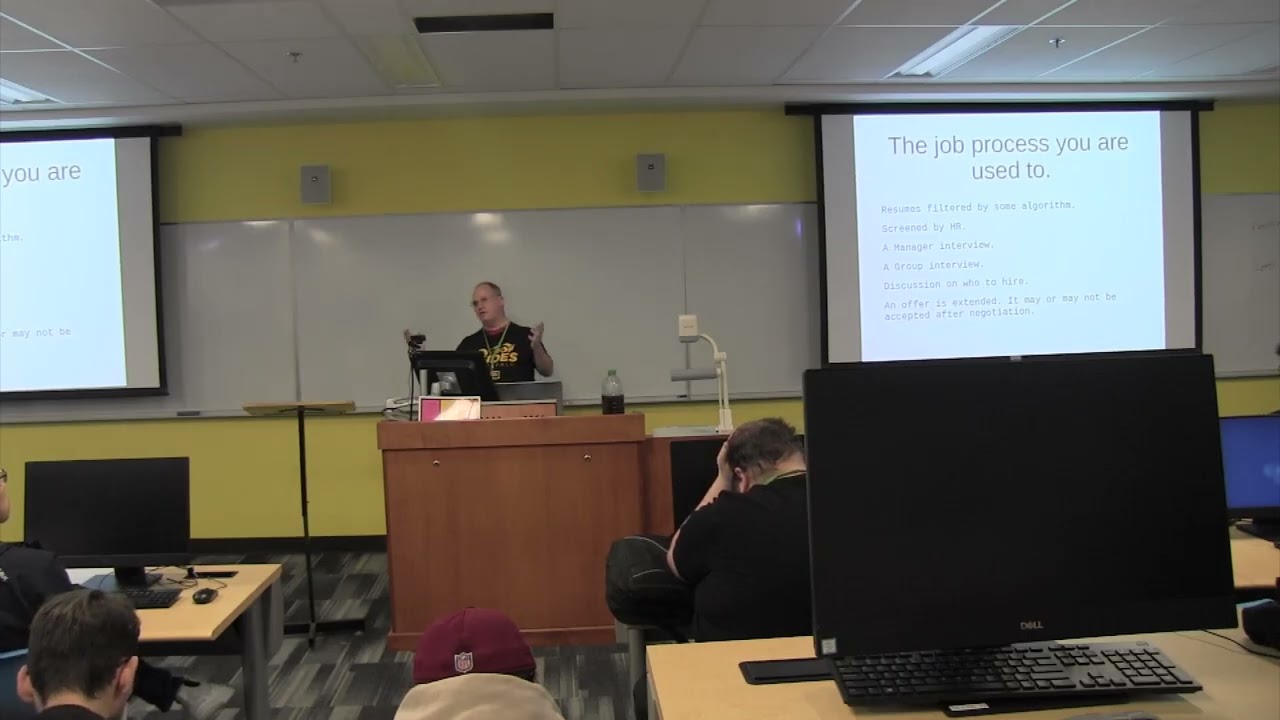
finished talking about. Um, so the when you're going for a job interview or when you're when a company is building out a job thing, the manager is going to have a problem, they're looking for a new person to fill it and they're going to get a budget and then they're going to go to HR to build it. And I've seen a lot of mistakes made at that step. HR sometimes has a really bad understanding of what it does. Um, even in companies that have it as their business. Um, and then that might go to a recruiter who massages the thing a little bit more. Um, I went out for a job offer for a IT
security person. Um, they started asking me finance questions for their business and how you know like what budgets I managed from the finance side which is not anything in my experience. um because that had shifted from what they were talking about they were looking from for for what they got to um and then a few hundred or a thousand people will apply because it's an online thing and so now you're competing with all these people. So um the business is going to run your resume through a filter and all the filters out there are designed to limit the number of people that humans have to deal with. So they're all exclusionary for the most part.
Right? So, that doesn't help you when you're starting out or trying to get into a business. Um, once they go through the filtering for the automatic filtering, HR, this person that doesn't really understand it is now going to look at all the resumes that made it through filtering and try to pick out the best ones for the hiring managers. And that can be another problem where things go wrong. Um, and then there's going to be a manager interview. And then that manager is going to determine if you know enough to talk to their team. Um sometimes the managers will do like a team group interview. Group interviews are very common. Um so so be ready for that. Expect to be able
to talk to people about multiple thing about across a broad range of people. And also when you're doing that interview, if you can find out the names of some of the people before you go into the interview, that's it's really powerful to be able to know what their background is. That way when you are speaking through your answering your questions that they're asking you, you can coach your answers in the perspective of the person that you're talking to. That's very powerful. It lets you build a really good connection with the person that's doing the interview. Um, then once all the interviewees have come in, they're going to get get into a huddle and look at how all the different
various interviews did and find out if you know who they want to bring on because it's a team that you're moving into and you need to be able to communicate with that team and you need to be able to jive with that team and you need to be able to be comfortable in that team. Um, and then you may give get a an offer and sometimes the client or the the person doesn't take it. It it does happen. Somebody can say, you know, I it was a great interview, but I didn't like this or whatever it is about your company. And so now the hiring manager is stuck with going back to those people that they said weren't quite good enough
and looking at their resumes and saying, "Okay, is one of these or do we just start the whole process all over?" And it's very expensive for businesses, right? All of I would say I don't know an actual percentage but I would say like 80% of the cost of hiring a new employee for business is frontloaded before they actually pick the person because of all this work with hiring recruiters and all the time spent. It's not just time on the person that's get going for the job. It's a lot of backend time on the hiring management side. So um Adam Savage he was on Mythbusters. Um he does a blog on tested where people can call in or write in and ask him
questions. Um a lot of them since he is a freelance model maker, a lot of them are geared around interacting with people at work and a lot of those questions are also geared around how you contact or communicate with people. Um what this is a piece of advice that he gave about two years ago. Um, when you're looking for work, you are your best advocate. You know what you know better than anyone else. And unless you can communicate that knowledge to somebody, they're not going to talk to you about whatever it is. And so for me, communication is very important because of what I do. I need to be able to walk into a business and seem respectable and
seem like I'm the right person to do the job. Uh you wouldn't let a person into your data center to work on a computer if they're carrying a Milwaukee drill, like a hammer drill. It's, you know, there's something wrong about that picture. And I've had that happen. I had a guy show up to work at a data center to replace a motherboard and he had like an 18VT Milwaukee drill and I'm like, "So, you're from and I I work with a a I've worked with and still work with a freelance aggregating site." And I'm like, "You're from that site?" And he's like, "Yeah." [Laughter] But he also, it was in the middle of COVID and he hadn't done any of the CO
requirements. So I said, "Oh, because he hadn't called and let us know that he was coming. He was sitting in our parking lot when I found him. Um, he hadn't called, he hadn't done the paperwork that we said he needed to do, and that was evidently not communicated to him through his business. But that's not my responsibility when I'm the person in the data center that says I need to be standing next to this person for the four hours while they replace the motherboard." How, however long it is. Um, so all IT jobs are based on trust. If you can't show that you are trustworthy or you can't engender trust in the people that you are communicating with or working
with, it doesn't matter what you know. If you are at a job and they lose confidence in your ability to do something, that will show in their interactions with you. And you should before you get fired start looking for work because once they don't trust you, they're not going to give you anything. You're not going to grow in the business. You're not going to move forward. So trust is vitally important. And what I'm talking about trust also with what I'm going to be talking about with communicating with businesses and communicating with hiring managers and trying to get shortcutting the job market or shortcutting the hiring process, which is what you need to do to improve your chances.
If if you violate this trust thing, it will get around really quickly. The IT community isn't huge. We aren't really great at communicating with other areas and we're not terribly great with communicating with each other, but when somebody that fallen falls into the trust category starts coming around, it gets around. Um, so what we want to do with our social engineering is we want to shortcut that hiring process that I talked about um to get past some of the filters, but you need to be trustworthy and accurate what you're doing. So, no resume padding, no lying, no anything because it will get caught. Somebody will catch it. Maybe not after you get hired, but sometime
after that. So, trust is vitally important. And the last thing you need to do is you need to be able to separate yourself from the crowd. Um, talking about home labs, I would go one step further. There's a lot of small businesses in the area that don't have any IT staff. They don't have any IT experience. They need all of that stuff that you now know as as knowledge that you just come out of school. Find a business. I wouldn't say do it for free, but do it for less than you would think or because you still need to make some money from it. Otherwise, the business won't value it. Like you want to go out to a business
and say, "Hey, you need this thing. I know how to do this thing. I'm going to build this thing for you. And because I'm not going to be supporting it for you for a long time, I'm gonna document the hell out of it. Right? So then you're giving them now you have some things to show. You can show your new employer that I know how to do this thing. I did it for this company. Here's the documentation that I gave them so that the next person that comes to that environment can proceed with what whatever they need because you're not going to be the person that's going to be supporting them cuz you're targeting some other company. or you
could be starting your own business doing this and still you're going to need to document that because when you have five or six customers that documentation for what you did is going to be how you solve the next customer's problem and it's also going to be how do you know what their environment is so you know what other things you can try or do or improve. Um so soft skills are much harder for employers to train than technical skills. Technical skills are something that's quantifiable that you can test against. You can build an environment to validate. Soft skills are only really shown by long-term interaction with somebody and a lot shorter time and you don't get that in
that really short interview process. So you want to show um how what you know is applicable to the business that you're applying at to solve the problems that the business has. So if before you go in for your interview, you go back through and do some documentation or your in your in your research on the company and you can try to figure out what the problem that they're solving by hiring you is. That gives you a lot of power during the interview process because now you are able to speak what you know to the problem that they are having. And the business goal is to get the person in that best solves their need. Not the not necessarily the best person,
although they want that, but they want the person that solves their need. So, you have to switch your thought around when you're applying for jobs. You're not applying for jobs because they're entitled to give you a job. You're applying for jobs because you're solving a problem specific for the business. And that's that's a key thing. So, so what I'm going to So, what is the shadow job market that I'm talking about? So, the shadow job market isn't this. Um, I'm not very good at graphics. This was made by AI for me. Um, I tried to get it to iterate on this so that I could do other graphics and it was a 4hour slog that I never quite got
quite right with anything that I wanted. So, I just said to hell with it. So, this is one of two graphics in my slots. Um, and the other one's a picture. So, uh, these are the job the shadow jobs are the jobs that haven't been posted yet, right? They're the jobs that a hiring manager knows that they needed some need something for and they might be bouncing it around within the organization to find out if there's somebody that within the organization can do this thing. Um, so that they don't have to go through the hiring process and they can just retest somebody from inside depending on the size of the organization. Um and the things that you um the ways you get
those jobs is you build a personal network and that personal network is how you learn those are the little feelers out on your spiderweb of how to find out about these jobs that haven't been posted yet or they may be posted internally. and they're not getting any hits and eventually they may get posted externally and like you're speaking to hiring managers have to remain somewhat um above it you know that you can't necessarily contact them directly. If there's somebody that the hiring manager knows, you can talk to them and they might be able to pass your resume or it's it all depends on the comfort of the person that you're speaking with, the relationship you've built with the
person that knows the hiring manager, the decision maker or whatever or the decision maker themselves. In the small business sense, when you go to a networking event, you're talking with the business owners, right? You want to go in and you want to learn what their pain points are so that you can target your business to solve those pain points. Or if your business can solve those pain points or if your business can't solve those pain points, do you know another business that can solve those pain points so that you can do a referral? And now two people are happy about happy that you you've talked to them. The person that you referred is happy and also the business that you
helped is happy because you solved them a problem for them. who made it easy for them. So when you're talking about social engineering as it applies to job hunting, it's the long game. So when you're going out and you're applying for resumes and you're firing stuff off to the whatever it is out there for, you know, apply here or click now or easy apply or all that stuff, that's the short game. I would say you want to put some effort into that when you're job hunting, but I would say cut it down to like 40%. Because it's high high high risk, low return because there's thousands of people applying for those jobs. What instead you want to do um and and this is my
personal opinion, this type of communication isn't talked about during the hiring process. because I consider it the game within the game. If you talk about it, the while you're doing it, while you're in the process, um it puts a level of strain on the on the communication. Um, so everyone knows you're playing the game when you're looking for work and you don't talk about you don't So, as somebody was saying about cold calling, uh, and I'll get to this in a little bit, but the one rule about doing this is you never ask for a job. If you ask for a job, you go right to the bottom of the pile. That's the instant like kill
in this process because you're not looking for a job, right? You're looking for a company. That's what you really want. Um, so everyone knows you're playing the game, but if you talk about playing the game, you you're you're you lose. Um, so you're now now you're all asking this sounds all crazy and really wild and really weird and all this other stuff, and you're wondering, can I do this? Right? So I think you can do this. Um, anyone can learn to do this, right? It's a skill. Believe it or not, I am an introvert. Okay, tomorrow I am going to be sitting in the woods listening to birds. [Laughter] But to in back in 2003, I learned these
skills from a group in Rochester called the August Group. and over lots of practice and many many hours and and lots of screw-ups. So, the other thing, if you're applying for stuff or you're doing stuff or putting it out on the internet and you're worried about, oh, if I do this and I screw it up, somebody won't hire me. Uh, that's that's wrong. It it's more if I do this, if I don't do this, nobody will know who I am and nobody will hire me. So, and and and you just got to you got to do it. You just it's like dating. You just got to go out and do it. You didn't you didn't get the first date you got.
Don't get the first job you got unless you know like you knew the person or it was like a family job. And some people say that social engineering this way is nepotism. It's not really. I mean, it can be, but it's not really. It's all depending on how you think about it, how you apply it. So instead of trying to find a job, you want to find a company and you want to research that company and find out if you want to work there before you go through the hiring process. You want to find out if this is a place that I want to work at for because they're doing this big brand thing or you're doing whatever. So
once once you do that, you want to get this is the basic process for flipping the script. Once you once you uh I skipped this step. Um I must have screwed that up. Um okay. So this is the the basic script that you follow when you're applying for a job using this technology there. This method, not technology. It's a skill. Um you want to gather information on the company. Um, and then you want to find ways to meet the people that work there, right? You want to be able to become a person to the people that you're going to be interviewing with because they are the ones that are going to be making that decision, not just the
manager. Um, you want to practice public speaking. Um, oops, sorry, I skipped. So, you want to get informational interviews. People talk about informational interviews, but they don't really talk about what you're doing at anformational interview. and I'll be going over that. Um, and you're gonna want to document everything you do through the hiring process because it lets you know what you've tried and the steps you've taken and the connections you've made. LinkedIn is useful for this a little bit, but if you build a spreadsheet for yourself and track a whole bunch of stuff, then you can get better at it. So the first thing you need to do is you need to develop a way to announce yourself to the people
you meet. And in business networking, which is basically what this is based around, um you develop an elevator speech. So if you've ever seen Shark Tank or any of the other business like shows, the people come out and they speak for about 15 to 20 seconds about the thing that they're doing or the thing they want to do. the the the keys for building a good elevator speech, it's got to be positive, forward-looking, and concise, and future focused, right? Nobody, no business gives a damn what you did because you've done it and it's over and it doesn't apply anymore. Um, I'm probably a little nervous, so I'm talking too fast. You really should talk about this fast. You're just talking to
people in a conversational and they have to be able to understand what you say in that communication, in that short window of time because you don't want to waste their time, right? You don't want to take their time if what you're looking for isn't a match. Um, and the practice needs to be done. You can't just think about this, right? You have to go out and you have to talk to people and do it and not worry about saying the wrong thing because otherwise you can't learn it. You can't just think about talking to somebody. you can't think about the process of talking to somebody. You actually have to go out and communicate with people
and you need to make sure that you talk to your audience. So like if I'm approaching somebody that's in um that so when I was a small business I would have to approach small businesses to find out what their pain points are for what IT issues that they might be having and I need to be able to so if they're an auto mechanic I'm not going to describe things around it using terms for the farmer or terms for the banker. So speak the language of the people that you're speaking to. If you're working going to work for a company that does banking, learn banking to topics. Read Forbes for a couple of issues and try to
get a feel for the language that the people that are in hiring positions in that industry are using to communicate between each other and coach what you're saying into those positions. This is more later on in your career, but the early on if you can speak the language that they are speaking that does two things. It shows that you can communicate with people and communication in it with stakeholders is like the big thing. And I'm using the word stakeholders because that's now the approved term for talking about people that aren't in it. And that's part of uh God I should know. Um version 4 I I itil um and so it is defines the way that it
communicates with every other department that it communicates with. So if you can learn to speak that language, that's a soft skill that you have that you can showcase to the business when you apply to them because you're speaking in those terms to them. And the ne last thing is it needs to be short. And the only way to get it to short is to get it to use it a lot. And as the more you use it, the shorter it will get. But you don't want to sound like a thesaurus, right? You don't want to you don't want to um sound like a bunch of buzzwords for for whatever it is. Um and then you want to get some cards.
Now, and I left mine over there cuz I'm dumb. I was going to bring them up here. Um the the cards are going to have some information about you, some contact information, and you can do technology and like show this and show that. In an networking environment, there's not enough time. You're talking with any given person for maybe five minutes. You're going to introduce yourself. You're going to exchange cards. That card is going to have information on it for the key things that you're targeting. It needs to be clear and concise. Um, it needs to mirror what your elevator speech is because that lets you tie them together for they've got this card and they remembered speaking with
somebody about it and you need to get good notes for the the events that you attend. So, one of the things I do is you bring a pen. And the reason why I say bring a pen is I got this gentleman Kevin over here. I was speaking with him before and I got his card. And so the first thing I did after I got his card was I wrote on the back of it besides Buffalo 2025. This tells me where I got this card. And three weeks from now if I need to if I'm looking at somebody comes to me and says, "Hey, I need somebody that does this. I can look at this card. I I I can see I
have this card. I can see what Kevin does. And I can then say, "Hey, I I met a guy. Let me reach out to him for you." Right? So what I will do is I will say, "Hey, Kevin, we spoke at Bides 2025." And usually I'll also after the event, I'll write on the back also what we talked about. And you you're you're probably all out there thinking, "Oh, this is what LinkedIn is for. LinkedIn sucks at this, right? So, you want something that's easily searchable and you could try to digitize their business cards, but the problem is remembering where you put stuff is really hard. So, they actually make sheets that you can get for these that
have 10 cards, 10 little slots for a sheet, a three- ring binder. Um, it's what I used for a long time. It's really analog. It works really good for scanning quickly through a bunch of crap because the other thing you can do is you can flip it over. So the front side you're getting all of the person's information, but when you flip it over, the back side of the sheet now has where you met all of these people just laid out. So maybe you remember that you met somebody at this event, but you don't remember, you know, which or you you might remember that you met somebody at an event. If you group all your cards by the event, you can then
quickly find the cards that you're looking for. as an example. Um, and you want to keep good notes. So, back to the regular social engineering, you want to keep good documentation because the documentation will tell you who you've spoken with, where you met them, what you talked about, if you've referred anybody to them, um, if you've reached out to them in some way. Because not only are your peers competing with you for jobs, but they're how you're going to get jobs. Because your network is not just the people that you're trying to get work from. It's also the people that you might be your competitors. They might not do the same thing. They might not
have availability to do something when a business contacts them. Businesses push work around all the time between businesses. Um, and this gives you an example of my current card. Um, you don't have to take a picture of this. I'm hopefully going to be giving you them. Um, and also in in all the slides, the QR code takes you to my LinkedIn page because that's where I aggregated the most information about me. But if you have a project hub page, a GitHub, uh, contact tree, whatever it is, um, I would stay away from link tree. I mean, it's a great tool, but it has a kind of sketchy vibe. Um, but it it's a it's a
good way to do stuff. You want some You want the landing page of this QR code to be everything that you want on the card and everything that you want to be able to shortly put before somebody so that they know they've got the right person. And so how do you build this network this this web of people that are helping you find your business and find your things? So events like this, this conference is a great place to meet new people, to exchange ideas, to develop and um connections. Um infosc 716, infocheny. Um if you're in an industry like banking, there's banking events. If that's the industry you're targeting, because it is everywhere. It's not just
in the businesses that are applying. That's a way to do it. um church groups, hobbies, people you know. Those people may know you're looking, but they they might not easily remember what you're looking for. This card can tell them that in a way that they can see and find and understand. and it has your contact information on it. Win. So, um, and if you want practice talking to people, go talk to random people on the street. It's zero pressure, especially if you do it in a town that you don't live in. So, like if I drove to Rochester, I know people in Rochester, bad example. If I drove to Cleveland um and just started talking to people on
the street and say, "Hey, I'm trying to get better at talking to people or hey, you know, what do you do? I'm I'm interested in what you do." People love to talk about what they do. Like if if you approach people, it will get you the experience of talking to people because if you just stand there like this, they're not going to answer back. Um, so when you're at a networking event, what do you do? Like I said, rule one, never ask for a job. And I'll go into why in a moment, but um, listen more than you talk. So, introduce yourself, give your elevator speech if you've have it, or you know what you want to do. Remember, positive,
forward-looking. Um, exchange the cards. um try to find out what problems they are experiencing at work. Even if they're not in it, they might know what problems what they perceive to be its problems are. That's just as good as knowing what it's problems are because then now you know something that it may not know, which is the way it is being perceived within their organization. That's something you can bring up in the interview. It's showing that you're researching the company, that you're trying that because you're trying to show the company, I want to work for you, not I want to do widget building. Um, if you can get a card to exchange it, that's great. Um, ask for pe other
people that they might know that you can talk to. Um, and like I said, bring a pen to write notes on it. I don't come to a networking event without a pen. And all of you guys have two pens in your bags. [Laughter] Um, so, so now we so we've we've gone out, we're meeting people, we're networking with them, and we're asking for informational interviews. So, so what do we do in an interformational interview? Once again, never ask for a job. Um, you're taking their time. Be considerate of that. Keep it short. I would say if you're doing an informational interview 30 minutes absolute top unless the person you are speaking with extends it. So you can say
at minute 25 you know it's really great that we've spoken and I appreciate your time and they decide to they they extend the conversation. Let them because that's a choice that they're making. That's the decision that they're making. You're there to learn from them. You want to have your resume handy, but don't take it out unless you're asked for it. Because if you take it out and show it to them, you're asking for a job. You're violating that first rule. If they say, "Hey, you seem to know a lot. Do you have a resume?" Then you can take it out and you can show it to them and they might look at it and say, "Hey,
this looks really good." They're giving you a free resume review. You want it to listen more than you talk. Once again, you want to ask questions about the industry they're in, where they see it going, where they see potential problems, and where what you know can be applied. You're not there to get a job from them. You're there to learn about things that they know about. And people remember when people ask them about what they know about because that because I'll go into the reason why. Um, if if you make gel with them, bring your cards. Obviously, you never want to go anywhere without your cards. Um, I have what I call a sacrificial card. I have a
stack of cards in my back pocket all the time, but the sacrificial card is the card that rubs the fates up against the back of my pants. So, it's the one that gets like abladed from all the other cards are good except maybe the back one that gets other stuff rubbed up against it. So, that's the sacrificial card. You're going to go through cards and that's great. Um, they're really cheap unless you go to some place like this fancy printer, but even then they may be able to cut you a deal. Um, I say buy like 250 blocks for carts because in that time your message will probably have changed and you'll want to put new
information on the cart. But as long as people have the landing page that you set on that QR code or on the URL that you put on it, they'll always get to whatever your current thing is. Um, and then when you're done, thank them for the time they spent. And also because you're keeping track of this someplace else in a week, send them a letter or send them a note, an email, whatever, and say, "Hey, I really appreciated what you said at this meeting that we had. I took this advice you gave me and I applied it this way and I really thank you for your time once again." Now, two things are going to happen with that.
one, you're now poking them to remind them about you. And this works really good when you're dealing with companies like Azelon or any of the the tech recruiting companies that are going to have people reaching out to them from the midsize businesses. Um, I would say giant businesses have their own internal recruiters. I would say 100 to 150, maybe 200 don't have their own internal recruiting system. and they're going to be going out to some agelon or whatever. If you're looking for contract work, it's a little bit harder if you're trying to go into a company that doesn't have a recruiting. If you're going for a really small company, then they're not going to be going through a recruiter
and you're going to be doing more business networking because you're targeting that really small business. You're going in to because they don't have the depth to have hiring managers. There's just the guy you're going to be working for. Um, and like I said before, document everything. Track your interactions with everybody that you can that's related to your job search because this is the leverage that you can use for sending out those thank you notes for tracking if you send out those thank you notes um for tracking if I followed up with XYZ if I've and this you want to build this for yourself you don't want to use like some cookie cutter thing because that cookie cutter
thing may not have all the things you need but this is like just a limit a few things that you want to put on it. And thanking people that help you for their progress does two things. It makes them more willing to help the next person. And it also makes them more willing to help you again. And later on, if they need help doing something, they might come to you. You can refer them to somebody else. And now you found a job for somebody else. That's very powerful for that person helping you find a job. And that's why not only are you competing with everybody that you're going against, but you're also you need to use everybody that you're going
against. And so why do people why does this work? People like being able to say yes. People get fulfillment from being able from being asked to share their knowledge. And people love being able to help others. Unless like you're a narcissist and then they fake it, but it still works. Um, and then when you it when you develop a feeling of being trusted, the uh the it releases oxycottton if the person trusts you, not if you trust them. And this was been proven in a bunch of different ways. So, who are social engineers? Those all still apply, but we are all social engineers. Thank you. I guess I have a little bit of time for
questions. Yeah, we got a few minutes for questions if uh Oh, got questions. Okay, start in the back corner. Yeah, my memory is not great. What are some ways you organize your relationships with people? Do you just have an Excel spreadsheet that you maintain? Yeah, I I basically on the left side I have all the companies that I'm targeting and then I will build out from that a tree of uh if you wanted you could also do mind mapping. That's another way to possibly do it. Good idea. Um so you build a mind map for a company that you are targeting to get into because remember you're not looking for a job. You're looking for a relationship with a
company. And if you can build the relationship with the company and build trust with the company and build trust with the people at the company, then you'll get a job with the company. Kevin, so um Rowan, I'm going to look at you and ask this question, but the entire room can weigh in. Uh tagging referrals on LinkedIn. So for example, you meet somebody at a conference or someone say, "Hey, we had a great time at Bides. Thank you Rowan for whatever." Like thoughts on that? Some people don't like that publicity on their LinkedIn. So there's no way to please everybody. Yeah. But um I would say that if somebody's giving a talk, they want to
have people reach out to them. I will say if you reach out to somebody on LinkedIn and you're sending a connection request to them, tell them where you met them and what you spoke about. Because if I get a request from LinkedIn for somebody that says so and so follow, I don't care about. But so and so wants to connect. If you don't tell me why we should connect, I either ignore it until the it times out from the system or I ignore it and or and just delete it. No response because you might be trying to social engineer me, right? Mhm. So unless you can you want to you want to build the connection when
you make a connection attempt because that's the thing you get jobs through your connections. There's one guy that did a Sands Summit talk recently that he said that the last six jobs that he's gotten he did not reach out to the people that contacted him. They contacted him and said, "Hey, we like what you're doing there. Would you be interested in doing this other thing for us? Maybe for more, maybe for less. Maybe it was a good match for his career. Maybe, you know, there wasn't much advancement going on in the company. Um, it says they're really good at hiring from within. We really suck at it. Um, most people to advance in their career will switch jobs because they're
not appreciated or they don't feel appreciated within the organization that they're in. I think that's probably about it. One quick question. Go ahead. You mentioned uh resumes the the first level going through probably an AI generation to to sift through it and whatnot. Um I've always chuckled at this but is there a benefit to putting white text in there saying no that right there hidden text on your resume. So it might make it through the AI right when it hits that recruiter or that HR person they know to look for that Okay. They they'll totally that right there. Let back to trust, right? You're trying to scam the system. Y you can work your way around
the system. That's one thing. That's what I'm talking about. But if you try to scam the system, that means that your trust level went to -10, right? You're not trustworthy. You're trying to you're trying to cheat it. Good point. In your experience, any fields adjacent to IT within bigger companies that that it will hire from. So, say you don't say you don't start as a as an IT specialist, let's say as customer service. Customer service. Customer service is probably the single biggest path through to it. It's the way I took um go ahead. So one thing I'd like to emphasize from your talk that the need to speak the language of the industry is very important not just because in the
end the company is hiring you for their benefit. So if you know what the industry thing is maybe some problem that the industry is trying to overcome kudos to you. Yeah that one is how you stand out from everybody else that's applying. That's the the way you do it. And the way you do it is by doing things that are different. You you can do the same things that everybody is doing, but that puts you in the same pool as everybody else is doing. Yeah. I'll I'll add an emphasis to like the importance of like knowing the company's goals and objectives. Like we get so focused on like what the role is and what we're
going to do, right? But we're supporting kind of like the larger missions and objectives of what's going on at the company. It's important to remember that. And a lot of companies have to post if they're publicly traded, they may have to post meeting minutes or if they're a state entity, like they're posting updates or articles. So look who you're interviewing with and see what the management of that company is talking about. It could be really helpful and differentiate you in an interview. Yeah. All right. One one last question. Yeah. All right. So, so, so this question is for new college grads, okay, who pretty much don't have experience, right? Now, you said something about not asking for a job. Y, but giving an
elevator speech. Now, how can you possibly give an elevator speech without showing job income for someone? No, no experience whatsoever. So you don't say, "I need a job." You say, "Hey, this is what I'm really good at." So you're not good at No, you're you're really good at something, right? There's some specialization, some particular love within IT field while you're going through school that you've developed, whether for me it was hardware. I I do infrastructure. I don't I don't program and I actually cannot program. I well I can I can script if you want to be really loose about it but um because I know the thing that I'm good at really well. It's the thing I'm
passionate about. What you want to show in your elevator speech is that you have that passion. Right? You're going out and you're trying to meet people to learn about what they're doing and to gain more experience from them. But you want to be able to show that passion that you have, that drive that you have, that curiosity that you have. He listed a crap ton of things at the beginning of my talk that I'm interested in. That's not even half of it, right? I I have I have stuff I don't watch TV. That's 4 hours a day that I have to read the internet. And you can get a lot of off the internet. Reading
Wikipedia, reading like I know like why Three Mile Island failed. I know like all sorts of other things. why planes work, why you know whatever, whatever your curiosity is, whatever your interest is, keep it live, right? That's why I'm saying forward speaking, forward looking. What are you passionate about? If it's something you're passionate about, talk to the people in that industry because they need it people, too. Okay. All right. Round of applause for [Applause]
Related talks
 50:07
50:07 53:45
53:45 50:55
50:55 52:57
52:57 42:26
42:26 37:04
37:04