Kathleen Smith - Get More Than a T-Shirt from Your Community Volunteering
Show transcript [en]
give it if that's where you're supposed to be you're here if not get out just kidding you're gonna hear today first we're gonna talk about some of the sponsors st. Mary's University you're here USA a Trend Micro digital defense sans San Antonio AFCEA chapter make sure you patronize those people also down at the registration table some raffles doesn't be given out during the day and later toward the evening at the party let's be sure you get in there okay now we're gonna hear about getting more than a t-shirt from your community volunteering from Kathleen Smith so of course kink in it I have a different title on my slide so you are in the same
presentation it's just I've been traveling this week and I didn't upload the right presentation it is the same content I just have yes I'm having a finger shook at me so anyway as some of you know my hecklers included I have been in the community for some time about eight years and one of the things that I saw while I was volunteering in the community is that other people that I was volunteering with were sort of advancing in their career development they were advancing as far as they started out as sort of a door room monitor and then all of a sudden they moved to the registration table and then from the registration table they were
manning all of the registration and then from there they moved on to a bigger conference but I also saw that there was a parallel progression in their career development they sort of got more responsibility in their their job and then they started taking on other opportunities and then got promoted and then got moved on to other companies so we saw this sort of parallel progression between people who were volunteering in the community and people who were also moving on in their careers I wanted to see if this was more than just a few people that I worked with if this was something that was happening in the community overall so we did a survey last year of people who volunteered
conferences and through organizations throughout the world we worked with hack in Paris Diana initiative mental health hackers and a variety of other groups to get information out there to sort of say do you volunteer what are some of the things that you find from your volunteer development and do you get your employer involved and it was very interesting a lot of the great statistics that we came back with but also we also found that there was a sort of road map that a lot of people could follow in their career development by being part of volunteering in the community so one of the things that we found in the study was that about 50% of the participants
said that they volunteered 8 hours or more in the community and I already know that this is an underrepresented number because a lot of the people that I work with were also part of this survey and I know that they put in a lot more than 8 hours a month and what's interesting is it's hard to sort of calculate or tabulate what the hours are because it's a conference call here it's an email there it's several hours on the Saturday afternoon and we sometimes don't think that it's a lot of time when it really is a lot of time I also noticed within the community that a lot of people volunteer but then they become known as
the person who knows how to do the t-shirts or the person who knows how to do the badges and all of a sudden another organization will call them and say can you come do it for us so not only do people volunteer with just one organization they start building a network and end up presenting it being part of other groups and start expanding their network it's very interesting when you get in out into the community you will see a lot of people at Circle City con or at Derby con or at besides Las Vegas or somewhere and you're like wow these people are all over the place and that's what happens when you start volunteering you start
building your network and that was one thing that we talked about this morning was when you're going to look for your next job it's really going to rely on what your network is about because if you're looking for your next job but you only ask for suggestions from those ten people that you know you're going to get the same ten suggestions all the time so you need to really be building your network so that you can build your opportunities for the next time you're looking for a job and I really believe volunteering is one way to do it when we talk about skills that are needed in this industry we talk a lot about the technical skills
but you see more and more studies coming out now that also talk about the need for non-technical skills LinkedIn has done several talent studies out there that say many people are looking for technical skills but they're also really pushing for what are the non-technical skills that you have because people are looking more and more to the technical department or the security department to get more involved in the business operations of the company being able to stand in front of customers and be able to explain the business risk be able to explain to senior management really what are the options that we have here but we really have opportunities within our workplace to work on our communication
skills or on our leadership skills or on any of our planning skills and this is what's really great about being involved in the community because those skills that you're not able to work on in your workplace you can put them to work here in the volunteering community I was really excited to see and not excited to see I first did not like the fact that so many people found it stressful and we love stress you don't like stress we love stress we don't like stress what's interesting to me is we acknowledge the stress we know that there's burnout in our community and we burnout in so many different ways when we looked at the results from the survey and they said
yes I'm stressed but it's physical stress is anxiety its neck and back pain from lifting boxes of t-shirts or standing on our feet all day but no matter what everyone says this is fulfilling very fulfilling and not many places in our life can we say that we have something that is very fulfilling and I find it very wonderful in this community that so many people volunteer this is a community that runs on volunteers I'm part of a recruiting community a sales community and I used to be part of healthcare and I can tell you no other community that I've been part of has as many volunteers as we do in this community so having that opportunity to have something
that's very fulfilling is a great opportunity they think everyone really needs taking up opportunity to take the advantage of but I want to step back a little bit because a lot of people think I'm gonna volunteer and I'm gonna run off and I'm going to do something and then they have a really bad experience and I think it's just like everything else in our life if we're buying a car or buying a house if we're going on vacation if we're looking for a new job we actually do the research before we go and volunteer someplace and there's this little checklist that I put together if some of the things to sort of think about when you're going to volunteer
I've been volunteering pretty much since I was a junior in high school and I just got involved in a lot of things and that's something that carried on throughout my career and I soon realized that I needed to sort of put this sort of checklist on the different kinds of volunteer opportunities so one do you have the time do you actually have that eight hours a month that you can put aside to be able to volunteer are you going to school at night do you have a full-time job do you have children what are the different things that you need to think about also do you have the skills I mean sometimes we go to the
volunteering opportunities to get skills but do you have skills that you can also contribute to the organization I usually get involved in an organization that needs marketing or social promote social media or event planning skills because those are skills that I can bring to the table also you need to understand are you going to be able to get something out of this or are you going to have other resources that you're going to need to put into this some professional organization actually ask you to contribute financially as well so you need to be aware of what is sort of your buy-in is it just your time or is it something a little bit more all of these
organizations or all of these conferences that you're part of are also opportunities to get your employer involved and you need to understand something you want to do do you want to get your employer involved do you want to actually get paid time to volunteer do you want to maybe see if your employer would be interested in sponsoring a conference or an organization so these are some of the things that you need to think about from your own resource management but then also as you move into what kind of organization do you want to move forward with I spent a lot of time in the environmental community because that was something was really near and dear to my
heart and so I volunteered for you know world wildlife fund I ended up working for them many other organizations because that really meant the sort of personal mission of my life but you need to ask is this do you have a mission that runs along the same line of the organization or the conference that you're looking to volunteer with I mean I don't think many people in here would sort of volunteer at a tea Association or American Red Cross well you might sorry I met height yeah you would do high tea but just understand that you're gonna get a lot more fulfillment out of it if it's something that aligns with your own personal values and then also a lot of
times people are interested in volunteering with the group because there is one really charismatic leader and they want to be in that aura of that charismatic leader that's really great but realize that charismatic leaders usually burn people out because they're running so high all the time but there also might be organizations that have key leaders or stakeholders in the community and it is another way to be able to move your career forward by having them in your network are you going to be able to challenge yourself so one thing that I am really bad at is financial management and one thing that I always make sure that any organization I'm part of I always make sure that I'm either part
of the treasurer or the CFO position because I need to challenge myself into learning spreadsheets and budgeting and forecasting because that is something that I am really weak at but it is something that I am not going to get that opportunity during my work environment to do and now I can actually run some spreadsheets so I'm really excited about that and finally are you bringing a critical value to the organization I would not be a benefit to an organization that was all about social media because we would all be bringing the same skills to the table if you're bringing something that everyone else has at the table it might be time for you to look at a different
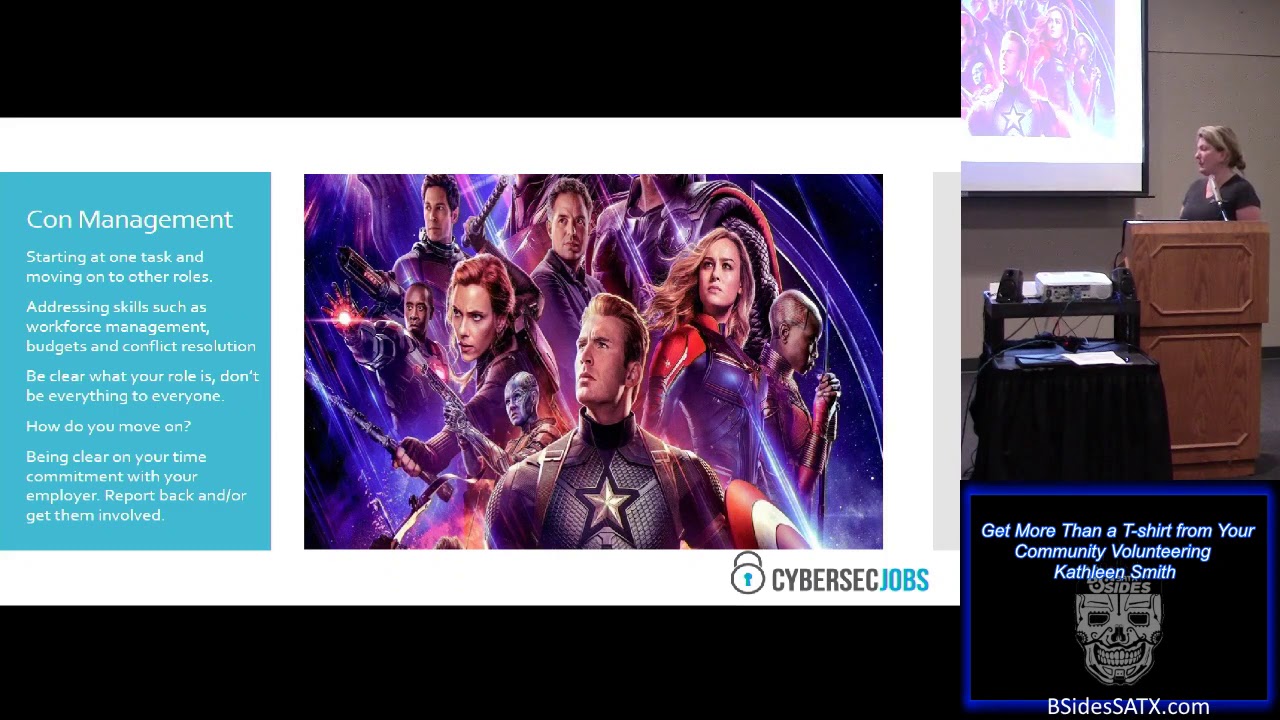
organization so that you can compliment everyone who's part of the team not you know being redundant so I wanted to go down into a little bit of the specifics as far as what I have seen in the community on management the one that's really big is Khan Management and I've seen a lot of really great people who have started out as the person who folded the t-shirt and all of a sudden became the person that ran the organization I like to say that a Khan is very similar to a small company there is a goal to be achieved there is money to be raised there is volunteers to recruit there's promotion to be done there is production of swag and badges
and t-shirts and things so it's really like a small company so finding the place within a Khan to be a volunteer is really great because you get to look at many different aspects not just the technical aspects but it's also looking at what do you want your role to be because a lot of people come into a Khan and they say I'm really great have me come work on something and they can't really say exactly what they want to do if you don't know what you want to do start one place and then rotate through the entire conference I've seen a lot of people who have gone to a conference and 20 years later there's still a person
doing security which is okay but as far as their overall career development they're not challenging themselves interacting with different people getting new responsibilities actually that person who's been doing recruit security for 20 years is now looking for a new job and I said the one thing you need to do is stop doing security and do something else because you need to change sort of your perspective and your thinking process I think that the other challenge that I see within conferences is that people stay in the same place and they don't look 2 to 3 years out and you really need to start realizing that you are the person who is in charge of your career and you need to start
planning your timeline and a lot of people and conferences say I'm just going to be doing this forever I'm sorry you're not what you're going to do is you're going to burn out and you're going to say nope not doing this anymore and the cons not going to be around anymore you really need to start planning on transition management and what I call delegation and leaving gracefully this is about saying ok it's usually 2 years when you say ok I've done this role I now want to move on to something else maybe I'm you know in sponsorship and I'm going to move over to registration or I'm going to move over to you know the CFP or something
like that you need to give yourself at least two years because you need to first in your mind put together what I consider a transition this sort of notebook and what this is is in the military we talk about this is your turnover file this is if someone came in the next day and needed to do my job I would just hand them over a turnover file and they would have absolutely everything that they need to do to do my job there is no place in the common workplace that teaches you how to do this and it is something that is for your own good to do but it is also something that shows amount of respect
and professionalism to your current employer and to the new people are coming on board so doing that within the volunteer workplace is really great because you will start to realize all the things that you have done and all the things my gosh I totally forgot that I do that and I do that and I do that and it's a really great opportunity to search think well I really I really have a lot of value and I have bought a lot to this conference and I'm really proud of the things that I'm doing but having the turnover file you then also can start to find in your mind who is the kind of person that needs to take my place and then you
start interviewing the people who are in the community who can start taking your place because believe me not everyone wants to take over your job once you find that person who's escaped take your place you start training you start delegating and then it's very clear that within two years you can pass it over this is not something that we learn in the workplace at all it is not something that really behooves us to sort of be professional about the accomplishments that we have made in the workplace but this is a really great thing to do because it also helps you start planning for your next career move a lot of people get into their careers and then
they get really frustrated with doing something and then they just quit on a Friday afternoon party all weekend and then try to find a new job on Monday not realizing that they've not set any kind of plan of what they're going to do next so sending up a transition file finding your replacement is something that's going to prepare you to manage your career but also help you as you move into management the other one is being clear with your employer because what's interesting is we all hear about the what you know the shortage of talent within our community and so many companies spend a lot of money getting advertising out there and marketing but having employees working in conferences
or organizations is what is called branding employer branding you're getting out there you're showing that I'm out here and like my employer is behind me so what you need to do is keep in touch with your employer and let them know what you're doing in the community now it might not be an email every week I would keep a journal of all of the things that you are doing in the community nnedi and once you go through your year you know semiannual review say okay well these are all the things that we talked about that I was going to do for my job well these are all the other things that I've been doing as well I've been in the
community I've learned some new skills I've met some new people I've been talking about how great it is and that is part of your professional development that you've also taken the initiative to do which are things that you're going to want to show your employer look I'm taking the initiative I'm getting out there I'm learning new skills and hey how about that raise but it's also looking at a way of making sure that you tell the company I'm out there on your behalf let's talk about you know maybe some paid time off to do volunteering because several companies do you do that and it's something that you want to start mentioning to your employer because you
want to stay there as an employee and employers want to keep their retention high and there is specific money set aside within any HR budget or recruiting budget for a retention so they could take that money out of the retention budget to pay for your paid time to volunteer competitions I mentioned this earlier this morning the competitions are something that many people are overlooking as an opportunity to learn work experience I specifically say this for a lot of students who say I'm trying to get a job to get experience but I can't get experience until I get a job well if you're participating in the community through volunteering you're definitely learning skills on workforce management or program management or time
management the competitions in particular are very very similar to any kind of work experience you know if you look at a competition you're looking at a goal short on time short on resources new people that you're working with and an adversary that you don't know as well to me that sounds like work experience that's exactly what a lot of people are doing in their day to day job but when I see a lot of people not doing is at the end of a competition taking the time to write down what they did in the competition so taking the time just 10 15 minutes on your phone or in your notebook sort of outline what the goal was of the
competition what you learned and what you failed at because we always have that question in the interview what is something you failed at and what did you learn and a lot of us really don't want to talk about we failed at work and everything you know went dark for two days so it's better to be able to say I was in a competition I did this you know attack it didn't work this is what I learned the other thing is understand how you work in a team because a lot of times in a work environment we're forced together to be part of a team and it's time to sort of take that internal monitor and say I'm in a room with eight
people and someone's not taking the lead I decided to take the lead or we're trying to assess what the problem is but not everyone is asking and the questions are you the person that sort of being the communicator or you the person that's taking the leadership role that is starting to send yourself some signals as to hey maybe I'm more of a leader than I thought or maybe I am not as good of a communicator as I thought because we all communicate thinking that hey when I'm saying that other person is understanding and you see sort of this blank stare and you realize hmm I'm probably not communicating as well as I thought I did or that person just
doesn't understand what I'm talking about there's that as well but it's also interesting as I see so many people doing a lot of competitions but they also don't show those with their employers they don't go in and saying you know I just learned about a new vulnerability and they're like where did you learn it where is another network know I learned about it in a competition so these are again things that you want to go through your performance evaluations and saying these are all the competitions I've been part of and these are the things that I learned and these are the kind of team involvement team management that I was part of again something to share as part of your
performance evaluation presenting what I find fascinating is that a lot of people think that presenting is easy and that they think it is something that all of us are hand-picked and we're just you know on some kind of speaker circuit and they fly us around and we have our hotel rooms you know paid for and their green rooms and all that sorry now a lot of us put a lot of work into presenting and it's something that really goes toward time management because once you look at a conference there's usually a six to nine month window ahead of that conference for when the submissions have to be sent in to speak sometimes if it's a larger scale conference like blackout
or RSA it's almost a year in advance and you have to keep an eye on that and you also have to say okay they'll understand what I'm saying a lot of people will put in some kind of outline with a lot of acronyms and say yeah they'll get the idea no you have to write a short abstract a long abstract an outline and the key takeaways from that talk and what's interesting is a lot of people are not willing to put that kind of time into a speaking proposal I sit on the CFP board for several other conferences and I am absolutely amazed at people who just throw in you know well this I just
think this is a really great idea and yeah everyone will think it's cool and they'll throw in some languages and get really bummed when I don't pick them out in like our job as conference organizers are to make sure there's valuable content that is shared at the conference and we have to make sure that when we look at these proposals that we understand a bruit we also understand that the person can communicate well what that topic is all about what's interesting is that these are the same skills that you're going to need to do in your workplace because you're going to be asked to write that management memo that memo that says what is the
vulnerability that you just found what is the security risk of this particular program and if you don't have a management memo that's being accepted no one's going to come back and say to you this is a bunch of crap they're gonna say yeah that was a nice idea we're going with something else and you're gonna bang your head against the wall as to why did they get that this was a really big deal it was because you weren't able to convey the ideas through your memo so now it is the same thing that happens with competitions excuse me with presentations is that we submit a proposal to talk if it's not accepted you know we know quel dommage and then
we say okay we go to the conference organisers and we actually ask for feedback we ask why wasn't this you know a talk that was accepted some of the larger conferences will say well you know we have a lot of proposals and they're all quality you know the smaller conferences will actually give you good feedback you know it wasn't a good outline didn't convey the key takeaway takeaways there was also you know two or three presentations on this same topic and we wanted to give the opportunity to someone who is new on the circuit all really great ideas so you know it's interesting a lot of people think that getting up here is a slam duck it's a
lot of program management and it's a lot of timeline management and then you get into timeline management if you're going to present excuse me represent your employer I did a workshop about two years ago with several women in the community because we wanted to get more women to be submitting proposals and we said you know one of the reasons why we don't see women up on stage presenting at security conferences is maybe they don't understand how to go through the proposal process so we actually did this workshop we had several women there's one woman who actually wasn't going to come but she was in my Pilates class and I said you know please come you've got
some really great ideas you work for this very large company why don't you come to the talk so she come to the workshop got really jazzed went home wrote four abstracts and made a commitment to present at 12 conferences in a year she then went to her employer and did the approval process and said these are my four abstracts these are the 15 conferences that I want to talk at over the next year will you if I get accepted will you pay for my travel and all of my expenses she actually did it she went to Brazil she went to Spain she went to France she went to several conferences without throughout the United States I think there was one day
she did two talks but it was that she not only had clear ideas that she presented she actually went through the entire approval process of having her boss sign off on it and then they went to the corporate communications department and had their approval process of okay are you talking about work stuff are you talking about your own home lab she was actually talking about work stuff she said they were so excited because there was actually someone out there willing to be the ambassador for the company so you can get your employer to do this you just have to give them time to go through their own proposal process because product management and marketing management and corporate communications
they already have their timeline in their budget set you have to give them time to respond to be able to say well we didn't know that we had this goldmine of this person willing to go out and talk about this how can we make this work there are some other companies that take almost two years to approve the process you also have to understand that as well I have a colleague who presents at Vegas some times and she's like okay what do you want me to present on in 2021 because I have to start the approval process now and get all the right images that can be a little frustrating but again if you want to get
your employer involved you have to give them the abstract the outline the conferences you want to go to and then also just give them the overall time to be able to get through the process and again just because you know volunteering is happening if you don't have the time in your schedule you can still get all of these skills the day of the event so a lot of people in our community only volunteered the day of the event I would make sure that you take like time off on Monday if it's a Saturday conference because it's going to take your time to catch up on wash and sleep and things like that but you're still getting these skills
being on-site you're doing conflict management you're doing disaster recovery you're thinking on your feet okay badges didn't come what do we do next or not enough t-shirts were done or something was wrong with a sponsor or a v's not working or we're having a fire drill or we have a sniper on a building which I had once so you know there are there are all kinds of things that come up at a conference that can really build toward your overall skills it's not always going to be your technical skills it's also going to be your non-technical sort of one-to-one skills so we really focused on in this survey was what are some of the key takeaways from
volunteering and you know over 95 percent of the folks said that it really improved their networking skills and sort of their social skills and we talked a lot in this community about that we work in silos we're work in a cubicle we work behind a screen we're not really sort of great one-on-one or we're not really great face-to-face or maybe we're face-to-face after we've had a few beers but it's really nice in this community to be able to start working on our interpersonal skills which can always benefit benefit us in the workplace but also your networking skills this is the way that you can start working alongside of someone who works at Geico or something like that
and saying you know I've never considered that company when I'm looking at my next job when I talked to the person that I volunteered with and sort of ask them those questions that you really don't ask during an interview process like does it do you like what you were doing so again volunteering expands your network and gives you more opportunities to be referred into a company the one thing that I really loved that it was really surprised I almost didn't put this question and the survey was the impact that people felt that they were having on the community we hear so many negative things about our community we're all about bad actors and we do bad
things or you know people are mean to each other or whatever bad thing is out there but this is a community that talks about the positive impact that they're volunteering does and I used to work for American Red Cross and several other small nonprofits and I can tell you they're volunteers they can't say this they can't say that they're having a positive impact on their industry and this is something we should all be cherishing that people are doing the volunteering but they also know that they're making a difference as far as the community is concerned I wanted to bring this up again as far as the non-technical skills that people are gaining from their volunteering because
these are the four top that we always hear about in the LinkedIn talent skills survey the skills that employers are also looking for so being able to say that you're volunteering and pointing to the fact that you know you're learning about teamwork you're learning about organizing putting on a conference like this or meeting a goal with people you don't work with face to face that you work with only through slack or email or phone calls do we still do phone calls throw any of the social media so realizing that you're able to organize with people you're not into meeting with face-to-face planning you know a lot of us are very reactive in the work that we
do very few of us have the opportunity to plan down the road so putting on a conference or being part of an organization really helps you to think about planning beyond what you have to do for your you know fourth quarter planning with your company this is a way that you can sort of think outside of that box and communication we talk frequently about how we don't communicate well and we really have that opportunity within the workplace to work on our communication skills mainly because we are interacting with the same people day in and day out and we already have the communication in our mind we already know what they're going to say when we say something we
already know what the response is going to be so when we're volunteering in the community we have an opportunity to talk with different personalities and different ways of approaching a conversation I had one organization that I was on the board and there was one person that no matter any whatever conversation we were having this one person and I would always butt heads no matter what we could be talking about catering and we were butting heads we could be talking about t-shirts and we were butting heads and it was disruptive to the entire organization and I finally realized after three years of me saying it was him I realized it was me it was me who was constantly cutting him off
and I mentioned that to my husband he says yeah you've been doing that to me for 25 years oh okay an opportunity for me to learn more about my communication skills so the next time I went into a meeting with this person I shut up I didn't say anything and it went beautifully and I realized and he was like God that was great I didn't realize it was me the entire time but I would not have had that opportunity my husband kept his mouth shut for 25 years about me always cutting him off the people that I work with they all work for me they're not going to tell me that I cut them off all the time I need it to be in
a volunteer opportunity R position to sort of say wow I really have to work on my communication skills so what's interesting is yes this is very stressful yes it is very fulfilling but the one thing that we only see about volunteers is they don't know how to say no you know they see something going on and I'll fix it I'll do it or people around you are starting to say well that person always fix it that personality always does it you really need to learn how to say no if you are in a position where you want to move on to something else within the organization and people keep coming to you and saying but you know how to fold
the t-shirts well know it's time for you to learn how to fold the t-shirts will you always do the website well it might be time for someone else to do the website because if you're not saying no within your volunteering opportunities you're probably not saying though in other parts of your life and you might be taking on more work at your workplace and starting to burnout and this is one thing that I noticed a lot within the volunteering community is a lot of people were burning out because they were not learning how to say no or delegating and I mentioned this earlier about turnover files when I left my position at World Wildlife Fund I had
way back in the day the six-inch binders you know we know maybe have 1 inch and 2 inch I had a six inch binder and I sat the entire team through and said these are all the things that you're going to want to think about because we were in you know mid negotiation for a large grants you know there's never the right time to leave but being able to hand somebody a binder and saying these are all the things that you need to think about and you know look for this that also gave them time to find the right person to take my place rather than just putting a button a seat and hoping that
they would do it it's also a really great opportunity for yourself to take sort of you know stock Wow I did do a lot you know a lot of us leave a place of employment and they're like a I'm glad to be out of there and no you know I didn't like it give yourself the credit by doing a turnover file and really looking at all the things that you did and all the things you learned and they may not appreciate you but you can definitely appreciate yourself and as I said leaning gracefully I can't tell you I any time I checked Twitter and someone says yeah I'm outta here I quit today and you know that they
basically just sort of through the laptop against the wall and and downloaded the files and set a virus and so on and you know we hear the stories well sorry guys that gets around in the community it's going to get around to your next few employers so please don't do that but we don't teach how to leave gracefully yes we all every now and then have a toxic environment that we work in and it's always their fault and we want to get out of there as soon as possible but do yourself a favor and learn how to leave gracefully say yeah you know it's time I'm going to move on let's see what we can do to make this okay because a
lot of people don't they don't leave gracefully they learn they sort of say yeah everyone else flames out if you're flaming out there's something wrong you're pushing yourself too hard you're not learning to say no you're not teaching yourself how to learn new skills and if you learn if you're not leaving gracefully from the volunteer position you're also not leaving gracefully from your professional situations too many volunteers in the community get very burned out and they say I'm out of here I'm not doing again they leave no instructions on how to log into the Eventbrite page or any of that teach yourself those skills on how to move from one position to the next it is
something that's going to take a few times but definitely use your volunteer opportunities as a way to train yourself to move to the next opportunity what was wonderful to see in this community is that most almost 80% of the participants had some kind of employer support so if you're not getting employer support for your volunteering download the survey take it to them and saying look you know most of your competitors all of my colleagues in the community they're getting paid for their time in the community so really look at the way to get your employer to support you as far as providing paid time off and what's interesting is that a lot of people said that the reason why they
stayed with their current employer was because they did get support from them and when we talk about this industry we talk a lot about the revolving door we talk about the slow drip of lack of retention so while the Department of Labor statistics there's it takes about 18 months to 24 months to find someone to fill an IT position most professionals stay in their position 13 months so we have a bit of a gap there which is you know how many people are willing to stay in a position and how long it takes to fill someone to be in that position but if you can go to your employer and say look we can handle we can do
something about retention let's make sure that the people who are volunteering in the community are getting support from us the employer to stay in our company because we want them out in the community volunteering let's give them paid off let's pay for their their training pay for them to go to the various different conferences don't push it say I want to go to 12 conferences this year but you know be very strategic which ones do you want to go to on your employer's time and which ones do you want to go to you know on your own it was also interesting we asked the question if your current employer didn't provide paid time off how much when
another employer have to provide you for you to move to the new position and most the strongest one was 25% people in the community we're only looking for 25% of their volunteer time to be paid time to be able to support so if you're not getting anything definitely go back to the survey and be able to say you know can we talk about this at my next performance evaluation to be able to say hey you know give me some paid time for my volunteer support so sort of wrapping up some of the key takeaways as far as you know what happens with community volunteering we talk over and over again about your networking this is one great
way of pushing you into a new community of people that you may now never have met and it is an opportunity to build those networks so that you can get a referral to get into the next company it is also looking at both your technical and non-technical skills because we need to constantly be developing our professional skills we don't want to be stagnant within our career importantly you are making a positive impact on the community and not many of us can say that our jobs are fulfilling not many of us can say wow you know I saved another server today the world is going to be a better place it's really about you've made a
difference you've you've made a positive impact on the community when I talk to employers I sort of remind them that supporting community volunteering is a way to maintain their top talent within the company so that they're not having that revolving door it is also an area of funds that a lot of companies are starting to set aside it's called employer branding or their overall branding for their company if they have employees who are already in the community that they're trying to get business from and that there are we're already trying to recruit from if they have employees that are already in the community it is saving them money and it is the best fit one-on-one marketing
that's out there and then finally it's also making sure that the talent that they have inside their company has the best technical skills that are out there we had a recruiter panel earlier who said you know the technical screener said if you tell me that you're on top of all of the key things that are out there in the community and I mentioned blue key or something like that that's going on right now that's a key vulnerability and you don't know about it I'm not going to think that you're top on all of the key technical things that are going on in the community so being part of the community is allowing you to stay on top of all of the new
trends that are happening or the new technology and I keep referring to where this survey is we have slideshare.net account so you can download this survey or another survey that we have which is about recruiting and job search challenges in the community thank you very much I really appreciate your time three on three any questions so 20 hours so I was asked this question at another conference because a lot of companies have these hey we're gonna go out and all of our volunteers are going to spend one day in the community and that is a real challenge for nonprofits so when I was running the chapter of red cross in Northern California and I would have a
local company call me and say I'm gonna have 12 people show up at your doorstep tomorrow to help volunteer I'm like I won I'm not ready for them you know we're not in the middle of a disaster I don't have anything them to do if they want to give blood that's great but I I have nothing to do with them and I think also from the standpoint if you're trying to negotiate sort of that 20 hours then I would say okay is it a conference or there two or three conferences you're going to want to do obviously you do a lot more in the community than 20 hours and then I would start negotiating for more you know sort
of what bigger impact can you get personally and can the company get from your community involvement but if they have one starting point let's sort of explain to them okay this is what it's going to get you but if you can give me 40 hours over a year these are the things that you're going to get out and that benefit wise so it's talking companies speak the return on investment you know and if you're like their top pentester or something like that I think presenting at conferences is is definitely going to get them the biggest impact any other questions I wish I knew where the latte machine was because of pretty much every one of you yawn
throughout my presentation so you know I know you need or not as many beers as there are out there thank you
Related talks
 51:04
51:04 45:00
45:00 50:45
50:45 52:47
52:47 51:46
51:46 47:47
47:47