The Law of Drones
Show transcript [en]
good afternoon everybody over there finance my cashier go by the present I Diego and talk to you about trouble what is wrong mama who knows there's really no there's really very little developments in this area yet it's coming and it's coming real soon and so I'm going to talk to you about a little bit about drones from the perspective from the legal perspective we'll talk a little bit about what drones are being used for now what they are anticipated to be used for and how the government's trying to get involved all sorts of issues to be interesting to remember so let's say a little bit about myself I spent nine years the United States Navy
as a naval flight officer doing electronic communications and jamming you to give me a 60 powder you ever go to an airshow probably going to air show you get to climb in flames see something that's yellow and black like this handle on the top of my head don't pull that that's an ejection handle instead of sitting in a rocket-powered ejection seat and the kit and then in this aircraft if I pulled that handle the canopy doesn't go away I go through the campaign so abhinav a fourth-year TV wall student at the University of Maryland he graduated in May and I currently work full-time for joking contractor for Booz Allen Hamilton so that's my credentials and
next time I tell you about why you should be skeptical of the things I said this is a slide that I really try to include all the time when I talk because I think I know what I'm talking about but maybe I don't maybe maybe you in one area of one thing that I talked about maybe you know more than me so call me on it or look at the original research and come to your own conclusions first of all I'm not aware yet I don't graduate till May and even then doesn't mean I'm an expert on drone law but I think I know a little bit about it so I
want to talk about terminology you'll hear lots of different terms for for what we were what I'm going to refer to as drones for the purposes of this presentation I use drones but really these are terms that people have proposed or people have talked about through what to call drones and even within the drone community people there's a this ongoing long long held fight about what to call drones and the first one is drone and a lot of people don't like it because when you think of drones you're thinking of some terrorists in Yemen being hit by a drone strike by the CIA or something like that and so that's it has a negative connotation associated to it so when
people think I don't want to call this a drone because it has that negative accommodation all of these are things that people might call them Kron like commercial drone that's just dumb unmanned aerial vehicle unmanned aerial system small unmanned aerial system quadcopter multicopter remote piloted aircraft a remote piloted vehicle remote piloted aircraft system unmanned aircraft model aircraft robot and Skynet well nobody calls it Skynet but i just added that because it's kind of for the purposes of this presentation i'm going to call it a drone but if you want to call it something else go for it the FAA typically uses unmanned aerial system or small and material system but the European Union engine uses remote piloted aircraft so I mean
everybody has their own terms and some of them encompass more things than the others but so there you go I want to talk a little bit about history because the history on development of aviation law is really important to the history or to the current development of drones and I know what you're all thinking somewhere in this slides am I going to talk about if there's a drone flying over your backyard can you shoot it down I will answer that question for you but not quite yet so there's an old common law doctrine called odd Coulomb it's there's the latin phrase and it translates to who's ever in the soil it is there's all the way to the heaven and
all the way to hell and what this meant was if you owned land if there was something under the land like minerals or oil or whatever that was you're right so if you live in Pennsylvania and the Marcellus Shale is underneath you and there's a whole lot of natural gas someone can't come in to you and just take the natural gas out of the ground they have to sign up you own it you own the rights to that so you can sign a contract so that they can take the natural gas out of the ground and up until the development of aviation this meant the other the opposite was true everything above your property belonged
to you well of course until this started happening at the turn of the 18th century people started flying hot air balloons so you could fly above someone else's property and then at the turn of the 19th or the 20th century people started flying and again now you could have controlled aircraft above someone's property so this idea that you owned everything above and below your property really started to come in conflict with eight with with aviation and the burgeoning industry there is one famous case that dealt with this that went to the Supreme Court this is in right after World War two but it was the case that came out of World War two there's a guy
named Cosby he know the chicken farm in North Carolina and write it right adjacent to his property was an the airfield and they were doing training flights all the time and so they were flying low there every time they're coming into land or take off their flying right over this guy's chicken farm and you can imagine you have a chicken farm loud all these airplanes taking off his chickens did not take too lightly so these aircraft flying over so he sued the United States government then basically said you are violating my property by flying over it so the Supreme Court referring to the ad colum doctrine said well that doctrine has no place in the modern world they're
sort of acknowledging the fact that you can't just Pro can't prohibit people from flying over your property but they did say that they were flying solo 83 feet over his property that they were essentially taking his property so the government had to compensate him for doing this and the theory that came out of this case was called the enveloping atmosphere and what this means is that you have the right to the airspace above your property to the extent that you actively use it so for example if you have a two-story home and maybe you have a 20-foot antenna on your roof that's that's essentially the extent of the property the airspace that you're using so if someone wants to fly a police
helicopter at 500 feet over your property they can probably do that without violating your property rights or a blimp or a drone or whatever don't get caught up on the 83 feet that's the number in this case but the idea is the atmosphere or the airspace that you're able to use on an active basis and I know what you're all thinking well if I just put a huge tower up in my backyard 500 feet tall then nobody will be able to fly 500 feet oh you there's probably other problems with that too or hmm what if I make a daily drone flight to 500 feet over the extent all the four corners of my property then i'm using
maybe maybe nobody really knows the answers to these questions yet because they haven't been litigated and we'll get to that
there you go he said what he said is you know send up a weather balloon with a camera surveillance of your property 500 feet again who knows whether you can do it and get away but I don't know so very brief history of aviation and and the airspace over your property and airspace I want to talk about the National Airspace System that is run by the FAA obviously this is focused on the United States but other countries will have similar authorities and similar laws and restrictions so the airspace in the United States is broken up into various classes and the ones that we want to concentrate on today our class b which is the big yellow one looks like an
upside-down wedding cake and when you think of Class B airspace think busy airports so Dulles bwi Reagan National all the busy airports around the country will have some variation of this Class B airspace and essentially what it means is right around the airport up to a certain distance and out to a certain distance everything within that yellow birthday cake or wedding cake is controlled airspace if you're flying in it you got to be talking to somebody on the radio smaller airports might have class c or class d airspace and then everything over 18,000 feet is class a airspace and that's where all your airlines are flying they're usually flying 35 35,000 feet if you are in
Class G airspace which is generally up to about 500 feet above the ground that's uncontrolled so you can do pretty much whatever you want in that airspace you'll see test aircraft people but that build their own aircraft flying in those altitudes not a lot going on other than transitions so the important thing to remember from this slide is when you're in the area of an airport or within a certain distance from an airport you can't just do whatever you want so where is it where does the authority of the FAA go how high to how low well the FAA would say it go there their authority goes all the way to the ground so if I want to fly this guy just
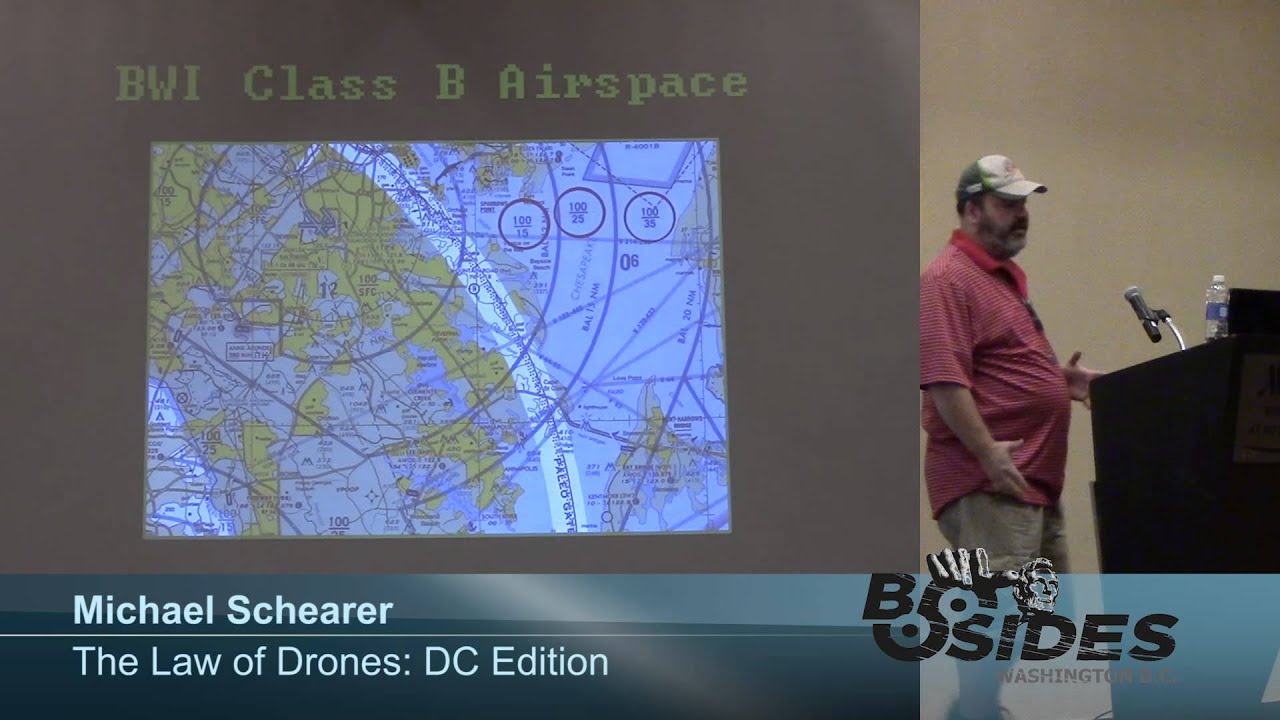
doesn't have a camera on but it is a drone it flies the FAA says that they would have the authority to regulate me doing that maybe so just as an example i'm going to show you this is a flying chart and i'm going to show you the air an example of what the airspace looks like over bwi airport which is where i live so you see the airport in the top left there and the numbers inside the concentric circles will show you what the airspace restrictions are so in the innermost circle surface at you see 100 and then a line and then sfc right here that means from the surface to 10,000 feet is controlled and then then 10,000
feet or 1,500 feet to a thousand 2,500 to 10,000 3500 to 10,000 so as you get further away from the airport the lower air space is free because there's no there's nobody using that airspace control
so after 911 so you can see the BW iris there are three major airports in this area Dulles Reagan National and bwi and after 911 the FAA established a the DC area flight restricted zone this is a temporary flight restriction for 14 years and anything that's inside the red line is inside the flight restricted zone and you cannot fly there without permit out permission or talking to someone on the radio from the FAA and that goes out I think 25 miles so it's a pretty big area so I live in south of Baltimore and I live under this area so theoretically by the letter of the law I can't fly a drone at my house because I
might be a threat to the White House or something I don't know this is the current picture I mean this is what it looks like we'll talk more about this I want to talk now about the current state of the law so what we talked a little bit about the history we talked about the development of aviation law and how that impacts what we're doing we talked about what the airspace system look likes so let's talk about the integration of drones into the National Airspace System so in 2012.the the congress passed what's called the effort at faa modernization and reform act and the law actually had a section it about drones which they refer to as unmanned
aerial systems and they put in a place of temporary rules which are in place now and the temporary rules are essentially this if you want to fly a drone for Hobby purposes you can do it there's some guidelines which I'll show you in a second but you can do it if you want to fly a drone for commercial purposes like say you're a real estate agent and you want to show you want to use your drone to get video of the property or let's say that you're a wedding photographer or let's say that you get hired by a golf course to do flyovers to the holes so that you can so they'll have to hire a helicopter all those are
commercial uses and those are prohibited without with without an exception from the FAA so that's what the law says and so the FAA put out a circular in 1981 this is before drones but this is mamata this applied to model aircraft and they consider drones to be very similar to model aircraft and they said if these these are the rules but these were the rules from 1981 until about a month ago if you're doing it for hobby or recreational use you stand or 400 feet notify a tower when you're operating within three miles of the airport important to note notify the tower not you don't have to get permission you just have to notify them and then you
have to follow community based God safety guidelines and there's at the AMA and there's some organizations out there for from model aircraft and drone pilots that have come up with their own guidelines about how you should fly and this is so this is what the FAA says you should do if you want to be a hobby drone user so about a month ago they revised the circular and that the only thing really that they did was they changed it from three miles 25 miles and then they stressed in the in a circular that even though we kind of let you do whatever you want if you if you fly in a dangerous manner the FAA can still bring
an enforcement action in it enforcement action against you and to date there's really only one significant case that I'll talk about where the FAA brought an enforcement action against somebody for flying a drone and we'll talk about that in a few slides this is the current state of the law for drones hobby or recreational use under four feet within five miles safety guidelines when the government salute the government we talked about how the commercial use was a temporary thing that's in place and that's temporary until the government comes out with a rule when the government wants to make a rule they have to do a proposed rule and so they publish it on regulations gov and then people you me anybody can
go and make comments on the rule and many of these new regulations now get thousands of comments and they it closed in April but the rule with the summary of the rule was this it only applied to commercial uses so the again the Hobby drone use was okay the current rules before this proposed rule was to fly a drone for commercial uses you had to have a private pilot's license seems a little odd the proposed rule would require that you don't have to have a private pilot's license but you would have to do pass like a written test about learning about the airspace and things like that under 500 feet and 100 miles an hour line of sight and only
during the day and you can see someone like Amazon coms gonna have a lot of problems with this right they want to use drones to deliver packages to your house well they can't do that with line of sight and daytime restrictions it's just not going to work for them so Amazon and other companies or about doing most of their drone testing outside of the United States because of the current regulatory environment so this is the proposed rule would probably come out sometime next year as a final rule and then when it's published in the Federal Register it will be the rule I mentioned a few minutes ago about there's really just one case that's been
litigated and there's a guy named Raphael pirker he was hired by the university of virginia i believe to fly a drone over their campus and take pictures and videos for their for one of their publications or something like that and he was flying over the campus and at some point he either flu too low or he scared somebody I don't know whatever happened so somebody complained and the case really came down to whether is drone is an aircraft and the reason this is important is because the FAA defines what aircraft is and if someone's not something is not an aircraft then the FAA doesn't have authority or jurisdiction over it so my mouse is not an aircraft so the FAA
cannot just regulate mouse mice because they want to they had can only regulate aircraft so the FAA brought an enforcement action against him and they ruled against him and then he appealed it and the case goes to an administrative law judge within the FAA and they reversed the case and then the National Transportation Safety Board which is the next level of Appeal reverse the case again against him and then before going to an actual article 3 court the case was settled so they tried to make him pay of ten thousand dollar fine he ended up paying a thousand-dollar fine the important thing to remember here is that all of this took place within the administrative law
context so no this case never actually reached an article 3 court when I say article 3 chord I mean a judicial branch court federal court or state court or whatever so this case is interesting but whether this is certainly not the final word on whether a drone is an aircraft but this is really the only significant case that's been brought so far and i had my presentation done until yesterday I read about this and it sounds like the department of transportation which is overhead of the FAA is proposing a and they'll probably come out with this on Monday this with the rumor in national drone registry which whereas when you buy a drone you're going to have to
register with the federal government which seems a little much maybe register your drone with the federal government obviously they don't they're probably don't care about toys but if you have like a larger drone like a DJI phantom which I have then they're going to want those registered so keep in mind that even though the FAA has authority over automobiles automobiles aren't registered at the national level the registered at the state level all sorts of things are not registered at the state law at the federal level yet the FAA or the and the department transportation is going to propose this so this be really interesting I think there's gonna be a lot of pushback against this rule and when it comes out
on if it comes out on Monday I think see a lot of pushback I will be one of those pushing back yeah I'm so there will be some kind of registration fee of course and you know so I want to talk about some of the things you may have seen in the news recently on drones and talk about their applicability and then we'll just this is a DJI phantom the one that crossed on the white I crashed on the White House lawn in the spring so most of you have heard of this case probably so a guy goes to a party the guy is a government employee by the way goes to a party he's drunk and it's not
his drone is it's his buddies drone and he says hey man could I fly a drone of course and it's one of those you know hey watch this you know or hold my beer you know flies the drone around Washington DC not to feel about three ball three or four blocks from here and somehow loses control of the drone and doesn't think anything of it wakes up the next morning and sees that someone crashed a drone on the White House lawn and so he owns up to it he said I think that might have been me and so yeah that put a lot of spotlight on the drone in the drone community that probably we
didn't want because if you can imagine this is not quite the worst thing that could happen but it's pretty bad because now the federal government is like well and and everybody wants to know how can we stop these things how can we control them how can we register them you know the secret service now is doing testing on how what happens when the next person brings it brings a drone with explosives or you know whatever you know who knows maybe they'll use a drone to carry drugs yes they've tried that this happens this happens like every few months now somebody try to smuggle drugs across the border using a drone and so this I mean I can just tell from looking
at this they've tried to put far too many drugs on this drug I mean there's like several packs on the ground if you just did like they were getting greedy do one or two and it'll probably work there was a case in just a few lot of case but it was in the news a few just a few weeks ago or a month or two ago you've seen people try to smuggle things into prison with drones cell phones drugs all kinds of things somehow they always crash amazon and other companies are looking at drones for commercial purposes like i said they can't they can't really test what they want to do in the united states so they're going to
Europe and other countries where the regulatory environment is not so bad because they can't do like they can't they're their delivery system is going to require them to fly outside of the line of sight so whether or not the the rule makes some kind of exception for this we don't know so this may or may not happen if the rule comes out the way that the FAA wants it to come out it's going to kill this this potential option I read about this case in this is from Lebanon but they're also doing this in Australia and a few other places on beaches where they this is called The Guardian where they just put a life
preserver on and then when someone's out in the water drowning or is in trouble they just fly the drone out and drop the life preserver before the lifeguard has a chance to even get there so this is one of those cases where like this is a pretty cool thing right i mean if you got somebody who's you know a quarter-mile out and they're struggling it's going to take the lifeguard a while to get out there if you can just get them something to hang on to people have also done testing with Aedes and other medical devices and ways to get using drones to get things to people real fast when they may not be available so the
point of showing these things are to show you there's a lot of cool things that people are developing uses for drones and then there's the government regulatory side and we have to find where we can operate within those guidelines but still be able to do cool things this is a circular put out by the Forest Service you may have read a few of these incidents in California where there's like a forest fire somebody's trying to fly their drone over it and then they have to ground the aircraft and it's a big mess and they're a couple of cases where that this has happened and a couple other cases were surprisingly and shockingly misinterpreted by the media so in one
particular case there was a there was a fire going on and it just happened to be that the area that a lot of the locals fly their drones was somewhat close to that area so it wasn't like they said hey there's a fire let's go fire drone over it it was more of like the fire just happened to be in an area where people normally fly drones so but of course that you know how the media is and they want to make it a story so but it isn't it is an issue I mean you have to think about this idea of you know interfering with with firefighting efforts these people they're out there working hard trying to save people's
homes and people are flying drones in that area so it's it's not something you could just easily dismiss somebody want a million dollars for this one it was like at a one of those prize things and it's it's basically a drone that has this like flexible structure around it so when it crashes into something it just bounces off so it's a crash-proof drone there there's drone film festivals now this is like totally if you think about it it's kind of interesting because it's it's not really about the drone it's the drone is just getting you into position to take really cool photographs but they have this is one in New York City that they have and if you
look at some of the videos they're pretty cool I mean there they just look like you know really cool documentaries you may have also seen I don't know if my wife watches like HDTV and all those like how Center shows and you may see a lot of shots in those shows where you see like sort of photography of the home from the outside and it's pretty obvious when you fly drones and you watch those shows you'll see like you'll really notice that the use of drones for photography for those types of shows so another thing that's been in the news that I want to talk about our privacy issues and of this psych think came out of Colorado
and then we're going to the town is going to issue like drone hunting permits to their citizens
I have no words for this guy but so how many how many of you own a go pro or a similar type of camera fair amount of you few of you what can I mean so a GoPro camera which is the sort of the most common type of camera that you'll see on a drone it's a wide angle lens right so the idea is to get as much sky as much view as possible at the expense of I mean there's no zoom obviously so I'll show you some videos but the privacy issues here I think are probably overblown a little bit the reason being is a GoPro cameras about the worst possible thing you would want if you
wanted to spy on somebody with a drone I mean it's not like as a telephoto lens there are other things that you're going to for people who fly drones you're going to have eventually you're going to have some kind of interaction with law enforcement or government officials most of mine have been relatively positive this is an interesting photo because it's was taken by one of my friends and the the police they they saw him flying the drone and they kind of he was standing right on the sidewalk and they just stuck their head out the window and they challenged him to land it on the car and he declined which was a smart idea but for the most part the people
that I have talked to having done an informal survey most people's interactions with law enforcement and government officials have been generally positive most most people if they're if they're reasonable they think it's kind of cool and as long as you're not doing anything dangerous there for the most part they're going to let you do what you want to do unless it's like in New York City and then your terrorist but you know I will talk about that I will talk about that I have a slide for it so we talked about the government sort of backdrop in the government regulatory environment we talked about all these this is just scratching the surface of uses of drones
I want to talk about what are the issues that come when we try to put these two pieces together so first of all what i would call patchwork lawmaking right so we have federal law right so Congress passed this bill the FAA is putting out rules so there's federal laws we have to be aware about state law states or passing laws about drones in some states have passed laws that for example you can't use drones to aid in hunting or something like that maryland where i live just passed the law that says only the state can pass drone laws the local governments can't pass their own drone laws then you have city county regional government authorities i was flying in a
state park area in a county park and they have some rule against flying model aircraft in the park so they told me to stop so but you would not know that unless you knew exactly every where you're going so that you have this patchwork laws if you wanted to go right outside the hotel here and fly like how do you know if you could fly it or not who knows well we're in DC so you really can't but there was the case in up in Connecticut earlier this year there was a traffic accident and there was a guy who lived right nearby and he happened to be a news photographer for he was a stringer for a new station so he flew
his drone up over the over the site of the accident and they asked him to stop flying and eventually they ended up arresting him and he ended up losing his job because of it so he sued the police officer for for arresting him because he said it was a fair this First Amendment right to fly the drone this case came down so I don't want to get into the whole thing but there's an issue with immunity so police officers essentially have qualified immunity when they're doing their job so he did win the case it doesn't mean there's not a First Amendment right to fly drones but it's just it's one of those cases that's out there we talked about so we talked
about regulations statutory laws now we're talking we're getting into constitutional issues right for First Amendment we've got the Fourth Amendment issues with you know can I fly a drone into my neighbor's backyard to peer into the window or to you know whatever and so you see that there's there's a lot of stuff going on here and what would be a drone presentation without some video so the reason I chose these videos because they fit the theme of what I'm trying to show so this is a really quick one I won't show the whole thing but this is just something example of something you can do this is the Annapolis field annapolis mall and I planned a route on
it Google Maps essentially plotted waypoints and said fly here do this at this altitude turn here etc completely automated upload the routes of the drone this is flying at about 200 feet so I'm just to give you the idea of what a GoPro camera looks like it from 200 feet so what you can see and what you can't see and I pray that this works and
No
always have a backup so I'm just going to show real quick a little bit of this so I'm in the parking garage on the top of the parking garage and I just hit the drone just took off and it's just going to fly around the outside of the mall around the parking lot it's flying at about 10 miles an hour and it's gone oh hey it would be helpful
so this is flying at about 200 feet with a GoPro so you can end in the cameras angle that about 45 45 degrees down so just to give you a sense of what 200 feet would look like from a drone I mean you're not really going to be spying on anybody from here I mean it's just sort of the nature of what you're doing but it's pretty cool this was the first time that I had programmed a route and hoping and praying that it came back cuz it's not cheap you know okay but that's just to give you an idea okay so the battery life 20 minutes that route was about it ended up being about
12 minutes or something like that okay there's another one I want to show you here and this is sort of an example of why as a as a drone pilot you might want to have a little bit of knowledge of what you're doing so
so this is a guy flying his drone and obviously and he's done he's he's starting to come down he's descending so he's pulling the throttle back and things don't go well
he calls it the wobble of death and that's not really a scientific term but I'll explain it his drone is starting to do this so he and he's falling out of the sky so he puts full power on to it and the camera is actually pretty stable the drone is actually moving around quite a bit you can see the propeller
anyway it didn't end well he ended up crashing the reason I show you this is because
just do this much easier so there's a thing called vortex ring state any we have any helicopter pilots no so there's a thing called vortex ring state and the idea is that when your fly when you start descending in a helicopter or a drone the prop wash from your propellers it gets recirculated into the above your propellers where your try your blades where you're getting lift so you get this circulation of dirty air and you're essentially have no lift and when you add full power like he did you're just you're feeding the problem right so this actually happened in on the bin Laden raid in Afghanistan one of the helicopters crashed it's because of this
this is what happened they were trying to land in a courtyard so the prop wash was coming down hitting the walls of the courtyard and then coming back up and that's what happened so going up is almost always a safe way to get out of the drone incident but this guy did in the one time when you can't add full power what you have to do is move laterally out of the out of the air that you're in and get into some clean air
this is a guy flying over a half of a fire an active fire with his drone think this will work out
so
just you know
now you this man was this is the K this was that of Kentucky a few months ago guy was flat there was a drone flying over his property and he shot it down with a shotgun and he was arrested so just to give you a sense of they actually I won't show it because I'm running a little bit short on time there's a good video from the drone that got shot down he was flying at 200 feet so as high as I was flying over the mall that's how high the guy with the drone was flying over this guy's property claimed it was like 20 feet above his house it was not so he shot it down so and he got
arrested so what this really comes down to you probably is not going to have anything to do with the drone this is coming this is going to come down to firing and take shooting a firearm into the air is essentially reckless endangerment and you're going to get that regardless whether you're shooting at a drone or a blimp or something else so yeah you have a question so he's asking about the hose that the firefighters you know it that Kate there's no case there right now with the guy with the firefighters shooting the water it whether whether you can do something like that that you can try and if you want to go to court and try to
prove it but it's again like I said these areas haven't been litigated in the courts so whether or not you can do it who knows
like that again who knows so here's what I would say I'm not a lawyer here's what I would say from my perspective if this device is sort of violating FCC regulations for what it's doing maybe you right so right so you the best so you guys are coming down to the critical issues here it's it really doesn't matter about the drone it matters about how you're doing it so if this is operating within the ham band and you're using your call sign and you the drone just happens to be where your you know maybe you can get away with it but I don't know I think that even this is probably getting a little oh we also
have the anti drone drone so I want to close with a few slides just like I talked about how do you know what to do the FAA just came out with an app called before you fly and because it's the government they only let a thousand people into the beta and so unless you are one of those thousand people you can't use it but basically what it does is when you turn it on it will locate you on the map and then it will alert you to airports heliports aviation area things that are around where you're at so whether or not you can fly or not just federal just federal so you have a question too
it's the first people first thousand people who signed up for the beta got it and it's already closed so there is a website called air mapped i/o and you can oh you can click on whether or not you want to do commercial use and then it will have generally federal airspace regulations but it will show you what's around you it's it's a different version of the FAA website there's a website called no-fly zone org where you can register your house and then supposedly people won't fly over it it's probably a waste of time the idea of this site is that you register with this site and then drone manufacturers would use the database to program like geofence areas
where you can't fly so for example after the White House incident DJ I pushed firmware to their drones to that you if you if you try to take off by the White House if you won't it won't take off so don't update the firmware I have a Facebook page called the law of drones just post interesting interesting stories about drones commercial use hobby use laws regulations a lot of the stuff that I've talked about here so if you're interested you can look at that and I will open it up for questions but before I do that I'm going to this will just totally distract you from asking questions but I'm going to play it anyway because it will be you enjoy it I
think
so I've got about seven minutes and questions
not really so what you're likely to see in the cases of drones falling on property or maybe causing damage is probably going to be the same kind of case that you have like a car accident right if your drone falls into someone's house and causes damage it's sort of just the simple insurance torque thing I told I told you this would distract you from asking questions yes
you
right
right
right it everywhere is different this is this is part of the problem this is part of the problem of what I talked about this patchwork law making its depending upon where you live there's different laws that apply and most people are going to open these drones that they get for Christmas and they have no they're going to not going to have any idea what they should do or can't do or can do so States will try if they if they don't like drones they're going to try to apply laws that they have to to prevent you from doing things right sure I mean right right so the question is what can you do if someone's like Stolte like
someone's essentially invading your privacy with the drone we have laws for invasion of privacy there torque things you can do that really don't involve the drone it involves the invasiveness of what you're what they're doing so pretty much everything that you could do with the drone pretty much everything you could do with a drone there's already laws out there to protect people against that yes you can't maybe shoot it down right then but you could elite you can call the police and explain what happened and maybe you have some kind of the case against them that's true it's true that's true but that you know what that's going to happen with any piece of technology I mean you get any any all
every hacker tool in the world has a bad use right I mean so the question is what's where to draw the line and what's going to happen is in the next year upcoming years it's it's going to be the government is going to push the line this way and consumers and advocates are going to push the line the other way and where we meet in the middle and nobody knows right now any other questions yeah
right so his question was how do you reconcile the DC no-fly zone with your ability to fly in the area that you control in your yard over your property nobody knows because nope I hate I hate if I gave you an answer it would be wrong because there is no answer it's going to take someone flying over their yard and then getting arrested for getting an enforcement action for violating that and then taking it to court because they're there haven't been there just haven't been enough cases for anybody to know what's going on that's not going to end well
they're usually in like 2.4 gigahertz or yeah so I mean you
right i mean all of these things that you guys are thinking about as hackers it's the same stuff you know everyone's thinking that we're thinking about and it's a matter of can you do it and and who knows if you can do it you know I don't know right and and I can't tell you to go to you can try it if you want I'm not telling you to because maybe the FAA will make you the guy they come after but what's so interesting about this field and I'll just close with this is that we this is sort of
how could I not end on that one by the way that was his just give you an idea of why it happened that was his first flight with the DJI phantom so that you're talking another twelve hundred dollars and and he lost if you lose communication from your controller to the drone it will it will automatically go back to the GPS coordinates where you took off and apparently he took off very close to that canal and so he did save it but yeah what I wanted to close with was this is a really even if you're just even if you don't care about the law part this is really exciting time for drones because it's it's a nascent
industry in terms of the government and how the government is going to deal with it and like I said there's so much that is so much is going to be done in the next few years it should be really interesting to watch thank you for your questions and thank you for coming today
Related talks
 32:24
32:24 35:42
35:42 55:38
55:38 47:55
47:55 44:22
44:22 35:21
35:21