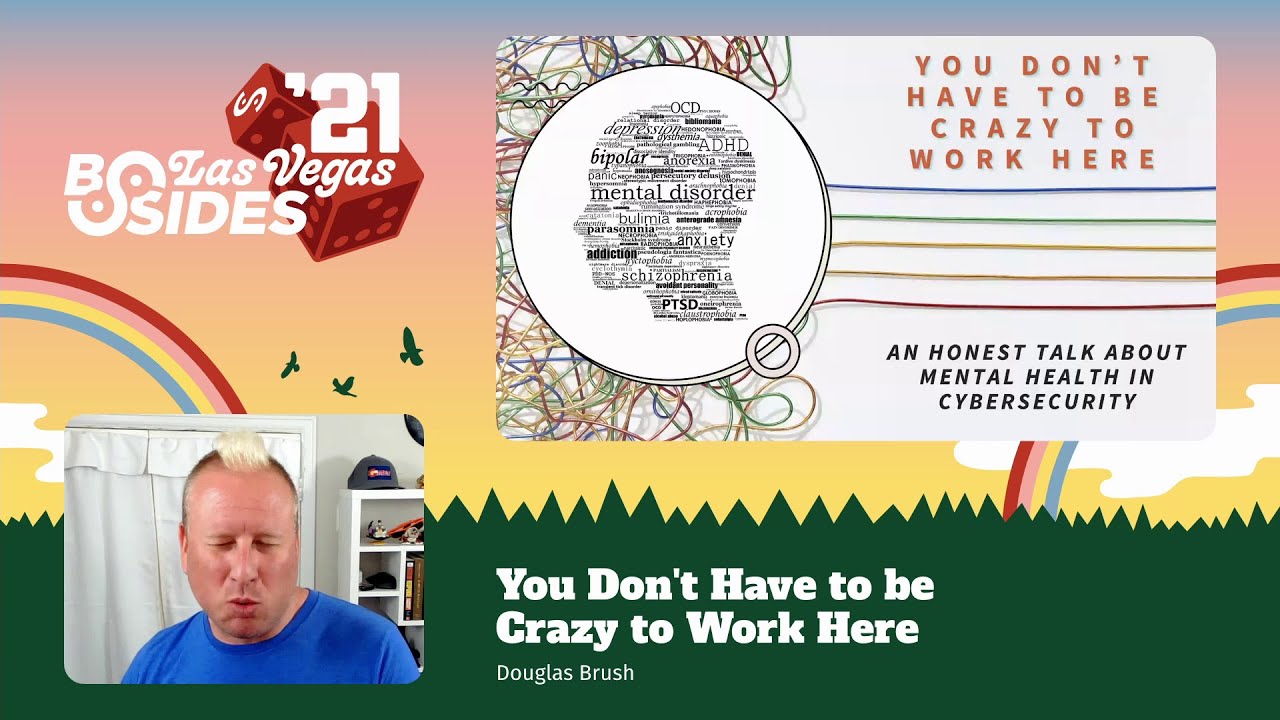
You Don't Have to Be Crazy to Work Here: An Honest Talk About Mental Health
Show original YouTube description
Show transcript [en]
so next up we have douglas brush talking about mental health with a great talk title you don't have to be crazy to work here but it helps now mental health has been a great theme in cyber security infosec because it's so easy to bump into the edges and the limits of what we can actually do as humans and so doug has you know over 25 years of experience in the technical world uh he's been involved in policy he's been a court appointed master which is apparently not quite as kinky as it sounds uh and and doug's going to talk about the stigma around mental health and the importance of being open and honest around it
so whether it's for you or those around you please pay attention to this talk this is a very important issue for all of us
hello everyone and thank you for joining i am douglas brush and i want to talk about something that i think needs more attention in our industry mental health and self-care now it seems easy it seems easy to say but cyber security professionals spend most of their day focused on the health and well-being of the environments in their care however the cost of reducing risk and keeping our network safe often comes at the price of our professional's mental health many information security professionals they burn out suffer from anxiety and depression and turn to unhealthy coping mechanisms which really only further exacerbate some of the underlying psychological and physical health issues so my goal with this talk will alleviate
the stigma around mental health and stress the importance of open and frank dialogues about this serious issue impacting our community i'll share my journey reverse engineer the stigma mental health and business and look at ways we can kind of hack mental health in productive and meaningful ways i do have one ask i know we're not in person together so i can't look you down at the eyes and make sure you are doing this but please focus on me the slides and what i'm saying so put down the phones don't be distracted mute the alerts and let's work on this focus together so let's get started i do want to warn you that there will be
some uncomfortable subjects as well as triggers and triggers are those things that to put it mildly haunt us and when discussed can make you feel like you're experiencing past trauma sometimes you don't even know why it's happening now recently i was listening to a podcast on mental health and the gentleman that was giving the um the talk had said something along the lines of early childhood abuse and started going in these stories and i'm listening and all of a sudden somebody felt myself very upset and like almost shaking and there was a subject matter he was talking about something triggered something in me to this day i don't know what it was uh but i had to kind of walk away from
it so to that do not feel that you need to sit through this if you start feeling bad please turn off walk away re-center do not try to tough it out and also i'm not a doctor nor do i play one on tv this presentation's information is not intended or implied to be a substitute for professional medical advice diagnosis or treatment all content including text graphics and information is only for general information purposes i my employer b-sides make no representation assume no responsibility for the accuracy of the information contained in or available through this presentation this is not medical advice please speak to your physician before embarking on any treatment plan and please above all else never ever
disregard professional medical advice or delay seeking medical treatment because of something you heard or saw in this presentation and i do want to talk a little bit about what some of the definitions are mental health being the first you know those kind of topic we're really going to dig into today and from health and human services says mental health includes our emotional psychological and social well-being it affects how we think feel and act it also helps determine how we handle stress relate to others and make choices many factors contribute to mental health problems including biological factors such as genes or brain chemistry life experiences such as past trauma or abuse and finally family history of mental
health problems so self-care when we talk about that is an activity that we do deliberately in order to take care of our mental emotional and physical health these are not passive actions per se but something that you really lean into they're self-initiated and self-controlled neurodiversity which has become a much more discussed topic in business terms these days is and really i pulled this definition from a few sources so do your own research but neurodiversity is the idea that neurological differences like autism adhd mood and other functions which have historically viewed with a negative perception are just the result of normal natural variations in the human genome and so this represents a new and fundamentally different way of looking
at conditions that were traditionally pathologized it's a viewpoint that's certainly not universally accepted although it's increasingly supported by science so neurodiversity advocates such as myself point out that neurodiverse and neurodivergent people often have exceptional abilities alongside what society has labeled as disabilities and neurodiversity should not be looked at as disability but due to the time constraints and not to completely firehose you with too much information we're going to focus on mental health and a little bit on self-care in this presentation however i ask you to please do some research and try to promote neurodiversity and mental health in your workplace because a lot of this heavily overlaps and about me you know why am i talking about this
i've been in front of audiences for about 30 years i started presenting on technology at local conferences in my area could have been you know everything like a a local business meeting to larger larger meetings with hundreds of people but this was in my my teens i'm now in my 40s and going forward i want to focus on different things i can only do technology technology presentations so much so my goals going forward around mental health and diversity equity inclusion so yeah i've been doing this for a long time this is 26 plus years probably gotten closer to 30. currently my role is at splunk and i'm a global security advisor so basically you know the joke on my linkedin profile
is kind of the cso whisper where i go in and i talk to security leadership about their program i've served as a cso i act as a shoulder to cry on so i get to hear a lot of things that work and don't work um and i get to see a lot of the program development see a lot of these individuals struggle with getting their programs off the ground and often it's not just technical it's the stuff that wears in on them as individuals as leaders so this is why some of the stuff started coming out particularly as i got into leadership is wow a lot of us are struggling with this and so it also led me to be part of the
neurodiversity employment resource group at splunk where i co-chair with the very awesome stephanie hoffman who i'll give a shout out to but she and i well she's actually the lead the founder of the group and and runs it but she and i co-chair the community engagement group so we go out we reach out to individuals at b-sides we'll be having a def con um mental health hackers village please check that out and we're going to work to continue to reach out to folks in the community other erg leaders to promote this idea outside of all that i love cooking getting outside spending time with my family in the outdoors but again i've been doing this a long time you
know when i think about my incident response roots and that's really where i started in cyber security was running into the fire going to save the day if you've done incident response or even litigation you know that 4 pm that 5 pm phone call that you're inevitably going to get that's going to ruin your weekend but you switch it on and you go this is a plaque i got in 1986 where i kind of think about wow this is really that's been something in my dna for a long time that i had helped somebody on a ski trip a friend of mine had fallen and gotten hurt and he ended up needing medical care he's sitting there
crying he's a ton of pain i went and got people i brought him to where he is helped the situation and i got an award for basically helping with that because in the end i kind of equate to some of what i've done in my professional life as almost being winston wolf the wolf from pulp fiction people call me in the worst situations to come save them get rid of that dead body put out the fire whatever it is and i can do that day in and day out sometimes with seemingly no sleep but it takes it takes its toll and it's not always what you see on the surface that matters because i have a lot of anxiety that's
led to depressive issues of obsessive issues and there's things i worry about it's this monster in the closet it's a thing that sits below the surface that yes while i can go in and i've done these global incident response lead engagements in just crazy situations doesn't bother me but i know in the back of my mind when i was right i bumped into somebody on a subway seven years ago in new york city and it's insignificant but it makes me anxious to think about god i'm such an ass like what did i do like it just makes me feel awful about all these little small intercon inconsequential things but i obsess and i worry about these things
and that's the dialogue i want to change because i i'm starting to find is more people i talked to is i'm not alone and as we do cyber security actually andrea lombardo said it really well in an interview a few years ago she said you know there's never down time every day is not it's a non-stop battle every day that just saw syncs with me because it's like every day we seemingly have to be right all the time attackers get to be right once or a series of ttps if you exploit a number of vulnerabilities but depression burnout and even suicide are becoming more and more common among cyber security professionals and depression is the leading cause of
disability in the world following heart disease according to the world health organization and people with mental health conditions are the highest risk group for suicide and there was a study done in 2019 from nominate and i encourage you to look it up it was really just focused on csos and security leaders again the folks i deal with the most but it was this global study of cyber security professionals ninety-one percent of the cso surveyed said they had high levels of stress that they were suffering sixty percent of them rarely disconnected from the work role eighty-eight percent worked more than forty hours a week and twenty-seven 27 worked up to 60 hours per week 89 of the us-based seasons have never
had a two-week break from their job most feel that their teams are underappreciated by senior leadership almost all feel that there is a breach inevitable however only sixty percent of the ceos in their organizations felt the same way and a third felt they would lose their job or be written up if there was a breach so there's no surprise there's this high turnover and most don't stay long in their jobs they're getting burnt out and beat up it's a lot to take so again think about that and when we look at cyber security as a whole program and how we're trying to secure enterprises and organizations that and again i've seen this working with csos that
it takes at least 18 months to really start affecting change so we have this slow ramp up for a year where they really can't get a lot done and then things start going well about for three to four months they get burned out then a new cso comes in same misalignment with management and they leave again and it becomes this vicious cycle and you can see why a top-down approach and we say in all aspects of security needs to happen with the human element too but this top-down approach is need needs to address um mental health issues and with leadership and look mental health conditions come in many form but the stress that people experience either can
exacerbate some of these conditions or even bring out some of these on underlying conditions to early onset and acuity so we just put these people in these this pressure chamber it's no wonder things start to break so stress management is a huge root cause for episodic symptoms of these underlying diseases that are now seeing folks read their rear the ugly heads and then what does cyber security professionals do if you're watching this now you're probably missing vegas or you're in vegas but whatever go to alcohol drugs script clubs the party scene to blow off some steam man that's not for everybody look i love going out having a fun time but jamie tomasello who spoke at black hat
into 2018 talked about the stigma she faced being a recovering alcoholic in a culture that pushes us far too hard to work and to party too hard so as a community i'm sorry we've done a piss poor job of helping each other here and i said i'm not i'm by far not for against going out for drinks having a beer on top of the office office but alcohol should not be the only answer we need to find some better balance and i that's why i'm having this talk i admit i've been really bad with it professionally with staff and clients it's like saying well it you know it's too much work just install av and
you're good to go but there's no silver bullet to deal with our attackers or our health so we know that's not true in our computer networks to just wing it but we seem to avoid multi-faceted layers to approach and maintain the health of our neural networks so we need to change this and look the last year sucks for everybody and it's adding in these other external existential factors and it's been a really hard year work school loss of routines and schedules this all adds to stress to people honestly until recently it was the longest i've not traveled my professional career i miss seeing my friends all over the world i miss being on stage and not
doing this with you folks in person right now i miss doing this doug show in front of clients and customers i feel completely off my game when i'm not in person and like i'm not looking for pity but to say you're not alone to feel that your life has been completely upended in the past year multiple times today a day i talk to friends and family that are really starting to struggle and continue to struggle with this because we're not out of this yet and i would do anything for those close to me but i feel powerless at this time right now i can't sweep in like i normally would in crisis situation just fix things so it's really stressful for
me and i know other people and there was this one thing about this term this idea of languishing and it's this unrelenting horizon list of a covered world as i once read and it just eats at people and the consequences can be dire the long tail effects of what we're dealing with now can be devastating suicide rates are on the rise even in my home state of colorado and it's grim people feel helpless but i'm an old school new york city punk hardcore band kind of guy and one of my favorite bands hco had a line in the song that sticks with me forever and it's i'm helpless but i'm not hopeless and you gotta kind of keep that positive
mental attitude as tough as it is and you have to face these problems we have to talk about this mental health cannot be avoided as a topic in cyber security any longer so i pledge to this community is to raise awareness and remove the stigma like i don't have all the answers and i won't pretend to but i will not be shy to talk about this issue and we're hackers we can figure out a better path forward together you know corona aside which is obviously a big elephant in the room which only exacerbates these underlying issues we still do some root cause analysis on this profession itself and so as i started to look at it
how do we get here right information security as an industry is still relatively new it's in a way a frankenstein monster that's been brought to life by i.t consulting ops legal compliance privacy and i think right now we're kind of in our teenage years and we're having a little bit of an identity crisis and so with that i've also thought back so i feel like we've adopted a lot of good practices from businesses but also a lot of negative there is far too much pressure to work harder work longer you know just tough it out just aggression aggression aggression look i do well in that i'm a type a personality um but it comes as a cost
which we'll talk about at least in my journey and look this mental construct does not work well for everybody of just being in the pressure chamber the staff i've started to hire over the past decade have wanted a better work-life balance money titles glory all the things that they threw at me when i was entering consulting in in the professional world it's less important it's harder to incentivize people with that so as an industry i think we need to have better answers to what people really want what their needs are and i have some ideas and i'll show where it works financially but we'll continue to have to adopt and test it and i want to hear what people are doing
to kind of face these struggles of giving people a better work-life balance and like one other thing i do want to touch on before i get into my journey that it's it's weird right it's like lives can be on the line if you're in certain industries with cyber security but often it's it's not you know one of the things that i try to reframe my perspective is look we're not curing cancer we're not delivering babies i think a lot of that started to change now with concerns on industrial complex uh controls things like that but for the most part most of our day-to-day jobs the anxiety levels need to come down but you know when i was in i.t it there
was other impacts and effects that were less stressful and i'm just saying i'm going to give it to us that we do have this weird thing with us is that again if i patch a server in i.t all right nothing's really going to be that bad but a you know we roll it back and whatever but a breach that's not just a technical problem that means a human did something that allowed a breach to happen and that always weighs on the individual that has to absorb that moment and it's no one prepares us for that um and again it's this feeling that we have to be all right all the time or else that something is going to happen and if we
don't the world's going to end and again we have to mitigate that stress level but in reality there are some really serious situations and we need to help each other get through that because it's not fair healthy or scalable to continue to put all of us into this pressure chamber so let's talk a little bit about my journey born in 1976 new york city grew up in the east coast and it was an interesting place to be at that time i had three older half sisters uh my mother and father were recently married my dad having with three daughters from the prior marriage and i was surrounded by a lot of type a's i mean people that were driven
back behind me i have multiple books that my sister and my parents have written my sister was a youngest humor writer on the new york times bestseller list my parents have six books on corbett communications taught it my mother was a business editor at a paper also the ceo of her company my sister the oldest is the the writer but the youngest was right now still is the largest broadway tour manager on the planet she's a producer of hamilton so i have people that drive and it's always pushed me i've always felt that and i also felt like i never fit in you know i was not that person that did well in high school as i know many of you
were i was a hacker skate punk i didn't belong there and i basically saw my way is like i have to deal with these people and get through and funny the administration was basically at the level of if you cannot ferris builder your way out of this we'll look the other way you just get through this don't cause any problems for us but do not start like dumbledore's army and have a revolt they were worried that i would create too much weight i didn't get along with people anyway but i just didn't fit in there and it stressed me out i got beat up i got bullied a lot um i was different and i was made to
feel bad about that and so i cuz mostly because i see the world differently i think about the world differently i approach problems differently yes it's been rewarded in my professional career but when you're a teenager that non-conformist does not bode well for you and i didn't know how to process or deal with that again i have parents that are just go go go and i'm like what do i do so i actually had an early you know by small group of friends i decide oh you know we'll blow off some steam and i smoked a joint i'd never smoked weed before it triggered a massive panic attack for me in a way that lasted for days i
thought i was dying um i couldn't deal with it and what had happened is whatever i had consumed or smoked it had triggered something between my synthetic and parasymphatic nervous system and so the symphatic nervous system prepares the body for the fight-or-flight response during potential danger on the other hand the parasympathetic nervous system inhibits the body from over working and restores that body to a calm and composed state that wasn't happening for me something was off for days it was bad i i i could get through things i was my parents i took told them what happened they're really fine we're from the 70s i've smoked weed before but they were like all right we'll take you to the hospital
go to the hospital checked out not dying two days later and i'm dying go back to the hospital i can't breathe heart attack i'm 16 17 years old i'm gonna die now fine blood work looks great actually finally like the fifth round the one of the doctors said i'm gonna panic attack dude i'm like what's that like it's all here and you're it's manifesting itself in physical uh symptoms it's like yeah you need to go talk to a psychiatrist and i did and it helped out it got me the care that i needed but it took rounds of that it took finding a doctor to even tell me the right feedback which was hard and i really in that 1993
i remember it was just brutal i never felt so disassociated with the world and everything was broken but it ended up getting better and i went on with my life and i decided i was not going to go to college because most of the things that i was doing wasn't taught at college network computer networks internet they wanted me to learn mainframes who knew that after cover that cobalt would have been a useful skill but it's not where i wanted to be so i started my own business at 18 19 years old i'm out there putting up web pages i started a business doing land networking and i started getting big customers big fortune 500 customers
and going on site and doing all this work and i'm travel travel travel um and doing well financially and but i'm also my peer groups are in college so i don't have like a close group of friends now i'm just in this weird spot and i kept going until i burnt out i never took time off and i just kept going in my system collapsed and the same thing happened again i had this this second kind of nervous breakdown where my body just gave up on me it's like you need to cut this out god can't help again but it was really disruptive you know at that point thinking okay it was never going to happen again and
this idea like crap i broke myself or there's something wrong again but it kind of went on and things got better and they continue to get better it was this weird point in around you know i was met my wife in 2006 married 2008 kid by 2010 and i switched over to corporate world from being an entrepreneur and i went through these series of things really quickly that we're very uh just changing life-altering ways out of perspective things now i'm working in corporate environment you know we have health care for the kid but i'm don't have full control of everything i just kind of felt like who am i what am i doing and i
just became bluff because that depressed that slow depression that just lasts for a period of time where i just didn't feel right and i was disconnected from my family my daughter i didn't feel great and i just kind of went through things um and then there was a moment where my mentor who i'd started business with at a company was unceremoniously fired in front of me for no other reason than cost cutting and he they gave the reins of the company over to me and all of a sudden i'm like okay or the internal group to me and i have all these employees now that are direct reports to me that i was helping managing forward now everybody's looking
at me what do we do and i turned it i'm like okay and i really kind of focused on some aspects of self self-care diet sleep and really trying to do things and i i started doing wow really well i was managing this group and i was learning a lot about leadership and employee communications and things were things were great but i needed a change so my family looked towards the west you say you know maybe part of this new york city lifestyle this this living in brooklyn and commuting to manhattan with a kid and i'm on the road all the time it's too much special so let's move ourselves out of that element move to colorado peaceful place
however two weeks before we were going to move out to colorado a lady on her cell phone texting ran a red light hit my side of the car just barely missed crushing me spun the car around twice um you know we get out kids crying every freaking chaos i'm like cool's cucumber go through everything go okay everything out however the next day i couldn't move complete neurological pain around my whole right side of the body toed ahead turned out i had busted out two discs in my back pretty bad that we're pressing on the nerve and let's talk about sciatic nerve it was that whole neural pathway i had dropped foot meaning my foot wasn't getting enough neurological
signals to even move properly and it was physical neurological pain that was non-stop i mean just brutal but i had to tough it out i'm moving i gotta help my family but i can't help them move what do i do so i get out of the plane i start seeking care out here i'm not really letting anything get to me i just got to keep going right gotta go i've got to be dug this dog show it was nothing i'm impervious right i didn't stop to process what was going on get out to colorado start out here and about three weeks later the company who had also fired my mentor and co-manager before said look we don't
think this cyber security thing is really a right fit for us we're going to focus more on the msp market we're going to eliminate your entire division all your sales people all your staff and you i get it it's like it's just a business it's just about money but that all ends today like what do you mean they're like well you get no health insurance going forward no paycheck no sevens i'm like you know i just moved halfway across the country um and i just got out of a car accident like so it's just it's just money and that feeling that dismissive way of just saying you're you're not you're you were just on a balance sheet you weren't
who cares like you'll figure it out and it it sucked um but i was like you know it's not going to bother me so i started volunteering at b-sides denver helping out with them getting involved local community just put blinders on not process things not let the basically the ptsd that was building up even affect me i'll just keep going and then i really really reinjured my back again bad moving a box i remember distinctly over here my office uh routers power cables all these things i was going to take down to b-sides denver and i just twisted and pulled and just felt the pain come back in a new way and that was it i was completely
then melted down i had a com every other crushing kind of breakdown i've ever had before all as one and everything just caught up with me when you look at this if there's this thing called the holmes ray stress inventory and it basically talks about all these different life changes and where you'll be and you're not supposed to have a lot of these things happen in a short period of time so i look at it over the years again 150 points or less relatively low 150 300 points you're going to have some health issues again these are things that manifest itself from stress and mental and physical health 300 reports remote points or above you don't want to be there that's like
really bad that you're going to have acute medical issues when i measured mine it was over 400 and the amount of things that happened in a two to three month period i mean there were things i even talked about it was just one thing after another uh and it starts the physical pain was one thing but the mental pain the struggle that you know when you start really adding all that up on top of this was i was even worse so we look at things that are like the you know you have some mild to moderate stress and stress is good it's not a bad thing in your life you want to have a certain amount but it
should be managed the thing i didn't really appreciate because mine was in seven to ten category it got dark and it was it was really hard because really i was at that that that ten point and you really think that it's not gonna get better you don't belong on earth that there was just no hope left i felt there was just no point for for those of you who've been there um you know that this level of depression there's no words to put on it the closest i could ever find was from william styron and he's an author in his 1990 memoir about depression darkness visible has this paragraph that you know normally i'd never read
from a slide but i think this one's important to read and hear at the same time because it it really frames this bottom of depression like you will never imagine and it goes the gray drizzle of horror induced by depression takes on the quality of physical pain but it is not immediately identifiable pain like that of a broken limb it might be more accurate to say that despair owing to some evil trick played upon the sick brain by the inhabiting psyche comes to resemble the diabolical discomfort of being imprisoned in a fiercely overheated room and because no breeze stirs this cauldron because there's no escape from this smothering confinement it is entirely natural for the victim to
think victim begins to think ceaselessly of oblivion you really do you get to that point where you don't want to go on um but luckily enough i was able to have some support i was have some people to say now you can do this push me i got the right care now again the problem was i didn't have health care at this moment you know i'm having to rely on public assistance for things just to pay bills never happened for me i'm always the entrepreneur and it was it was really hard and this is one of the problems with our medical system is i had a real hard time finding the right care that i needed
but i did thank god i did and it allowed me to get the right therapy the right type of medication the right road to recovery both physically mentally this was only a period of as i then got into a new job and was able to kind of refocus again three or four months but to this day i mean it felt like it felt like years it was just an eternity of being in that that cauldron um and it was bad but i got out of it but you know things things you know come and go and it's not like that's ever gonna be behind me and it's not like it can never happen again and i
think that's the perspective i gained out of this is look i'm not broken um life's worth living i can do this but there's going to be other things that happen again i mean the last couple weeks have been brutal um dog died car got stolen mother's been in and out of the hospital other stuff happening at work and at home you're gonna deal with stress and so you need to think about you know what what can you do and first of all it's accepting the fact that mental health is an illness you've got to move past the stigma and shame that people feel about their illnesses and differences the problem forces people to self-medicate and not see professional
treatment and that's crazy to me no pun intended but probably bad use of the word but you know the first thing is to really accept that this is this is an illness and that you can get help because you won't tell someone who's diabetic to just suck it up and just smile we wouldn't also call them names like insulin babies like oh you're just being crazy we need to stop treating each other that way and i bet many people have experiences where they just didn't feel healthy mentally for a day and end up using a physical ailment as an excuse to take a sick day so we need to grow past this and there's going to be business pushback people are
saying oh what dog you're just trying to be altruistic and blah blah blah but capitalism look i'm a capitalist i i know how to do it but what if i told you i've consistently looked out for the mental well-being of my staff and it didn't then result in people who were happier therefore better at their jobs so i had had higher employee satisfaction happier customers as a result end up with more top-line revenues greater profit margins when people feel the best they perform their best full stop i'm not going to sit there and redo their work all the time and write off hours so mental health versus business is not a zero-sum game everyone can and should win this
and so how how do we start staging this again first talk openly about mental health then educate yourself and others about these issues be conscious of language encourage equality between physical mental illness show compassion for those with mental illness choose empowerment over shame be honest about treatment it's just like getting treatment for anything else that you have physically it's just a different doctor and please by all means please call out people when they're being stigmatizing i know there's a lot of pushback at times where people say oh the world's getting too sensitive everyone's so sensitive these days and to those people i just say no people have always been aware of what an you are
we're just letting you know now because we're not dealing with the anymore that stuff has to stop because language does matter when you're trying to help people and whatever you do above all else do not harbor yourself stigma it is okay not to feel okay because pain is inevitable but the suffering is optional i know it's a little bit flippant to say that but you need to realize that you can you must make the the first steps on this journey to health i've used things and i'm not ashamed to say it like lexapro for medication help that um acceptance and commitment therapy is the modality of psychotherapy that i use it works really well for me and you have
to find what works for you but i also found there's other things not really when it comes to self-care and again self-care is this these things that you do deliberately for yourself to establish maintain mental health it's like exercising going to the gym but it's for your mind and it really helps prevent this long-time term illness and think of these proactive and preventative steps just like you do at work vulnerability research threat hunting patching firewalls not always sitting there wanting to do incident response it's the proactive stuff that helps mitigate long-term problems and this also helps your body really regulate to the most important neurotransmitters serotonin and dopamine they help regulate mood and well-being and so
serotonin does a whole variety of things in the body um well they still don't really know exactly how it helps with anxiety and depression they realize it regulates anxiety happiness and mood and low levels of the chemical have been associated obviously with depression and anxiety and dopamine is that feel-good transmitter and the brain releases it when we eat food that we crave or when we have sex contributes to feelings of pleasure and satisfaction as part of that reward system this is the most important or chemical that boosts mood motivation attention and it really even helps things like regulation learning and emotional response but it's not it's not an infinite well your body needs to recharge and make more dopamine
then receptors have to reset so what are some of the ways that you can do that you know first um exercise exercise and sleep those are the two basic ones and exercises doesn't have to be this huge thing and honestly just set small routines small goals maybe i'm gonna walk for five minutes today i'm just gonna go to bed for five days in a row on this at the same time just start out small build towards it other things you do is that work they celebrate the small wins or even in life i mean there's things that you do every day and really take a moment like really be in the moment and enjoy those small wins
because again we are dealing in crisis situations all the time and we often only hear about the bad things that work well why not talk about the good things say thank you to somebody who really helped make your day go well so you can celebrate with yourself and others for god's sake stop doom scrolling on social media all day twitter's toxic it's really good at times but it can be really toxic in our community and we've all seen that in the past year especially but we often find what the algorithms do it's going to feed us more negativity balance it out just don't be so obsessive about that in news the last election year was
horrible everything that's been happening on it's black lives matter has been stressful step away from that um don't just get so consumed by that stuff it just burns out the good stuff in your brain and remember even at work like done is better than perfect sometimes because you need to give your sign some break time and management set some boundaries and make sure you're taking all your pto each year and put down your phone when you're with people be more in the moment these little things about setting some routines where you're not consciously in this fight-or-flight kind of world that's up to you to level yourself down so you're in that moment where you don't have to
react to everything look we call it incident response not instant reaction for a reason so you need to find ways that you can react less respond better also i highly encourage this and i'm really trying to promote this within the community but is to take time off from drinking um anxiety and depression are often exacerbated with booze my buddy and we all know danny uh the khaki he he and i have been talking about this too but like it's very easy to slip into bad areas with that take about a month off your body and brain start to reset after that time but you need almost a full month and honestly some of these other self-care
things are going to be much easier to do without alcohol so moderation balance even absence for periods of time can be super healthy so by all means go for it but really do focus on what real self-care is versus fake self-care and this is kind of an often trap of highly driven people i've i've done all the fake self-care antics on this list dieting drinking talking myself when things don't work out to motivate myself rushing to go things so i just get in the mo you know whatever exciting things can happen because there's going to be some fomo instead of just staying home and relaxing and it's really easy at times to fool yourself and do unhealthy things in the
name of health most of these fake self-care tactics make you feel good but it's fleeting and really not impactful and you deserve it this is the thing it's like should i really yes make time for yourself you are that important we love you we want you to take care of yourself you're not being selfish in doing this um and it's not gonna be a big ask in your life you deserve it when you feel better you'll treat others better and vice versa and try this for some time give yourself 21 days to really get in a good habit of trying this and it just has to be a few small spots per day but it needs to be an ongoing practice
and i just want to leave you all with some parting thoughts and there's a great quote here from robin williams and i'll read this one but everyone you meet is fighting a battle you will know nothing about be kind always you just don't know what somebody else is dealing with at any given time and it's really easy to really be tough on them but even on yourself and that first thing i ask people to do is forgive yourself be kind to yourself first be vulnerable um i mean we have to do in our networks right like we have to address the fact that our vulnerabilities and work to improve them it's how we improve our cyber program so
do the same with yourself accept them and focus on ways you can improve your well-being you want to be mentally and physically resilient and look and one of the things too is when we talk about other people you can't control other people in most situations you can only choose how you respond so you don't have to flip off everybody you don't have to jump down everybody's throat you know there was a piece of advice warren buffett got he said was the best piece of advice he ever got was thomas murphy one of his authors that he works with he said and thomas says you know warren you could always tell someone to go to hell tomorrow and what warren said that
was such an easy way of putting it you haven't missed the opportunity just forget about it for a day if you feel the same way tomorrow then tell them but don't spout off in a moment of anger it is only going to make them anxious you anxious it is going to become this vicious cycle so slow your role be like dalton does be nice because ultimately you need to choose to make time for your wellness or you will 100 like i did be forced to make time for your illness and it's there it's just something i have to deal with every day and i'm fine with that but i know i have to take time for myself my family for you
because if we're not looking out for ourselves and you're not looking inside yourself how you can be resilient how are you going to do it for everything else you support and work in your family you're worth it we love you we need you so support each other pack the planet
thank you doug for that talk that was both sobering and serious but also probably one of the more important things that uh i need to hear uh and hopefully a lot of you got a lot out of it uh doug couldn't make it today to join the q a so but i'd love to have the conversation continue uh in the chat in the in the discord and if you have some thoughts about what works for you again absolutely no pressure i think one of the great things that we've learned is that there isn't any magical fix but it's an important thing that we're aware of for ourselves and aware of for those around us so please continue the conversation
going uh in this uh in the discord and um you know hopefully you guys got we're able to take something away from it and take better care of yourself and those around you so thank you and enjoy the rest of the campers
Related talks
 25:40
25:40 51:33
51:33 51:54
51:54 5:33:20
 2:11:51
 7:38:49