BSidesPhilly cg01 Innovating for 21st Century Warfare Ernest Cozy Panda Wong
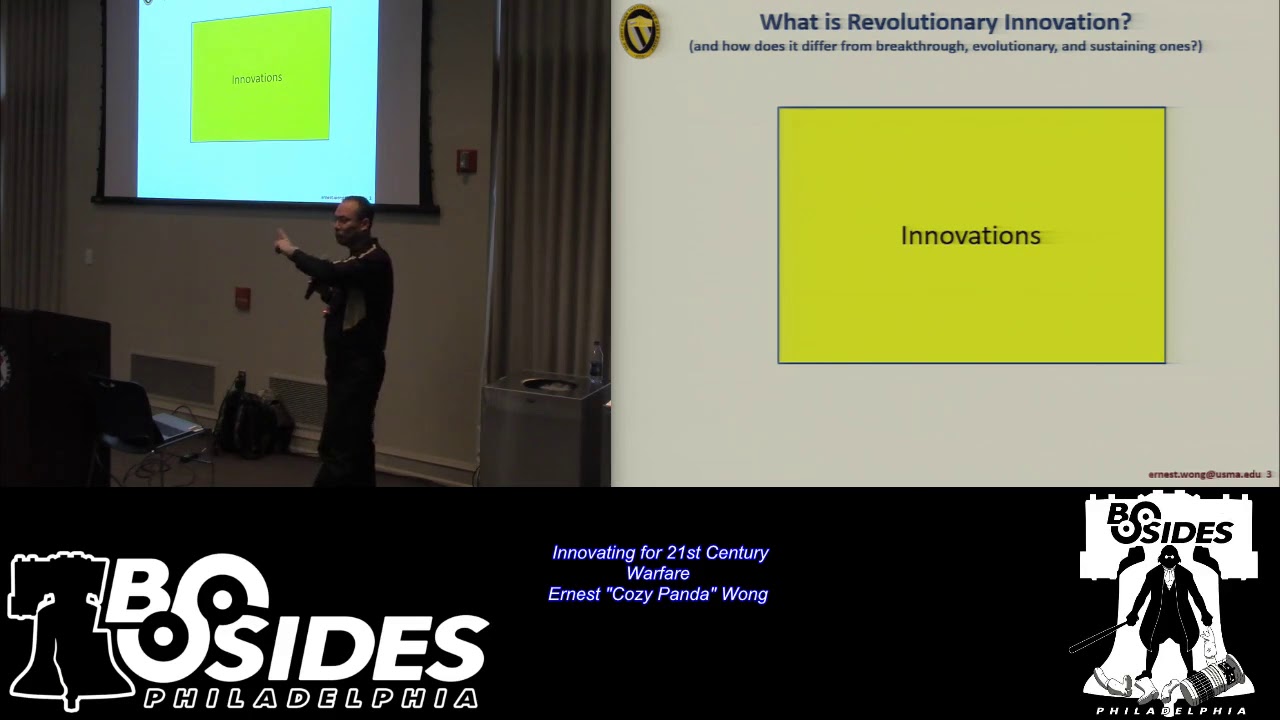
Show transcript [en]
well good morning so my name is Brett Bowers I want to be organizers here for b-sides filly first of all thank you for joining us for another year this is our second time around love to have it at Drexel hopefully this is convenient for everybody I know how hard it is to get into the city first thing in the morning so we appreciate you being here just a couple quick logistics that I wanted to provide everybody so restrooms right outside this door to the left there's restrooms or if you go straight down to through the hallway there's another set of restrooms down there vending machines lunch course will be coming will straight up on that get some coffee out
front or T so Wi-Fi you will see an AP actually you're gonna see a whole bunch of APs but focus on the ones that say Drexel and of course like any other con be careful what you connect to right the one that has been provided to us is called Drexel guests the user ID for it is b-sides and the password is dragon one two eight twelve eight get it today CTF there's a couple going on so we have the IOT village guys if you haven't checked these out before they are completely awesome these are the same one that you would find at Def Con or any of the other really major cons we're very very fortunate to have them so
check it out you'll find them over in the vendor and breakout room next to us the other one is point three point three has one that you can do in the room you can do in the hallway you can be at home and working on it they've set up a set of different challenges going from very very easy all the way down the path to hard so if you feel like having some fun today and breaking out and just trying some of the different pieces have at it they look really really cool other pieces want to talk about your badge so these badges are something we've been trying to do for a while these are a lot
of fun you'll notice if you bring up your phone that they're broadcasting in AP they are not only hackable but they are also a challenge so you can get into these badges you can figure out how to get the information from them during lunchtime we'll do a little breakout session and we'll talk about a little bit about how the badges work how we put them together and how to go through the challenge when you're done use these for home I am right now learning this to open my garage door opener to open my kids lights doorways outside they've been rock-solid use these we Mo's to do use for your Amazon Alexa or your Google home stuff if you have it at the house
great pieces what else we want to say Garrett feels put these together a ton of blood instead of going into it so have some fun with them they're pretty cool other challenges so you'll probably notice in the front there is a post card so make sure I don't get the names wrong here Ryan Donohue and Nick Danya I apologize I bought the name these are our first little crypto challenge they're designed to be done relatively simplistically in the day check them out you have any questions on it hit one of the staff members or somebody with a black shirt and we'll square you up and show you how to do it but they look like they'll be a lot of
fun so other logistic pieces around 11 o'clock 11:50 excuse me after that presentation we will have that little break in between that period and lunch will have some spent sponsors come up to talk to you about some of the services that they got those that are looking to hire people visit them next door in fact you know spend some time with them guys because here's the bottom line if it wasn't for our sponsors we wouldn't be here today they're who make this possible for us so just going down the list comcast xxx risk advisors access IT group Drexel Trek point Susquehanna investment group radware CrowdStrike f5 NSA 0.3 and notice starts all of them have given us resources to be able to
put this together to be able to feed you to be able to give you these cool badges and to be able to give you prizes I want to talk about that so a little bit about prizes if you did not get one of these handouts grab one it important the back of this is what we were calling b-side bingo and what that is is spend a little time with our find sponsors next door drop off a resume for the ones that are hiring or anything along those lines but if you get their mark their initial their scribe whatever it may be at the end of the con right before or a little happy hour with beer and wine
will be doing a drawing for two iPads they're 128 gig iPads brand new 2017 and Amazon Alexa so get the markings off the back there's anything you have a question about hit us up we'll be able to set you up and make sure that you have what you need but else we're going to talk about there's special thanks to a few folks here so Garrett fails them back the guy who put these badges together Ryan Knox they Perillo Chris Manor Mike mullet these guys have put in a ton of personal time and they do it for no reason other than to put a con together nobody gets paid none of us make any money out of this we simply do
it because we want to give back we believe in what b-sides is about that low cost no cost kind of conference where we can bring people like lieutenant colonel long hair he's going to talk to you about the things at the end of it and I say may not be telling you completely and you know in order for us to be able to do these things and to have an environment it's really what this whole thing is about so please spend some time with your peers network as much as possible talk to the sponsors mingle with everybody make this as best as we can so with that I will hand her over to Lieutenant Colonel Ernest long
to give you our keynote speech guys thank you thank you I appreciate it so when Brad asked me to give the keynote speech here I figured yeah I'm not a clock keynote speech not a problem when he told me was 8 o'clock and then I'm doing volunteer duty in the afternoon so he's got me running multiple duties I'll be a writer at the end in the afternoon so uh you'll see me a different culture just a quick show of hands here in the audience who's former military I know Brad's army army folks mommy okay we have few army folks Navy oh we have few maybe folks all right America's game going on tomorrow all right okay now of
course no F Force started I make fun of the Air Force in this video okay that's okay I've got probably in the next room I should be asking them to come these seats up here I actually look you know in the Sun see they say keep your friends close but keep your enemies closer so if you're on your air force most we have some front-row seats for you Marines any Marines yeah good Coast Guard FBI NSA folks okay well great as Brad mentioned I actually am working from an institution called the army cyber Institute anyone know what that is even for military folks okay be on someone that knows he'll what the army taught my
students what we really are is were looking at West Point New York co-located with the United States Military Academy so 50 miles north of New York City and what we do is we like a think tank and we're trying to hopefully give our not just the army but our government an understanding of what the future threats will be and that's really one talked about for this this talk innovating for the 21st century worker so cyber warfare is real what I'm talking about and these subtitles by Talk is sometimes I call it I know someone who's been to beside Rochester I gave a earlier version is talking at some of these conferences I usually call this thinking
inside the box but I'm trying to get our military really I love coming to the b-sides and all these hacker conferences because I really do think that this community is already thinking outside the box so I hope this clock resonates with you with what you're doing and hopefully if you're not any students in the audio yeah great for the students this is really why I encourage for the students hopefully this is encouraged you to think outside the box in a way of doing so I'm giving you a framework for how innovation sort of works and try and promote more of it better innovations and more importantly more successful innovations so hopefully that's what you get out is talk now I normally do not
introduce myself I will introduce myself as the slides go on so you'll get a feel for my personality and my likes and dislikes but the army cyber Institute just a very quick recap of what we do but here's our current mission statement we started in 2012 so from a star tech startup wanna be yeah that's ancient right five years ago that's ancient government time hey we are still a start-up and actually we have a new director come on Andy Hall's our new director and he's proposed this mission I'm not too different right things in blue I've highlighted our current mission impacting it trying to impact the partnerships we understand that in the cyber cyber security the military
government can't do it alone in fact we need industry we need smart folks from academia to help because we know the problems of cyber cyber security it's not just one industry that's gonna be impacted it's not one organization is not one agency it's really the safety of entire nation and that's why it's important now building intellectual capital while most of what we do right NSA they try keeping is classified by law those offensive tools offensive techniques at the army cyber Institute we published what I'm doing here outreach trying to get this information out to this audience we partner with and we tell folks that we partner with we're gonna publish as much you can share do we abide by
non-disclosure agreements sure but we try to pour about partners that we're going to publish well with our new mission our proposed mission still live same things conduct interdisciplinary research that's amazing you would think that for an army cyber Institute we'd have a whole bunch of computer science electrical engineers mathematicians on the systemization air we have a two lawyers in our organization once teaching ethics once teaching cyber law we have a historian we have a psychologist a behavioral analyst and we have two social studies type of folks policy folks so we're really trying to bring together right not just a tech but the non tech as well because we believe really the solutions for this future really are going to be
the melt between two not just technical solutions and really developing innovative solutions enabling cyber resiliency for our nation Wow what the key thing here is that here's a picture of our organization we are just outside of West Point itself outside the gates this is called Spellman Hall and for those anyone been to West Point visited so if you've been to West Point this is right outside it's outside the gates and it's lady cliff College the former land of Lady pick large they fell out the furniture troubles in the 1980s West Point took over lands and so when we have start-up tech companies come and visit us and we tell them were five years old but they we tell them this is
our building and this is a the old lady cliff dormitories so all these tech CEOs CISO CIOs they come visit us they tell us hey you guys are in the drama Tori a ladies dormitory you guys are still us to hard up it's worse actually one of my colleagues calls it it's worser we're undergoing renovations right now that governments right we're got her going renovations right he outside this building in the parking lot and trailers so it's worser right we're still a start-up uh-huh again in tech field and tech years were all but for government business we're still brand new and so when I think of innovation I don't think of it as this one mile identity I break
it up any business majors in the audience yeah so if your business major right you know you can break up the world any problem into four quadrants so that's what I've done here okay so am I on my x-axis right I'm assistant math guy I'm sister Jenna on my x-axis I'm calling this technological sophistication of complexity of the innovation itself okay on my y-axis I'm looking at who the targeted user is whether it's an existing user right that's most most businesses were talking existing users but there's an option of talking targeting new users or underserved users okay and so when I look at this when this in some quadrant system on this low tech side existing markets
I call this sustaining innovations meeting existing customer needs and really it's the biggest customers that's who that really is you're targeting the biggest customers the most profitable the highest margins right business school teaches us that right don't worry about the low margin folks there's a problem with that as we go through this briefing them on the high tech side but existing customers I call that incremental or evolutionary right think of Darwin evolutionary type innovations it's high tech right but still tart musics and users all right these two quadrants actually tend to be the most innovations okay where do you see that as this presentation goes on what about on this new new markets if I want to go
high tech but new markets I call this breakthrough innovations okay or jump in the curb I'm gonna come back this notion of jump the curve in the brief blue wall so hope you get a better sense of what that is we're out this side this notion of new markets underserved markets but low tech solutions does that even exist do we even call the innovation I do okay I call that revolutionary innovation right being here in Philadelphia it's great right the birthplace of our nation right Revolutionary War right 1775 1776 Constitutional Congress right here in Philadelphia so I call it the revolutionary innovation it's also known as disruptive innovation I'll get more in that little while but I call
revolutionary innovation for a reason if you are beside Rochester I think I call it disruptive innovations I'm calling revolutionary aerations from here on out because I think it makes the distinction a little clearer between breakthrough and revolutionary but the problem is when you think about innovations right most V most folks really and again I tend to give this talk to military folks most folks in the government right you like to think of high-tech stuff yeah there's only the only inner vision the world is from the high-tech stuff there's no low text as innovative what's worse right what's worse they go to the breakthrough side right lots of government folks lost CEOs right I know we lost sister was in the
audience we have a lot of IT folks when when have you had those CEOs latch onto that bright shiny object right says it's gonna solve all your cybersecurity problems government does that all right that's the way we think okay and that's the problem right because if you start just looking at that breakthrough innovation that's only one quadrant that's 1/4 of your innovation okay I'm gonna tell you it's worse as this presentation goes on I'm trying to get our government leaders to understand that yeah revolutionary sustaining innovations are possible as well okay looking to the past not just in the future and not to sci-fi but to faciem pop into the past hey George Washington costing the boys that
Delaware River Potomac what was that Delaware okay ya Dums down the down the street right okay but so perhaps we can get some innovation in this size Rotech innovations do you believe me everyone this room should be saying that if you're a hacker you're doing low tech innovation you might think you're doing you're high tech but I'm gonna convince you hopefully after this talk you're doing low tech innovations but I really want our government leaders to understand this okay so if now if I understand this box okay from a military intelligence I'm a military intelligence officer okay so when you think of military intelligence officers all right I'm not a cyber officer cyber as a new branch of the
army cyber is - where I came from gave a lot of resources a lot of white papers that developed a cyber branch and that's what I'm trying to do here try and talk about innovation when I think about sustaining innovations I'm thinking about Spock any Star Trek fans here yeah good sort Trek fans so when I think of Spock right he's given Captain Kirk right the enterprise the most logical the highest probability of success types of courses of action right the recommendation Spock gives is going to give these highest degree of success right so Spock is for me the character ature for sustaining innovations a lot of efficiency gains we're about evolution any Mad Magazine fans
yeah it's still online stuff you want to read the slifers so evolution or Darwin is talking about right the white spies trying to kill the blacks fly right in evolutionary types of innovation all you're doing is trying to one-up your next best customer or competition that's all you're doing right and overtime right white supply is trying to kill the black slide next issue black spike kills the white spot that's this whole notion of Darwin Darwinian or evolutionary types of innovation what if we go up though breakthrough breakthrough for me right what's defining breakthrough is James Bond and for me the quintessential James Bond that's breakthrough is Pierce Brosnan right he's got all the gadgets that the Korra master Division cue from
the United Kingdom's out of mi6 gives all these resources you might say Daniel Craig he's trying to go revolutionary especially in Casino Royale right not a whole lot of high-tech gizmos right a lot more fist-fighting right but come on last three James Bond's were its qualms soulless Skyfall and what was that Spectre come on he's got all the gadgets right he's breakthrough as well so what about revolutionary do we have revolutionary types of innovation doesn't even exist do we have a spy that's can you think was supply that's using what's that is disposal to save the day come on with this audience MacGyver yes I'll for be honest the students in here let's do this if you don't know
MacGyver there is a reboot on right now those reboot so you can watch it I hear it's not that great but you can get a sense of it okay now if you have Amazon Prime you can watch all the other episodes er cheesy we can watch them a driver right he's saving the day with what paper clips duct tape whatever is in his pocket right chewing gum by he's disarming missile he's disarming a nuke with with chewing gum and his army not right he's got that Swiss Army knife it's amazing that should be American army not it's can't be the Swiss Army knife this is an American Army knife it's an American right the American
Revolution we have all these disruptive revolutionary type of matter okay so for the kids in here are all the students you don't know MacGyver you should know Jason Bourne right Jason Bourne is saving today right he's saving his life he's saving his girlfriend whatever ever episode it is that's a different girlfriend every time with wherever that disposal rights that mini car that swerves to the right a little bit right it's got the whole clutch right sticks pens right he's using whatever lies disposal now one of these characters really is not a military intelligence type of character right even as much as I like Star Trek has a military intelligence officer Spock really doesn't fall on us that's uh
doesn't really give us that same analogy so by Spock he's really doesn't fit there I'm thinking right Mission Possible Mission Impossible is doing some pretty good stuff but I'm not thinking I'm not thinking Tom Cruise Mission Impossible right because Tom Cruise I'm not thinking Tom Cruise mission posix Tom Cruise mission boss he's up here right he's breakthrough even in even in what was that the fourth one what was that rogue nation right when they get disavowed they got high-tech stuff in this one like he's climbing the highest tower with a glove the high speed glove can stick like spider-man sure it fails a few times it fails a few times but that's the notion about breakthrough
innovations who fail the same thing with revolutionary envision they can fail okay now again I I saved Mission Impossible so I'm not seeing Tom Cruise Mission Possible I'm thinking the original Mission Impossible original I'm if forces the visual impossible mission forces back in the late 60s early 70s yes a spot right Leonard Nimoy he played Paris now again for the kids in the audience go to Amazon Prime all five all five seasons in there it's excellent I recommend watching all five episodes of all five seasons because you see disruptive innovation or you see sustaining innovations in action because really it's not just Leonard Nimoy write the entire impossible missions force look at them all five seasons a lot of
great actors here right got Sam Elliott got Lesley Ann Warren Barbara Bain Martin Landau a lot of great actors Peter lupus was a strong man right really all these folks they're playing a con game on foreign nations they're playing con games on criminal organizations so they're using their wits to outsmart their enemy I call that sustaining types of innovation because really all these folks they actually played actors while they're actors on TV right they're using their own skills that's acting to con these governments are there secrets or to influence and do certain things now the nice thing with the mission possible also is they actually span all four sectors remember Barney now again if you're the Tom
Cruise mission possible it's Simon Pegg so they're the there's a high tech guys right they give they give the Mission Possible four team the all the high-tech gizmos but again if you watch the old episode Barney's electronic right listening devices high tech at the time they fail right same thing with Tom Cruise's glove it fails it's not 100% perfect that's the whole notion of targeting new markets it can fail sometimes I think they do a pretty good job but they fail sometimes now the bosses do you remember the boss of the original Mission Possible Peter Phelps right I guess it was in Mission Possible wine the movie it was played by a jon voight i turned bad guy while
Peter Phelps right he's evolutionary incremental because he's always looking at who the threat is now by looking the threat she's assembling his best team for the every episode right three at the time so he's taking the best actors the best skillsets to combat the threat now I'm also looking at before before Peter Phelps there was any law and orphans yeah we had some law and orphans Stephen Hill the original DA in law and order he was original Mission Possible is impossible missions force director right so he was the one that assembled his team at least she's the one okay so that's that's in this case revolutionary disruptive because he's assembling this team right he's making
use of these actors he's probably got some dirt on him right yeah that's why they're working for the IMF they're not right they're working with penis it'll work for government even if they say even it's a black clandestine organization right Wetworks that's government organization they've got budget constraints they might have had a what budget impasses this back then as well yeah it always happens okay so again a tow job and we do have some Tom Cruise fans in here right no Tom Cruise fans come on on my Omicron you sad i I still like the mission Impossibles not so much exact meters right Jack Baker sir that is that is actually a revolution he's not giving
a lot of high-tech stuff there but if you remember there's a Tom Cruise movie where he actually does revolutionary innovations he think about which one it is smaller we figure it out I normally have to play this intro I have to play this intro because I would not have believed it myself when I saw this intro it forced me to do a little bit more digging a little more looking back in history right a little of that revolutionary tap innovation look in the history this is actually giving me a break as well so right when you see top Tom Cruise it's really when you see killing McGillis right when you see killing me goes yeah a stop that
but really it's this one right here yes part of the intro now I'm gonna blow it up here so in March of 69 the US Navy right we have some Navy folks here I'm gonna give some props the Navy folks here ok so hopefully by the end of this lecture into this presentation you're supporting the army folks for tomorrow's football yeah so so the Navy right yeah go army beat Navy I've been teaching mine use that three and five-year-old the Navy and 69 they started the school the amazing thing is when I look back at the history Benjamin Lambeth already wrote a great book a transformation of American airpower one of those pivotal moments was Vietnam War in 1968 I would not
believe this I didn't read this right our our notion of history is stored distorted by what we seen the media did you realize that the US government suspended air operations in 1968 I didn't know that if you read through that we were losing so many aircrafts we were losing so many pilots that are the department offense said we can't sustain this throughout the Soviet Union is gonna kill us in the air supremacy it's not bad though look at the ratio that we were achieving right the ratio of Russian or Soviet killed to us three point seven to one prior to 1968 from ninety sees five ninety sixty again a lot of these were secret operations but
three point seven oh one is good right normally if three three two one is what military officers are looking for off for a 50/50 chance three point seven one that's good however what was problem when we're looking at so V Union when we've put our criminal head on he Soviet Union was based on mass they had about ten times as many fighters and pilots as we did we can sustain it so its primary defense stopped air operates for about a year 1968 to the start of 1969 we suspended air operations and while during that year we're trying to figure out hard way outs more how do we outwit how we all compete against these Russian fighters
these Russian MIG 17 is a mix 21s we had the f4 phantoms well the Air Force the Air Force worthy of course yeah we don't have airports guys well we do have no force tell you I want you to sit up front all right my enemies close right the F worst where's the of course always do well they always want the best equipment right I check the Air Force went high-tech they say The Pirate Fest if you want its increase this ratio we need better thrust or a force we need faster motion we need weapons systems longer range so we can start targeting those mix 17s mig-21s before they get in their range zoomed out for the target us that's F worst
mentality breakthrough right breakthrough innovations what the Navy do training like the last time the Navy had dogfight experts was World War 2 1945 Vietnam War 1968 1969 we had lost the art of dogfighting so the Navy said we're gonna we're gonna come to the school that was called the fire weapon school more affectionate noise Top Gun but the amazing thing is look what the stats were good when they resumed operations in nineteen late 1969 early 1970 F war suffered a little bit right as a mathematician with statistic in singing out it actually went down I went to a three point six to one kill ratio Russians to us hey about the same even though they had their weapon systems
right improved F Force but look at what happened maybe any any guesses any guesses yeah up but how much this is crazy thirteen to one that's crazy right even if you're even if you're my math is off right I'm actually getting from betterment but even that his math is off by a factor of a hundred percent right still looking at six point six and a half to one thirteen and one ratio and what's even more amazing did every pilot go through Top Gun remember top guy in the movie did every pilot go through Top Gun who wants Top Gun the best of the best right the best fighter were best true from each squadron one writes a
phenomenal movie was Tom Cruise the best fighter in his squadron not initially nine the opening sequence who was the best fighter I don't have this call sign up there's Kruger Kruger was the best flyer right but he got PTSD because in that opening sequence right there do not out combat patrol and that Russian fighter law had missile lock on cougar and he had PTSD he said I can't go to popgun right he resigned his commission so the captain of that air carrier that squadron said all right Cougars I mean maverick is gonna be it right he hate it right maverick right he wasn't up team player so he has in maverick and goose right they said maverick who's Top Gun
and again so the amazing thing is the best fighters so not all fires its best fires from each squadron rat and it was by eight ten week course in eight to ten weeks what was the rationale well the Navy figured we send the best pilots when they get back their squadrons they'll teach the other pilots what they learn that's what happened to be it Nam all our pilots who went through the course they taught the rest of the squadron the dogfighting techniques they learned 14:01 amazing that's revolutionary success okay this notion yeah I really haven't talked about box yet right I told you the alternate I'll was thinking inside the box but right it's a square right with
only two x's what do I need to do to make this a box how mycology that's what I need to do to make this boss just that yeah how does he axes at one more axis right you you've been out of college for a while alright oh I'm so disappointed in college students it's still early in the morning that's okay it's late for me right it's late for me there's the army saying is we get more before done before 9 o'clock than most people do all day I have a corollary to that I get all my work done before 9 o'clock so the rest of the I'm free after this presentation aren't free not another Brad's got me doing a Wrangler
duty after this so again still not for math missions perspective but if I add one axis now offset potential the notion that innovation can change drastically change the environment well what are those from these four from this four quadrants where are the innovations that can actually change the environment most what's the top two its revolutionary and breakthrough innovations not sustaining an evolutionary right sustained evolution you're talking your existing market you're just improving slightly just to capture that market share for for the existing markets for new markets underserved markets right if it's successful breakthrough or successful revolutionary you're gonna change an environment so when the CEO is are writing those books on how to do innovation right Apple is
writing I do the writing books about innovation all those business school guys the reading about I do innovation they're not talking about sustaining and evolutionary innovation that's why this framework is important you got to be doing revolutionary breakthrough innovations you have to be targeting new markets underserved markets ok so this is a more representational view again still no numbers right I tell my cadets I teach put some numbers on here ok at least at least scale wise is little more reputational not by change is offset potential to a different axis I'm now going to call it public success which innovations give me the highest public success what's got to be the bomb to you right
you're targeting existing markets you can do market research you can get bank financing right banks don't like the finance right something that's new you can't do market research off that banks don't like that so we're right this is actually more recitation view of what it would like if I call probably success as a third axis okay so if you want to be doing innovations and have higher process do the bottom to don't do the top to write lots of failures so in the tops again still no numbers right I told you I told my cadet sake that give me some numbers well let's look at a case study right give me some numbers anyone remember what happened in 2010 2011
still recent history just about five years ago five six years ago seven years ago the all-star with Tunisia right the police confiscated the army police Tunisian please to confiscated the wares right the fruits vegetables of this vendor on the streets I don't know what the reason was but because of that that vendor Sam self on fire self Emily Tim song right that's top right to take what your livelihood mask bar that's part amazing it sparked the 13 other approaches sure there were other things going a lot of time again with a cyber audience we should remember WikiLeaks State Department US State Department cables got leaps all these embassy folks ambassadors telling us we were working this country but these
Kings are kind of corrupt right when the people of Tunisia people Algeria Morocco Egypt they read those cables on WikiLeaks the US thinks they're corrupt my livelihood suffering yeah they're corrupt we also had this thing called Twitter right even though these government agencies were shutting down media Twitter sort of helped spawn and spread the this revolutionary right revolutionary types of thought so here's a nice way of looking at the the numbers anyone remember who actually succeeded the revolution yeah Egypt somewhat but the first was Tunisia the war first started on a few days 24/7 two hours that King fled right when the protests erupted in Egypt right someone said Egypt right voila I've got I got it did my stickers out it's like
plus dude Egypt we had Yemen right Yemen still fighting right there are a couple of revolutionary factions still find each other in Yemen we had Libya those are are for anyone else any other countries who's fighting right now Syria right serious question mark right because it hasn't succeeded yet the government's still in power they're fighting I the reason why Egypt I have the question mark not quite revolutionary so who took over in Egypt the army took over right Aziz took over so when we call when the army takes over we call that not a revolutionary success we call down a military coup as a military officer right remember back to our forefathers George Washington Thomas Jefferson John Adams
all those guys they didn't like a large standing army other than George Washington we're joshing behind a big army right because he wanted to fight the British with a regular force but when the war was over we as Americans don't like large to end the army so if you look through our history any times the war drop down the numbers very quickly world war one drop down where were to wrap up drop down does your store drop right Americans we don't like our sign because of this we know that militaries have the resources they have the training they have the equipment they have a leadership to conduct a successful move they can take go Realtors can take over government's very
easily we see that around the world South America Southeast Asia Middle East Africa okay so when going back to the Roman history when Caesars Roman legions are crossing the Rubicon the Roman Senate does not like that they like it when Caesar is fighting the Britannica right UK right now he's like they like it when they're fighting the barbarians in Germany yeah when Caesar's army comes back to Rome that's bad news for the Senators and right it was true right Caesar took over so again the question mark right now well these are the numbers right I told my cadets right never make the general do math in public because if they do it wrong you're never gonna convince some
of their numbers are wrong so it's always that tell do the numbers for them I do the math more so in this case very quick showing about 21% right for successful revolutions again Yemen is the question mark I'm not Yemen Syria series the question mark you don't know if the revolutions recede right the u.s. is supporting the revolutions not Isis but some of the revolutionary forces Russia is backing Assad and the Syrian government I study a lot of counterinsurgency warfare it's not looking good for the US and the revolutionary forces once because as a presentation one you're gonna find out why right I'm giving you some insights in counter spiritual warfare here because once the government responds bad
news for the insurgents so now we have some numbers right it's about twenty percent successful again you might have different thoughts right some I think single digits might think decimal places but for me I kind of like to think of this as Major League batting averages that's that's a nice way of looking at maybe you're doing pretty well if you're thirty percent you're doing pretty well if you're twenty percent you're doing very well yep forty percent right so try to get this for you try to get the fifty percent how do we do that well understanding this framework will help up okay because here is right here's the problem though with the the Hollywood gives us
Hollywood gives us the impression that revolutions are easy as Americans right we think of revolutions are easy work work we're in tennis 1776 we beat the British out right we beat them again in 1812 the problem is again for me the patriot didn't really work out I actually actually like Star Wars hey I told you as a Star Trek fan I'm also Star Wars fan so I'm equal-opportunity I just really don't like I'm not a big fan of doctorhugo great premise right the doctor keeps treating coordinating but I actually like Star Wars so if you're Star Wars then yeah we have Star Wars Episode four and I guess Road one was Episode three point eight or three
point nine whatever so pretty much same premise but actually this is my favorite movie in Star Wars it's episode 5 because when the Empire figures out a revolution is going on that's why they came up with the best star they came with the Death Star so the Emperor and Darth Vader came the best are because they don't want you with rebels one at time the face is stuck there's a rebel base there you know Blair at the whole planet who cares about civilian casualties right that's the right thing to do if you are if you're in this evolutionary space you can obliterate the entire level courses all at once that's why we're so important for Row
one and uh starwars new hope to defeat that Death Star right that was a game-changer that's a game-changer now here's another way of looking at instead of looking at in the quadrant system alright look at his timeline so in this case I told you that the it's not that there is no innovation taking place in evolution is staying I told you there is an evasion it's just at a slower rate right the rate of change is just slower compared to breakthrough and revolutionary like on the breakthrough thought I'd call that jumping on the curb right because this notion is that innovation jumps off what the existing market is expecting for the innovation right it jumps off the curve and really
the folks who actually studied disruptive innovations which I'm calling revolutionary innovation it's a couple of farm of Business School professors right Joseph Bauer and clean Christians it's mostly Clayton Christensen who's done a lot of books on disruptive innovations right it's this notion that you can actually have a crappier product right this is actually a crappy product if you look at on timeline right it is performance is terrible right is below the Green Line it's below what people expect and but the notion that just bombing Christian said was that you know sometimes these crappy products they succeed and not only do they succeed they displace the monopoly force that's in the green is that possible come on
everyone this room should be saying yes right we're hackers of course it's possible well how about some awesome examples this notion of revolutionary innovations right it's it please the emerging markets feeling too small segment of the market usually the individual as a hacker we are doing things for ourselves we don't like what the Microsoft's are doing we don't like even what these vendors out here are doing right we figure it to our own personal tastes we hack it now here's what it is it's initially far worse in at least one area least one area usually - but here's the thing if it's successful the newly value criterion such a rapid rate that it will overtake
right it successful it will overtake the companies and green some examples yeah Bitcoin might be yeah I would I would say Bitcoin is probably good example is it getting displaced currency they said credit cards with displace currency use flat currency I'm not sure if you're a little displaced currency mobile phones you're stealing my thunder you must have heard my presentation somewhere else let's go with let's go with Xerox versus Canada first what did Xerox focus on Xerox is green right there are the they're the monopoly power in terms of photocopy machines I know they're college students you might not remember this one relying on the old timers what is your ox do copiers but how big were they huge they're the size
of this room you universities and fortune 500 companies they had print divisions some of them were bigger than the R&D divisions right 10th divisions he's back then if you wanted staples if you want a hole punch if you want collated you had a big machine you do and you had Xerox do it all right every time a Xerox right some customer big customer University one it's something else right they went along the line and cared about small customers we're selling million-dollar copiers I don't care if you're a mom and pop store we don't cater your market underserved market so who can cater to the mom-and-pop stores the home-based business was there canons copier crappy can his copier was crappy right was
those inkjets crappy copies right Xerox laughed when they saw those smudges right Xerox left a cannon when they bring out who the paper quality is trouble your your paint your copiers jabbing a lot more than horses all right so Xerox left a cannon you should be okay I'll hold off this what about this one right and one knows about this one would I p.m. focus on 1970s may all right we've got a mainframe we're going to cater the university's fortune 500 company same thing right if you want our services you want computing power come to our mainframe punch cards who remembers come punch cards if you got those punch cards out of order I interview punch cards but I always had a
professor tell me had it shipped odd order it's like in your term paper out of order same thing right doesn't it Coley doesn't compute what Apple focus on same thing personal computer right just like Canon this personal market was apples Apple one apple 2e terrible a corner IBM it was who would ever want to buy this crappy right personal computer that has 1/5 our computing power of our best mainframe terrible terrible system right but it appealed to an emerging market the personal home base user costs cost was the factor right thousand dollar PC versus a mainframe that costed hundreds of thousands of dollars now here's not a non tech example the Big Three automakers versus the Japanese
imports this happened in 1979 anyone remember what happened in 79 yeah Iran gas gas prices you might say we're having some of that right now right we'll see so the big three the big three American automakers they focused on power right large vehicle they didn't care about fuel economy gas shock forced us to go to the Japanese vehicles quality was not initially a Forte of the Japanese automakers early on right it was not quality we think of Torreya being high quality now who steel efficiency as they went up the curve as more people bought the Japanese cars then quality improved then it overtook a big three whose overtaking Japan now this is amazing that this the key is the
Hyundai's right the South Korean companies they're nipping at the right we can say the Japanese companies on the Green Line now it's the South Korean vehicles like their qualities improves drastically improve who's nipping at the South Korean companies it's amazing that this Cyclopes repeating China our company called cherry also India there's a company called Tata okay we don't know if it's gonna succeed right I told you revolution innovation stuff to do at best 30 percent major Major League batting average but this cycle store repeats that's the notion what the bow unchristian study it's amazing right these guys in green you'd think they have the market power to crush these guys in the red they ignore that market they ignore that
market to their peril that's the way this notion of revolutionary innovations is kind of powerful game changers someone said cell phone I'm looking at slightly differently blackberry versus the smart phones what was BlackBerry's she featured that they had a happen on the phones the keyboard they were wedded to the keyboard because their primary users their best users wanted the keyboard what did by phone focus on simplicity no keyboard did you ever see a grandparent with a blackberry few and far between you see five-year-olds with iPhones you see grandparents simplicity is really what it was then they became lot a little customizable mile off people said customizable first but originally simplicity was first and again I just
want to highlight right it's not that breakthrough in sustaining a revolutionary innovations are easy to do right 20% 3% chance obsessed if you're really good 40% might try to get a 50% if you understand this framework can I try to bump it up I can give you examples out for examples but I got the five-minute mark let me be doing his job pretty soon so I'm going to try adhere in my time limit let's see so how do we best protect cyberspace how you protect cyber for cyber warfare future I've been focusing on revolutionary innovations it's not enough we need to be doing all innovations breakthrough sustaining and incremental we need to do all types
envision the problem is the problem is we've been ignoring revolutionary innovations and as a military we are very guilt right we're guilty of this all time if you look at all the wars where the military US military has lost or they called tied right start with the Korean War the Chinese very simple technique they did MacArthur John MacArthur relied on what film technology right for his Intelligence Surveillance reconnaissance what's the problem with film technology what Phil you can't see it not you need light to get the images the Chinese will not be knew it they operate exclusively at night MacArthur consistently underestimated the Chinese strength by a factor of four instead of a three-to-one odds he was
facing ten eleven twelve to one odds she was expecting three to one it's hard to fight a ground war when you're that far off your estimate what about Vietnam there was this thing called the Ho Chi Minh Trail by Air Force right we tried bombing the heck out of it but we suffered a lot of casualties right we had to stop our air operation but this whole notion of the Ho Chi Minh Trail we didn't understand that Ho Chi Minh Trail initially was just a route line was dismounted infantry if you put a crater that I would what do people do when there's a crater he walked around it that was the Ho Chi Minh Trail for the
first three years the war sure after the bombing campaign stopped they did start putting roads in so infrastructure came later but initially we had a mistake of thinking we could stop the Ho Chi Minh Trail just by bombing the heck out of it Iraq Afghanistan what's going on right now him where does ie ie D stand for and prove the highest and premised that's revolutionary right decided in a weapon system its improvised explosive advice that's a revolutionary technology it's not a weapon system improvised that's causing casualties on the battlefield three essentially initially they were just studded munitions from iran-iraq war I was stationed there we used to have a I'm wrapping it up now yeah I'll
tell you my stories afterward to come talk to me cyber warfare my contention is that nearly all malware discovered first time resides that space you can debate me on that sure there are some that fall in other spaces right Stuxnet I'm thinking yeah might be breakthrough yeah but guys here's the problem on defensive side were ignoring this base offensive you don't need to do breakthrough innovations with offense my concern is when the bad guys start doing breakthrough we're never gonna catch up we think we're bad now what happens when I've asked person threats start doing those breakthrough innovations were screwed anyone doing cyber defenses screwed all right we're never going to catch up if we leave that
space open this is my one slide with the wording so if you want to take a picture of this probably the best one especially with college students taking notes here really the Muslim I think it's in the sampar if you're an early adopter of comics experimentation that's the best way to encourage disruptive innovation revolutionary innovation if you do these other things right you can you can merge with another company that's doing it it's tough though mix that mixed cultures you be an incubator do alliances but really last days have shown that the book is by Katherine captain aizen heart and Shonda brown a Stanford professor in the heart Business School professor they really studied that really being an early adopter of
chronic spirit is the best way and that's how you encourage us are the box thinking I'm client inside box thinking knowing this framework but it's courage and creativity to do that and so to conclude wrap it up yeah we mean we do need to be doing all types of the nation the problem is when we ignore but if we ignore revolutionary innovations right there's a saying in the military we're proud to say that we are no longer a 0 we are non zero defects military like Colin Powell used to say that right it's bad when your zero defects why any mistake is bad but now we say we're nonzero defects in military I'm saying that's not sufficient
I'm saying in order to really be in the forefront of cyber warfare we need to be an experimental military and the great thing is our cyber branch they're doing some of that I gave a talk to the B sides Augusta cyber center of excellence the cyber branch down there I talked to a bunch cats who are volunteers Wranglers and their tummy some of the things are doing their class and they're doing a lot of experimentation there which is very good we'll see my contention is that we'll find out about five to six years because those second lieutenants right-side rats are two years ago those second lieutenants those g5 buck sergeants they will become this art majors they'll
become the majors in ten kernels five six years from now we'll see if we can get the get a handle on the cyber-defence thing Wow just a wrap-up look at all the talks today yeah we have some Mara purple right someone breakthrough and but look at all the talks today when I looked at all these titles these are all revolutionary types of innovation so enjoy the talks day-lewis on them and last thing I want to have might submit your own talk for next year have the courage right based on this talk right not very technical it's okay to get rejected right to do revolutionary innovation 30% is the magic number I could do a presentation
all all false I've been rejected from okay it's not quite I'm happy I bought the 60 percent success rate so I'm actually doing a little better but it's tough to do revolutionary innovations have to do breakthrough innovations these are the Constitution Hall talks first then we had some more congress hall talks so if you're in the other hall you can't ask me questions but they'll take questions from you guys it's better being this all I just want to thank really all my credits and I want to thank Brad de Lyonne really the entire piece lights Philly team for asking me out here and that is a lap right I think I'm going over a little
time if you do up for Chinese come see me I'll be here for the rest of the day I'll be the Wrangler for the afternoon's talks or talk to me in the hallways just to come up to me I appreciate it
Related talks
 1:05:41
 30:35
30:35 34:04
34:04 33:12
33:12 41:38
41:38 52:47
52:47