Women in Cyber: Brute Forcing the Glass Ceiling
Show transcript [en]
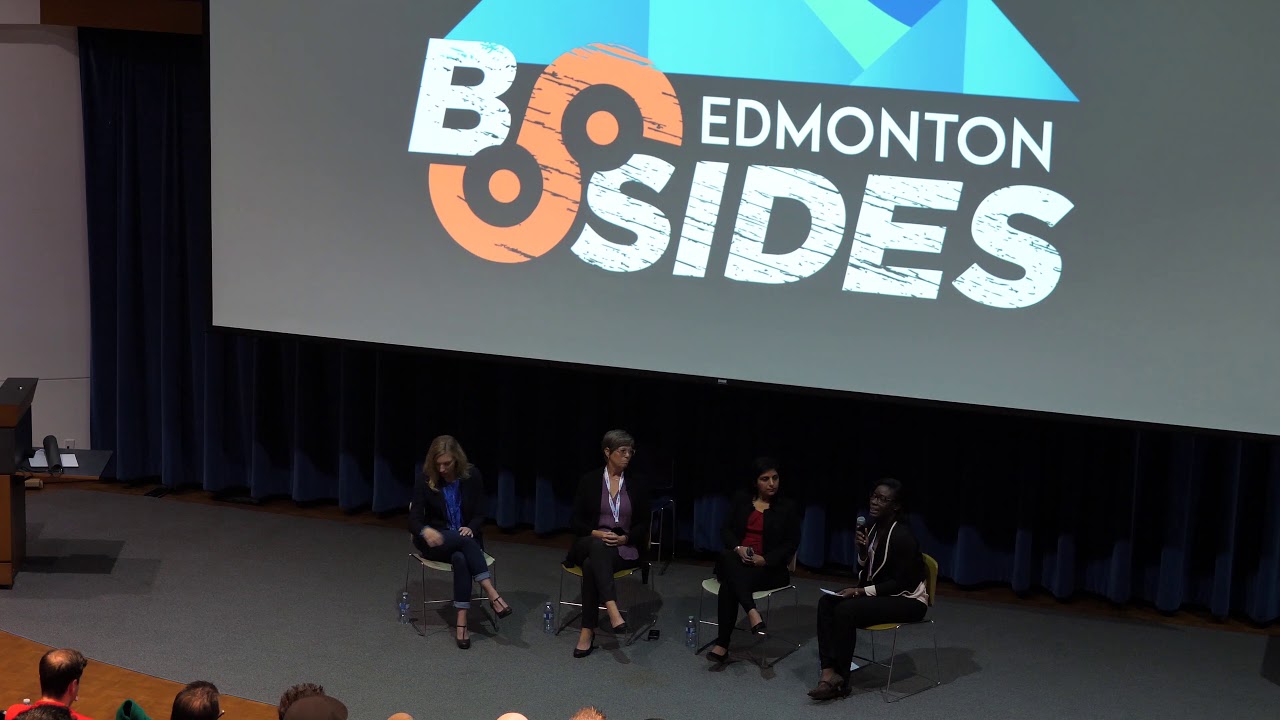
Thank You Thomas good morning everyone welcome to b-sides welcome to this panel on women in cybersecurity like Thomas said I'm really excited to be up here and to be facilitating this discussion so this morning you'll notice that I have three ladies with me and I'll just go ahead and introduce them right here on my right my direct right is Harpreet Colley she is a cybersecurity leader and member of iose iso/iec standards Council of Canada she has 15 years of experience in leading and developing cybersecurity programs for academic utility and banking industries she has helped organizations realized their business goals while effectively managing cyber security risks and compliance requirements she is currently a manager at a co group
and her pre is leading development and sustainment of the cybersecurity program there which includes risk management governments governance sorry cyber security incident response and security awareness ladies and gentlemen our pre Kali next to her Creed is Lauren schwanman Lauren has been involved in IT for over 20 years with a strong background in business management she is a successful leader of initiatives that define and deliver quality solutions effectively supporting business strategies through organizational change and technology over the last few years she has taken on the challenge of developing effective governance of IT risk and security and Ament and implementing those practices and processes at the Albert Emoto Association and to the very far right is Rachel Heywood she is the director of
compliance and Special Investigations with the elbow to Information and private commissioner's office she has over 15 years experience working in the privacy field rachel leads high profile and offense investigations including the largest offense investigation in the history of the office which resulted in 38 charges under the Health Information Act and additional criminal charges and so that rounds out our panel this morning so what are we here to talk about I named this session women in cybersecurity brute-forcing the glass ceiling and we've had a lot of research recently a lot of pieces being written about the gap of talent in cybersecurity and in addition to that gap we've seen stats there's a there's a particular study that was done by Frost & Sullivan
a few years ago that highlighted in about 2020 we'll need almost 2 million cybersecurity professionals and we just don't have the numbers to fill that need additionally that study points out that currently women in cyber security only represent about 10% of the industry 11% but yeah 10% right so we have this gap and currently women are just under represented in the industry so today we wanted to talk about is this is this really an issue are we really underrepresented and I think we'll find that it is then what do we do right so 2020 is just around the corner how do we address this issue and cyber security and so I'm gonna go right into questions ladies I thought we could
get started with your story each of your stories so essentially how did you get your start in the industry was it kind of something that you fell into or was it something that you always knew you do perfect ok thank you making sure so many years ago while I was working in India as part of the professional development program I got an opportunity to undergo an extensive one month training offered by Cisco it was a network security so Cisco was brought into our organization to train a group of us and then the expectation was that we will train others in our environment and that training was followed by some sessions where we could develop ourselves further
if we want to as part of the training I got to configure write routers I got to program firewalls and I learned quite a lot about network security and the knowledge I acquired at that time I realize how critical security is for any system design development of configuration and how significant impact it can have on organizations if not done right and since then cyber security has been my passion I have worked hard to develop myself in this field when I came to Canada 10 years ago I did my master's in information system security management and that program really enhanced my knowledge and exposure about the technical aspect the governance aspect in the audit aspect of cyber
security and yeah so this has been my passion so far so my background is not so much in technology although I always follow technology and picked up classes in computer science but my background is truly business but through the course of my career I've always been involved in managing technology or governance of technology and so have developed a real facility for talking to business about technology challenges in a way that the business understands what the risk is to them and what the potential benefit is to them and do it and through that became very good at organizational change so my organization invited me to take on the challenge of taking on enterprise risk management with a focus
on IT and you can't talk about risk management I tea without talking about security so about a year ago they just threw up their hands and said well that's it now you're responsible for the governance of IT security as well as IT risk management and it's although I fell into it I'm fascinated by it and love a learning challenge and this certainly has been a learning challenge but I still get to do those things that I'm good at is talked to the business about how IT security represents a risk to them and put it in terms that's meaningful to them so that IT can move forward doing the right things yeah Rachel so I fell into
it I when I was in university I was gonna change the world right I was gonna I was gonna be part of you know United Nations I was gonna do all this great work and and I have an undergrad degree in political science and when I graduated with that degree I couldn't get a job I only speak English and I'm not fluent in any other languages and I quickly learned that if I wanted to work in those areas I needed to develop some other skills so I took a real practical approach after six months or so of realizing that I wasn't going to get to where I wanted to be with an undergrad in political science so I got a master's
degree in public administration and as part of that I had a practicum where I worked at for the government of Manitoba and a small little office called the office of information technology that was what it was called and during that time and this may date me we were actually developing the security policy for the government of Manitoba because there was no unified security policy for the government of Manitoba back then and back then I was the only woman in that in that office everybody else we had deputy ministers and and so on everybody else in the office was male and then from that position I sort of fell into privacy and I think I offer a
little bit of a unique perspective here because privacy is at least in Alberta it is definitely female dominated as opposed to male dominated but I've worked in those fields prior to working at the Commissioner's Office where I was I the only woman in the office or one of a clear minority in there so but I fell into it after I had after I died worked for the government in Manitoba I ended up working for Alberta Health and and sort of fell into working with the Health Information Act and health privacy from there and then I I really really loved it I really love what I do I love the opportunity to protect rights and that kind of goes back to what my
undergrad degree was really about anyway I wanted to change the world and I'm not really changing the world necessarily but I do think that I'm working to protect the rights of Albertans so it wasn't exactly what I'd planned on doing but through weaving through a couple of different areas I fell into it and I really love what I do today all right I think probably what I take away from that is you know getting into the industry can look a lot of different ways a lot of times we think it's something that's linear you know you have to maybe that's been your dream for like 20 years and you've worked on that all your life but a lot of times it
doesn't have to look like that and so that doesn't have to be a barrier to entry what about um what about challenges like what kind of challenges have you faced you know in your career dust water so I would say coming to Canada with a limited knowledge of Canadian culture Canadian work culture was a challenge raising my young child with doing my Master's and searching for charm force a challenge so it but but I successfully rose up to every challenge and embedded myself successfully and I think that's the best way to educate yourself and embed yourself so especially because I was an immigrant woman there roars different some different challenges which might not be there for women who are already born and
raised here and then the biggest challenge was balancing family commitment with work because I come from India and in Indian culture there are more expectations from women and family that's not that it's not that my husband doesn't support me but it's just something in our culture that we have their more expectation the family so I think this was a challenge just as a woman I had to work extra extra hard stretch myself to really balance more great well take it a little bit deeper into that in just a minute chef Lauren so I'm going to talk about two things one is and and this will date me far worse than anything that Rachel's said I entered the workforce at a time
before the Human Rights Charter so there's some extraordinary stories that go back there but one in particular and I'll talk about my reaction to it and I think it's still the appropriate reaction today is that when I I was in a position where I was training management trainees and I went to the senior HR resource person in this institution who happened to be a woman and said I want to become a management trainee I want to get into that program and she looked at me dead in the eye and said no we would not put you in because you're most likely to get married and have children and at that point it struck me is
extraordinary but it wasn't that unusual at that time it was unusual to have it put that blank Point Blank to you but it wasn't that unusual as an attitude and my choice at that point was to quit training the management trainees and go find myself a position in an organization that was far more supportive I still think that's the right thing is that you need to choose your battles and if you end up in a situation with an employer who is not supportive and that doesn't matter if it's gender or if it's a race or or if it's whatever your situation is is that you don't you know burn your bridges but go find there are lots of good employers
go find a good employer and develop your potential in a place that's going to allow you to develop your potential and potential people around you yeah just so I knew that we were gonna be asked this question ahead of time and I thought about it a lot and I went very different ways yeah and and I I decided that I'd shared share something quite honest with you and then kind of go in a different direction so the first thing is it's when I first got out in the workforce and my first real job I was like I said the only woman in the room and literally the only the only woman who was involved in in writing a security policy and for
those of you who haven't been in government implementing change in government especially when it's across government is challenging probably like most organizations I would guess but it's and you were challenged a lot in those positions and and when you're trying to implement change and it was it was intimidating a lot when you're in a room surrounded by when you're the only woman sometimes you can feel that you feel that like you sense that you might not have the same level of credibility and being young as well I just finished my master's degree so that was challenging early on lately I would I would steer this in a slightly different direction and say that my biggest
challenge today is try and I'm which is why I'm so pleased that I have the opportunity to be here today is to try and unite the security world and the privacy world a little bit better where sometimes where your best friend and organizations and other times we seem to be eyeties worst enemy and I find that a constant challenge outside of my office when we're working with organizations large medium and small it seems like sometimes where they're still on very different levels and it's a challenge that I have faced from those early early days up until now it's and it's something that I really want to work to change going forward so my next question
was really going to be do you think that women face different challenges than men do in the industry but I think that you already kind of alluded to the fact that maybe we do so I'll just I'll just ask something that kind of has been on for some time we've seen a lot of reports that there is various gender inequality in a wide variety of industries not just cybersecurity and one of the ways that that shows up would be a salad see a salary sorry a salary disparity between men and women so is this something that you've seen or you've experienced at all over the time that you've been in the industry so I'll answer that question first Havok I
experienced it I would say no I haven't experienced it and if I had ever concern with any organization I would always take it up with my hiring manager and HR so I've been able to resolve all those issues and I would encourage everyone every woman who have who think there is a disparity they should talk to their hiring manager coming to the question gentle in quality so I'll go back go to a report which recently was not recently I would say it was a 2017 study it was done by IAC square in collaboration with executive women forum and Center for cyber safety and education this was a study done and published in 2017 and it
had key five findings I'll talk about it basically did that serve that surveyed 19,000 641 information security professionals around 170 countries to understand the trends and issues affecting their profession and career and the five key findings and I'll talk about only four findings which are relevant to our discussion today so those findings are number one there are only 11 percent women in information security industry that's at that those are less number than overall representation of women and workforce our second key finding is that globally men are four times higher than mode more likely to hold c-level positions and nine times more likely to hold managerial positions third finding is that 51% women report various form of in
discrimination in InfoSec industry and the last which relates the question you asked in 2007 2016 women aren't less than men at all different levels in context of enforcing industry so it is the de data which suggests there is a problem and now we have to solve this problem all professionals organizations executives hiring managers everyone have to collectively address this problem and when we talk about gender inequality there are a couple of things going on there so when I talk to some cecil's and some hiring managers sometime ask them know what would you why don't you hire them and more woman he said her faith we don't have in file pipeline we don't get cybersecurity candidates out there so
that is a problem and I think we need to fix that problem and that has to fit we fixed holistically and how to fix that I think that's your question right how do we address that how do we have more women in cybersecurity so if we think or address this problem holistically we have to start from schools and there has to be a very critical and what critical is a collaboration between businesses between a cadmium and between universities like Andrew government's that's extremely important so at school level we need to have school boards and schools creating optional cybersecurity awareness courses for grade 11 and 12 students to attract those girls out there to do take those courses for
example my son is in high school right now he has optional courses computer science he has accounting we can have a cybersecurity course just to make help them become better digital citizen they have Ivy Knights in schools they can have cybersecurity Knights in school so there are many ways they can put the programs in place to attract those young girls to come into the cyber stew to take those courses and and and also we have to I believe educate educate the career counselors to know to educate those kids to guide those kids that there is our courier which is called cyber security and what does it entail so that's where we can really address that problem then we have to come to
universities and they're the businesses have to really very strongly collaborate with universities to send a word out that it's not about technology cyber security professional is profession is not all about technology and we have an example here I was talking to Kimberly here and I said I'll cut you she is from economics back background and she is in cybersecurity so whenever I talk to someone and I introduce a mastaba security professionals they say oh my god you're a geek you know you're pretty technical and I am but but there are many opportunities we need people with critical thinking skills we need people with lawyers with cybersecurity skill set so we need business good auditors who can articulate well we need
good writing skills for writing policies and standards so that message has to go out to universities and colleges so that students know what this entails and the last step I think I'm going overboard right now the last step where we have to work the last where we can tackle the situation it were business as the organization's the hiring managers the executives they have to develop programs to attract women to develop women and to retain women in cybersecurity and I'll stop there thank you her free so many points in there but Rachel or Lauren like what are your thoughts there she said I just take it a little bit further and I think in some ways some of the challenges
we're facing are not much different than what for example the engineering profession taste or the science professions face is that we need to stop stereotyping that females are good at English and males are good at math and sciences and because that's not true and we we just need to stop doing that so that we can start talking - and right before their high school that in public school we're starting to socialize all genders that math and sciences are equally as interesting as the literature's and the soft sciences and that there's really interesting stuff and it's not geeky - like math and which you know I was classified as a geek because I like math but but that
it's cool and I think more we need to be seen as panelists like this I noticed that the ASE squared conference coming up in Texas this fall for three of the four keynote speakers are women so these are subject matter experts that are not geeks that are doing really cool stuff and we need more role models like that and that so we stopped looking at gender and just start looking at expertise in what interesting things are you doing yeah so I'm supposed to come in after all of those really important so I um I to go back to the the pay equity thing so in some ways I feel like I might not fit on this panel because at the
Commissioner's Office where I work there's about 40 employees and I can count the man on one hand so we are the vast majority of the people in that organization currently are women and so in some so in terms of pay inequality I would find that difficult to be able to comment on I think and where I am today where I've been in previous places in my life yeah I can I can be pretty comfortable in saying that there was some pay inequality there but not currently where I am and in terms of just what you'd mentioned before about there being gender inequality and having different challenges in in the workplace for women I really struggle with this as
a question and as something to talk about but because I think I look at it differently I think women have challenges but I think men are missing out I think that when women are women may or may not be passed over for an opportunity because they're having children they're taking time off they're having a print they're taking parental leave I think men are missing out men should be feel as though they can take parental leave as well and that they won't be discriminated against because they're taking parental leave so I think there's this there's this there's this need to kind of come together and and support each other in both ways it's not just that I'm not saying that women
aren't necessarily discriminated against because they're taking parental leave in my office that wouldn't make sense with five men in the office but it just I don't think it would work but but I do think that there needs to be a change in the way we look at things and we look and say and all those men out there that miss the opportunity to take parental leave when you had small children or you're thinking about doing it now what an opportunity what a great time to spend in your life right and if we support men and men support women more I think it's much more of a it's much more of a two-way street and sometimes then
we we have the opportunity to to think about it really get our head around do we have any men in the audience who may have taken a paternal leave at all oh yeah we have quite a few all right it's good it's I mean we don't want while we talk about equality and women we don't want to also make it unfair from men to have the same kinds of experiences with their families that we do right I think about the fact that we should have societies where you know an employer doesn't say well I'm not gonna promote this woman because she'll be off for 18 months or nine months I think that it should be I wonder if you know if Harvin
that has a kid if will have to be without him for nine months you know as well it shouldn't just be you know about the women but there was something that you said Rachel that that popped a question into my head he talked about how at the privacy office its female donnelly or its 50/50 right do you think that I think Lauren olia was talking about how we a lot of times we tell girls they'll be good you know softer things maybe like psychology or more nurturing type professions do you think that there's a reason why women are drawn maybe more to privacy and compliance type roles as opposed to see security or is there just
not enough data to support where I'm going with this so I love this question because those of you who know me and my work life would know that it's not nurturing to be privacy I am and that I what I always say to those who work on my team and and who work in privacy generally is we're not in it to make friends we're regulator right so it's not it's not an opportunity to for that nurturing environment I do think that it's it's it's fascinating that it does seem to be more female dominated at least I would say in I would definitely in my office there's far more women than men and in Alberta and most of the
larger organizations that I work with and actually many of the smaller organizations as well they the privacy officers are often women as well but it probably evens out to be a bit more 50/50 outside of our office I don't I suspect that it has something to do with ours and availability in government and traditionally women look for more of those positions which are more 8:00 to 4:30 because of the family commitments today I would say that if if that's the reason why you're choosing a job then you're making decisions in the wrong way right and you should find an organization that supports everybody right and not just taking it for those hours but I do find it interesting that
that at least in our office there's definitely more more women than men and on my team specifically we do we do have the the IT expertise and and we're working to continue to build that expertise as well so we definitely have the the tech people on the team as well but and my team maybe that's actually you know what maybe that is interesting because my team is more 5050 yeah men and women but when you look at the office we've got like five or six men and 40 employee so it's it's interesting I don't really have an answer which is why I'm kind of babbling no no that's fine I think there was one point that came up her Preet
when when you were kind of talking there in my own experience of being in insecurity for the last few years and then IT for last ten years I think it's definitely always been a male-dominated environment undergrad I think maybe over a couple of goals my my classes even when I did my master's program none of my lecturers were female great and I think as women sometimes it's important for us to be able to see someone that looks like us in the position that we envision for ourselves and when I was when I thought about putting the panel together I thought it would probably be nice to have a guy sitting here with us to see how how they feel about these
issues that were talking about I don't want to go off on a rant here right yesterday I was talking to Michael veiling and he mentioned that he was at a conference some time ago and they had a women in cybersecurity breakfast and he said you know he walked by kind of one of the organizers and she said you know are you gonna come join us at the breakfast and he said you know am I am I invited because he was kind of like by default he wasn't really sure if it was something that men were included in that discussion and so I my next question is are we doing enough to engage not just women in this conversation but also men
and is that necessary that we have men help us champion champion this issue or is it just something that we should be doing what can I start this one oh because I have a dancer absolutely so my answer to is can are we doing enough the answer is absolutely not we're not we should have whenever there's a gender issue we can't just have one gender sitting here saying we're gonna solve the problem because we're not gonna solve the problem without your help right we absolutely need to engage men as much as we can and and again an engaging men in the conversation helps men to it helps because I know and I've heard from men
saying while I could never I could never take Matt Levi or parentally if I could never do this I get frowned on if I'm taking if I'm the one taking my my daughter to the dentist appointments definitely not right so I do think that we absolutely need to engage men and we need to understand their perspectives as much as ours as well and and I think in in your conversation yesterday I think that it's it's really important that men feel welcome when we have you know opportunities to talk about women and in cybersecurity and that they can share their perspectives and vice versa as well yeah this is not just women's problem like when you look at you know
how we started off this conversation that we've got this huge shortfall of cybersecurity expertise that we're facing and part of that shortfall is over represented by a lack of women in the industry that that shortfall is not a woman's problem that's that's an industry problem and we need to solve it but beyond that it's also a social problem is that the things that we're talking about here are if we fix them it fixes quality of life not just for women but for the men who are partners and the men that are part of our families and the boys that are being raised by equal men and women and it just improves the quality of our society so this is a far
bigger you know you wanted to fix the world this is one way that we can all contribute to fixing the world is by becoming far more aware some of the subtle things that go on that put women in their place and sometimes it's not intended but we're just not aware of it and sometimes it's been pointed out to me and I've totally missed that a comment could be taken as offensive and that what it was derogatory and could be perceived as putting women down or putting somebody a brace down or put it in and we need to get better and more alert to those things and fix them yeah I agree any thoughts so the question that should
we include men I think we there's no option because we don't have many women out there we have hiring manager men we have executive men way so they would need to be included in this discussion and I'll go back to research I do I want to go back to data because data is everything else right so if we see today we have only 11 percent women that's 1 research what says one of the research says the diversity if you see google lot of researchers and diversity which are happening quite a lot diverse diversity is extremely important for increasing the bottom line revenue of company and they McKinsey had done a research and they said companies which had more women
and gender diversity their revenue was more than companies we didn't have women so we have less women here in in for secondary and we know that these two are facts so what do we do what is the best way to fill that gap I think we are missing out on a talent pool unclear which is sitting there and we can use it but how to use it do you again it's incumbent upon executives hiring manager organizations to do more and that's what yesterday my question was to see so panel now it's upon the leaders to put those programs in place I know it's challenging it's not easy to do in organizations but somebody have to take
that initiative to put those programs in place to attract and develop internal talent and I know in my organization there are so many people who interface with me in from business they are always excited what's going on in cybersecurity Harpreet what kind of incident we had what happened they will like to share with me some of the you know stories going out there which I'm already aware because I keep myself up to date on what's going on in threat landscape but so you can gauge that that they are interested in cyber security and they have out-of-the-box thinking skills so obviously if there is a leader out there they can develop those internal talent anything that's really very important
which will help us in a long term because this is a global problem and it's going to bite us if we don't act towards that so obviously men have to be engaged in discuss this question yeah um when as you guys are talking there's a saying give a man a fish feed him for a day teach a man to fish you know feed him for life but I thought what if what if we were to throw women into that and I thought if you give a woman a fish she'll feed her family and I'm not being biased right if you teach a woman to fish you empower the entire family like research shows us that women when we
empower women and when we allow them to be you know contributors in our society economically that you empower the entire society right so just something that kind of popped into my mind as you guys are talking we've talked a lot about the challenges but as we kind of wind this wine this down and we want to talk a little bit about solutions can you comment on triumph or you know just just uh some times that you've had so far in your career encouragement yep I'll give you a minute to think about it yes my book is rather than talk about trance because I because I've had a lot of high points through my career I'm gonna talk
about why I had those high points and and what enabled them and you know I can credit my parents for you know raising a smart girl but beyond that I've had some incredible mentors and some of them formal mentorship and some of them informal mentorship mentorship but I've had incredible mentors throughout my career that have helped me by asking me tough questions at times and by guiding me and and so that has certainly enabled me to do some really fun stuff with my career but the other piece of that is that I have become a mentor and both formerly with the U of A MBA program but also informally I you know I like mentoring I
like growing people and and helping people grow and so I think more of us need to do that more there are so many opportunities if you grab them to just help somebody by asking them a tough question sometimes by pointing out that perhaps their approach was not the best and helping them think about how could they do it differently the next time not in a derogatory manner but in a manner to help them learn and I think if my mentors have taught me anything they've taught me to appreciate that kind of approach and to pass it on and and I think if I look back over my career that's probably the one thing that I
really say is it has been a huge accomplishment on my part is that I've helped individuals and organizations change and grow and that's been fun that's awesome Rachel so I've also had some really incredible opportunities some great challenges presented to me and great support and helping reach some of those I think what I'd like to touch on is what you mentioned when you were providing that brief bio where I had it was my first offense investigation we do have regulatory investigations as a small piece of what my team and it was my very first one that I had done and it resulted in 38 charges and it was it ended up becoming this massive investigation that was way out of my the
normal work that I do especially when it ends up resulting in criminal charges which is not something we we deal with right so it was it was far beyond what I felt comfortable doing but I rose to the challenge and I got the work done and and I do think that a lot of that triumph comes from the fact that I had a lot of support from the people that I needed it my boss at the time who happens to be in the room was very supportive of me and kind of just let me go with the with the investigation and I would go to him and I would say okay this is what we found so far do we still
need to go down here and and it was very supportive and encouraging me to get to that point and so I do see that as being a high point in my career but it was because I had all that I had that support and I had somebody that I felt like I could trust when I was entering a territory that the office hadn't entered before and that and that I certainly hadn't before so I don't think that my the triumphs in my career and I would say for most or all of them are really based on having that support around me as well and that trust of those people that I know that they've got my back has
really helped to to solidify what those challenges were or those those triumphs were I should say I prayed I would say many times again my entire tenure Kenny or journey in Canada has been a tribe I worked on some major cybersecurity projects or initiatives I would say with me with some organizations and that increased the security maturity and that really gives the results that satisfying feeling that's a triumph balancing that family commitment with work life and raising a healthy family you know all along the way it has been a triumph so overall I would say I see every challenge as an opportunity learn from it and then you have that feeling inside oh I could do it so that itself as a
child I have been able to build great relationship both within and outside my organization with great leaders and great role models I consider it a big tribe and I would encourage everyone like young people out here who are entering in this field associate with the people you want to be like you know the leaders are Network more and try to connect to just go for coffee with them say I would like to be like you you know I want to learn from you so I believe that it has been a bigger part associating with with the people I wanted to be like with the great leaders and role model so I would say natural many times whichever is louder alright
one of the things I think that came through in all of your answers would probably be mentorship right you all mentioned that in some way I don't know I think I see a lot of young faces like student faces I've interacted with a few people in the audience and I know that some people are just getting started in their careers how do we how do we tap into those networks right as as professional women you've all been in the industry for over a decade you know do you have time like how do you find time for a mentorship with everything else that you have going on right full-stop that's the first question I guess and then how how would
a young person or you know someone just getting into the industry tap into that to be able to connect with mentors I'm gonna I'm gonna start this one is I'm gonna start by pointing out that my mentors as I look back over my history really have they've not been female and one of the one of the cool things about engaging a male as a mentor is that they all the sudden are engaged in understanding your problems and your challenges and helping you address them so one so as a female looking for someone to mentor do not think that it should only be a woman in fact you may further your cause by choosing a male who can be an
extraordinary mentor to you the second thing is that meant being a mentor doesn't mean that you're getting a mentor doesn't mean that you're gonna have somebody solve your problem it means you're gonna have somebody who maybe in a very short conversation asks you a couple tough questions and sends you a way to think about them so it isn't necessarily time-consuming although it does take time but the other part of that is as a mentor it's very rewarding so and I've never had a mentorship relationship where I'm mentoring where I haven't learned a ton and it hasn't caused me to stop and reflect on how am i engaging and how am i learning and what am i doing so it's
it's a it's a two-way street you know there's benefit for both parties and and if you don't enter into the relationship thinking that way then you're not gonna get as much out of it yeah I mean I I would like to add her and 100% agree with what Lauren said I think mentors are very important for learning more and solving some of the problems because they will not solve your problem but they will kind of ask those questions what exactly she said and I would encourage all those young people out here who are just entering them to see this field to find a mentor you can find it through LinkedIn you are coming to these conferences if you like
someone strike a conversation and talk to them about it there are Asaka conferences any conferences you can get hands on you're able to come to you you are fail and and talk to any professor you know just send them an email and I have seen being my experience in Canada people are so good they respond to your emails and whoever I have tried to connect to to ask a question they have already always responded to me so never if somebody doesn't respond don't hold don't worry about it there'll be next person who will respond so always go ahead and find a person you can associate with who is already there and can help you out so mentoring is the key I
would hundred percent agree with what lemon said Rachel so I'm gonna take this in a different direction a little bit and I give you a personal story about the power of mentorship I've had a number of mentors I would say they were all pretty informal I saw them as a mentor they may not have realized that I was I felt that relationship but when I was back at the government of Manitoba many years ago the assistant deputy minister at the time his name was robear Gregg and I encourage you all to google him he was a brilliant man he's passed away many years ago now but and I looked up to him I went to him with all of my
all of my my issues as being new into the the workforce and and trying to navigate a lot of a lot of unknown territory for me and also I was still my masters in public administration which did not prepare me for you know IT governance right so I was trying to navigate that as well and he was he was a fabulous man and he the day I left the government of Manitoba he wasn't he was in a meeting with a couple of ministers he wasn't able to be there and he sent me an email apologizing for not being there and the context of the email was that he'd sort of seen me grow over the
time I was there and pointed out some of my strengths and stuff like that I still have that email to this day and there are days where I come home and I'm like oh I've had a horrible day I'm horrible at my job I give up right I need to find a new career in landscaping or something else right and it don't work and then but I look at that I still look at that email it's all right it's in my jewelry box and it and it still gives me that power and that strength to say you know what I believed in that man he was a brilliant man and he believed in me and
so there's there's power in that and I do think that even if even if it's an informal relationship rather than a formal relationship there's you know a formal mentee mentor relationship there's power in in working with with people and helping to encourage their careers grow and you remember them I mean this was several years ago when I graduated from my my master's program and I keep that with me thanks Thomas do we have time for a couple of yeah certainly we definitely have some time for some questions so thank you panelists um they've just with a show of hands does anybody have any questions for the panel having discuss about the inequality and challenges that
women face in technology I I want you to know if you have any mentorship programs or workshops in your respective organizations or like if not already there if there's anything you would like to any share in your organization in my organization we have mentorship program but not for cybersecurity so there are many organizations out there like Deloitte I have a mentorship program Rachel I think your vote for the Lord right I did okay the reason I'm mentioning Deloitte we when I came new to Canada I was desperate for the job I wanted to work in right so I was looking for avenues where I can really network with people and there was a Deloitte women workshop where they were going to
there'll be women leaders out there and they will talk to you and they will there will spend five minutes with you one women and then tracking them and then they you keep going like that so there are some organization where those programs are there but they open it up to other you know external people so keep an eye on that research search out on Google and on those companies and I think it's extremely important for organization to have those programs and again and again I say you know it's important executives and hiring managers and organizations have these programs in place so that's what I mean whenever I say that so we should have those programs but in my organization for
cybersecurity we don't have that but I whenever somebody reaches out to me on Linton and people have reached out to me from Australia from US students doing masters and more about cybersecurity I have always responded to them I've tried to encourage them and answer their questions so I think right now online information and ability to connect geographically is huge so you can really take advantage of that thanks I'm great thank you I'll stand up for this one my name's Chris Hammond Thrasher and I'm the security consulting practice lead for Canada for Fujitsu consulting and my organization is formerly committed to diversity when it comes to hiring and promoting practices but I wanted to say that we're hiring now and we've been
hiring for ever since I joined the cyber security business unit I've been with the company for years but I've been with cyber security for two years and we've been looking for intermediate and senior cyber security consultants and we have yet to have a single female applicant so if you fit that bill and you're looking for work come come chase me down but yeah I mean some things something's wrong out there right that we all need to work together to fix yeah there's this one more wait at the top I think we can fit one more in set a question about mentorship you mentioned that you will some people can sometimes look outside of their organization for
mentorship and that has the benefit of connecting you to people you know if you're looking for a female mentor you can find that outside of your organization maybe easier than you can inside or if there's a skill set or a role you can seek them seek them out outside of your organization do you have any tips for people looking outside of their organization for Mentors specifically around the dice eNOS of the subject matter that we deal with like in privacy if you're dealing with a very legal problem it might be difficult to discuss that outside of your organization legally so we need any suggestions for how to pursue that no I do think it's a really good question
because when we were talking before today about what this panel would look like I said it's hard for me as as somebody who works for regulator to to mentor because I can't be seen as providing advice right so we do struggle with that I do struggle with that my advice would be that and this is going to sound like a cop-out from a regulator but I generally provide more general advice that's able generally speaking if you're experiencing a lot of ransomware you you may want to consider it right and and I'm a little bit more careful in my wording but I think that generally speaking for an organization like my office for 40 people there's not a lot
of room for big mentorship programs right and most people who work there are at an intermediate or senior level already so people new to the organization or looking for a bit of a career change there's not a lot of that opportunity there so so you are like people are looking from outside our organization in so I think that in like this so when there's opportunities to network here there's I'm betting that what was it called this something that's a great opportunity to look for people to to work with and mentor and privacy has this this group that meets a couple times a year called privacy after-hours it's through I up I know it's got kind
of a funny name but but you know like there's opportunities like that you look outside and then as long as you're careful and it's that one-on-one relationship and that the person's not providing you a direct advice like and you're not writing it down saying Rachel said to do this I think it's probably gonna be okay but you it's a it's a really good point that it does make sometimes for some of those conversations to be a little bit more difficult and complex so I'm just gonna jump in with two things is that mentorship doesn't always have to be a formal established relationship is that I've been mentored and I have mentored people on a one-time basis with a quick
conversation and I've had other relationships that are ongoing for many years where we've never actually talked about you know the fact that somebody was a mentor to me but in all cases a really great mentor is not going to solve your problem or not even going to give you solutions they're just gonna ask you really good questions so and have you go think about them and you may come back and bounce ideas and they may go yeah that sounds sense sound but and that's something because I've gone through formal mentorship training that's something that is really underscored is that it's not the mentors job to provide you with the solution we're just there to help you come up
with the solution that you really have you just haven't discovered it yet alright I think we're definitely at a time thank you so much ladies yeah so just a quick story before we finish the panel we've heard a lot about mentorship we heard a lot about finding sort of the union between information security and privacy so tenure ago I worked at a professional services firm and I worked on digital the digital forensics site and I had an opportunity to apply it a position at a public entity but it was in within the information security and privacy office so I felt a little bit out of my element I didn't know really know what to do
but I wanted to do really well at the interview so Rachel and I went to second cup in Manulife place and in the 45 minutes that we had a talk I said tell me everything that you know about privacy I really want to a sis interview so we talked about community I interviewed I always see with Brent and with Christine and I got the job so so she's responsible for where I am at today so thank you Rachel
Related talks
 44:49
44:49 45:38
45:38 32:14
32:14 29:06
29:06 40:05
40:05 52:07
52:07