Burnout, Layoffs, and the Silent Crisis: Navigating Mental Health in Tech Today
Show transcript [en]
[Music] I want to welcome or thank everybody for joining us uh to be here today for this conversation. We spend a lot of time in the tech industry talking about resilience, about high availability, uptime, disaster recovery, but we don't talk about our own uptime, our own disaster recovery. And if you work in security infrastructure DevOps there's often this silent expectation that you're the one holding the fort together, that when the system breaks, you don't. That you're calm, composed, and capable no matter how many fires are burning. But the here's the truth that's harder to say out loud. Even the strongest people get tired. Even even the strongest people get stuck. Even the most capable people question their
worth. And that's not weakest weakness. That's just being human. I've been in an industry for a long time. I've worked in incred with incredible people on high performing teams in companies that are leading the world in cyber security. I've also seen and felt the mental toll that mental toll that comes with it. There were night nights I couldn't sleep because my mind was stuck in an instant response mode. There were times I felt like I was drowning in expectation while still trying to appear calm and button down on a Zoom call. There were moments I started to believe that exhaustion, the pressure, the emotional flatline, maybe that was just the cost of doing this kind of work.
I obviously prepared a little bit of notes this time. Usually I wing it, but I wanted to do a really good job with this. And eventually I had to make a decision that wasn't easy but necessary. I stepped away from a role at one of the top companies in security, not because I couldn't do the job, but because I couldn't ignore the cost anymore. And stepping away, that's when the real recovery started. Mental health and tech isn't just a nice to have conversation anymore. It's not an HR checkbox. It's not a hashtagwwellness Wednesday post. It's something we have to talk about openly, honestly, and without shame. Because every alert behind every co-commit and every project deadline,
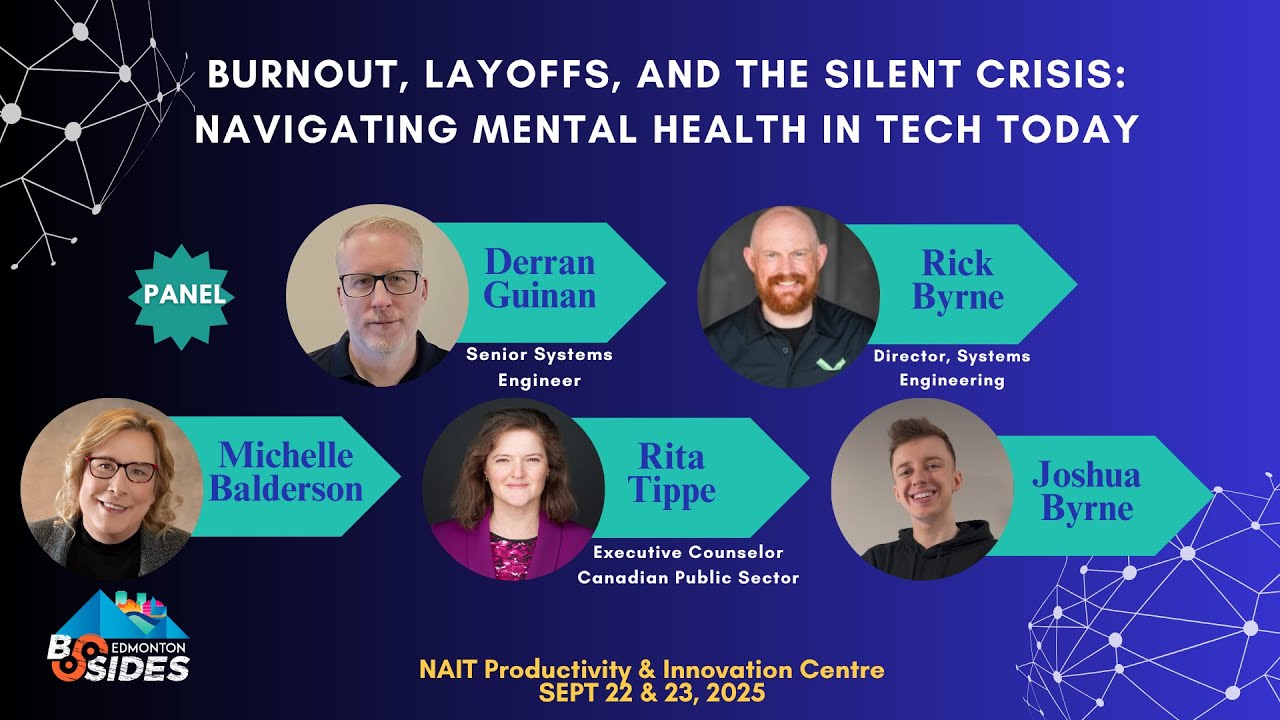
there's a person, a full complicated, brilliant human navigating a life. And it's not enough to tell people to take care of themselves while still glorifying overwork, toxic positivity, and the fear of failure. We need to do better together. So today we're doing something that's both simple and radical. We're talking. We brought together a panel of IT professionals who have lived through these experiences from burnout and aposta syndrome to leadership challenges, sleep disruption, addiction, fear of job loss, and more. This panel isn't about solutions in a box. ible stories, reflections, and a space where it's okay to not be okay. So, just to give you guys a little bit of an agenda what we're going to do here
today, we are going to introduce each panelist uh as an introduction. I will be showing their bio um and the picture on the screen and they have one minute to go over why they wanted to be part of this mental health panel. And then for each section, we are going to put up the list of what we're talking about. And after that section, we're going to pause quickly for some questions. Michelle, hello everybody. My name is Michelle Balderson. I am currently unemployed in the industry and it's actually one of my biggest fears is being unemployed in this industry. Um why do I want to be a part of the mental health panelist is that I've been in the industry for 30
years. I've always been that person. That person who is the strongest person in the room, the person who has that a type of personality, that person who is talking to the executive, that that person who is uh taking a technical solution and describing it to people in very non-technical terms and that takes an extraordinary amount of brain power. um in my personal life and we got to separate the professional life from the personal life is in my personal life I have three boys and uh less than two years ago my third son my youngest son and 18 years old uh died in a motorcycle accident and it's it's been the most difficult experience of uh of my life.
That being said is is that my eldest has been suicidal since he was 11 years old. is 23 years now and we're still not through that period of time. And so for me, my own mental health is at stake from the perspective of I've been going through a whole lot. I've gone through a lot then uh in the last two years than than most of us will ever experience this in our lives and and mental health becoming critical in the respect that I'm in that midlife crisis mode at this particular point in time and the best thing I can do is just pick myself up, dust myself off, get in front of people and talk about my own mental health
challenges and recognize that I'm probably the most mental instable person in the room. But that doesn't make me not an asset to a company that I could work for. >> Well said. >> Thanks, Darren. Rick Burn live here in Edmonton, Alberta. I lead up a tremendous sales engineering group for BEH Canada. We do data protection. Sometimes that can get stressful. But that's not why I'm here today. This is nothing to do with what I do as a career. What really relates to me is I have what I call and I don't call it suffering. I call it having the benefit of having highly functional anxiety. It means there's a voice in my head constantly driving me to try to do a little bit
more, try to be a little bit more perfect. But the hardest thing about that and understanding it took me a lifetime to get there was that it doesn't actually define me, it drives me. And I want to share that with individuals and even to the point I have a book started about seems fine is that whole concept of just because somebody seems fine on the outside doesn't mean they are. thought it's taking those challenges that you have and we all have voices in our head. I guarantee you everybody here does. It's what you do with that voice and how you let it either drive you or define you. Pick what you want. So that's what
I want to share today is some of those aspects and some of the things I've dealt with. But one of my biggest successes was having my son here with me. And one of the biggest successes of my lifetime is that individual right there. And I'll pass it off to Josh M. >> Thank you, Dad. Um, well, I'm a little unique when it comes to >> Isn't that unique? >> I'm a little unique when it comes to especially Bides in general because I'm an esports and content creator. So, I'm a lot online and a lot of the struggles that I have faced aren't only unique to esports and content creation. Um, whether you're dealing with stress,
burnout anxiety self-doubt whe whatever it may be. Um, even right now, right, I got a little bit of anxiety. It's my first time speaking here and it's unique to all industries or just in life in general. So, being able to speak about the things that I've learned, the struggles that I've been through and being able to hear other people's struggles and what they've been through and how they've learned is a big part of why I'm I'm here. And uh, yeah, I'm excited. >> Rita, >> Rita, >> over to me. Good afternoon, everyone. Thank you for the opportunity to be part of the panel. Really appreciate that. This is a really important topic and I think we all experienced in our careers
different aspects and challenges. And so for me, I've spent uh over 30 years in technology. I keep telling everyone I started when I was two because I'm never older than 35. Um that's that's the way it's always going to be. At some at some point it's going to surpass. We'll figure that out later. Um, but I think a big portion of it is I've spent a significant amount of time really digging into my values recently and spending a lot of work really identifying what that is, what that looks like and how I show up. Um, digging in from a resilience perspective, I've always thought throughout my career and being being in it is has its own challenges, but you
just plow through it. You just keep going and you know it'll get better, it'll get easier. And what I found is it really is a very delicate balance between your physical, your mental, your your emotional state. And so being really thoughtful about how you want to show up, what those values are, and really spending the time to do that work is really important. So just wanted to spend a bit of time with uh this group, be able to both hear your stories and your questions and being able to share a little bit of my experience. >> Thank you. So section one is all about identity, judgment and culture, fear of uh judgment in other people's opinions,
imposter syndrome, and the mental health stigma in technology. So I'm going to start off with a question for Rita. How do you balance balance being yourself with the pressure to show up at a certain way at work or online? >> That we're starting off with a really easy question. I see. Um, I think the the biggest challenge is really knowing who you are. So, I talked a little bit about values, really understanding what those values are. And even though it kind of earlier on in my career, I really was I couldn't identify what those values were, but I they were still really core to the way that I showed up. So, for me, three as an example um of
the ones that are critical is integrity, authenticity, and impact. And so each one of those would show up in different ways, but it wasn't something that I could really mask. It was something that I wanted to make sure that the decisions that were being made were being done accordingly from a perspective of um being making sure that they are the right decisions and they're the approach is the the ideal way to be able to manage it overall. So the honesty, showing up how how you truly are and it's about walking the talk. It's making sure that people are seeing you the way that you what you are telling them you're actually delivering over and over again because
that's critical. That's part of your brand. That's part of how you show up. That's how you build credibility. Um and as far as you know impact, that continues to be a really critical component of how I show up. I want to make sure that when I enter is and I'm leaving better than when I entered. I should put it that way. And my dad actually taught me that right at the very beginning of my career. He said always remember to, you know, make sure that whatever impact that you're making is going to be not just the projects that you do or the the check off all of the different tasks that you've done, but it's also about the people. you
know, how have you impacted the people in a positive way that they've they've been able to attain something out of that experience engaging with you. So impact has been really core to how I show up as well. >> I I like how you defined it comes down to values and I think it's not so easy to define your values when somebody asks you directly. It takes some time to figure out and perhaps you have to be in those certain situations to try to figure out exactly how you would handle that, what your values are. So I really like that. Rick, what about yourself? >> Yeah. So, I mean, a lot of it goes back to what Rita was saying, values. But one
thing I really looked at as well is as you know, I'm matured. That's what we'll call it, mature, right? It's not aged, it's matured. There used to be the work Rick and then the personal Rick. But you need that tremendous balance within your life. There isn't a work Rick. There isn't the personal Rick. there's Rick and that's what I had to be comfortable in is being who I can be no matter where I am whether it's in a business meeting whether it's in a friendship that's the thing I carve out and when it comes down to those values the big thing I always look at is the humble hungry smart there's a book about it and Darren might
even have it up here but the whole concept is humble literally truly be humble ego is the enemy and I never try to take an ego into a conversation. It's always trying to look at the different perspective that somebody else may be facing. The hungry is being to go after achievements. It doesn't matter if I'm shoveling poop or trying to win the biggest deal ever. I'm trying to be successful with that and get that achievement. The achievement to me means something. It means I'm accomplishing something. I'm proving that impact or value. And the smart has nothing to do with books smarts. That's definitely an equation, but it's the emotional intelligence. But one of the biggest thing is
self-awareness. Are you self-aware? And that's one thing I always try to look at. Do I understand where I'm coming from? Whether I'm angry, whether I'm happy, whether I'm content, doesn't matter. Why do I feel that way? And why do I act sometimes in those fashions? I would just like to know Darren how Rick gauges how successful he's been picking up poop but that's just my question for him >> would be that uh it's a great question. Um how I'm going to ask this to Michelle. How has the pressure to maintain strong online personal brand impacted your mental health? Don't worry. >> I know. I'm reading I'm reading my notes as we're going along. And um the strong
online brand uh impacting mental health for me is is that I was very similar to Rick in the respect that I had the Michelle that showed up at work and the Michelle that showed up at at home. And they're very two different people. And then you have the online stuff. And I I I'm absolutely detest social media. Uh I detest LinkedIn. Um I I think they're they're tools that are past the usefulness in in our industries today. And from that um my representation of myself on on Facebook is very different than my representation of myself on on LinkedIn. And and when you get to that point, it's how am I representing the whole Michelle to everybody? And I get terrified from
the perspective of showing the whole Michelle. That goes down to my journey. At 9 years old, I was I knew that I was transgendered and I buried my feelings until I was in my mid4s. Uh, I thought being a man meant 2.3 kids, white picket fence, and that's exactly what I did. And I learned to hide things. But I was a salesperson. And from a saleserson perspective trust honesty and integrity is what every salesperson needs to bring to the table. Yet, I was hiding my personality. I was hiding the person that I was. Um you may ask another question uh later on that's in my notes but uh from that perspective is is is I hid the person that I am from my
manager at forinet. I started with forinet 2004. I knew that my marriage was crumbling and I knew that I needed to go through transition. I didn't show it to him. Why? because I sat there in meetings with him and he told me, "Women do not hire women for sales jobs." And I'm like, in the back of my head, I'm like, "Well, I'm a woman, but you don't know that yet." And and so there was this feeling of I'm breaking trust with him. At the same time, I'm absolutely terrified to talk to him about it because he kept on telling me that women are going to be inconsistent. Women are going to have periods. women are going to have babies and they will
be inconsistent in work. And with that, I was just like flabbergasted by what he was saying. And what it got me lead leading towards and I'm hoping that you guys can do this in your life. Please don't see gender, right? See see capability within people. See the expertise and the knowledge that people have. We're all human beings. It is nothing to do with gender and the ability of being able to deliver a job. >> Well said. Josh, I'm curious on your u opinion on this because you're a different generation than myself. You also are into esports. You're also into personal branding. So, I imagine the pressures and stresses that come along with that are very different from from
your side. >> Oh, most definitely. And I think a lot of the younger generation that are here can understand the impacts of social media right on your mental health. Um, especially when it comes to other people's opinions. Um, personally, when I first started out in content creation, I was always worried about I need every single person to like me, right? I need I I can't if I get a bad comment, if I have a hater, right? Like that that's the end of the world for me. I'm going to lose sleep over it. Um, my energy is going to start to drain. Um, so over the years, um, it's kind of through experience, but you you learn that other
people's opinions shouldn't affect how you treat yourself or right what what you think about yourself at the end of the day. Um, so it's it's a really big thing. Uh, and yeah, I'm kind I'm kind of losing. >> Oh, no. I I think I think that's I I when you said the first part there, I was I was actually feeling like at a young age being online and it's all about content creation and you get that negative comment and it's affecting your sleep at such an early age. >> Was MySpace though, right? >> Sorry. >> Wow. >> You know what this Darren Rick stickick? It goes on all day long. Uh yeah. So I I
I like I can't imagine at your age sitting going to bed worrying about that person who's saying this and that about you. Like that must have been hard. >> Oh yeah, most definitely. Like I would lose at least 20 hours of sleep a week just because of the things that people would say to me. Like imagine the worst thing you can possibly think of that you could say to somebody that has been said to me. Um, and that's said every day because I've had each month I get tens of millions of views um, across Instagram, Tik Tok, Twitch, Facebook. Um, and it's it's from different generations, right? It could be from someone who's 10 years old to somebody
who's 50 years old. And that's something I got to remember at the end of the day, too. It's just somebody behind a screen that opinion doesn't really their opinion doesn't matter. It shouldn't matter, right? Whether even if it's a good opinion, right? It's I should say true to my own values, what I respect, what I enjoy. And that's something that I have learned and it's honestly made me a lot happier. My content has done better and I've enjoyed it a lot more and I'm able to sleep perfectly at night now. So that's a >> I think that's a tough thing to learn at a young age, but you obviously did it. Did it how long did it take you to get
to that point where I don't care anymore? uh in recent years honestly. So I kind of started the content side of things when I was 15 years old and I'm currently 24 now. So I would say probably around like 22 years of age so couple years ago. >> Yeah, that's that those are pretty formidable years too to being losing sleep over what people and we didn't grow up most of us didn't grow up in a you know when you're 18 19 20 and everything anything you do can be put on social media and rubbed in your face. So, uh, yeah, great, great answer. It it almost kicks off to the next topic, which is all about imposter syndrome.
It's pretty prevalent in our industry today. Uh, can you share a time when the fear of being judged kept you from speaking up in life or at work? And we're going to start with Michelle. >> Okay, perfect. Well, I've already given you part of my answer and I'm going to throw away my notes, okay? Because have some fun with it. Um, I talked about uh bringing it up to my boss from the perspective of of being transgendered and it was really literally like five or six years before I even could have a conversation with him about it. And I chose to talk to the HR department first and foremost. And the HR department went, "Oh, okay. Well,
we haven't had to deal with this before at Fortnet." And so they went to our CEO and our CTO and their reaction calmed me down completely. They basically went, "Oh, we've seen it before. Don't worry about it. It's all good, right? She's an exceptional employee. Let's just keep keep going. We'll support her through transition." And then uh it took me probably another year from there working with HR to have that conversation with the manager that told me that females couldn't perform. And then I basically put goals in front of me, which is you're telling me I can't perform? Well, I'm going to show you that I can perform. Which then caused other mental health problems
because I was working 12 to 18 hour days trying to show that I can perform. But the person that I am didn't change. My gender changed, but the person that I am didn't. I've always been a woman in my mind. And the reality of it is is that that fear that we all have to be able to bring up those tough conversations, it's worse than the actual reality of those conversations. And so I suggest to you guys that if any of you have fears from the perspective of bringing up that tough conversation, find ways to motivate yourself to do it. I I wish I had done it sooner because my mental health as a woman is 100 times better
than as a man. >> Rita, what's your take on imposter syndrome? Have you experienced this? I think we all experience it in different capacities, you know, different times in in our lives. I think for me is I'm going to bring the word that I'm pretty sure most people are tired of, but you know, the psychological safety is really important in any organization, in any teams, in any environment. And that tends to be kind of the gauge I think where most people are feeling that can I be can I show up as myself? Do I have the safety to be able to to do that? And if you don't um it it starts to kind of
come up in different ways. So as an example for me um I was in a certain situation where there wasn't really psychological safety and there was competitiveness and it was actually encouraged for people to compete between themselves amongst amongst the various different teams. And what I I started to get into that and I started because it was part of the culture and I started to realize that at some point I needed to step back because there was a a bit of a situation where I said I'm I'm actually contributing to this. So having that self-awareness which we talked a little bit about earlier was really critical. So when I stepped back and I just became
an observer of what was happening that really gave me the opportunity to look at it from a different perspective. And so the next step was really talking to the leader to be able to even see if is that something that they recognize because they might excuse me that that might not be something that they either encourage or or cons are conscious of. So having that conversation not me bringing it up but just bringing up in the context of how do you think the the team is doing? You know do you see any rub points? Is there anything that maybe we need to think about that might be a little bit different and getting their perspective and then bringing examples
into situations of if we did things maybe this way is there an opportunity do you foresee the team working more cohesively and better so I think it's it's multifaceted one is would you contribute what you bring to the conversation the second one is is a leader even aware that some of those symptoms are there just because they've potentially have operated in cultures that have evolved D and and they're at that point in their career as well and really being intentional and thoughtful. And then the third part is does that align to your values? Because you do have to sit back and really think about is that the type of environment I want to be part of and if so that's great. Uh
the other part of it though is can you influence it to be a better environment? So not only is it oh I'm just going to walk away. Is there potential that you have to influence it to be better? um when as as you're evolving in that group as well. >> Well said. And taking that next step, is there trying you know with trying to make things better? Is there a way that we can normalize talking about mental health? Rick, I'll start with you. >> Let me ask you this, Darren. I'm going to turn the tables on you now. Uh >> oh. So, just to take this into context, >> to take this into context, if somebody
is training for a marathon or going to the dentist to get their teeth checked on and taking care of their physical health, is there anything wrong with that? >> Nothing at all. >> So, why shouldn't we be exercising our mental health as well? >> Well, that is the biggest thing I kind of look at. There's no reason for it ever to be looked at as bad because if you don't work on it, you can't fix it. So, you need to work on it. Means you need to understand it. It means you need to talk about it. And repetition makes it better. >> We still get this stigma is that if people bring up mental health, they're
weak or they're unfit. And I think that's part of the problem where that gets brought up a lot. >> I think that's where you got to say they're intelligent, right? They are self-aware and they know they need assistance. It doesn't mean they need to go to a doctor for it, but some people learn in different ways. Whether that's self-help books, podcast, venting, frustration, it doesn't matter as long as they're exercising it and know what they need. >> Well said, Michelle. How about you? How do you think we can start to normalize that conversation? >> That's a good That's a good question. And I I wanted to make sure that I pointed out that I segueed to humor
because of the fact that they're having that conversation across me. So for me to be able to uh control my own mental health, I just stepped away and segmented and went to humor so that the audience could have some fun with it as well. And Murray, I did see your hand up. So we will get to questions shortly. Um you know, I'm not even sure how to answer the question. I've been in a sales career for a long time and in sales organizations they pit sales people against each other to be able to uh increase performance and so and that pitting of the salespeople against each other uh is just simply ingrained ingrained cultures in those types of of
of organizations. If you start to become aware of those sort of things, it's where Rita was going is is having conversations of saying, is there a way for us to be able to talk about the culture and being able to evolve and and and change and change the culture of the organization I think is is critically important is is is being able to open that dialogue. Um, it may not be your direct line manager. In my circumstance, it wasn't my direct line manager. it was HR where I started having those conversations uh because of the fact that you're you're creating an environment that is completely unhealthy. And the other side of the equation is is us as
employees, we have choices. And what I would suggest, and I'm going to be doing this in my interviewing process, um let me talk to other employees. Why don't you guys tell me first what the culture of your organization is and then I'm going to go and compare it to the other the employees that I'm talking to to be able to understand the culture of the organization and if I hear toxicity in the organization I won't take the job. Now I'm at an age where I'm like 57 going on 58. I can choose to not take that job. But if you're younger you may end up wanting to take that job. But think about it before you do because if
you're going to go into a toxic organization, understand where you are and understand how you can manage your own mental health in a toxic organization. >> Well, well said. To me, I always look at it as I I love what Rick said and I always think it the same way is that if I break my leg, I break a foot, I go to a doctor. If I have mental health issues, why would I not go and see a doctor? It's my my head's up here. It's part of my body. Um and the other part I always think of is that the best way to start that is we want to talk about it right if everybody's talking about it
more and more then it becomes more normalized within the environment I personally have tried to bring it up our own team and I always start with myself some of the challenges I've had so I try to make people feel more comfortable to communicate and talk more about it so anyway that's section one and Rick did uh get to or did mention that we're at the question section but we did poll poll for your value of number of books that we found that related to this section that you may find interesting to help you. Now, do we have any questions? I think Michelle said Murray in the back. Murray, do you have a question? >> Question.
How do we deal with stigma on this subject? It's I I think from personal experience that so long as people are at the risk of losing their health benefits or life insurance due to something that may or may not have happened in their mental health state, >> there's not going to be a lot of conversation about this regardless of how much we do let's talk or talk within the workplace. And then uh further to that, if the environment is such that if you did talk about it and it was weaponized against you in the workplace is also going to be a problem that needs to be addressed before we can really move forward on this subject.
>> Yeah. No, all valid. I I mean >> totally points. >> I've I've had my personal experiences with having mental health and being part of an organization and I've seen the dark side of it and how it can weaponized and I've seen how let's be honest most HR it was I'm glad your HR department was there and it helped you right but most times HR departments there to there to protect the company they're not necessarily there to really protect the employees. Uh so I think very valid point that you made >> over a few years after this. Um I was having a mental health breakdown at work and I went to HR and the opposite
occurred in the same company where it was weaponized against me. Um I'm going to ask a question of the audience. How many of you guys run incident teams or have been involved in incident responses? Okay. I think I think it's critically important today that we talk about the mental health of the individuals when an incident occurs. How many of you had impacts of mental health during an incident? >> And that comes back to that unfair expectations that you're having some big event happens and now from the business side, we need you to work what 15 16 hours a day. We need to get back up and running. How about how about the worst scenario? How about when you have um
called bad day and you get there's some kind of breach of something and you you see this team working 18our days over and over. They're burnt out and all that and you see the business not address the root causes that started and guess what it happens again. I I this is I've seen now two or three instances of this in the last two or three years and it's pretty like I feel you know Rick and myself we dropped off lunch to a team at one point that was in the middle of a major incident and they were on like week four and by week six they were still on that instant and then we thought they were in a better place
and four months later the exact same thing happened again and it's because management wasn't making that decision. They weren't moving forward. they weren't changing and they were really subjecting those poor employees to the same situation over and over. >> One of the other things that I've seen in my career over and over again is is during an incidents the employees that designed and built the security systems get pushed aside by consultants and the consultants don't take in consideration the impact of the employee that hey look they they have their pride and their life and their joy of what they've been doing and work built into this. So, as we get to the point of asking having you
guys ask questions, I'd love for any of you guys to talk about if you can when your mental health was impacted in an incident and and what you might propose as solutions to the problem because it's the definitive problem. I come from the vendor space. Many of us come from the vendor space, but the reality of it is is that for for for the the people that are in the field operating, your mental health challenges are different than my mental health challenges. And we have to remember that and in that incident response mental health is probably the most important thing to this audience in my mind. >> Can I add a quick thing to that?
>> Okay. >> Was that a no or a yes? I'm just checking. >> I want to keep moving on. I don't want to get too far behind. >> The only thing I will throw out during those times you take that as a life lessons a best practice. If an organization does that to you, keep improving your skills, set your values. That can be a positive outcome as well. It's not just the problem you faced at that point in time, but now you know this company organization may not fit your needs and you're starting to learn what you need for your mental health. So keep those things in check as you go through life and experiences because
that's who builds what we are. We are in full control of our mental health. >> We all make choices. >> Okay. Segment two, pace, pressure, performance. How has the constant pressure alerts deadlines incident in incidents impacted your life outside of work? And we'll start with Rita. >> Thank you. Um definitely has had an impact on my family. um really looking at the amount of time and the amount of effort that's that really has taken. I've got a very supportive husband so that has really helped me in my life to manage it. Um not everybody has that fortune. He also was in it so he understood some of the challenges but it really is around what do you when you're
not working what are you doing? What are you spending your time on? How what's that downtime look like as well? Because if you're on all the time, then that causes you're going to have some other issues to address. But it's really around segregating as much as you can. What can I do for myself? How does my, you know, physical being mental stimulation? I'm I'm all about that. I I want the more challenges that there are, the more I'm I'm engaged and want to be able to move things forward. And those situations actually inspire me to do better. But it's also you need to have the appropriate support system to be able to make sure that you're you're
managing that and that you do have that balance. So if you are spending the time and the effort, what are you doing for yourself that is outside of of the work and being able to be really thoughtful and intentional with that. >> I like it. Josh, what about you? Because you're from a very different um well work environment than we are. How about where does this fit for you? I mean, yeah, when it comes to deadlines and just setting aside certain certain things, I mean, for me personally, it's like, okay, I could stream from 8:00 a.m. to 300 p.m., but then you have practice. I know practicing in esports, that's whoa, that's weird, right? Um, so
you practice from 3:00 to 6:00 and then maybe your friends want to play games with you or you have meetings or you know you have to talk to organizations and it's a lot because you have sponsorships you have to deal with and keep um and this really affected my relationship with my family um friends right you don't really have a lot of time to you know see your friends and family and personally what I found is you really like Rita said you need to set time for yourself. Whether that be reading a book, hanging out with family, friends, um could be watching a movie, could be learning something new that you enjoy that doesn't have to do with work.
Um and personally, that has kept my mental health, you know, and my energy levels uh at at a good at a good pace. And you know, it helps when I it helps me fall asleep easier. you know when I wake up I don't feel drained because oh I'm missing these deadlines or if I'm not always working always you know performing then yeah >> thank you uh do you um new question here do you oh I'm going to give this to Rick first uh do you feel like being always available is still celebrated or are people starting to value balance more >> yeah balance is that fun thing we all try to achieve in life and everything we
do. >> Mythical legend. >> Mythical legend. Was that a thing? >> I always say, >> is that a joke? I don't get >> I always say work life balance to me is like a myth. It's like it fluctuates up, down, back and forth. >> Okay. Yeah. And it it really boils down into what does always on mean to you as the individual. You'll probably get from every question that I get asked, it always comes down to what does Rick think about that? What do you think about that? Because honestly it really means what does that mean to you? Some of us take jobs where we do have to be always on but you accept that challenge
or you don't accept that challenge and you make a choice whether you want to be that and some people need that in their lives to actually provide their mental health. Let's be honest not everybody wants a slow paced job. Not everybody wants work life balance. They actually want balance. So if you're doing the thing you love to do, that's balance right there. There's no always on because it's just there. It's a part of you. That's that's my take on it. Darren, thank you. Uh Michelle, what's your take? >> Um maybe it's a very negative take, but I don't think that employers are really embracing work life balance. Uh I think that the expectation of always on
culture and particularly in IT is just there and it's prevalent. Uh I as a manager would always say to my employees, you got to have work life balance. And then as a manager, I was working 12 to 18 hour days and and it was because of the expectation of my management above me. But my my employees, I kept on saying, "Hey, you got to have work life balance." And then my employees came back to me and going, "Michelle, you don't you're not balanced." Right? Um, and and what I find right now is what I've lost is that I lost time with my family. Just like Rita, my boys suffered because of me not being there and not being present in the
moment. And not being present in the moment meant I didn't do a lot of things with them because I wasn't present after work. I was so exhausted. And now I've taken the last 10 weeks off of work, 10 or 12 weeks off of work, and now I'm completely imbalanced where it's like I don't even know if I want to go back to work. And so when I go back to work next, it will be setting the expectations. And and there's a few people that I know in the industry that just basically say to their employers, I will give you an exceptional 40 hours, nothing more. And I think that we as the employee has to set the expectation back to the
employer. And then we also have to find an employer that doesn't set crazy expectations. When you get down to incident response, I think it's about managing the expectation of your manager and the manager expectation of the team and then giving people the appropriate time and breaks to be able to get that mental health back because if you do weeks and weeks and weeks of incident response, you're not going to be doing the job well anyway. I think I think that's a great point and I think there's organizations like we it's easy to say everything comes back to the organization you're in but really it comes back to really who do you work for, who's your manager, who's your
leader. I know one thing that when I came on board the company I'm at now. Um I made a very purposeful thing is I don't have any notifications on my cell phone. I don't get email. I don't get teams. And I remember telling one of my sales guy that one day and he must have wanted to kill me with the face he gave me. and I didn't care. And I'm like, you know, if there's an emergency, something happens, call me on the weekend. I'll sit 12 hours trying to help somebody on instant response. I've done it before. But you know what? I don't need an email to say that buddy boy needs this delivered on Monday. I don't need to get
that at 7:00 at night. So, you know what? I don't keep my notifications on. >> So, I think it comes down to who's >> that later Darren. Keep your notifications on. >> I know. I know. I know. Okay. I'm going to call this one father son. Well, I'm just gonna want Is everybody aware of the French law relative to that? They have to turn email off at 5:00 PM every single night. That's what we need to ask for in North America. That would be nice. Going to call this the father son u back and forth. And I'm really love this dynamic we have here especially the the question because it's all about AI. Has AI started to make
things better or is I AI introducing new pressures? And we'll start with you Josh. >> I mean, I think AI is beautiful as a tool. I don't think it should be used as you're making it do all your work because then your personal creativity just goes right out the window. But if you're using AI to set schedules, right, if you're asking it for even idea generation, right, you're still able to choose which ideas you want to use for yourself. So I think personally AI has made just work and life a lot easier for me at least personally. Um, I'm allowed to find information a lot quicker. Um, I can tell it to find reliable information, make sure to fact check it.
Um, and overall I think AI is a very good thing. >> Ricky, >> I think it's both. It's uh making our lives easier and harder. Easier with everything Josh said. Take the busy work out of it. Use it for what it needs to be leveraged for. However, it adds another level of pressure to everybody because you're expected to know more. You're expected to know more because you have tools to help you with more. And yeah, that's valid, but that's getting to decide how do you free up your time to focus on the things you need to. And I always look at it and I mean, I'm in information technology. I'm part of a vendor. Guess what? Every single vendor
is at it. AI. Isn't that the new bingo buzz word? I >> I heard AI is coming any day now. >> It is. It is. But that whole concept is the way I look at it. AI is not going to replace me. What's going to replace me is the person who leverages AI because it's a tool no different than do you go to library anymore? Maybe. But do you use it for a research paper? Maybe not. You're using the internet. Word processing. I was listening to the radio coming back from the Oilers game last night. Yeah, they lost. I know. But they won in the other one. So, that's the main thing. But stalemate. I'm totally going on a
different there. So, yeah. So, sorry, but they were talking about >> keyboard lessons. Does anybody remember keyboard lessons? I'm not talking about like the ding ding ding music, but like typing. >> This is one of the things I think about a lot is that in high school, I took typing. You know how efficient that made me when I got into computer science and and >> that's not a thing anymore, Darren. >> I know it isn't, but I know you want it to be there so you can go back and do your what was that that program called? Mavis typer that thing that was great. Yes, Mavis beacon doesn't exist. It's not a thing anymore because it's just
people naturally do it. >> They just do because that's what they are using every single day. So when you went to courses to do that thing, that course is a waste of time now. Fair enough. Fair enough. Okay, this is for everybody on the panel and I start with Rita. What's a boundary that you set that felt scary at first but made your life healthier? And you only have 10 words to say this. >> Less than 10 words. >> Oh boy. Um I think for me it was really around um having psychological safety, making sure that I'm part of a team that I can be really um open, honest, and engaged with the team members and that I
can really bring my my full self to the conversation. >> Fair enough. Michelle, >> setting that 40hour work week and being able to make sure that I am calendaring absolutely everything I'm doing, not just simply the meetings and being able to represent that back to to to management. It was uh difficult to discuss at first because the expectations are much more than 40 hours for a vendor job. But in the end is that I just basically was able to describe to them that they're going to get much more greater degree of productivity out of me by me focusing on 40 hours that then allows me to be able to spend the appropriate time with my family and my
boys. And there's no argument. They can't give you an argument when you when you get down to it. >> Rick, 10 words. Well, I remember when Darren I'm going to have to get him to repeat the question. But before I do that, this is not part of my boundaries finishes. So, yeah, I know. But I asked him the question had to be less than 10 words. Okay. What What was the question again? >> What's a boundary that you set that felt scary at first but made your life healthier? >> Saying no. Being comfortable saying no. >> I was going to bring that up. You stole it. >> And I did it in less than 10 words. Just
saying. Josh, can you do it? Do do it in under 10 words. >> Staying true to myself and my values. >> Love it. Love it. For me, it was saying no to say yes to much more important things. So, question period. Again, we have more resources on the screen. If you want to take a picture, these are books that we have a number of us on the panel have found uh that have helped us on some of these topics. Any questions? Go ahead. How about this? Is that um my employer kept on telling me that I was more productive on vacation than I was when I was at work and that I closed more business. Uh the other the other
thing I think that you need to bring up. >> Did you just take a vacation the whole time? >> Yeah, I know. I needed to take a vacation in the entire time. Um I don't we don't see this in Canada, but you see it in the United States. Unlimited paid time off. that's intended to change the behaviors of the employees to reduce the amount of time that we take off. >> I see danger warning signs when you see that. Yeah. >> Yeah. Absolutely. And and then we should talk about the stigma of taking time off. I had a manager that was proud that I ended ended the year with 120 hours of uh paid leave that I didn't take.
My manager was proud of me for doing that over the course of 18 years. And I lost so many hours. I know they didn't give me the money for that. I just lost it. But the expectation was don't go on vacation. Right? But if we don't go on vacation, we're not recharging. We're not taking the time for ourselves or that the stigma of of using those services from an HR perspective. HR is not your friend. And then you start to talk to HR about the need of those services. And then at that point, you get targeted and you get and you get people um putting notes in your file of this person has mental health issues. We need to be able
to change those stigmas. >> Any other questions before we move on? Oh, one right here. I saw first. >> Yeah, I think it's a great question. I think a great question. >> You don't have a great answer. >> Yeah. I mean, >> I'll give you an answer is is that we're not considered blue collar. We're considered white collar career professionals and therefore then unions don't apply. >> Um, >> big enough though. I mean, in most it you're not a big enough >> you're not big enough form a union unless you're in an organization that >> that currently has a union. That's the problem where I know we are specialized workers. We are critical to infrastructure but typically we do so
much with so little right which makes it hard to unionize. I was part of organizations that had unions. I wasn't part of it because I was considered a critical service. >> I think it also comes down to at for us to be to your point like almost white collar. It's almost like the way that to go about that would be more like a union tied to a certification of some sort something like that. But then that organization's going to put themselves out in front and nobody's going to do that. >> And I was I was going to make a very similar comment here is is that in IT we're not professional. We have no professional designations in
IT. We're certified but there's no such thing as a IT professional designation. We need to be able to elevate it into a professional designation just like a a a CPA. And that's exactly what I was thinking because coming I went to school at Nate uh what the program I took is gone. The program that replaced it is now gone and I was thinking that's where the the accreditation came from. You were able to be part of uh one of those credited groups when you came out in Nate but we don't have that and now we're getting less of those programs. There was one more question over here. >> Pashant mic. Yeah, great panel and uh great
discussion. In fact, a very interesting topic. So, couple of questions on two different areas. One is can you share any personal strategies on reclaiming your mental health whether in terms of cyber mindfulness I heard this term in fact pretty recently people do mindfulness meditation >> to try to make sure that they are present in the moment and not click on fishing emails because they're thinking something else as an example. But any personal strategies? Um and also my second question is around I teach in certain educational institutions here. I see students and people who are who want to have an entry-level role in cyber security but they can't and they are struggling mentally. They have the skills. They may
have the education. They may not have the experience but they're not able to cut in and there could be various reasons that not enough jobs or whatever the case may be. How can we help those new to the workforce or trying to enter but struggling mentally because they can't enter the workforce right now? I think we're going to we're going to pause on the first question because it's going to get covered in the next section. Um, as far as helping the next generation, I I think it's interesting. I have a 14-year-old and a 13-y old daughter and I hear a lot about the different generations, how the Gen Z and the this and that and I never really
kept track of a lot of that stuff. The one thing I found interesting about the different generations is that for a long time millennials have had this bad rap. They get this bad rap and and I'm not trying to say that some points I didn't see it as well, but you know what? The one thing I think that they're really changing for the better. Millennials, unlike my generation and I'm Gen X is the millennials when for example they're like hey you got to go back to working in an office they're like no and we're like we would be okay how are we going to make this work? They're like no well you're going to lose your job.
Okay I'll find another job and employers are having a really hard time figuring out what to do with that. And my generation wasn't we're we're always built to figure out a solution. We're figuring out the next solution for that. I would have never thought of saying no. And I love the fact that millennials are pushing employers. So I almost feel like I'm learning more from the millennials who are doing this and I'm loving it. I don't know if anybody has a quick comment though. >> Very very quick comment is for the young people in the audience, seek out mentorship. >> Yeah, that's great. or the folks that have been in the industry for a period
of time, mentor. And when I have taken the opportunity to mentor a few people out of the UC program uh in the state program and the NATE program and the programs are disappearing because the the kids can't find the jobs. kids can't find the jobs because the employment methodology so of being able to put your resume in isn't working for that generation and that we need to be able to connect people with people and that's one of the things I did with mentoring one of the students I helped him find his first job soon as I he has his first job now he's thinking about where he's going to go next and what he's going to do next so I challenge all
of the folks that have been in the industry for a period of time find somebody to mentor. We need to be able to mentor. We have to. >> Okay. Mia, you want to make a comment? >> If I can. So, I think, you know, Michelle, to your point, I think there's all kinds of different opportunities for mentorship and there's all kinds of different associations that are out there, but also finding who you want to be intentional. I've had I wish I would have taken the opportunity earlier on in my career to to find a mentor. I did later on. It was exceptional just from a a growth perspective. But I think to your point, Michelle, there's all kinds
of different ways to continuously engage. And I don't think it just needs to be with the the upcoming generation. I think we can all leverage that and have different perspectives that are brought in to broaden our mindset as well. >> Well said. Okay, turning to breaking points and coping mechanisms, burnout and chronic overwork. I know none of us know anything about that. What are some of the human warning signs of burnout that people often brush off as just work life, Ricky? >> Oh, my hair fell out. >> No. No. So, I thought that's what happened when I joined. >> Valid. Valid. This is this is all natural. Uh when you when you're exhausted all the
time, right? I mean, that's one of the things that really starts to come out when you have no joy in anything, right? It doesn't matter what it is, whether it's spending time with your family, frolicking around in a field with your Yorks, whatever it is, you you don't get the joy in it. So, it's that whole concept where you need to find that place to recharge. So, I mean, that's that's my take on it. Anyways, Michelle, >> um, so I'm divergent and I have, uh, OCPD, which is obsessivecompulsive personality disorder. And that disorder focuses me towards perfectionism. But also within that disorder, I have annoy my mind just doesn't stop. And when my mind I can't control my mind
from the perspective of being able to get that downtime. I know that I'm having mental challenges and I'm reaching that burnout stage. We have to be able to take that time as soon as we see it. Those signs is then take that break and stop and refocus. >> You know, it took me a while. So my when my anxiety used to come out was would be something difficult work would happen. It used to be a really bad manager. My first time having a manager or a director when I was a manager and I used to when I was going to bed at night I'd start thinking about what was happening and how I'd react. When I knew it was a
problem was when what I was thinking about and how I'd react became so never going to happen. Like it's like he pulls out a gun. You know what I mean? It was just over-the-top imagination that it was so unrealistic that I knew I'd now crossed into an healthy part of my anxiety. So to me, if the scenarios you run through loans are realistic, but once you start unrealistic, it to me that's a pretty big warning sign for myself. Um, so going to almost with Pashant. Oh, Pashant left. He would have loved this. Uh, what routines, hobbies, or practices outside of work have made the biggest difference for your mental health? Rita, >> um I think for me is I know this is
going to sound cliche, but I'm going to go there anyway. Uh exercise. It's the ability to get out and also get some fresh air that on an ongoing basis, the fresh air makes a huge difference. So my my husband drags me out with the dog and and we go for a walk. Um other things for me that are important, I read quite a bit and I try to not always be reading business books. I don't always promise that. uh but gardening and and doing other activities. We do spend going back to the comment about family, we spend a lot of time with our family and we make sure that the kids are really well connected with our grandparents that's
really important to us and it builds that sense of community and and family and the relationship. So that becomes really critical how we we want to show up and how our kids kind of continue on that tradition. Um so those are all aspects and really being present. So, I think we've we've talked a little bit about that, putting the devices away. Um, not not always are we successful at doing that. We attempt to do that, but the kids are are getting better at it. We're not that great ourselves, but just really being intentional. So, spending that family time and being engaged is is really cherished and I think that gives us an energy to reconnect in a different
way. So Josh, I'm really curious on your opinion on this because you have a very different life than us where you're up late a lot. I know you're gaming sometimes at 4 in the morning. So how does this Well, I'm giving you too late. >> 4 in the morning. >> 2 in the morning then. Okay. So how does you know, how about you? What do you do to try to unwind, bring it back, especially with a different type of schedule where you do go long on your streaming and gaming? >> I mean, I think Rita hit the nail on the head. really exercise is super important. I used to be I think a year ago I was around 240 250 pounds and
that's when my mental health was almost at my worst like anxiety overthinking everything. Um and then I started you know getting in shape you know going outside even just getting sunlight be you don't even need to go outside and walk around. You could literally just go outside sit on a chair and just take in the sun cuz that vitamin C you know really helps. It might not look like I'd take a lot of vitamin C, but uh but uh yeah. So, really just getting outside, getting some exercise, weightlifting. Um and also another thing could be for energy levels like supplements like vitamins, um creatine. Uh you don't even need to work out to take creatine. It's just a very
natural uh energy booster. So, yeah, hanging out with family, going outside, getting that exercise I think is a super important thing. So, I'm going to pivot this a little bit. So, one thing that I've I've struggled with and I've had to be very purposeful of is that I have a hard time being at home and not doing anything. I feel lazy. I feel judged. I feel so I I'm always constantly like, "Hey, it's Saturday and what am I going to do? I got to get this done, this done. If I'm not doing it, so nobody's doing it." Uh, etc. So, eventually I came up with Sunday is a no pressure, no obligation day. But I'm curious what
are, you know, how can we create a culture of rest and recovery are valued not seen as lazy? Josh, >> well, let me ask you something. You know, when you do feel like you feel lazy and you don't want to go do something, how do you feel after you go and do it? >> I start to get more tired and more exhausted. So, I mean, I >> Well, I guess it's a little different for me because like even yesterday, for example, I was like, "Oh, I don't want to go work out, you know? I'm just I just want to lay in bed all day, right? But then I got up, got my workout in, and I had all this energy and I felt
absolutely amazing right after. So I I guess it's different for each people, for each person. But yeah, personally for me, it's just just doing it. Put go into autopilot and just get up and do it. Don't don't overthink it. The more you think about it, the less you want to do it, right? So it's just >> how do we create that culture, though? How do we start to create that culture where rest and recovery are are are valued as seen as something that has to be that we need all the time? You can't always be on. We need an off sometimes. >> Yeah. >> So, how how do we build that culture? Rita, I was also going to ask you as
well. >> Yeah. I think it it really is how people show up on Monday mornings because, you know, do they show up exhausted and the conversations are really, you know, just the the mood just lack of energy and those that come, you know, that have that hopefully the the rest and relaxation have the energy can really spice the conversations can really bring a different element into the the whole energy level of whatever it's happening. So I I I actually try to do that myself when on Monday morning is when it just feels heavy and hard is just bringing that that level of enthusiasm and starting to shift the conversation towards okay so we don't need to go
through a log of all the things you did over the weekend but what brought you joy what brought you you know energy what brought you enthusiasm what what what are the things that really you can speak to so that's one part of it I think the other part of it that's just as critical is incorporating the things and really connecting with people of what what is what they're passionate about. How do you incorporate some of those aspects into some of the work that they're doing? So, some of the conversations I I've had um throughout my career has been what's your passion? Let's talk about that. and then really understanding how that can be, you know,
incorporated into whether it's projects, whether initiatives that just gives people more of that fuel in in the tank, so to speak, and brings that enthusiasm level that's that's heightened. So, I think there's multiple things. I don't think it's just one. I think it's multi-aspect, but I think the the energy Monday morning continues to shift and provides visibility of those that have had rest versus those that kind of continued on. >> Thank you. gonna add a question in here and just, you know, challenge Michelle a little bit because I think this fits perfect for what you've been talking about today, Michelle. >> And I think I've been in this situation somewhat as well, not quite probably too
my >> anxiety is your you've brought up, but no. Uh, once you've been in in deep burnout, >> Yeah. >> is recovery possible without a major reset? >> Oh, that's a wicked question. I'm in deep burnout right now. But you've had your reset, haven't you? Is two weeks enough? >> No. >> Great answer. >> No, I'm changing my entire life. I'm changing my attitude uh towards work. Changing my attitude towards how many hours I work. And I'm I'm really looking at work from the perspective of it's it's infinite. The work will always be there. As long as you're employed, the work is always there. you know, what you leave on your desk on Friday is there on
Monday. Um, my focus at this particular point in time is is that I've kind of broken my life into thirds and I'm in the last third of my life and the last third of my life is going to be the best third of my life and I'm going to take care of myself first and foremost. I'm in the mode right now of loving myself. And I think we all just simply need to love ourselves. 14 years I had a marriage that just broke up in in December and I lost my femininity completely. I didn't wear any makeup and here I am wearing makeup. Why? Because it makes me feel good. It has nothing to do with anybody else.
And so recovery from the perspective of burnout is is is is possible. Uh change is possible. We need to embrace change. And in that change is is is really looking at what we've all been talking about today is taking care of yourself. And taking care of yourself isn't necessarily always taking care of your employer. It's being able to understand when you need to step away. and I'm going to step away the next time that I'm in that, oh my god, I've got this big project that's due and I'm stressed out and I know that I'm going to just like get upset with somebody. I'm just going to step away. And when I step away, I regroup myself and then at
that point I don't get into problematic situations where I'm yelling at somebody. I think it's just simply a matter of changing perspective, looking at it from the perspective of of where we need to or where I want to go. Setting those goals, but not only setting the goals, but setting the dreams. Like we can't we we in society, I think we forget to dream. We need to be able to dream. And those dreams and aspirations cut down on the anxiety. Manage our money better. That's another thing I'm I'm planning on doing. Um creating less commitments, spending less, managing the money so that I'm not running out of money. I know a long-winded answer, but >> Well, I think it was a great answer and
I think the the thing and I went through a burnout at one point as well, but and a couple things I love you said is uh I personally think it takes time. When you first take that break, you're I was a bitter Betty. I was upset. It took me a long time to be able to have a really honest conversation and have self-awareness of the situation I had been in. And then it also took my and I love what you said perspective. I had to change my perspective and I had to change what Rita mentioned earlier was start to think about what values are important to me. Where do I want to work? And it became to the point of
looking for the right person to work with, work for. Don't get any ego going, Rick. Uh, but it was about finding the right situation. And I don't I and I I'll be very transparent. I don't have any loyalty in my opinion anymore to companies that I work for. But I have loyalty to people, the relationships I have in in companies, both managers, people beside me that have showed me loyalty, I have loyalty back to those people. >> I work for the company. I worked for Fortnite for 18 years of my life. And near the end of my tenure of working for them, I was feeling entitled. I was I was the person that everybody came to because I knew all of the tribal
knowledge of Forinet. I know the products inside and out. I I still know all the products inside and out. But with that entitlement came anger and resentment. And then I ended up getting a micromanager. And then HR told me, "Don't call him a micromanager." And I'm like, he's a micromanager. Uh because he's going to get upset with you. And then I blew up on him. I blew up on him several times where it was just like I and I can't use the words that I use, but basically I quit on him several times. Um and then ultimately I made a decision to leave. Uh and with that I started to realize where I was at. And it's just like Rick
started with being humble. We have to be appreciative of what we have and be humbled by everything. I have a wall in my house. I own a church in Nanton and I'm humbled by the home that I have, but on the wall I have everything that humbles me. I can't I'm not very good at musical instruments, but my son is. And I have six or seven different musical instruments on my wall. I have family pictures. I have family past histories because family is critical to be humbled by. I have um things that I can't do and I have things that I remember. I have like a big um uh sled from from from being a kid because
in Canada that that's associated to us being Canadian. And so I'm humbled by being Canadian. And so I'm replacing anger and resentment and entitlement with being humble and realizing that you know what, maybe I don't need another job. Maybe I do. I probably do. And with that, I'm going to go and do what you did is you found the right manager, you found the right organization, and you found the right balance, and you set the right tone and direction right from the get- go. >> Yeah. And you know what? That wasn't easy to do uh for myself cuz it felt like going out on a limb and saying, I don't do notifications and I'm saying
more saying no to a lot more. But I really it was uh it was a breath breath of fresh air and it definitely made a big change for my life. Okay, we got question period here. We're going to speed up a little bit. Um again, some more resources for you. Any questions on the burnout, Brashant? And you missed the answer to your last question when you uh went outside. >> Sorry about that. >> It's all good, Pashan. My question is more around your idea of macromanagement versus micromanagement of your employees. Um, have you had ever that of an experience? Usually we all frown upon micromanaging your employees to the extent that they feel burnt out. But
what are your takeaways on how I can be a good leader in delegating work but still not be called a micromanager and uh and help my team work as a team? Basically, >> since I since I brought up micromanagement, I'll I'll answer your question Pashant. Um, that I'm not sure exactly how to answer it. The the the key to me is employee autonomy. Having the employee know that they can make decisions on their own and not be questioned on those decisions. Then there's also the assignment of work that a manager needs to be able to do. And for me, I think it comes back and forth from the perspective of dialogue across the entire team.
I was a manager for for nine years at Fordinet and I started to believe in consensus based management decisions. And when I was hiring new employees, I would always create a team underneath me to be able to make a decision. Will this employee fit on the team? Will they give us the right skills? will they give us the thing? Because in the end, this is that as a manager, if I was the only one making the decisions to hire those employees, it would be always on me. Whereas I could have the team make that decision and if that person didn't work out, it was on us. And so for me, I think it's more along the lines of that
team consensus based discussion decision making. >> Rita, >> yeah, I just wanted to add a couple things. So you the the whole notion around building high performing teams is really around trust and so building that trust out of the gate. What does that look like? How does it show up? And it was interesting because I at one point I did a bit of an exercise with a team. And in the virtual room because we were hybrid um I said I'd like to go around the room and everyone to define what team means like or sorry what trust means to the each team member. And it was a really interesting exercise because what that really demonstrated is
everybody has a different understanding what trust is, which that shows up, what's it, what it means to them. But if you don't have the trust in your team as an as an onset, you're not going to be able to elevate that in multiple different capacities to be able to really have a high performing team. And I think the Bernay Brown's comment, I'll try not to butcher it, I can't promise I won't. Uh but when she talks about that it's you talk to people, you don't talk about people. So you know things like you shut down as a leader really quickly any of the gossip anything that if you can't say that to the person to their
face, you shouldn't be talking about them that uh Rick. >> Oh, sorry. I just like to add one one thing that uh because it made me think about it. this micromanager that I had at Fortinet didn't build trust with me out of the gate and um pride pride month came along and he decided to bring up pride in an employee meeting where we had 15 people on and and he pinpointed pinpointed you know we should be talking about pride and Michelle and everything like that and it's just like dude you never even had a conversation with me on how I feel about pride because pride parades as far as I'm concerned are ridiculous. And so
when he brought that up, he just continued to break trust with me. Rick, I'm curious on your opinion as well since simply because I know the team you built and the culture, but how have you approached the whole macro micromanagement? Um, and I loved what Rita mentioned as well is about uh it's something that I learned a long time ago, which I think you've been really good at, is that I've had managers that will talk about other people. Um, I always think if they're going to talk about another employee, eventually they're going to talk about me. So, I'm curious your perspective on both points. It's management. Everybody's got to deal with it when they go into a people manager type role
responsibilities and it really boils down into what Rita said with the strengths but it's also understanding what their strengths and weaknesses are and each individual person needs to be managed in a different fashion if that makes sense. I don't want to call it servant leadership because I don't believe that anybody is a servant to anybody, but it is knowing what they need to be beneficial in their role. If you're trying to focus on their weakness, you're probably focusing on the wrong thing because there's a reason it's their weakness. And if it's just because you believe it's their weakness, but it doesn't really influence their job, keep focusing on those strengths. That's that's my whole philosophy on
everything. I don't care what the weakness is, right? Even though you wear a pink shirt, I think it looks great on you. Your your choice of clothes doesn't impact me. But I know that's not Darren's strength, but I know what his strengths are, right? >> And this is what happened. >> A great joke. >> You know what? This is honestly one of the biggest things that I enjoy about my job is that me and Rick have this constant banter back and forth. And I'll be honest, I laugh my ass off. And when you're at work and you're laughing a lot, that's always a good thing. Can I can I just add one more thing about
manager? >> It's got to be within five seconds. >> It's going to be it's going to be two seconds. Is is uh I've told Rick multiple times that I want him to be my manager going forward because of the nature between these two and it's awesome but I'm not a system engineer so I can't do it. Um but from a management perspective I just want to say this for the people who are managers in the room. It's okay to fail as a manager. I failed as a manager. Uh, and then I I analyzed the things that I was doing and the one thing that I I think I needed to do was go to my manager and say, "Hey, look,
I'm failing and I'm trying multiple different ways of being able to manage the team and it's not working." Um, if I had done that, I might still be in management, but I'm not. >> So, we're going to pivot. >> Two two seconds. I promise. Um, so in terms of tools, something that I had found, Patrick Lynchion recently came out, well, I don't it's a year and a half ago or whatever with a book. It's called six types of working genius. It's really very good. What it does is they actually have an online quick survey that you do and you do that with your team and it outlines what they're passionate about, what are the things
that they like to do and what are the things that they don't like to do. doesn't mean that they're not good at or good at, but it gives you a really good map for you to be able to leverage with your team to be able to understand how do you actually position their strengths and where do you have your weaknesses and it's only specific to work. So, it's a strength specific to work, but I think that um I know that it's been advantageous to well numerous people. I've used it, but numerous others have used it as well. I think that's a I think that's a great point is back in the day I my whole office at one of my
um where I worked we all did a a personality uh workshop and we were inviting our spouses and everything. It was really funny is that my wife went and sat in the all emotion section and one of my co-workers sat there with her and every day I had a desk facing this individual and he'd come in he was the most happiest guy and the one day he came in you could just tell something was wrong and I got up I do you need a hug and he came running over for a hug and you know what you I would not have known that or even thought about that because I didn't understand his personality type so I do find those type
of >> Don't worry about that with me >> never need a I You do the running over. I know. >> Okay. Segment four, connection, culture, and change. Um, let's focus on the remote or hybrid life. What helps you build genuine connection with others? Rita, why don't we start with you? >> Sure. That's been easy since co, right? Um, I think the the aspects are really around understanding first of all goes back to what we talked about earlier is understanding the people. How do people want to be engaged? Some people are not comfortable engaging in a group. Some some don't want that. Um others are are comfortable over time as you build trust. So when you're looking out and
saying, "Well, we're just going to do team dynamics or we're going to do, I don't know, ice breakers or whatever it is." Not everybody's comfortable with it. So being really thoughtful about the individuals, I think is important. And I think the other thing is quite frankly is is care. Is making sure that you're building that culture of care of what do you need? How how can I show up for you? and then what do you need from me? I I say that to the kids to get that ingrained into their mind is shifting really around what you know what's your ask because the more clear you are about what the ask is the easier it is for
people to engage and connect. So if you know that they need to connect in a certain way uh being able to do that. So I think there's individual cultures I think there's you know group cultures u being available is is a challenge. I mean, it's great for everybody to be able to say, "Oh, yeah. I'm always available." We're not always available. Let's just be frank, right? There's certain situations and circumstances that doesn't happen. But knowing that you're genuinely there and you and you care, I think is it goes a really long way. And then how do you want to engage with people individually and being thoughtful um starts to shift that culture. >> Thank you. Josh, what about yourself?
because you have uh you have you have um your esport followers, you have people who watch you, you counsel people and help them on this. So, what's your perspective? I mean, honestly, just for building connections with other people is just being there, right? Being present. Um and just sending that occasional check-in message, just be like, "Hey, how's it going?" Right? Could be once a week, could be once a month, right? And that means more than anything, right? Especially for me, right? if I have any friends or individuals that just message me, you know, it could like it could be every two months, three months, I know that person's there for me and if I needed to
go to them to talk about something, right, somebody I need to somebody I can trust, um I just Yeah, the biggest thing is just being there and just, you know, if somebody needs help, right, be there to to help them out, especially if you want to build that deep connection. >> Yeah. Well, I like the one, you know, I have a lot of friends that I don't see all the time. I I didn't grow up in Alberta. Uh my best friends don't live here. But getting an email or a text from somebody uh that is in your life or it matters or sending that to somebody I think does make a big difference. So I I
totally do agree with you. Uh Rick, what's one small behavior that kills trust or safety even if it's unintentional? And we're going to try to be brief with our answers. >> I'm always brief. I'm a man of little words. Honestly, stick to >> Is that because you only know a few? >> It's true. Yeah. I'm simple and I'm okay with that. It's not one of my strengths by any means, but I'm okay. So, to keep it simple, it's sticking to your word. Even if it says you're going to email somebody or you're going to remember something, remember it because they won't forget it. It may be a small thing to you, but that maybe that was a
massive thing to them. >> Michelle, yourself as well briefly. Um, I think I said don't micromanage, right? What was the question? >> That's what a moderator does. Okay. What's one small behavior that kills trust or safety even if unintentional? >> Yeah, micromanagement build uh kills trust. There's no ifs or buts about that. And I'll just leave it at that so that you can gain some time back. >> Thank you. Um, Rita, have you ever experienced toxic positivity when people uh when people dismiss real struggles with empty encouragement? >> Yeah, I think that we there's a tendency to do that based on what what's happening, right? And either we've experienced it or or have been part of that. And it is unfortunate
because it is quite challenging to kind of from a navigation perspective, right? when you think about well yes it's it's it's not taken seriously it's not someone doesn't show up in a manner that really is where you're at and I think goes back to what I said earlier is meeting people where they're at you know what does that actually look like what do you need what is that um being honest and being genuine about it rather than just glazing over it >> fair enough I also think if if you're not willing to have a conversation or you don't want to have a conversation about something potentially negative you're You're invalidating somebody's feelings, right? If you only want to
talk about something, you're basically saying, "Ah, your feelings aren't valid." >> Well, and some I mean, Darren, some people are they struggle with difficult conversations and we see that over and over again. So, that becomes really really a critical component is for people being able to have those crucial conversations. >> Thank you, Rick. Have you had toxic positivity? You've experienced that? >> No. I don't know. I this is actually we we've talked I I've talked about sometimes the toxic positivity I used to see in where I used to work. I I haven't seen a lot where we were but I was curious if you've seen that. >> I mean it happens and it's sometimes they don't mean it to happen but it it
comes from a good place but the overall picture of things yes I agree it is a challenge but I haven't dealt with it myself personally. >> Okay fair enough. Um this is the end of section four. We have some uh other resources here for you as well. Any questions on this section pashant? >> Your first hand I you were the only hand there. I saw I thought I saw somebody over there but they're taking >> such an interesting panel. I can't stop asking questions. >> Keep asking my friend. >> So uh one topic more on the culture side more like let's put it that way more from people coming from different cultural settings. Let's say I'm an
Indian. People can come from different cultures. So as a manager or as a leader, what would be some of your strategies to try to sympathize with them or know and understand and be like create that trust relationship because something which is normal in one culture may not be normal in another culture and you know you got to be I mean Michelle made a point like pride you know but she doesn't believe in that and and you know people may not have invested time to understand where she came from. So I'm just thinking out like these cultures because this is a workforce where every people have different kind of cultures. So how would you deal with that?
>> I think it's a great question and uh Rita, why don't you take that? You've you've managed many teams. >> Yeah, I'm happy to do it. Um I think it really comes down to the mindset, right? So it's building the individual relationships with each person, understanding their perspectives and then incorporating. I don't I don't think you you want to think about your team as a team, but they're also individuals. So, we you know, we used to uh joke around because in certain teams we it would be like we have pretty much international presence from all over the world, which was a good thing because you really want to build that dynamic where different perspectives, different
experiences, different cultures actually all contribute to a better outcome of the team. So I think it's that initial engagement first and then bringing that into the conversation into the team as well. So others know what you know how do you want to be treated? How do you engage? What's impactful for you? So it's it contributes to that whole trust that we talked about earlier. Rick, >> curiosity. Ask the questions. That That's how I deal with it with myself because just because somebody may even seem like they're from a different culture, they may not actually have a different culture in some cases, too. So, looks can be deceiving at times, too. So, I I always just be curious.
Even I like to send out birthday wishes as an example to every employee, but I actually check with every employee first to make sure that's even okay because it may be something they don't want their birthday known or something like that. So then I don't send out those invites. >> I'd love to add >> uh I I personally embrace worldwide cultures. I've intentionally worked for a Taiwanese company, an American company, a Chinese company, an Israeli company, and an Indian company in my career. Um, and I want to learn I want to learn as much as possible from all of these other cultures because I I believe we're put on this earth to be able to
understand. And so when you start to look at the different cultures is just have an appreciation for them and make make sure that people know when you ask the question you notice that I got all excited is because of the fact that it's like I just love the cultural differences cuz if we were all the same it would be really boring. And so if we can as managers if we could just simply em embrace that and then show the team that we embrace that and and from that then at that point the team may like that they may not like that. It all depends upon each individual. Thank you. Okay last section here. I'm going to ask this to Josh. When the
future feels shaky, how do you stay grounded as a person, not just as a professional? >> I mean, honestly, it comes down to if the future starts feeling shaky, is that honestly something that you really want to keep doing. Um, and something I always lived with because I've kind of transitioned through a few things, right? I first wanted to get into it, then I switched to computer science, and then now and then I switched to competitive esports, gaming. Now I do content creation, coaching, all that fun stuff. So each time has felt shaky, but I've always stayed true to what I want to do, my dream, and yeah, it's basically staying true to yourself. Uh,
and then there's times where maybe it is still your dream. That job is feeling shaky. So maybe it's having that conversation with maybe your higherups, right? Uh or, you know, having that conversation with someone you trust, your family, because then you can get maybe a little different perspective on it because they have a different view. Or, you know, maybe you just got to stick it through for a little bit, see if it starts to, you know, regain. Um and if not then yeah you got to maybe look at other routes or yeah [Laughter] >> uh when the future feels shaky how do you feel grounded as a person not just as a professional so what do you do to
ground yourself when when things are getting hairy when things are getting a little out of control and maybe your anxiety is getting a little bit much >> I look deep inside and go is this something I can even control >> right is this something that matters. Can I control it? If I can, well, I do if I don't like where it's going. But no matter what, everything I do in my life is under my control. I get to make the decision. Do you have a a happy spot? >> It's usually with Yorks and frolicking in a field. But >> I just what you meant? I I bring it up because I do know that um it seems over
the last year you've transitioned to having um um a cottage and when you come out you go out there and you come back you're much more relaxed. It seems like that's a happy spot for you where you totally get away from the pressures of the job maybe even uh of the city and it seems to definitely relax you. I actually envy you for that. >> I'll agree with you. >> Okay, Michelle, how about yourself? when times are shaky um and you want to feel grounded and and this is really topical for you right now, right? >> Well, it's pretty simple for me is is that grounded to me is is to be close to the earth. And so I go camping, I go out
fishing, I go out 4x4ing. Um I eliminate whatever that stressor is and go towards my happy place that we just talked about with Rick. Great answer. Last question, Rita. What overlooked resources, friends, therapy, community groups, faith, hobbies have helped you through tough times, tough transitions? >> So, I've I've recently gone through one uh myself and it was really around having the space to really know what was important. So, I'm going to go back to the values because I like I said, I spend a significant amount of time really digging into that. It was it was having the space like it was mentally we're we're so busy. There's so much going on all the time and having the
ability to almost st sit back, stand back, whatever, walk back, whatever it is, and really think about what is the future where what's that next chapter? What does that where where I want to be? What does that look like? and envisioning that and actually thinking about what that looks like. So I think for me in a lot of cases it's having, you know, I'm going to go back to the family portion, but it's having the headsp space like just having the ability to breathe and to think things through really changed, you know, changed my perspective and really being focused on what is it that I want to to do in the future and where do I see
myself? >> All great points. I think to me for myself when I was through a difficult transition and and burnt out time time it takes a while to come and wind down. I used to laugh like my my parents used say why don't you come visit us on the island and I'd be like because it's five or six days and by time four days go and I just start the d-stress I'm already having to ramp back up. There's no point that that doesn't give me a a break a mental break. >> Yeah. And for me, it was about 5 months where I took the time to to really decompress, think about what that future needed to look like. Um, and really
being intentional of where what the next chapter comprised of. And I'm I'm so glad I did that. I can't even tell you how how much of a difference it has made. And the kids, you know, my kids and and my husband and the rest of my family have seen how much happier I am and how much more engaged I am and how much present I am. >> Good for you. Good. That's the end of the last question. So, we have five minutes left. Any questions about anything we covered today? Anything we can help you with? Not that we're have all the answers by any means. Anybody? Pashant, are you going to ask your Oh, no. We got a question. Okay.
>> Sorry, Pashant. Um, my question is specifically for Josh. Um, I've got a an 11 yearear-old son who's into gaming. So, I am constantly worried about his mental health uh online and also the kind of uh friendships and um relationships that he makes. So um whilst you were talking I was just imagining him uh playing with you online because I always try tell him that don't play with people who are not your age but so I don't know if that's the right advice. Uh so what I'm kind of getting it is uh what would be your advice to parents of younger kids who are gaming online and um doing content creation because a lot of young kids are
also on Tik Tok. Yeah, that's a great question. That's a because a lot of kids are dealing with that. Even myself, uh, he can attest to it. I dealt with that for many years. Um, where, you know, my parents didn't really see it as a career, an option, anything like that. But I I totally understand their point of view, right? Because especially from their generation that that wasn't a thing, right? It just gaming was a hobby. It you couldn't make it a career. You couldn't make money from it. Um, and when it comes to like speaking with friends or people you meet online, uh, it's genuine connections. Like you're you're talking with them, right, about anything, right? You're
having a fun time. It's like you're hanging out with somebody in real life. Um, I've met so many of my friends that I've met met online and I met them in person and it felt totally the same. Like it didn't feel weird, didn't feel awkward. We still had that beautiful connection with each other. Uh, share those laughs. Um, and honestly, a lot of those people helped me get through those tough times. Um, being able to, you know, speak with them about stuff, even maybe they were going through similar things. Um, and I think personally for parents, it's trying to understand what your child wants to do, like what they're going through. If they're genuinely want to do content creation,
um, maybe it's like talk with them, try and generate ideas with them. Maybe, oh, have you been posting online? Right? You ask them that stuff. um you know maybe what do you need to start posting online um and I think it's just genuinely just talking with them get understanding it um and if it's truly their dreams and goals no matter what they'll keep fighting for it um whether you take their their stuff away like for example my dad here he he would take away my computer all the time so what I did is I hid parts around my room so that I could build it and still play at night right so that has helped me build like a lot
of resiliency and I've honestly learned so much through it. Um, and yeah, this is my first time talking at one of these mental health. I've I've talked about this on stream before, but it it's different talking to it with a with eyes looking at you. So, sorry if I've uh if you've seen a little bit of my anxiety, but um yeah, I think that's the that's the biggest thing just trying to understand. And >> you know what I took out of your your conversation today is that you've been on a journey and you're still on a journey. I mean, you you've changed what you've been doing three or four times because you're on that journey. And each
time one thing brings you to another. So, to me, when I look at kids and I look at my own daughters, I look at they're going to try this, they're going to try that, it's going to help them along their journey. So, try to be as open. I would have been like Rick, you know, there's times I've tried I would love to smash my kids cell phones and and get rid of them because of the amount of online. Um, but it's a journey, right? They're learning from it. >> And it it's better than going out to and doing like all this reckless stuff because there was a time where I was hanging out with the wrong group of
people before I started taking gaming seriously. If I would have went down that path instead of the path I went down, my life could be totally different. I could be, you know, I could be doing illegal things. Who knows? I could be a criminal. No, but uh right. It's like if you're s at least, you know, like your son and stuff is safe, you know, uh and know they're enjoying themselves and they are learning. They are learning a lot. The one thing I'd like to add to is that I have a son on a similar journey to yours. He's 22 years old and he is working to monetize uh streaming and gaming and what he's
doing. And I made a decision several years ago to support him through that journey and then also try to have empathy and understanding because he was using Discord for communication with everybody and and in the end this is how this generation is socializing. They need that socialization. >> I just want to we're getting the hook here, so I just want to make sure I just finish this up. Bit up some of the resources. If you are suffering from any uh if you need any mental health uh help at all, there is lots of resources in Edmonton in Alberta. And I also want you to know before you go, you are not alone. Um it's okay to be not okay. You are not
broken. You are human. You deserve rest. You deserve support. There's strength in asking for help. You're not the only one feeling this way. Really, you're a part of a community that gets it. That's what the IT industry is, right? We are a big community. It's not weakness. It's wisdom to speak up. You are seen. You are valid. You belong here. We are a group. Everybody in this in at Bides is we're all in the IT industry. You can come and talk to any of us about some of your challenges. Maybe maybe we have a vice, maybe we don't. But that's the beauty of having a community that we all belong to. I hope you found value in
this. We really appreciate you guys coming out today. Thank you for the question. Pashant, you're obviously our favorite because you asked questions. We loved it.
Related talks
 41:28
41:28 42:45
42:45 32:49
32:49 43:03
43:03 39:57
39:57 44:49
44:49