Hackers of the World — Unite?
Show original YouTube description
Show transcript [en]
hi hello can you hear me can the camera hear me as well hi everybody this train is about to leave the station I mean if you'd like to stay on the train then I'm the one speaking today thank you that's okay she's my sister so I can she's my kid sister so I can tell if stuff like that to her please join us gentlemen or ladies if you're leaving if you're coming and as I mentioned there's a lot of seats here on the front you'll enjoy the presentation more and more importantly I will enjoy the presentation more oh hello how nice to see you MA we begin yeah let me just say a few words um thank you hi everyone thank you
to our sponsors please make sure you silence your phones during the talk please come in towards the end if there's time for questions I will be passing around the mic just go ahead and please raise your hand and here is our speaker Karen yes I'll introduce myself alright cool thank you thank you very much hello thanks for joining once again for those who just joined us there's lots of room here on the front row I'm very happy to be here thanks for having me as the closing speaker by the way I was supposed to be speaking yesterday morning and thanks to the good people at I am the cavalry since I had a schedule change in night plans they were flexible
enough to move me to this lot right now which is actually even more appropriate for the subject that I want to share with you today so what I was thinking about as I was thinking about suggesting a talk for besides Las Vegas this year I was really thinking about the fact that this is the 10th year and that it is a massively global community and it didn't start out so massively global now I want to ask a quick question who here has heard me speak before I think a couple people have okay for the rest of y'all I've got brand new jokes that nobody else has ever heard I just got them dropship to Vegas just for this but for
those who have been with me on my previous talks please don't tell everybody the answers to all my questions I do have prizes for people who get the answers right or at least for participating I do absolutely encourage active participation so as I was thinking about this the closing talk for the I am the Kaveri track and this this year's besides Las Vegas I was thinking about this statement hackers of the world unite it was shouted out in one of my favorite movies of all time hackers from 1995 a movie that significantly changed my life and we'll get to how exactly halfway about halfway through the talk and I'm sure that many of you here have seen that movie as well
and it influenced you if you remember the call to action was for hackers all over the world to help the heroes of the film from New York City overcome their adversary and we are told that in fact coming together as a global community can be a very powerful thing this year besides celebrates the fact that there are hundreds of b-sides events all over the world now I was thinking about this actually in our community in the global hacker community for my point of view it's really interesting I feel like we actually experienced two separate things that are also represented in the hackers film that are kind of pulling us in two separate directions what are these two
separate things well on the one hand there's that concept that the hacker community that I know is really built on the concept of meritocracy the concept of really bringing your capabilities to the table and it doesn't matter exactly how you got those capabilities it's just the fact that you have that know-how means that you can get in now that can sometimes also be a little bit latest in the sense that maybe some of you have experience I know I've experienced it when the first time you come to a hacker convention for example and people are asking you Oh is it your first time oh I was here 10 years ago oh do you know that particular person or do you know
that particular group or do you know all of those you know the slang terms from the IRC and the 90s and there's a little bit of that in our hacker community even today people questioning the validity of belonging in that community on the other hand we absolutely have this very powerful sense of a ecosystem of sharing in fact today there are hundreds and thousands of hours of hacker powered content which is shared freely and available to people all over the world never before has it been this easy for people who are interested in hacking to get access to knowledge information or even meet a local community where they live so how are these two opposing
forces influencing our hacker community and more than that one thing I noticed and this might be very clear but it actually wasn't really clear to me until I thought about it community also hide in it the word unity must we all actually be the same talk the same way share the same slang terms have the same pathway into that world I don't think that we do and I think that our community especially at this year is experiencing a change whereas in the early 80s 90s even not if the cybersecurity world and yes I said cyber and we'll get to that as well the cybersecurity world and the hacker community was really shaped quite a lot
by mostly the North American community and to some extent by the British community or generally speaking the english-speaking world but that no longer is the case and in fact the global community of hackers today is much more ethnically and globally diverse and how does that really work out well if you remember and hackers there so there are so many quotable moment but here's one that we actually often overlook if you recall Oh actually who here has not seen hackers okay well for those of you sorry to call you out on that kind of acting in the same elitist way that I was just trying to you know highlight I really recommend that you do if you don't have the time
to watch the full movie if you dig deep enough on YouTube there is a three minute fan version of hackers the movie filmed by myself with the participation of many of you world hackers you do have to look it up it's not easily accessible online but if you ask me afterwards nicely maybe I'll share it with you so you don't have to watch the whole movie I do recommend it though so what interesting scene is when the plague spoiler alert yes hello that's great information so the movies transcript is online in fact the script itself if you really want to see the Hollywood script you can find that as well I actually have a signed copy of it
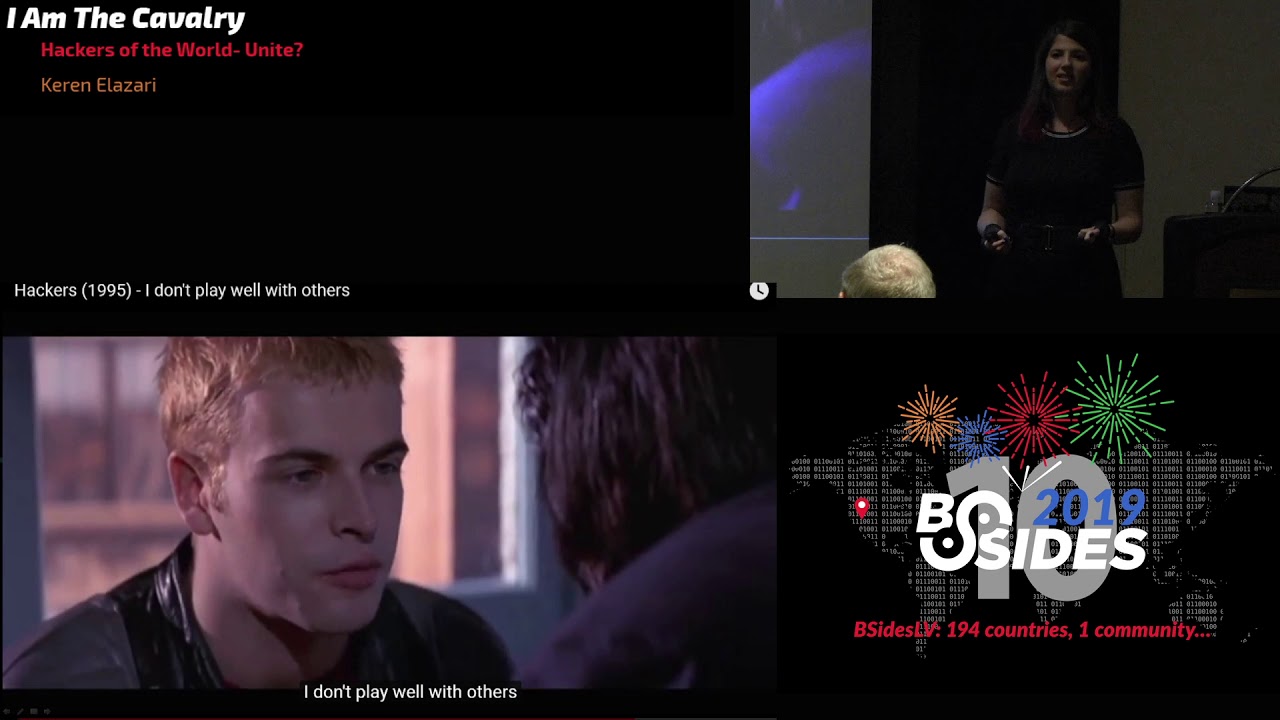
at home it's not the original it has been it was it's xeroxed but I knew a guy used to work at the studios and he just got it to me actually this year with like well now it's actually yeah yes anyway thank you my lawyer I didn't I found it in a dumpster maybe and it doesn't have anything to do with the copyrighted film that you know and so speaking about copyright here's I I didn't want to share a video so here's just a screenshot of a scene from hackers where the bad guy spoiler alert his nickname is the plague or mr. the plague and he attempts to recruit the protagonist zero cool and zero cool says
now I don't play well with others and that that ethos of individualism and you know really being a lone gun is also deeply ingrained in the hacker community so where are we between these three opposing forces the individualism the you know the meritocracy and the ecosystem or the wide community that's dedicated so much to sharing if you think about it these are almost at opposite ends well I thought we could take a short trip in memory or maybe in history and I found it actually really quite telling that the original origin of the word hacker actually kind of speaks to that so anybody know where the word hacker originally came from and I'm talking about like Old English
1700s and prior to that any ideas what a hacker used to be in those days or what the art of hacking was you have an idea over there woodworking yeah well you definitely it is a sort of word woodworking that's actually quite right and it was actually somebody who would cut into pieces things from a West Germanic origin so cut into pieces literally some someone that would take things apart not put them together and actually very interestingly I found this really cool perfect illustration of this hipster hacker who has just finished hacking up some you know maybe chopping some wood and now he's hacking on his looks like maybe as a blog about where to find the
best tacos in Austin just guessing because of his beard but actually it really is a really fascinating article published by none other than the new New Yorker magazine so that's a really highbrow kind of long for magazine and they actually published this little piece about the meaning of the word hacker and its origins and I really recommend that you read it I actually found out as well speaking of woodworking that a company existed called hacker craft and they really took this idea that hacking is a craft but not our type of hacking rather woodworking and building crafts rather boats in fact so this was taken off actually a boat that was the state of its art I guess sometime in the early
20th century so hacking actually has a pretty long history and many other meanings to what we are used to thinking about the first actually modern use or the use that we usually consider hack that was recorded actually came from this this was the rail the Model Railway Rail Club I guess so this was at MIT and people in the 60s would build these little railway I'm sorry I can't spell my w's today that's quite odd railway yes so it was these model railway systems that they would build and then hack on and in there in their context this actually was in one of the you know the protocols one of their meetings I think it was in 95
1955 where the head of the tech Model Railroad Club asked that anyone working or hacking on the electrical system please turn the power off to avoid fuse blowing so this was the first modern use of the term hacking and it originated not with computer hackers per se but actually with these tinker's and people working on these trains now I thought that was kind of cool that it started in MIT because there's another word or another thing that started in MIT that's also very influential to our community today and that is this gentleman's work so this is Professor Norbert Wiener and yes that's really his last name and 1948 as a professor at MIT he actually
coined the term cybernetics and that to this day is the reason that the prefix cyber is so prevalent in our language and back in 1948 cybernetics what was the study or the discipline if you will of control and communication in the animal and the machine so it was all about how humans are going to interact with technology and in many ways he was very prescient he was ahead of his time he wrote this at the end of the World War two and you know the concept of a digital computer didn't fully exist in in the sense that we know it today very early concepts of computers did begin to exist so I personally feel like there's
a really good reasoning that we actually use the term cyber in our community but that has also been a dividing factor if you notice in the past couple of years how many of you have kind of noticed or heard that people make fun of the usage of the word cyber quite everybody how many of you know why or you feel like you know you know why cyber shouldn't be a word that we use anybody want to give me an idea Josh please speak up for the rest of the class should I repeat it that's fine I'm not I'm not ashamed to admit it cyber sex that's right so actually you know especially in the 90s where checked
online systems were really popular things like IRC for example were really popular people were discovering that they could actually you know protank in cyber sex or virtual sex by chatting and speaking to people all over the world and for a very specific generation I think of people who grew up on the Internet in those days the term cyber was actually used as the verb to cyber meaning do you want to cyber meaning would you like to partake in the sort of virtual intercourse if you will and today one person here in the room knows that that may be one reason why the term cyber can seem laughable and yet we all you know don't use the word cyber
because somehow somewhere we went to a conference maybe we went to DEFCON and we try to use the word cyber and people came up to us and said well you said cyber now you have to have a shot you have to have a drink because it's an unacceptable world where word in our why does that I really have a problem with that in fact you know when Norbert Wiener created cybernetics he went to very classical very cool philosophical roots he went back to the ancient Greeks and in fact it was the word kubernetes for the steersman the person controlling the ship that was his inspiration for cyber and so today I really think it does make sense to speak about
cyber-physical systems especially in our world and in fact if you considering this is something I've said many times we're no longer protecting information we're not in the information security business per se we are protecting cyber-physical systems in the scientific term if you really adhere to these you know to his ideas and so I actually think that it's ok to reclaim back the usage of the word cyber but in my quest to convince you on this I went to Wikipedia looking at looking up at the origins of you know who else has used the word cyber and I discovered some really curious things I expected the first modern usage of the word cyber to be something like the maybe the Air
Force Cyber Command which in 2008 predated the US Cyber Command this is the Air Force Cyber Command were perhaps one of the first military organizations to use cyber in their name but I in fact discovered which surprised me even more was these two comic book characters that predate the cyber command in many ways interestingly they are both from the Marvel and DC Universe imagine that so there is cyber who is this guy who is an adversary of Wolverine mostly in the x-men which is kind of a subset of the Marvel Universe and will not go into the intricacies of that although we could definitely have an entire conference dedicated to that fascinating subject and this lady believe it or not dr.
cyber almost like my six my sister who is actually a doctor of cyber law but this dr. cyber was actually an adversary of Wonder Woman back in 1968 so the word cyber can mean a ton of things it can mean a military organization of course and why is it important that we speak about this well from our point of view one of the things that brings the community together but also maybe carries it hard times is this insistence on jargon and on the fact that you know to use the right words at the right time do you speak the language can you pass a test I'll never forget how at my first Def Con a couple of very well-known
hackers whose names I shall now omit from the record I was chatting to them and it was my first Def Con as I mentioned and they were trying to quiz me on my knowledge they were trying to see if I know what certain characters meant no due to I guess my lack of understanding of the English language back then or some other reason I didn't quite perceive that they were asking me about the unpleasant character I didn't quite know that term and for them that was reason enough to consider me not leave they're like oh yeah we knew that you're not really a hacker because I didn't pass that test I didn't have that she bought us if you're familiar with
that term I didn't have the password to get into the club that's something I'm really hopeful that we can change and in sense when we're trying to build a community if somebody doesn't know a term it's a great opportunity to teach them that term to share the message not to make fun of them now speaking of jargons actually a great opportunity for you all to learn some more hacker history is to look up the jargon file which from the end of the 70s until the late 90s in fact as it evolved into the new hacker dictionary was a file that existed on various online systems and shared hacker slang terms and all kinds of references on how to use hacking
terms and programming language it was vastly based on the MIT Stanford and you know the computer programmer hubs of that era let me bring it up a little bit bigger for you so Eric s Raymond Raymond who was one of the curators of the jargon file also created this fantastic document called how to become a hacker written 2001 believe it or not so this is something from the jargon file it does speak about the definition of what it means to be a hacker originally someone who makes furniture with an axe but now it's a person who is either good at programming quickly not everything a hacker produces is a hack necessarily you might be an expert at particular
program for example a sale hacker this got nothing to do with sales and chips but actually a computer system that was prevalent at the time or you might be a malicious or positive meddler who tries to discover information by poking around hands keyword hacker or network hacker that's a definition I kind of relate with but here's even something that you know some even more people have related in the resonated with this is the hacker manifesto originally coined the conscious of a hacker written a day after the arrest of a infamous hacker called the mentor in the UK he was British and he released this on frac which was until as I believe an online magazine for sharing hacker content so
the most powerful quotes from the hacker manifesto also resonated with the hackers film and of course there are these really powerful worlds yes I am a criminal my crime is that of curiosity my crime is that of judging people but what they say and what they think not what they look like my crime is that of outsmarting you something that you will never forgive me for it's really powerful so this day I get goosebumps when I read it out loud and the hacker manifesto I first discovered it when I watched the hackers movie but that brings up a next question and I had a conversation with somebody earlier about this who is a hacker who gets to call
themselves a hacker how many people here in the room feel like they can comfortably say hi I'm XYZ and I'm a hacker I would expect that at a hacker convention and besides Las Vegas many of us would feel comfortable calling ourselves hackers why aren't we did we not pass the test somebody didn't qualify us we don't feel like we belong back again in the 90s this sort of image was kind of a popular way to you know check do you belong in a certain Club are you a cyberpunk this actually was published in mondo magazine in 1993 and 1993 was actually a very transformative year for yours truly so this is also what a hacker looks like and this is kind of
what I looked like around that time but of course here's the actual photo from the yearbook of my school some of you have already seen this but for those of you who haven't anybody want to guess where I am in that photo and again there are prizes to be won yes please second up this this this guy this girl no but thank you for trying yes Rex up this person you're not sure well it's definitely a cyberpunk judging from the 1993 state-of-the-art Sony Walkman but actually Rex you're a winner you got it it's me and I was that much of a nerd back then and that's what I really looked like and that's what I
wanted to look like she was my hero because when Angelina Jolie portrayed that High School hacker she had short hair like I did and that's how movie really created that image for me finally for the first time I realized my passion for technology my curiosity my inquisitiveness it's called being a hacker and it's a global community according to that movie it only took me a couple good years almost five years to really find my way into you know a fraction of that global community the one that Hollywood showed me you know has like computer you know amazing computer animations and everybody's got really cool handles and they've got like TV shows and that you know if you
remember that what was those guys's names razor and blade they had this underground cool TV show I was watching space rogue on Hacker News Network and I don't know how many of you have seen that but that was kind of my connection to that hacker world or hacker community until the year 2000 or the year y2k when the first ever international hacker convention in tel-aviv took place wait a minute let me let the whole animation play out check it out this is an animated gif from 20 years ago I think that's kind of you know that's kind of cool that it still works but this was the first ever hacker event international hacker event in my
hometown of Tel Aviv I found myself there as a volunteer for the first time really feeling that immediate connection to that global community and then we also felt a connection to the political landscape as a member of the Israeli Parliament tried to shut down the conference and that speaks to that value or ethos of hackers having to be on the outside having to be maybe countercultural maybe on the fringes and if you're adopted and embraced by the mainstream can you still be a hacker I wonder it's a question for all of us to consider many years have gone since then in fact in 2004 I organized another y2 hack and I was able to really you know
bring 1,000 hackers in Tel Aviv together that was in 2004 the next time I was able to do that was almost 10 years after that because I founded besides Tel Aviv in Israel and actually are you this this year was our largest yet and we've had our event runs for four times bringing more than a thousand hackers together very proud of being able to do that you might think hey well why does Israel need a hacker community event there's just an amazing cybersecurity ecosystem in Israel we keep hearing more and more about it well it turns out that we had that amazing business you know ecosystem in Israel but we didn't really have a space for that community and
between 2004 and basically 2015 or 16 we really didn't have a lot of hacker events per se I also started a group called leading cyber ladies which brings together women in hacking and we actually have one of our members here today hello Chrissy from London the group now has ladies in New York City Toronto and of course in Israel occasionally I write about my passion for the hacker community and what it can do I wrote this little thing for motherboard and I'm not just inspired by you know Hollywood movies I'm also inspired by real-life people so I would be remiss if I didn't mention Barnaby Jack as we are standing on his shoulders in many ways today for those of you are
not familiar with him his research work on medical devices catalyzed I believe many other researchers and many changes in that ecosystem that the I am the cavalry has really been really deeply involved with Barnaby said that sometimes it's up to us hackers to demonstrate a threat so that we can spark a solution that was something I absolutely resonated with and it was my original inspiration to think about the way hackers are working together but also individually kind of like an immune system if you will and that was the basis for my 2014 TED talk hackers are the immune system of the Internet I still feel like the immune system analogy works because an immune system isn't a single organ a process a
chemical or one type of cell indeed it requires all these different elements to work together in order to help make a person's life better or safer and that's one of the reasons that I'm actually really passionate about I am the cavalry and hopefully over the next or rather within the last two days you've heard many ideas on how you can be a part of something like that so for me I first heard about I am the cavalry because of that TED talk and it was the woods that reached out to me and said you know we've got this thing going on with hackers that are trying to make a difference in the world where where it
counts and I was immediately hooked I said okay sign me up how can I help from me helping is sharing the word sharing the stories maybe even sharing them with popular media organizations like this show on Netflix with Bill Nye that I was on a while ago is that funny Rex okay thank you I thought it was really in fact this was actually filmed during besides Las Vegas two years ago so I flew in was besides flew out to LA to film this and then came back to besides and I couldn't tell anybody anything about it because it was all very secret but you can now watch the show it's on Netflix Bill Nye saves the world however
the point I'm trying to make is that for me saving the world or for me making that impact is by storytelling and by sharing the word about I am the cavalry and about our hacker community now I know that I need to wrap up but I do have a couple of other fun stuff that I want to show you so bear with me for just a minute here okay because I promised first of all that it would prizes and second although there is fun stuff so we talked a little bit about the past of the word hacker and I talked a little bit about my past what about our future well our future can seem
quite scary especially as we live in a time where many computer systems in a sense have been weaponized maybe it's because it's an end-of-life operating system environment or maybe it's because there are people out there that are very happy to use hackers for their own means or oles sometimes people who believe that hackers are just like painters who wake up in the morning in a good mood and start painting of course if they work for this gentleman I don't know if they have a lot of time for painting but they definitely have a way to use their skills for the benefits of that country so the future that we're looking at is more connected than ever before it's got
more BOTS machines and devices in it this is a reference to the classic Futurama episode fear of a bot planet it's got AI oh my whatever that means it's gonna be a part of our future as well and as we look towards that future without more security researchers working together but also maintaining the individual aspects of their local community of their own pathway into this world I don't think we have a chance in fact you know the outlook might be like this or if you're in Vegas like this if you haven't heard that last week where you guys look under this plague of bugs of the six legged kind six legs I think so so today the global hacker community
is spreading William Gibson said that the future is already here it's just not evenly distributed where can you find that future I believe you can find it in the global hacker community this is a map of global b-sides events all over the world if your hometown is not on that map start the b-sides if your hometown is on that map go volunteer support in any way you can now here's another map this is a map of security researchers reporting vulnerabilities to Google this is from the data released from their bug bounty program as you can see it's not just a US or a North American culture or movement it is vastly global and it's becoming even
more so this map is from the first Association who here is familiar with first just a couple of you for those who are not that is the forum of incident responders in other words it's an association of all the certs the computer emergency response teams in the world and they've got 500 organizations listed all over the world in fact they have an event coming up for small island nations focusing on cybersecurity and Fiji so it is an absolutely vastly more globally diverse community than it used to be just for friends the first-ever cert the first ever computer emergency response team was in Carnegie Mellon and it was actually part of the university and in fact all other organizations that
use the term cert I believe must have some sort of like a copyright understanding with the original cert for their usage of that acronym so as I wrap things up I think I shared a lot about what our global community can look like what a community means here just a couple resources please feel free to take a photo of the next slide with some ideas I definitely relied on works like hackers heroes of the computer revolution by Stephen Levi which came out maybe 20 years ago and the article the Anthropology of hackers from the Atlantic magazine by Professor Gabriella Coleman who has always inspires me and there are a few more works that you may
want to check out there I want to leave you with a final quote if you will I'm just giving you a moment to take a photo without interrupting the image okay so this final quote that person who helps others simply because it should or must be done and because it is the right thing to do is indeed without a doubt a real superhero I absolutely believe in that message of course shared by the late but hopefully sainted Stan Lee creator of so many heroes and stories that have inspired so many of us a person I know that josh has actually had the honor of meeting in person and I am I will be always deeply
envious of you for that for me heroism can have different shapes and sizes I like to dress up as cat pool which is a cat version of Deadpool and hang out with my other Deadpool friends and if you take a look at the photo you'll see there are all kinds of dead people we've got fan pool and Lady Deadpool somewhere in the background is fat pool and this cyberpunk person who's maybe from the future maybe he's trying to be cable in any case I would encourage you to think about what does a hacker community mean for you and does it have to be unified do we all have to speak the same language no slang terms or can we just
all get along nicely even if we're not sharing that you know particular subset of words and backgrounds after all from my point of view I [Music] will never give up the hacker community so please join me in a resounding chant of hack the planet hack the planet thank you very much for your time and attention everybody thank you
Related talks
 24:35
24:35 28:17
28:17 51:51
51:51 32:48
32:48 33:48
33:48 54:33
54:33