Cyber Burnout: 30 Seconds From Death
Show original YouTube description
Show transcript [en]
Okay, looks like everyone's settled. Um, so last talk of the day. Um, I'm delighted to introduce and thank you for coming, Elner. Elner Doway, uh, Cyber Burnout, 30 seconds from death. Over to you. >> Thank you.
I was actually reassured a while ago that there wasn't that many people in here, but there's more people creeping in, so I'm getting a bit nervous. Um, I'm I'm Elellanena. All my details have been cut off. Um, and I'm I'm sort of a reverse and berlin for some reason. I'm not sure what I've done to my slides, but that is me. Um, I've been a cyber security journalist for 18 maybe 19 years now. Um in my former life, career life, I was the editor of Infoscurity magazine for 15 years. And then I finally um escaped three years ago to become the co-founder of Assured, which is a um it's UK the UK's only cyber insurance exclusive broker. Um, so a
very different world, but I'm still I still have a podcast um called Grab the Mic uh people in cyber and a content platform, Assured Intelligence, where I publish articles and features and interviews with people in cyber. Um, so that's me. Um, and thank you for coming to the graveyard shift today. I know that the desire to flee is always high at this time of the day. So, a very different type of presentation um that doesn't often belong at cyber security events. Um the talk stems from a research article um that I wrote on the very same topic a few years ago. I interviewed 10 people at great length in order to pull together this piece. Um and I did a deep
dive into a lot of the research available on the domain. I will put the link um to the original article at the end of the presentation for anyone that wants to read the full piece. Um and if any of it resonates um and you want to discuss it, please do get in touch. I'd be happy to hear from you. Um the people I interviewed were all senior leaders, CEOs, founders, CISOs, and CSOS. Um so it's specifically about the stresses on senior leaders, but actually I think a lot of it resonates and is relevant to anyone in any role. Okay, my my my slides aren't moving, so you might just have to look at reverse and
for a while. [snorts and gasps] Am I just Is it just the arrow?
It's a dramatic pause. Doesn't like us, does it?
I don't mind if it goes small again.
Okay, I'm now seeing a very small version of it. So, if I get really close to it like a grandma, please don't um judge me. Okay. Um I've picked this quote not to be sensationalist. It's from the original article I wrote. Um although I am still a journalist so I suppose it is slightly to be sensationalist. Um but it's more because it truly demonstrates I think the rock bottom of burnout. Um the vulnerability and the honesty that this interviewe showed me in sharing this story was quite incredible. Um and I think it really does demonstrate the size of this problem. one that's ever had the opinion that burnout isn't a big deal. Um, let this
story prove otherwise. So, what is burnout? Well, obviously it means different things to different people. The World Health Organization don't actually classify it as a medical condition, which blows my mind, um, but instead calls it an occupational phenomenon, or in its more extended form, it's a syndrome conceptualized as resulting from chronic workplace stress that has not been properly managed. of the three dimensions that they list, um, energy depletion, feelings of negativity and cynicism, and reduced professional efficiency. Um, I imagine there's very few people in this room that can't resonate with at least one of those. And one of my interviewees I spoke to for this article summarized it in one sentence, which is that it's an
overinvestment in anything other than the self, which I thought was really um, quite prolific actually. So, in this um research, I learned about something called ego depletion, which isn't what it sounds like it's going to be. Um it's the theory that willpower is connected to a limited supply of energy. And once you run out of that mental energy, that limited supply, you're more likely to lose control, which obviously then leads to burnout. It suggests that self-control draws upon a conscious mental resource and when it's taxed to exhaustion, it leaves you without any sense of control whatsoever. So, for example, if all your energy gets used up at work in the office during the day, when you go home, that person is
then incapable of making healthy or controlled decisions. So, for example, they they might choose to eat badly. They might choose to drink to excess or have a short fuse with friends or family. So, by showing self-control at work, that then plays absolute havoc in your personal life. And that always reminds me of that famous analogy of that Pepsi bottle when you shake it all day but keep the lid on it. Um, and then you go home and you just sort of slightly start to undo the cap and it just explodes. And then obviously the people around you, people that don't deserve it are the ones that get wet. Um, just a little bit of theory because
I think it's quite important as a backdrop. Um the Holmes and Ray stress scale was a psychological study um by Holmes and Ray of course in 1967. So it's old but even then when they studied the link between stressful life events and mental um health impact of the 43 life events considered stress aggravators, nine of them were work related. That's a lot. And I would argue that that's probably got way worse um today because we're now expected to always be on. We have devices, work devices. We work remotely. We work wherever we are. It's very difficult to get away. So, I think that stress scale looks even bleeer in 2025 than it did back then.
So, why does burnout strike? Um, the type of personality that lends itself to senior leadership roles typically also lends itself to burnout. There's there's a belief that those personality types are the people that are striving for more. They're always putting in 100% which are all although it makes for a great leader, it also lends itself to burnout. There's this thing called the insights discovery psychometric tool. Um, we used it in my last company actually. is a big footsie company and they like tools like that. Um but it classifies people in the workforce in four different categories and that's red, yellow, green and blue and most leaders um it's a generalization of course um but the data suggests that
most leaders fall in the red category um with qualities such as being competitive demanding determined strong willed. And on the surface, they're not traits that you would associate with vulnerability, but they are traits that often do equal burnout. I spoke to one CEO, um, a serial entrepreneur in the research for this. He was called Fred Shebasta. He's the CEO and founder of a fintech company called Finder. And he told me that burnout is inevitable, and he's actually more than okay with it. He says he uses it to push himself further, to push himself harder, and it betters himself and his business. he said to me, he recognizes it's not for everyone, definitely not. Um, but it did work for
him and I thought that was just an interesting flip on the concept. One theme that continued to shine through my interviews was how lonely it can be as a leader. I think one reason for this is that CEOs and senior leaders don't allow themselves to be vulnerable. They worry that they're going to lose the faith of their staff, the trust of their staff, the trust of their board worse. And I think crucially then that plays out at home. They feel like they can't then be vulnerable at home because they're not used to being vulnerable, but also because I think they live in fear of their partner saying, "Yeah, I get that, so quit." Humans are a tribal species. Um, and one
of our biggest fears is not belonging. So, senior leaders keep quiet so as not to risk rejection from their tribe or what we would call workforce. It's a lonely job, I think, because they've got the ultimate responsibility and it's their job to check in on everyone else, but who checks in on them? One CEO said to me that it'd been two years um since he was asked, "How are you?" And he actually got really emotional when he said that. And as everybody knows, by looking after yourself, you can then look after your team and set the right example. Red flags. I wanted to talk about red flags because one of the questions that always comes up is how can I spot
burnout in myself or perhaps in my friends family colleagues. As is true of most illness, um the earlier it's detected, the earlier it's caught, the greater the chance of prevention or remedy. Many of the leaders I spoke to described themselves as totally unaware at the time of the severity of their burnout, which is why I like this saying that you you can't spot the red flags when you are the red flag. Many of the leaders I spoke to um said that there were there were themes in the things of how it came out. Recurring illness or pain, fatigue, excessive behaviors, whether drinking, risk taken, drugs, medication, prescription meds, anything in excess, and depression. And then there's the one
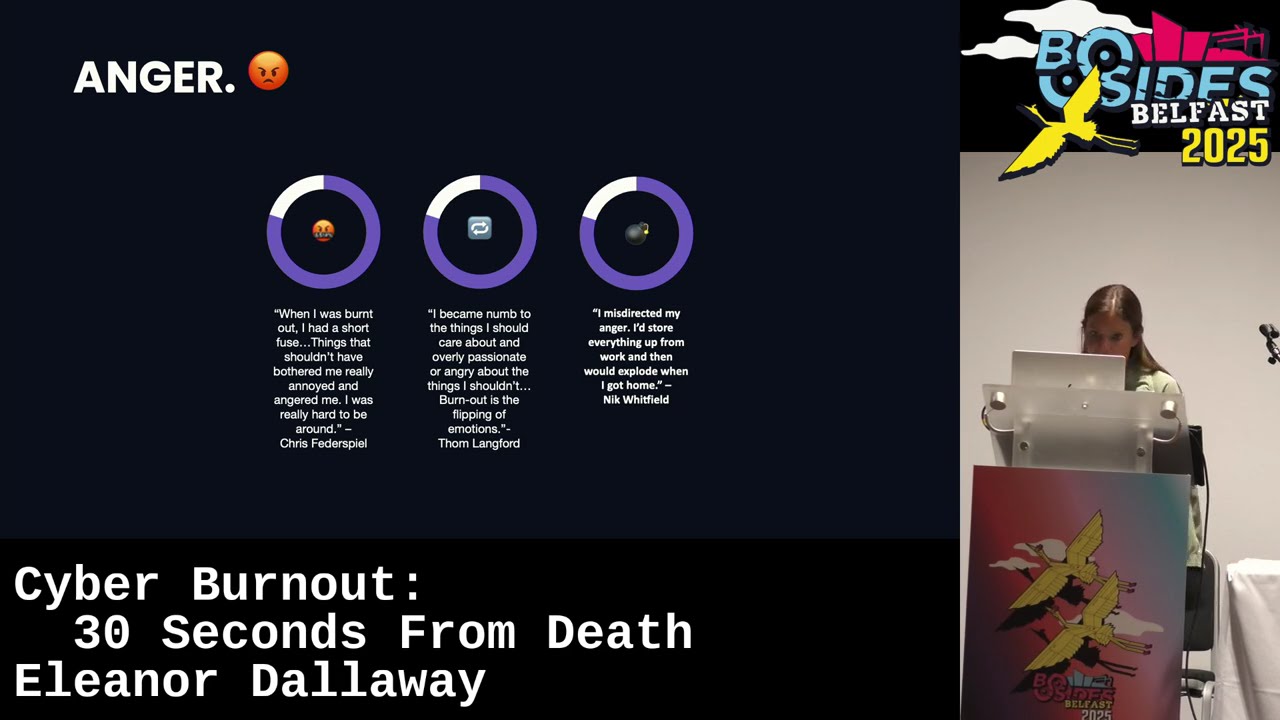
thing that kept rearing its ugly head in all of the interviews I did unanimously, which was anger. It's unfortunately ironic, but also true that when you need your brain the most, that's when it shuts down. And during intense periods of stress, the brain shuts off the cognitive functions of the preffrontal cortex, strengthening your emotional responses, um, one of which, of course, is anger. And I've shared three direct quotes, um, from three of my interviewees around their experiences with anger. Um, I'm try and read these on the tiny little thumbnail I've got. Um, when I was burnt out, I had a shell fuse. Things that shouldn't have bothered me really annoyed me and angered me. I was really hard to be
around. I became numb to the things I should care about and overly passionate or angry about the things I shouldn't. Burnout was the flipping of emotions. And finally, I misdirected my anger. I'd store everything up from work and then I'd explode explode when I got home. In hindsight, I think all of those leaders recognized how hard they became to be around, which takes us back to that shake and Pepsi Coke analogy. Motivation comes um down to two drivers, fear and attraction. Um and the science behind this is genuinely really interesting, but fear triggers our fight orflight response. Um a survival tactic deeply ingrained in humans. Um, it's a powerful tool and it does serve us in
some situations, but it only takes us so far. Thinking, so if you think about coming face to face with a lion, um, you probably don't think about that very often and probably never will again, but the fear in that instance would trigger you to run. Um, but you could only run for so long before you get burnt out, of course. Um, and probably eaten in this example. Um but those primarily motivated by fear um so the fear of not making enough money, the fear of not getting the next promotion, the fear of not being able to pay your mortgage will only do well in the short term. These people are set to never feel that sense
of achievement, the purpose or the confidence because the fear is always there. It's that dark shadow behind them like following them around. Whereas the motivational driver of attraction is rooted in pos uh positive aspirations um it will provide longer and healthier fulfillment and motivation. So you could be motivated to get that new house or that new car but you get that sense of fulfillment once you've achieved it which you don't get with the fear motivation. So before we move to talk about the solution part, um I wanted to lay out the severity um of burnout. The consequences are life-changing um perhaps even life-ending. And of the people I spoke to for this interview, 30% bravely admitted that at some point they
had been suicidal. I've picked three chilling quotes which you can read um here and I just genuinely thank God that they're still around to tell me these stories. I think quite often mental health is seen as like a dirty little secret. Your burnout is a dirty little secret and it's not dirty. Um and it's definitely not little, so it shouldn't be kept a secret. There's a reason that we're told to put our own oxygen mask on first. Um leaders are no different. They've got the power to make or break a burnout culture and it's imperative that they do lead by example. They've got the power to create a culture where it's okay not to be
okay. And I think Gen Z are actually really helping with this. They're making changes because it's not actually seen as cool anymore to always be on. Um it's no longer seen as lazy when you kind of need to take that break. It's more seen as setting boundaries. So I do think that there is progress but to put your own oxygen mask on first um you need to be aware that you need to do that and I think again that awareness is the hardest part. Once you've found the awareness you can understand it you can take the ownership you can take action and you can make change. Just like um cyber security generally when it comes to technology there is no
silver bullet for burnout but there are healthy coping mechanisms. Um some of which include taking time out doing absolutely nothing retreating. Setting clear boundaries that Gen Z thing I was talking about. Um and the learning to say no really important journaling. Um Nick Whitfield, uh CEO, got rid of five years of chronic back pain, um where he'd been told he needed several operations on his back by journaling. It literally disappeared overnight. And he tells the story really powerfully. Cutting alcohol. Um four of my interviews, four of my interviewees went tea total after their experience with burnout and experienced much better life for it. cutting the noise um reducing exposure to news to social media talking
um the whole a problem shared saying WhatsApp groups were a really common thread amongst the leaders I spoke to that they were in these WhatsApp groups where they could share their problems they could talk about it they didn't feel that sense of loneliness in that group scenario um and exercise or whatever it is that make you happy do more of what makes you happy and if like me it's not exercise do more of what does make you coffee, have warm baths, play with your kids, do just do what makes you happy. So, now I'm going to get a bit more personal. Um, for the second time since I've been writing about cyber security, I think I may be about to become the
subject of my own article or presentation or research. The first time that happened, my car was hacked on my driveway while I was asleep and uh stolen. um which was an awful thing to happen, but I wrote about it and it was actually the second most read article that I've ever written. So, Every Cloud. Um this time I'm talking about burnout. At Christmas I gave birth to my third and final baby. Um and this week I've returned to work from maternity leave like four days ago. So, I find it hard to talk about that um without hearing that saying, can we really have it all? Well, I think the very nature of that is notion of that is
outdated. Um, and as I say, I'm not sure it's even really cool to want to have it all uh anymore. But however you want to phrase it, whatever it means to you, it's about the desire and the right to be professionally successful without having a negative impact on your personal life, whatever that looks like. And that is often really, really hard. Um, so in my situation, I've got three children. They're 10, they're six, and they're nine months old. I live in Oxford, but I work in the city of London. My partner also works in London, but right in the south to make it extra fun. I've got one child in nursery as of this week, and I've got two in school.
Between them all, they have nine clubs or matches a week. My eldest son's also been signed by a professional football club, so he has games around the country. I'm the co-founder of a startup, now a scaleup, um, which me moves a million miles an hour and requires a huge amount of my energy and output. And I've also got my friendship circles and my family that I don't want to let down. It's a lot. Um, so despite this being my third return to work after maternity, it doesn't get easier. Actually, if anything, it's got a lot harder. There's more to juggle at home. There's an extra little tiny human to look after. But there's also a much bigger
responsibility for me at work this time. I've jotted down some of the emotions that I felt this week just on my return to work. Overwhelmed is probably the biggest one. Happy, anxious, sad, guilty exhausted worried ill which is why I'm sounding like my sniffly aunt Mild Mildrid right now. Um, I wasn't ill once the whole time I was off on maternity leave. So, what does that tell you? But all of those emotions are true at the same time. And I can see how that leads to burnout. But the thing I have felt like the most of all of those things is like me because the balance, the juggle, the quest to have it all is
me. And I'm a mom, but I'm also a co-founder. So I I know that this feels like me. Where I work in my company, we've got a lot of 20 30ome men. Not by design. and hiring diversity remains one of my top priorities. It's a really important admission of ours, but right now that's how it is. So, I'm a minority as a woman. I'm a minority as a parent. And even as a co-founder of the business, perhaps especially as a co-founder of a business, I feel guilty when I run, and I mean literally run into the office later than everyone else every day. And then I run out again before anyone else. and I have to hot
foot it across London to get home for the children. But I also feel guilty because I'm not always at the school gates. I can't compete with those 20somes who have no dependables and just a gym membership that they're they need to be loyal to. But it is on me to lead the way and advocate for balance for for anti-burnout if if you want to say it like that. But if you've worked for a a startup or a scaleup, um you'll know that that is easier said than done. So in my role as editor of Infoscurity magazine, I'd always encourage our speakers, our writers, our contributors to try and present a solution at the end um or a learning outcome or an
actionable takeaway. Um something that balances all of the the fear, uncertainty, doubt, gloom of cyber security reality. We've already been through the coping mechanisms, but in terms of solutions, I'm not sure it's that simple. Um, maybe not accepting speaking speaking gigs in a different country on your first week back may have been helpful. But, um, I genuinely am thrilled to be here, so I'm glad I said yes. Um, but what I do know is the only sort of solution I can offer is that sharing experiences, talking about vulnerabilities, there's a lot of power in that. and knowing that other people are experiencing the same things I think is really helpful. So, keep talking. Um, that's it. Thank you for listening. Um,
it's not conventional, but it is important. Um, so I do appreciate you giving me the time of the day and the platform to talk about it. Um, and I have definitely finished early, right? So, it's very anti burnout, I think. Um, so that's it and that's the link to the article if you want to read the full piece from a few years ago. Thank you.
Related talks
 47:19
47:19 36:38
36:38 38:09
38:09 17:07
17:07 30:36
30:36 1:06:07