Space Attacks: Nation-States vs. Cyber Threats Explained #shorts
Show transcript [en]
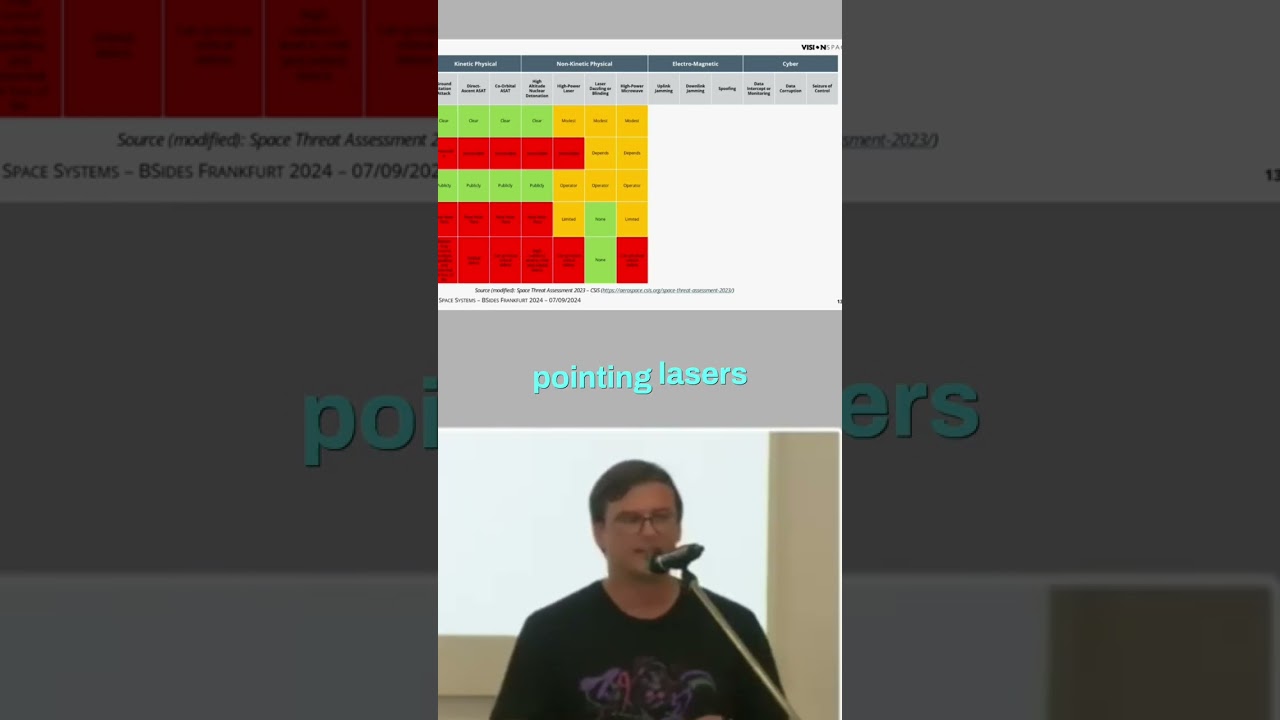
How how do you counter that? Um what is now interesting is that attacks on these systems are typically not done by individuals. So, this is not your uh lonely hacker attacking you. This is usually a nation-state actor trying to do something. Of course, you can have a ransomware attack from a ransomware group that suddenly gets your IP address and I don't know, finds a vulnerability in your system. You can totally also have that in space systems. But the the most worrying things are the more sophisticated attacks by by nation-states and also the things that recently show up more and more. And for that what is important to understand is that if you have like a kinetic attack, it's very clear
who did it. Like it's very hard to hide anything you do in space. You cannot shoot up a rocket and think no one notices. Everyone knows. Um everyone knows where it was launched, everyone knows what was hit and what was the result. So, you probably don't want to do that if you are not like in a in an open conflict. Um then come the non-kinetic physical threats. So, uh a bit like pointing lasers at spacecraft still fairly easy to find out because there's like a physical limitation to how you can point a laser. Um and also the the risk of causing permanent damage to the asset is pretty high. So, in cyber systems, often the the
damage is not physical. And with that, somehow policy makers decided this is not as bad. So, if you have physical damage, it's bad and this can cause some escalation. If if it's not permanent, yeah, maybe you can give it a try. We see now with for example in in Estonia and and the the Baltic, there's a lot of GPS spoofing, GPS jamming very actively. Um also some some other regions um where where they're trying to to find out how far they can go. Um and then come of course the the cyber attacks where you have very limited attribution.
Related talks
 0:38
0:38 0:41
0:41 0:18
0:18 0:22
0:22 0:25
0:25 1:22
1:22