AI Is Taking My Job... But Is It? - Lauren Spokes
Show transcript [en]
Hello. Uh, as it says is I AI could be taking your job, but in this we'll explain if it's actually going to possibly take the jobs. Um, but first, who am I? Um, I'm currently an acting digital digital forensics investigator at West Yorkshire Police. Um, I've been there since August 202. Um, going through the ranks of digital technician as well. Um, with a different history there as well. Uh, but outside of work, I dance and I go swimming. And for anyone that went to my talk in Newcastle, also still trying to learn Italian. So, just a quick little disclaimer before this starts. Um, this is all my opinion based on things I've seen. Um, none of this is my place opinion.
Also, this is going to move through quite a few different aspects of my job fairly rapidly to fit it in the time slot. Um, so if anyone has got questions, please feel free to put your hands up throughout and I'll answer them there and then because it'll help me try and remember what I'm on about. But also don't be scared to open your bottles of water. It is very warm in here. Please keep drinking. So let's get started. First of all, we've all seen these headlines saying AI AI is taking our jobs. AI is going to replace humans. Nobody's going to need us. Kind of. Are we really going to be replaced by a robot?
So, the Guardian said the AI apocalypse is taking away almost 8 million jobs. That's 23 and a half% of the workers in the United Kingdom. Um, so what's that nearly? Yeah, quicker max than I have. Um, so between this room, that's quite a lot of you. But what I'm going to talk about in this is how AI could possibly replace it to a possible standard. So in order to say a possible standard, what am I saying? I'm saying it's understandable and makes sense because nobody wants a report that looks like that. And it's factually correct. If it's telling lies, nobody's going to read it. Um or at least if they do, it's not worth reading.
uh and presentable. If it looks like that, who's going to read a fivepage report, let alone a 15? So, things it can do. Uh at the minute, as it stands, AI can write reports, create cases, and analyze documents. Very straightforward. However, what it can't do, it can't check before an investigation starts. Can't do the kind of admin tasks that we do. It can't analyze images very well. Um, and it can't analyze internet data very well. And we'll see both sides of these as we go through. So, let's start with things it can do. So, case creation, given the right information, AI can create a case. And we see this every day in different industries, mostly in support, because
if you ring up your bank, what's the first thing you get? A robot. How long does it take you is actually get through to a human? Um, so it's already been done. We we know that. Um, report writing. It can write a report. This was generated using chat GPT. Um it was quite entertaining to actually read the four-page report it generated. Um but these are two very different styles of writing that it outputed for me when I asked it. Uh the one in the center is when I just asked it to write a four-page report on the evolution of AI in the last 5 years. The one on the right hand side as you're looking at it
is when I asked it to do it in a Jordy accent. Mhm. >> Um, as you can see, it's a little bit more friendlier and a little bit more like you would talk to people. So, the analysis of data, the documents I gave Gemini eight documents to analyze downloaded from across the internet. So, they are publicly available documents. They're nothing I've created. Sorry, just for a bit context, are you using the free trials of Gemini? Are you using subscriptions? >> So, everything I've done on here is free. >> Um, but yeah, I gave it eight documents and said which ones are about dogs. Something quite easy. You can tell from a title, from keywords within a within a
document, which ones are about dogs. Fairly simple. Um, yeah, it it got both of them out of the eight quite easily. Um, but I wanted to see why. Um, so I looked at the thinking process to see if I could try and make it fail as it possibly could. Um the thinking behind it analyzing the documents was of course first of all the titles. Anything that says dog kennels or dog boarding or anything to do with dogs in the title of the document it picks up straight away. Um, but then it does look at the file content and the resources where it references within the document, if it's got external links or anything to other dog websites,
um, and then evaluates it all as well. So then I tried to rename them. Uh, there was one that was called something about uh, dog boarding kennels. Uh, so I renamed it and it didn't trip up as much as I thought it would. Um, it worked. It well, it failed my trip up attempt. So, now we go to things it cannot do. So the pre-investigation admin checks that we do before we do uh the analysis actually involve downloading the phone and getting the data off the phone to read it. AI can't put the phone into a computer. AI can't dissemble a laptop and take a hard drive out. There's quite a lot of things it can't
do, including uh when the software goes wrong and you see an error message that just says no. Um or like I like the image at the bottom on the left where it says no and okay. It's about the options we get. Um so we move on to images on everyday people's phones. You will have hundreds of thousands of images whether you realize it or not. You watch Tik Tok videos, it'll cache them. You scroll a website, it's got photos and adverts down the side, it'll cache them. Every single image you ever view on your phone, even if you don't actually acknowledge its presence, the phone will see. So, it caches everything. So, categorizing these can be a pain.
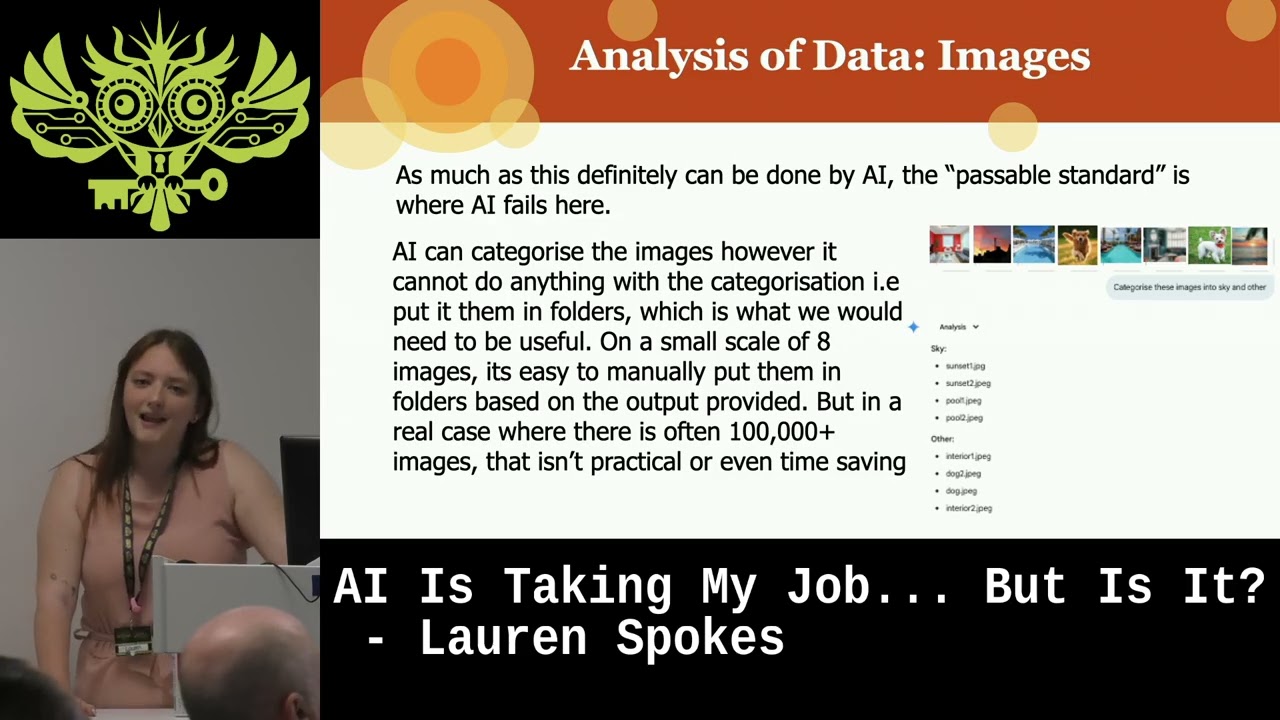
Uh but can AI do it? Uh the passible standard is where I AI fails on this one. It can categorize images. However, as you can see in that example there, uh I gave it some photos and said which ones are of the sky. Um I didn't even rename the images. I gave it names uh that were very very very easy to categorize into sky and not but it incorrectly identified the pool as a sky and it's understandable because the pool is also blue. Um however for reliability you can't have inconsistencies like that. Um if you if we were to put it on trial it would just fall apart instantly. And once it's even categorized them, it
just gives you a list. So, not being able to do anything with the actual files, um, it kind of makes it pointless. You may as well manually change uh, move them. So, internet, uh, this time I used both chat GPT and Gemini um, to analyze a list of 25 websites. Um, again asking about dogs. Very nice research websites to find. Um, but 10 of them were about dogs, 15 were just random websites. How many do we think Chat GPT got right? How many did Google Gemini get right? Are they the same? Oh, that didn't work. Um, so in the light orange is what Chat GPT got. The dark orange in addition to the light orange ones is what Gemini got.
And the one yellow one is the one that neither of them got. Uh, that one yellow one is a dogs boarding company uh who basically take on your dogs whilst you go on holiday. Um, so it is a bit of a rogue one given the name, but there's plenty of references to dogs on the website if it had actually used its powers. Uh, so report writing, it can also write reports. We know this. Um, but if we ask it to use the image categorization results that it had previously generated and the web analysis, can it combine them? Nope. Uh, did it output a report and make it to a possible standard? No. So, uh, future prospects of AI, uh, AI
hasn't taken my job yet. I'm currently still employed. Um, do I think AI will take my job in the next 5, 10, 50 years? Possibly. The data that I've got in this presentation was done in May this year. By the time I'm giving this talk in June, it's already been updated and some of this data is wrong because of the fast uh progression we're on with AI at the minute. If this continues 50 years, who knows where we're going to be. Uh so yeah. Um but I don't think it's going to take all of it. There's definitely parts of it. Um can we put AI on the stand and ask it why it did it
wrong? It's not going to go down well with the jury. But yeah, 5 10 50 years. Is anyone going to trust it in a criminal prosecution case to have done the job right? If your life depends on AI doing its job, are you going to trust it? >> Yeah. Questions? >> Just an observation. Um, I actually work in securing AI and I know that the government are already using AI to determine things like who are likely candidates for attacks. >> Um, they're using it for image analysis, satellite images to defense, security buildings and targets. Um the reality is our government or trust uh they've released in the last month official guidance encouraging teachers work to use to create teaching resources. um
whether we trust AI or not I think is immaterial because it's going toffect >> it is it's going to affect everybody and whether the government the fact that the government trust it it means it's already been accepted into our society as a acceptable form of you can use this to do your job but it's the whether we should we as individuals still need to have moral kind of thoughts of should I be using this? Is this the right way to be doing it or can I do it better? >> I think it also depends on what you're uploading to the cloud. >> Yes, >> Samsung developer decided. >> Yeah, AI is very susceptible to hacks
obviously as we've seen. Um and >> sorry, but then you also get um you know colleagues and staff trying to save the company money thinking they're doing the right thing by you know translating a document from English to a different language upload it get it all done like that but don't realize it's sensitive it's intellectual property or whatever >> and suddenly it's publicly available >> we've had yeah we've had to that's why I think a lot of the AI stuff Certainly some instances become more integral into you know onre using cloud providers. >> Yeah I mean I know there is some companies now who have paid for chat GPT to have their own hosting. Yeah, like a
private cloud or private >> essentially um which kind of saves themselves the risks associated with uploading sensitive data to the public cloud but also that risk is still inhouse isn't you know it's still potentially depending on you know it's it's out of your arms it's not necessarily under your direct Yeah, exactly. Yeah.
[Music] >> Um, so at the minute given its current
>> so yeah, given the current state, no. Um, a lot of this stuff that I've done for this presentation took me a lot longer than I could have done it myself manually. Um, those eight images, the thinking process behind it, I think I timed it and it was something like 3 minutes and 14 seconds. To categorize eight eight images, you go 1 2 3 4 5 6 7 8. Was that 10 seconds? >> But um, you know, DNA evidence is used all the time. >> Yeah. And I saw it saying test every test.
>> Well, the thing is the first DNA sequence took decades to do. >> Now they can do every
step. Yeah, this is definitely >> it's a solution looking for something to do. >> Yeah, this is definitely kind of the infancy of it and I mean DNA has now been around for quite a few years. So if we look at how long that's been around and how far that's come, we then have to apply it to AI to see right so we're now at stage one. How long did it take DNA to get there? How long is it going to take AI to get there?
will the um will the AI improving as it is today? There is negatives there is negatives being it's taking the art form of this example social media as a student character. It's taking someone's passion, talent, years, years of training, tasting the positive side. Uh again, um I'll use example. We've got AI vehicles which are able to go into life battlefield recovers. um take take that risk away from German soldiers and with manpower as it is right now in military we've got no manpower so AI is now taking over >> yeah well there is always a place for AI to be in society it's just finding the right place and at the right levels it shouldn't replace humans human
perfectionism that is at varying levels built into us all kind of is the finishing touches to everything we do. Nobody's going to go, "Right, yeah, that's done." And it look like the report where it was all words together because we're humans. We need it to be readable. So, there was a place for it. It's just finding those places for it to be.
>> Do you think you change those? So, I did try a couple of different outcomes, a couple of different prompts for it to give me the outcomes for um it was these are the best outcomes I got. Um there was a couple where it it completely just went nah. Um I tried it with track GPT. Um there was a little sentence on the bottom there, but um tried one of them with chat GPT and it went I can't do that. that kind of proved my point a little bit. Um, which was kind of nice to see having been accepted to talk um to see that it was proving my point. It did the job for me.
Yeah, >> at the moment I'm trying to use AI based
profil I order but um it was I do I wanted Mark to try and ask me hey still >> yes >> but as soon as it becomes
less jobs that people hiring and firing that how bad it actually Yeah, that was a problem um someone told me about was that their executives were using it to pass the information and replace their recruitment team and I was like ah so not only the recruits being replaced the actual recruitment team who are vetting people are now being replaced kind of defeats the object. Um but yeah, the inaccuracy, there was a report a couple of days ago, weeks ago, um saying that AI wasn't wrong. It's acting how it was meant to be. Uh so it's not telling lies, it's hallucinations. Um which is quite a interesting way of putting it, but it's basically saying that AI hasn't been
taught well enough. Well, I've used the last couple of weeks to write a web back end in Go, which is a language I've never used before and it's been an absolute godsend huge amount of time. I'm still driving it. >> Yeah. >> Someone does. So, yeah. I'm a better >> That's an instance of where it's an assistance tool. It's not a replacement. >> Absolutely. >> It's a assistance. But a lot of things like those headlines are it's replacing people and that's what we kind of we want to avoid. Humans are still going to be here. We just don't want AI to do things for us. >> Yeah. As I say, I'd be the person who
doesn't use AI get replaced by the person who does it. >> Yeah. >> Conversation my young son who's uh yeah against AI but technical. do have to embrace it to help you. >> You think AI is going to just end up becoming like the next search engine rather than taking your jobs up? >> I think it possibly already has. >> Yeah. >> Um there was there's a lot of things where even if you use Google, there's a AI summary at the top before you even get to the search results. Um, and the instinctual thing to do is to use that AI summary. It's got links to other pages in it, but it's summarizing an entire web page into a sentence. So,
it's picking the information it wants to answer your question. Um, so it kind of already has. Um, and there is people who use Google to say how is this or how do I do this or what is this? which is the same thing. >> I go straight to chat or whatever else. >> Yeah. >> Yeah. >> What happens when they say please? >> We waste their money and say please and thank you. Yeah. Seemin. Sky
anymore.
Related talks
 22:47
22:47 47:59
47:59 29:06
29:06 1:00:30
 57:48
57:48 48:48
48:48