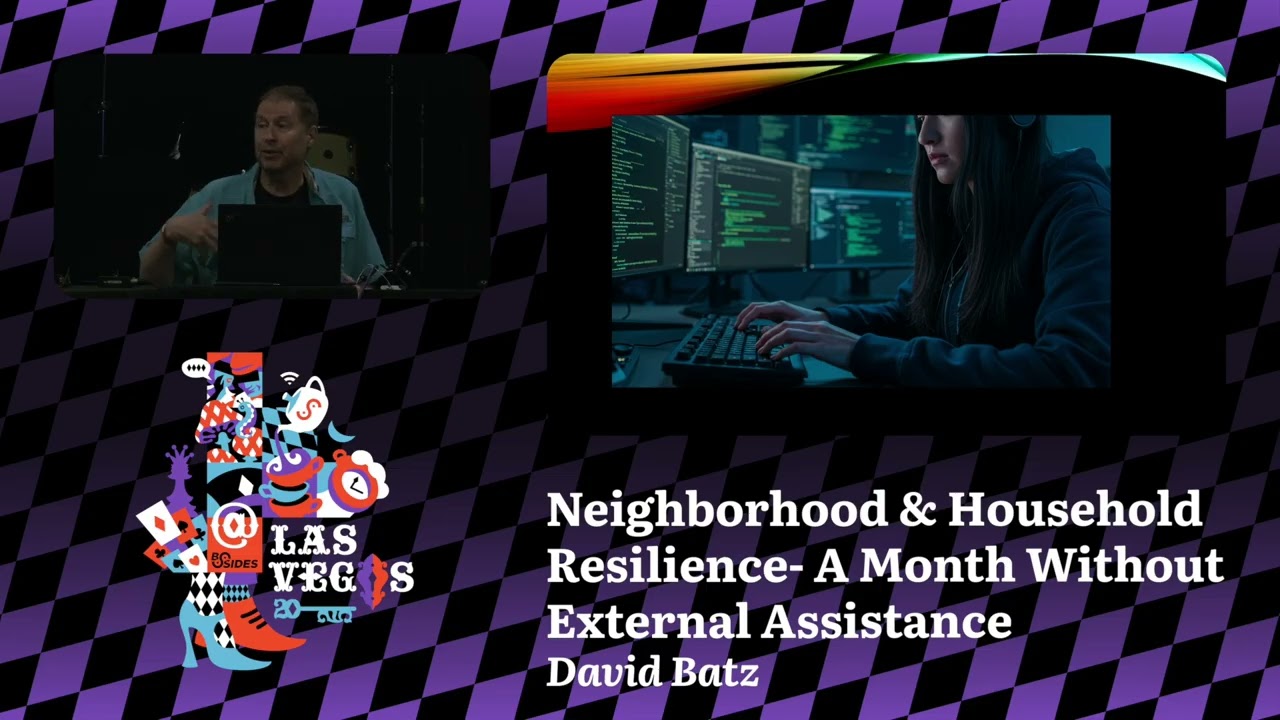
Neighborhood & Household Resilience – A Month Without External Assistance
Show original YouTube description
Show transcript [en]
You ready, sir? >> Ma'am, I am definitely ready. >> You are so ready. So ready. Good morning, Las Vegas. Woo. [applause] Okay, let's give it up for Give it up for our next speaker, Mr. It was me. I'm your next speaker. Um, very self-referential. Okay. So, uh others have done this. So, I am going to do this as well. The views expressed by me today do not represent those of my employer, the federal government, Clark County, or the state of Nevada. They represent my views. Uh if you hate what I have to say, you should tell me. But if you love it, you should tell Mr. Josh Corman that you love it. Uh there will definitely be
time for questions. So as you think of them, please jot them down and save them for the end. And I want to just start by saying this session is really I would call it a thought experiment. And the the the question that we pose for you today is could you or how could you your family and your neighborhood support themselves survive without external help for 30 days? That is what the question is today. All right. Here is our agenda. Please look at it on the screen. I'm not going to read it to you because reading is boring and people don't like to be bored, especially in Las Vegas on a Wednesday morning. Um, but this is this
is where we're going. So, this is where I tell you what I'm going to tell you. Only it's on the screen. You can read it. But this is this is what we're going to talk about today. And now I'm going to tell you what I'm going to tell you. Join with me, will you, as we start story time? Once upon a time, there was an old man who used to go to the ocean to do his writing. He had a habit of walking on the beach every morning before he began his work. Early one morning, he was walking along the shore after a big storm had passed and found the vast beach littered with starfish as far as the eye could see,
stretching in both directions. Off in the distance, the old man noticed a small girl approaching. As the girl walked, she paused every so often, and as she grew closer, the man could see she was occasionally bending down to pick up an object and throw it into the sea. The girl came closer still, and the old man called out, "Good morning. May I ask what it is that you are doing?" The young girl paused, looked up, and replied, "Throwing starfish into the ocean." "The tide has washed them up onto the beach, and they can't return to the sea by themselves," she replied. "When the sun gets high, they will die unless I throw them back into the
water." The old man replied, "But there must be tens of thousands of starfish on this beach. I'm afraid you won't really be able to make much of a difference." The girl bent down, picked up yet another starfish, and threw it as far as she could into the ocean. Then she turned, smiled, and said, "It made a difference to that one." So that is how we are starting our discussion this morning. Making a difference. Even a difference for one person is still a difference. So uh I showed you what we're going to talk about. I want to talk for a minute, just a brief minute about what we're not going to talk about because sometimes sometimes it's useful to compare and
contrast. We are not going to talk about this. We today we're going to talk about neighborhood and household resilience. We are not going to talk about fullon prepping. I if if you're a prepper, I do not mean to be offensive. Okay? This is not what this is. We're not talking about prepping. Um, I recently heard like yesterday about a person talking about prepping culture and he said that anyone with less than six months of supplies is not being serious. Well, we're not going to do that here. We're not talking We're not going to talk about ammo and guns and 1000 other things. We will take questions at the end. So, >> photos. >> Oh, yeah. Yeah. Take take all the photos
you want. Especially the slides. Uh most uh all of the slides were created by environmentally dangerous AI, just so we know. Uh so there's no copyright issues. Uh it's just AI destroying the environment that was used to create our slides today. Also, I didn't pay any actors or models um because the budget was low. Um so we're not going to talk about this. We're also not going to talk about this. We're not going to talk about billionaires who rather than spending a little tiny bit of their money to solve or address societal problems have decided to rather protect their own selves uh by digging holes into the ground, spending multiple millions of dollars to protect
themselves and their families. um without naria care for anybody in this room. We're not going to talk about them. I would suggest that this is not the approach uh for long-term sustainability. Um this message brought to you by the Times of India uh August 3rd. So this is a very recent story. Feel free to read about it later uh at noon or after that. Okay. So let's but we want to talk about this. This is the thing that we want to talk about. The first step might seem the easiest. It might even seem silly, but many of us do not. We don't know our neighbors. People move in and out all the time. Sometimes we are satisfied
literally not knowing the person who's next to us or across the street or down the street or the apartment next to us or you know the the flat at the end of the hallway. I don't want to uh just propagate uh cultural stereotypes. So, I'll just talk about me. Me. I I'm not talking about you. I'm just talking about me. It might be hard for me to get out of my comfort zone to actually leave my house, walk across the street and talk to somebody else, leave my apartment, walk across the hallway and talk to somebody else. There is there is this typ cast of, you know, nerds being very insular and talking to their
computers and not talking to humans. I'm sure that's not the case in this room. But for me, this can be a little bit of a challenge to break out of my shell. It's all right. The reason why it's important is that this is about humanity and being a good human. It's about helping others, not just yourself, and being able to bring uh comfort and relief. Our discussion today is really going to focus on low tech, yay, low tech and no tech approaches. It's going to be about breaking out of our comfort zone. And fundamentally, this is about being the Calvary. Let us presume for a second that no one is coming to help. No one is coming.
So if no one is coming, who's going to do anything? Well, I can do something. You can do something. I am the Calvary. You are the Calvary. That is why we're here. All right. Uh another uh another statement. I do not know about you. I don't have any idea about you. I don't know where you live. I don't know your geography. I don't know your finances. I don't know if you're in a high density housing, low density, if you're out in the middle of nowhere, in the middle of 10 million people. I have no idea what it is that's going on with you. So, this this I let me put forth a challenge for you to listen to my words.
Think about what I'm saying and apply the lessons that are relevant, that are gerine, and make sense to you in your situation. A lot of this is going to be a choose your own adventure really where I'm asking you to take the part the parts that I share that make sense to you and then do something with it. We're going to have a slide later that reviews all of our homework assignments because because this is an I am the Calvary presentation. There will be homework. You will be graded. Uh anything that's talked about in this presentation will be on the test. So that's all right. No, no pressure. I just I want to set expectations.
All right. Let us dive in. Who are the people in your neighborhood? Who are the people that you meet each day? Who are the people as you're walking down the street? They are the people in your neighborhood. I searched for a long time for that clip from Mr. Rogers and I could not find it. The good people at Pennsylvania must be very, very well trained on their intellectual property protection cuz I could not find that song. made me crazy. That's okay. But who are the people in your neighborhood? Maybe there is somebody in your neighborhood who could use a helping hand. Maybe you've got somebody who's elderly in your neighborhood. Maybe there's somebody who's disabled,
somebody who is hard of hearing, somebody who is mobility challenged, somebody who is language challenged, English is not their first language and might not be their second or third or fourth. somebody who is transportation challenged. They do not have a vehicle for whatever reason uh which is unfortunately the case in many American cities. Public transportation is not an option because for reasons that I don't not understand uh investing in such things have not been deemed uh efficient. They might need oxygen. They might have other medical needs that you know what you cannot see because they are not externally presented. Here's another one. They might be single. They might be a single parent. They might be a parent uh with a child
or more than one child with special needs. These are the people in your neighborhood. How would you know? Well, you might know by talking to them and learning what is what is their situation being a human to those of you who are around. Now, this is not all bad news because there's also people some of the same people that I just mentioned that are also they know about construction. They are plumbers. They are trades people. They are electricians. They might be a physician. They might be a nurse. They might be a teacher. They might be able to fix cars. They might be a tinkerer. They might be a ham radio operator. Very interesting. Uh I forget the the quote. Uh I am a
multitude. All of us bring a lot to the table and we can find out what is going on by talking to each other by being actually part of a community.
What is going on in your neighborhood? I do not know. But you have an opportunity to understand what is happening in your neighborhood. What makes it special? What risks are [snorts] present? Is your neighborhood at risk of wildfires? And uh after reading about wildfires in the burrows of New York, for God's sake, um almost every neighborhood, frankly, today almost every neighborhood is at some risk of wildfire, which seems crazy to me. Uh, is your neighborhood on a flood plane? Is your neighborhood in or adjacent to evacuation routes for things like hurricanes? Maybe. Is your neighborhood uh specially situated as it relates to crime? Are there other environmental threats within your neighborhood? Do you know? If you do not know, or maybe you
think you know, here's some homework. Reach out to your local community and state officials for information on this question. What are the risks that are present in this neighborhood? Create a checklist of these risks. Prioritize the hazards that pose the highest risk. Can you reduce the risk to your family, your community, your your neighbors? What is the time horizon that you have to reduce these risks? Does your school have an emergency plan? Does your employer has the plan been tested? Because having a plan is one thing, but if that plan is not exercised, it may not be as valuable as if it was actually used or exercised. What is the one thing that you can do
that your neighbors can do working together to mitigate some of this risk, your neighborhood? Now, let us talk about your household. Maybe your house looks like this. Maybe your house is an apartment. Maybe your house is something entirely different. I encourage you to think about these questions. 30 days. What would it take for you to be able to survive without external assistance for 30 days? I would like you to think about this one step at a time and not to be overwhelmed because it very easy. I will tell you, you turn on the news. Oh my god, it is very easy to be overwhelmed. But here's the good news. You do not have to be overwhelmed.
You can take one step to help protect your household. You can take one or two steps this month to protect your household and then next month, guess what? You take a couple of steps. Do you solve everything in one day or or one week? No. Please don't do that. [laughter] [snorts] Because you will make yourself and your your significant others, maybe your children, maybe your neighbors. You'll make them all crazy if you try and do this in one day. So, don't do this in one day. Don't do it in one week. Don't do it in one month. Give make a project plan. Consider 18 months. In 18 months, I want to be here. Define what here is. I've got some ideas about
what here, the definition of here is. And then you just take simple steps toward the objective. Dave, Dave, Dave, Dave, Dave, why are you why are you getting us all worked up and talking about this? Why are you doing this? Well, we've heard already over the last two and a half days about things like Taiwan 2027, but maybe it's not 2027. Maybe it's 20 2030. I don't know. Maybe having some household resilience would be really nice in the event of other hazards or events, maybe pandemics. That could never happen. I There's no way. There's no way we could ever have a pandemic. Or maybe there is. As you think about your household, please, and this is the goal, think
about your neighborhood because we we're we should be thinking about others as we think about ourselves. Think about your space storage limitations. Think about rotation um and etc. So, now we're going to get into the details. Where to start? game. >> You start with some no regrets items. No regrets or no regrets. What? However you want to do this. Get yourself some plastic bins and start to collect the following items which might be very handy to have. Markers pens pencils notebooks index cards. Batteries. I would tell you batteries are awesome. Many of them can last for years if left unopened and stored properly. What are some other no regrets things? Uh toilet paper, paper towels, disposable paper plates, uh
disposable uh utensils, forks, knives, spoons, bleach, unscented bleach, liquid soap, liquid hand sanitizer, other cleaning supplies, Xacto knives, kitchen knives, can openers. I cannot tell you how important this is. Can openers, not just one, but more than one. We're thinking of our neighbors. Basic tools, a hammer, a saw, screwdrivers, a crescent wrench, a socket set, cash. Cash is good. Small bills, uh, not Fort Knox. Don't don't go nuts with this, but you know what? Having a little bit of money in tens and 20s can be very helpful. blank notebooks. Medicine uh medicine is very important for some of us. Medicine is critically important in the sense that we will die in some number of days if we don't have
medicine. So, we should think about medicine, kids stuff, hygiene products, tampons pads diapers catheterss flashlights, flashlights with batteries, flashlights that are known to work, string, twine, fishing tape, gloves, PPE, eyroppers, matches, waterproof is even better, toothbrushes, extra for your neighbors, toothpaste, floss, basic medical supplies, bandages, tourniquets, rubbing alcohol, all topical antibiotics like Neosporin. As we're thinking about these no regrets items, also think where are your vital records? Insurance cards, passport, driver's license, birth, marriage certificates, social security card, pet ID, and pet vaccination records. Think about those. Now, this is a big one. Water. What do you do about the water? What do you need? An adult human generally needs one gallon per day, unless you live in Las
Vegas or Phoenix, Arizona, where you definitely need more than one gallon to live. So, where do you start? You can start the commercial route. You go to a camping store and buy one of these big old blue things. You wash it out with dish soap and then you put tap water into it. Cool. You can buy commercial water. You know, it's fit for purpose. That's great. You can use 2 L soda containers. You clean them out. You you clean them out with with soap. And for the uh the the leaders, you put in, let's see, uh you add a little bit of bleach or I'm sorry, a little bit of chlorine. um to like a drop per liter. So you can
build reasonably a water supply that is low budget, very doable. There are options for water treatment if you can't get it ahead of time. Uh this includes boiling, chlorination, and distillation. There are options. Uh if you can deal if you're dealing with an untrusted water source, the best option I'm told is boiling. U but there are other options including chlorinate chlorination and distillation. In addition, there are other options including Life Straws and alternatives to LifeStraws because if you look at the LifeStraw very on on the very edge probably every time you want a drink of water, you don't want to grab a LifeStraw, lay on your belly next to a water source and drink cuz that that'll get old after
about the first time you do it. So, there are other ways that you can approach this issue. Um, take a look at the commercial options that are available and make informed decisions about what makes sense for your budget. Shelf stable, low prep food. I am not recommending that you run out and you invest tens and thousands of dollars into MREs. That is not my suggestion. I am suggesting that you think about shelfstable, low prep food that you can use. Salt-free crackers, whole grain cereals, peanut butter, canned tuna, other canned meat, canned food with high liquid content. Choose items that do not require refrigeration or special preparation. Consider the special needs of the household, allergies, etc. Also, can openers,
you think about your food and your water storage. You you want to store the stuff into a a cool, dry place. You want to store your food in containers that will resist local vermin because if they find it, they will help themselves and you'll have a bunch of nothing. So, um they don't care about your water, but they do care about your rice and your other food. So, uh, metal or glass containers for those objects is good. Uh, mice can eat through plastic, no problem. So, uh, keep that in mind. Rotate rotate your food. Rotate it. Rotate it. You can actually eat the oldest stuff and store the newest stuff. Um, I'll mention to you, uh, we're not going to go into it,
the list. These are the top 10 vegetables that you might consider growing within a victory garden because they're easy, they're low impact, and this is a thing you can start on now. Either your victory or community gardens. Okay, assignment time. This is your homework. You are leaving with homework and this is going to be on the test. What is going on in your neighborhood? What are the risks? What are the things that you can do to ameliate the risks? What is your neighborhood risk profile? And who are your neighbors? Think about signing up for a Red Cross first aid class so that you can be a part of the solution and not only being a part of the problem. Think about your
supply reservoir and think about your neighbors and think about your elderly neighbor next door to you who may not have the means or the information for their supply. I want to uh give you uh a URL where you can do more reading on your own uh if you trust me. If you don't trust me, don't don't look at this QR code. If you do trust me, go ahead and use this QR code. These are from the good people. uh at Utah put together uh a a series a large long series of all kinds of videos, most of which are helpful. Um but this is for reading afterwards. Um and now we have a few minutes for
questions. And that mic need to might need to be turned on because I think it's currently off. And the on switch is at the bottom.
Can you go back in that QR? It's just slide out. Thank you. >> Well, I feel better. Just had trouble with that. >> Um, so my question has to do with the reality of people with lower incomes being able to do this. >> Yes. >> Uh, I'm a community college teacher. I when I talk about uh disaster recovery from a computer sense I'm like how many of you are ready for this and of course when students are dealing with housing uncertainty and all those other challenges the idea of oh and be ready for 30 days you know like so how do we address that that inequality where people are just trying to survive and we
want you to be able to be on your own for 30 days >> it's a great question. I I think the answer probably needs to happen within a community to think about our neighbors who maybe they're unhoused, etc. I like I don't have all the answers, but that's we have to work with our communities to start to drive toward answers to deal with with the have nots. Okay, this was for a tall person. Okay. Hey, so I have an answer to that. Uh, first I'll say I'm an emergency manager, so I won't I don't mean to offend any of my other emergency managers, but the focus on gathering stuff instead of doing stuff is the thing that alienates
the people who don't have. They have more than they think, but we have to reframe that message. And we did that in my community. But what and I'm not I can talk about that later, but here's some things to help you cheat on your homework that Dave just gave you. Uh if you Google for a a program called Map Your Neighborhood that was created in my state, Washington, it's no longer supported, but the info is good. So, if you don't know how to have conversations with your neighbors, it tells you how to sit down and have the conversation with your neighbors, focusing on not the gathering of things, but on the inventorying of skills and the
inventoring of needs of your community, your neighborhood as it were. The other thing I'll throw out there is community emergency response teams. Lots of communities have those. They give you basic disaster skills. Uh, and every state and nearly every county in the country has what's called a hazard mitigation plan, which lists all the bad that can happen in your community. So, find those. >> Oh, dropped. >> Mic dropped itself, but it survived. Anyway, that's how to help you with your homework that Dave gave you. There you go. >> Thank you. Thank you. >> Thank you. A big round of applause for our previous speaker.
Related talks
 26:53
26:53 32:26
32:26 53:01
53:01 51:51
51:51 32:48
32:48 33:48
33:48