Corporate Governance For Fun and (Non)Profit
Show transcript [en]
oh yeah yeah no problem all right folks we're ready to start our next talk uh we have uh Christy Dudley doing uh corporate governance for fun and Prof and nonprofits excuse me uh Christy started with a bachelor science and electrical engineering with an emphasis in digital Communications she went on to work in network engineering in finance and Manufacturing before jumping ship to study anthropology uh after a time waiting for the great anthropology industry boom that never seemed to come to pass uh she drifted back into Tech delving more into information and device security with the goal of uh wrapping all these diverse interests up in a single career she earned a jurist doctor from Santa Clara
University and she now consults on privacy and legal issues and if she hadn't told me as much about the Privacy implications of connected vehicle digital short-range Communications as she has over the last few years I'd probably sleep a lot better at night um please put your hands together for Christy [Applause] dadley uh wow that was um more of an introduction than I really expected so um I'm here today to talk about something um kind of on the periphery of um everything else that we've been talking about here um this weekend um and and the idea is that uh I've worked with a lot of you Jack Daniel at bsides Las Vegas talked about um forming your
own uh nonprofit and different uh not for-profit models that are um options uh really with the idea of encouraging people to start these well once you start the starting is only the first step keeping them running is actually where you can get yourself into trouble and I also recognize that this is a big stumbling block or point of uh concern for a lot of technical people who don't really get the business um corporate legal stuff and you could get into a lot of hot water etc etc um really I'm here to tell you okay these are the things you need to do they're fairly simple if you want to follow them um also I wanted
to point out what I'm talking about here today is only for corporations um nonprofit corporations um that's how you form them um if you're interested in um in for-profit corporations uh this will a lot of what I'm saying here will apply but other forms of organizations not so much okay who am I I am technical he gave more of an introduction than I plan to so but I've been engaged with a community for a long time and a lot of people come to me with um issues I've I've um been involved in the formation of an organization as well as working out the tax status of another organization and um getting a lot of things together for people uh since I uh
studied law and know uh the law uh people look to me and oh by the way I am available if you're looking for help with things um so first of all incorporation is easy I have here a section of the form that has the majority of the information that you need to fill out in order to form a corporation yes it's a one-page form issued by the Secretary of State of California and that's all you need to know all you need to do you form a corporation for any legal purpose and they even have the language that you need on the form for the uh 501c3 formalities or any other organization that you'd want so a lot of people wind
up I I have to make an aside here a lot of people wind up paying $900 for online services to file their organizations which is kind of silly because this is a simple form it's easier than a tax form uh but that's that's the first step it's an easy first step and anybody can do it so it's 35 bucks why not um the real question of why not is accountability okay you file the form uh you are now accountable as an organization uh if you had a for-profit you'd be accountable to your shareholders because they own you your organization but since you're not and you don't have shareholders you have donors who you are not answerable to
because that would wind up being very close to a for-profit organization if you're operating at the will of your donors so you'd like to encourage donors but they can't tell you what to do so who can nobody nobody can tell you what to do except the state in a few very specific corporate formalities so um what what the state's done is established or defined roles and assigned duties that's every state has done this it's a fairly uh uniform uh practice although I have a focus in California I I I really look at California law so that's where I'm I'm looking from so the formal rules okay the before you become Incorporated you don't have officers you can't have
officers because you don't have an organization to be officers of so everybody who is acting as an officer is actually legally called a promoter you're promoting the organization you're establishing it and so that role is a separate role from Once from the time that you become Incorporated and then once you become Incorporated you have your board of directors and your officers people get these confused a lot officers are different than directors directors don't do anything that's the role of directors they are not supposed to do anything in fact and a in a it's kind of a a cultural common belief that it's a good idea not to have or to have at least half of your board of directors not
involved in any oper operational role at all so that they can be outside advisors and have a a unique perspective so the board of directors they they only make decisions and tell other people what to do basically so the other people who actually get stuff done Are the officers the president the treasurer the secretary these are legally defined roles you must have each office filled in every organization you can't like leave an office empty so you have to have either an acting or an active or a permanent um and then there's another legally defined role uh that covers all the other whatever if you want to call them officers if you want to call them
members whatever they're all everybody else other than these three and the board of directors they're just agents board of directors by the way aren't agents and that'll become more parent agents are people who do stuff but don't have the accountability of other people so here's a relationship and it's really important to consider the directors hire and fire um that's one of their major drw roles they hire and fire that's a decision um they make the decision on the budget they make decisions on what you will be doing next year um really highlevel stuff but not you know down in the weeds we need to get this person or that person in uh directors don't if you have an
organization that's say looking at a a conference um your directors aren't the ones who pick the speakers you have people for that um and that's that's more of an operational role because you're you're having to do stuff so although the directors hire and fire these people they can be the same people it's not always a good idea to have them all exactly the same people um it's also a good idea to have an odd number of directors that way because most of what directors do is vote having an odd number eliminates those those challenges there so um and there's bard of chairman of the board people talk about that is it as if it were a special role really
chairman of the board is just the person who uh sets the agenda sometimes they have the chairman taking the minutes sometimes they have the secretary for the organization taking the minutes it's not important the secretary is responsible for recording the minutes and making sure that they're kept up to date in the corporate records and that they're approved but there are a lot of different people who can actually do the job so um uh the the next problem that you get with this kind of structure is in in selecting your so the directors select like the president quits you need a new president the director select or the president's bab mouthing the organization you want them out you the
director select a new well the problem is who selects the directors in a for-profit corporation you have shareholders and the shareholders vote and they say okay this director is our director but that can't work with a nonprofit because you don't have shareholders so there and there's no statutory way to deal with this um on almost every other thing having to do with a corporation there are defaults you can change the defaults but there are defaults but there's no default for selecting a new director usually what happens is the other directors get together and decide but it's really a good idea to have that in your either Articles of Incorporation which was that one page form so you probably don't have
it there but your bylaws which talk about the how your organization operates um it should have director selection in there if you're a nonprofit corporation so oh and one more thing I wanted to point out um I think I'll get back to this later but the president has to be different than this a different person than the secretary and Treasurer but the secretary and Treasurer can wear two hats they can be both the secretary and the treasurer um that's giving an awful lot of power and a an awful lot of responsibility to a single person and we'll get back into that but this can be a total of three people and you're done it's usually a good idea to have at
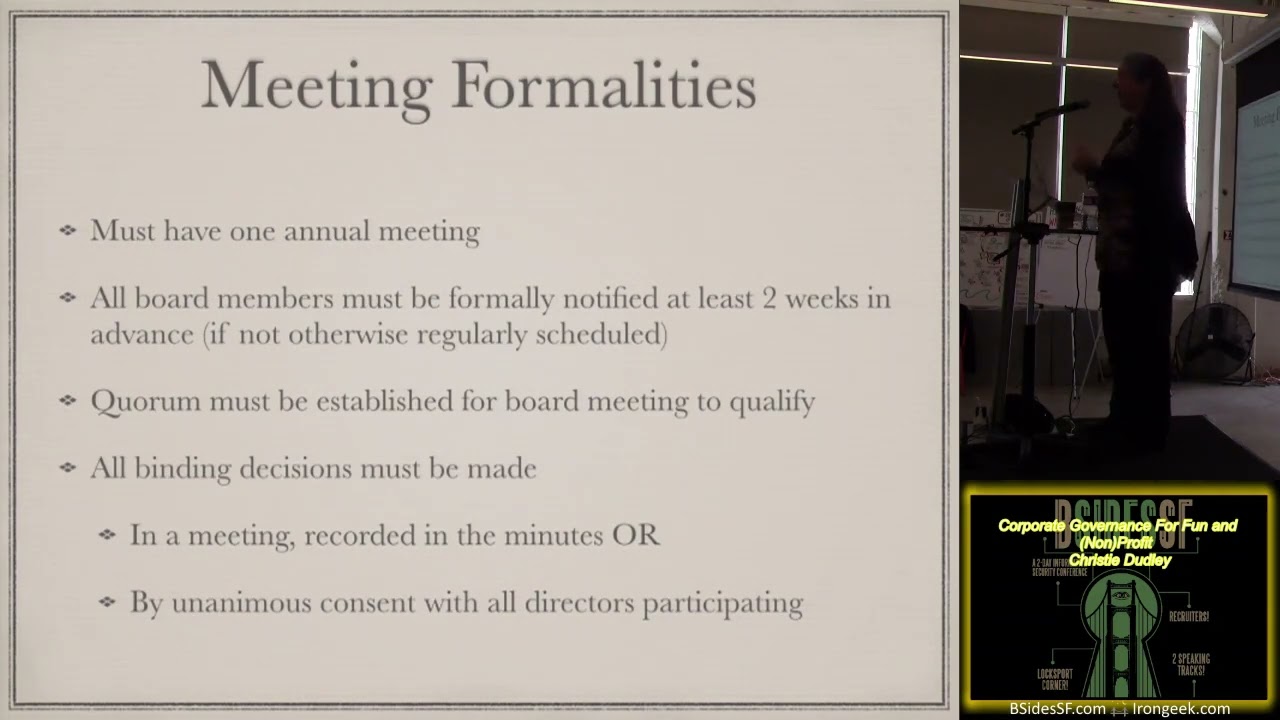
least four but that's that's what can happen Okay directors their responsibility is to approve the biolog and attend meetings at least one a year and follow all the duties that every single officer and director must follow and these four duties it's really important um that everybody who is responsible for leading a nonprofit organization be aware of these so first I'll talk about the meeting formalities um you have to have one annual meeting um you have to have formal notification um unless it is a standing board meeting and this has to have any agenda items that aren't recurring uh the idea is um sometimes when there are board takeovers and almost all of these have to do with conflict within the
organization and how you deal with and address conflict so if you have a board meeting with an agenda item that somebody doesn't know about in advance and so they show up to the meeting and they're not prepared for your attempt at corporate takeover or something like that then um then it becomes a representational issue and a problem for the organization so you have to have your um formal notification two weeks in advance pardon me so um you have have a quorum so you have your formal notification and you send it out when all the officers you don't or all the directors I'm doing it too all the directors you don't like are on vacation and you know they're going to
be gone so they can't show up uh that's not okay you have to have a quorum and you have to um the statutory default for Quorum I believe is 2/3 of the D directors um but you can change that in your bylaws if you want to to do that um all binding all binding decisions mainly things like appointing the president appr approving the budget um all the really important stuff must be made making commitments they must be made in a meeting where you have recorded and approved minutes um minutes have to be approved by the board as well or else um they could be called into question if there's challenge so they have to be recorded and approved
and they have to be or unanimous consent and I've seen a lot of stuff it's unanimous consent is a really good way to get stuff decided in an organization where people are on the go because you can do it asynchronously via email um a lot of the reason for the meeting minutes is that these are public you're you have a public corporation you have a an organization serving the public the public has a right to review these minutes they have a right to see who voted on which issues so moving on uh fiduciary duty this this is a duty for um you you're responsible for your for your organization you have to uh you have to take uh care in how you
spend your money um this is tax exempt donations um the donors can't make a complaint but the Secretary of State the doj in California has an interest in charitable organizations um so that to to make sure that they're still operating as a charity for public benefit and so they they from time to time look in on finances so and so you need to U not use a little sense here in serving your organization not yourself um duty of care you need to pay attention and it's your responsibility to keep up with what's going on with your organization um ignorance of what's happening in your organization is not a defense against anything that's bad bad that's happening um once you step up to
that role uh if you don't know then it's on you um there have been cases to support this um an old woman inherited a directorship from her husband and she was kind of dotty but she lost she wound up be being liable as a director for the actions of the subordinates because she just wasn't paying attention so you need to pay attention and it's a good thing you're here because you're learning about what you need to know and do and so that's part of the duty of care duty of loyalty is you can't compete with your own organization if you're a director and there have been a lot of interesting things um in Silicon Valley uh duty of
loyalty is actually one of the things that's contracted out um in the bylaws or in membership agreements um various uh documents where say uh an investor uh wants to invest in multiple companies and put his guys on the board of directors so they they contract they agree in the bylaws they agree that uh they'll wave the duty of loyalty if you wave the duty of loyalty for a nonprofit you will lose your nonprofit status because that's one of the things they look for is you you can't set up a a straw man to pillage basically and and and the looks for that sort of thing um and it's really important not to talk down your own organization even um this
is It's it seems very counterintuitive but it's it's the sort of thing that you you you stand for that Organization for a reason and you need to continue standing for it or else you'll tear down the work of everybody else around you because you speak with a louder voice than those outside your organization um the duty of good faith um you can't give lip service and expect to get away with it the courts figured that out a long time ago um you can't get around the fiduciary duties or the duty of um any of the other duties simply because you've come up with a good story to explain it uh they they actually get can dig pretty deep
and determine that that what your actual intentions were um okay moving on we're talking about officers now um I'm good time I guess uh the officers are responsible for how the organization works the directors lot of hot air that's their job um and often in a for-profit and sometimes even in nonprofit corporations if they're large they get paid for that and they they it's reasonable to pay them because the decisions they make are so weighty if if you're throwing around thousands or millions of dollars hundreds of thousands or Millions not thousands um then uh there's a lot of responsibility on your shoulders um so anyway the the President is responsible for the overall uh functioning of the
organization uh but there are not any specific duties for the president the president doesn't have to do really anything except lead the organization um on a day-to-day basis uh but again those General duties they apply to everyone including the president so the secretary has a lot more in fact I talked to somebody who is a secret for nonprofit organization and he said oh wow I have all the power I sit down on the board meetings and I take notes and I could post anything and they'd approve it uh that's kind of one of those bad faith sorts of deals but um he always posted everything correctly but it's it's their responsibility to keep the corporate records so if a
member of the public decides that they want to go and look at your records because corporations are answerable to the public if they're public um then then they have to you have to have them ready and a reasonable time present them you might have requirements like if you have to mail them or something or they have to show up at your offices or but they have to be made available um and also um decisions every decision that's made by the organization to include ESP special to include the budget that has to be in that record that's approved by the directors um and then treasure this is the last um specific role for an organization they have to keep all the
financial records just like the secretary keeps records of all the decisions the treasurer keeps records of all the finances and they have it is the treasurer's duty to make all the necessary tax filings so if there's any discrepancy it's also on the treasur to figure that out or make it up um and that can be kind of scary for somebody to take on that role as well so now you have all these responsibilities what do you get to do okay um the board of directors votes that's their thing nobody else gets to vote this is may sound obvious but some people don't get it so um in fact in California uh they've recently passed a
statute figuring out that there have been Shadow board members floating around influencing unduly influencing organizations and so they made they passed a a statute saying you can't do that uh everybody who's there has to have a specific reason to be there uh frequently you see like for example the secretary is not on the board the secretary is there to take minutes that's cool it's it's not cool to have people who are not board members who are influencing the board but the treasurer and the president have the authority to spend money the president if you recall has no accountability but he has the ability to spend money which is kind of cool and kind of scary and broken but somebody H
only one person has to be accountable for each item and the treasurer is responsible for that uh the President should be fired by the board if they come into conflict but that's how it works and that's pretty much it as far as authorities specific to the roles um but there are those two special roles that I talked about in the beginning the promoter and the agent the promoter's role is as I mentioned before you form a corporation there's a lot of stuff going on you've got to form the corporation you've got to get all your agreements and all your contracts and all your stuff together um it's important uh that to to recognize that as you're
beginning to form each person takes on that liability personally you don't have the protection of the corporation you don't have the organization they don't own it they don't have it they don't they're not responsible for it it's all on you as an individual um as soon as the corporation forms um a couple of things can happen um first of all you have to give the property Grant the property to the corporation um second of all you have to um you have to sign over all the all the or the board has to adopt all the agreements and contracts that's kind of a a weird thing that happens um and then the third thing is you have to with all
the people you have contracts with you have to get what's called a Novation which means that the person you sign the contract with has to agree not to hold you personally liable any longer which can sometimes be a problem if they don't understand in advance that you're forming this organization and that although you're signing it now you want to have it signed over to um the organization once it's formed and and legal so so because what happens then is they can they can no longer go after you and all your assets and you have this limited liability brand new has no assets organization they might not want to agree to that and they might want to
resend the contract entirely and say forget it
question possible that's a good question the question was why don't you file as soon as possible a lot of people think it's hard to file I think that's the best thing I can think of um but you get your corporation backdated to the date that they receive it so um I I don't know actually but I I think a lot of people think it's hard to form a Corp operation uh people will pay Legal Zoom $8 $900 to do to do effectively fill out the onepage form but um they wouldn't be in business I have friends that have made an entire business out of fixing the problems at Legal Zoom because Legal Zoom doesn't actually give
you advice so and and that's what you're paying a lawyer for you're not paying them to fill out forms or do that you're paying them to give you a advice so free advice I am not a lawyer by the way I'm not licensed in any state yet just to let you know yet is a keyword um and uh this is this is an i to give you an idea of your responsibilities so take that as you will um so
anyway oh
great that's a that's a good point what Jack Daniel was saying was that if you if you if you're not well first of all if you're if you plan to be a 501c3 then you need to not so do certain things and that's a a state thing a state-by-state has different requirements but but you can't do like there's a li long list of things you cannot do and if you don't want to have that if you want to do one of those things on the list then you do it before you're Incorporated and it's okay um also another reason is if you're not sure about what form of Corporation you want like there's 501c3 which is uh
public benefit um I formed a 501 C7 which is a um basically a country club it's a a mutual benefit organization where you basically share your assets and you're not taxed on anything but you also are not able to take TA or let people take their deduct or their donations off their taxes which is a huge benefit of the C3 um the and and a C4 if you want to do political lobbying a C6 if you anyway there lots of different organizations and go look at Jack's talk if you want to see the the discussion on several of them so so if you're not sure about what what form you want or if you want to do
things outside of the ideal that you're shooting for there there are some good reasons to do that um an agent an agent is somebody they can have like I I remember somebody coming up to me and saying I am the cioo of hacker space it's like well that's not a legally defined role fine cool I'm glad you have that title um I guess that makes you an agent of that hacker space um and so what that means is if they've given you a title and they've given you an area of responsibility then there's an implied um authority to act on behalf of that organization within the scope of that title so the the the commitments um
that you make are binding to the organization unless the organization says otherwise and in fact if that happens and there's any question like the CIO happens to be buying office supplies um with purchase orders generated for the organization and the organization didn't really want the office supplies if they accept them keep accepting them and decide oh why is this person ordering office supplies it should be that person we shouldn't have to pay for that um well then that's a problem because they've accepted it in the past and so that generates an implied um uh authorization to do that um agents also have the same duties that the the officers and directors do when performing their agency t tasks
basically except loyalty you can have a real estate agent that's you know all over the place or or a a promoter or all sorts of different different types of agents that um corporations um enlist to do different things so um there there there's a lot of flexibility with this and a lot of people get really caught up in the idea that only the officers and directors have the right or ability to make decisions on behalf of the organization I bought stuff for the Red Cross it was a Sheltering operation and they needed somebody to come in and help um or manage to get food for people and I I made arrangements and I went and
picked it up and paid for it and all on the Red Cross is dime and I was acting in that capacity as an agent for the Red Cross I didn't have to have three levels of approval no president or official person signing off on it so agents are very important to the functioning of the organization and they're pretty much ad hoc but they don't have the duties the secretary and treasurer do which are the really big ones only secondary to the board meetings so now the penalties can be very serious if you don't follow these it's not going to jail time nothing here it's not legal to not hold a board meeting every year but you're not going
to jail for it I don't like to call it illegal it's extra legal um you can get fined pretty seriously for that um you can face lawsuits um the doj might get really uptight about it or the AG's office not doj the State Attorney General's office might come down on you um and more likely the IR IRS will be or not the IRS the IRS is the nice people the California Franchise Tax boards they have no humor at all so somebody who has dealt with FTB they're they're not fun people so um however the wonderful thing about financial challenges like that is you can buy insurance to cover any mistakes you make and I really really highly
recommend you do that if you have any money at all buy your insurance also if you have any money at all pay a nonprofit specialist to do your taxes and um get a nonprofit attorney to go over your bylaws um and pay these people because a lot of people I I've been approached by a number of people and it's like you're really lucky if you find somebody who's willing to do nonprofit work for you um in an attorney capacity because the it's a very different area of law than uh for-profit law and so because this area of law is so different and the issues that you face and the the specific problems that you have in in um
abiding by these laws is um these these are very special areas that you need to have addressed the attorneys that are interested in gaining experience it's not useful to them uh the attorneys who do the nonprofits they don't make a lot of money anyway and so they have to do this full-time and you're trying to tell people that you are more um worthy than the the uh women shelter who is barely funded and barely has beds for people um you're trying to tell people that you who can get corporate money um can't afford to pay a lawyer and help support all these other nonprofit organizations because that's what you're doing when you pay services that specialize in nonprofits you're
you're helping the nonprofit Universe when you do that so any questions no questions in the
back I'm sorry yeah yeah my slides will be available um so that you can go back and look over them I I usually post them on slides share I have a slides share that I have all my slides posted to so great any more questions wow
thank you very much all right folks thank you uh we are going to take a break and we'll be back on the hour with our next talk which is not on
Related talks
 28:29
28:29 29:24
29:24 32:13
32:13 30:17
30:17 38:53
38:53 32:39
32:39