Lessons from Ancient Weapons: Applying Material Science Principles to Information Security
Show original YouTube description
Show transcript [en]
good morning welcome to b-sides dfw uh this is track one the ten o'clock slot my name is jason kohler and i'm gonna be talking to you about uh the tools and weapons of the material ages and what we can learn from those and apply to the information age so by way of introduction my name is jason kohler went to the university of north texas where i got my degree in computer engineering did a lot of work with the club for cyber security over there participated in the collegiate cyber defense competition and the national cyber league a couple of times did a really cool networking project for nasa while we were there uh from there i went on and had an
internship and got a full-time offer with one of the largest investment banks in the world did that for a couple
warfare and how the tools of the stone age the bronze age and the iron age were created and and how they play into each other and a little bit about how that works within the new and current information age and we'll be taking some questions at the end all right so just kind of um an uh an overview about what tools and warfare and how they come in uh they're very prominent in human history but for a long times uh people thought that humans were unique in in many ways but those included and so initially people thought that humans were unique in our intelligence but we've since learned that a lot of cephalopods are very intelligent we've seen octopuses
and uh and other other cephalopods find very creative ways of solving puzzles and retaining information and memory and then it was commonly thought that our emotions is what made us unique but i would argue that anyone who has a pet would tell you that emotions are not unique to humans i have a dog we'll be talking about her at a later talk this afternoon and uh i am fully convinced that emotions are not unique to humans because that my dog displays a lot of emotions we've then kind of determined that speech and language are what makes humans unique the ability to convey information to other members of our species well this has also been disproven there's been
several experiments with crows and other corvid birds where uh people have gone and disturbed the birds and generations later using the same disguises and masks and clothing these birds these new generations of of crows and other corvettes who had never seen this before already knew this was an enemy and and went and uh attacked them and defended their territory against this uh unknown invader that their their predecessors previous generations had seen and described to them this is the only logical conclusion that how they could know that intra-species friendship was also thought to be unique to humans you know how we've we've tamed dogs and horses and we keep cats as pets and goldfish and things like that but there
are many animals that do this as well there are several species of tarantulas that keep frogs as pets the idea there that the frog can get the smaller bugs that the bigger tarantulas can't and that keeps their nests safe from bugs that would eat their their young uh it's been additionally postulated that tool usage and warfare are unique to humans and as we're going to talk about today that's
and how we turn those into weapons and use them for warfare and so we're going to talk a little bit more about some tool usage common in the animal kingdom besides humans so it's been pretty commonly observed that that apes and various monkeys will use sticks to fish termites out of termite mounds and eat them there's also the anvil technique while they'll smash something between a large rock and a small rock in their hand this is definitively tool usage elephants also use sticks to scratch themselves where they can't reach similar to how we have back scratchers as well dolphins have been observed using sponges when they forage in the sand at the bottom of the ocean
so that the stingrays and things like that can't penetrate the sponge and get to their skin and hurt them and so they use that as protection otters are commonly known to use rocks to break open shellfish that they find to the point where certain otters have favorite rocks they've got little pouches under their arms that they keep them in and it's been observed that some otters pass through their favorite rocks down through generations and so you'll have an otter who has their favorite rock tool for breaking open shellfish that they received from their parents who see received from their parents this one was interesting i discovered while while researching this brown bears have been observed to use rocks to
exfoliate their skin when shedding and molting and so i thought that was really interesting to accelerate that process and octopuses have been observed to use shells and other hard objects to create a portable home if you will so there's the the octopus that'll take old seashells and coconut shells and carry them around with them as they move around on the ocean floor and tool usage in the animal kingdom is so prevalent now that it's we've kind of taken a step further that humans aren't unique because we use tools but it's more that we're unique because we use tools to make more advanced tools and that has not been observed yet so it's a very interesting distinction
warfare also not unique to humans we're going to go over three examples here this is the the gambi chimpanzee war it's occurred in the gambi stream national park in tanzania in africa and this started in 1974 specifically on january 7th where six members of the kasakala uh community of chimpanzees ambushed a member of the kama community uh the the six of them uh got him while he was feeding and that particular individual goatee had been very friendly to the aggressor community before and they they went and they killed him in an attempt to take over the comma territory which they viewed as better resources and more feeding and things like that over the course of this this four year
war the casa kala killed 10 and enslaved three of the chimpanzees from the comma community and they only lost one of their own in the process three of the comma are still missing that being 30 years ago they're presumed dead probably killed during that warfare but also interestingly they didn't keep the territory that they fought so hard to get the collinday community further south came up north and overpowered the casa kalas and took the the former commas territory and so that's an example of warfare in the species of chimpanzees specifically pan troglodytes another example of warfare and primates are the thailand monkey wars this started when covid kicked off in february and march of 2020
there was a large population of these macaw monkeys in thailand primarily kept fed and resourced by tourists who would feed them and of course the monkeys would also steal food from them as well well come covid there was no longer these tourists coming in and providing food for these monkeys so there's also a resource shortage and so uh as our species does they began to fight amongst themselves and there were multiple monkey gang wars out in the streets of thailand there were primarily known as the the temple monkeys and the street monkeys and they would fight for access to food and the ability to keep themselves and their own gangs alive and this was the the crab eating the
cause i'm not going to pronounce that because it's been a long time since i've done latin and another example outside of primates but still in mammals the uh the singapore otter war and this started in 2017 and is still ongoing and this started in 2014 when a family of five smooth coated otters moved into bishon ang mokoi park in singapore and in 2015 they they moved to the marina which they decided was a better and more fruitful territory where they could feed their young and continue to flourish so the bisane family and the marina family have been fighting ever since the visions seem to be dominant at this point there it's important to note that there
are 10 other romps or families of otter living on the island of singapore so it is not just those two families but there's uh a lot of interaction between them but this has kind of been the main rivalry that we've seen and these are the the smooth quarter excuse me the smooth coated otters that we've been observing this in so now we've kind of gone over an overview of tools and their usage across the animal kingdom and and uh humanity and why warfare and tools are not unique to us i want to talk a little bit about the various material ages that uh historians commonly identify humans as having gone through that is the stone
age the bronze age and the iron age and it's important to note that these different ages don't have very hard uh cutoffs in time and as it do in part to a the um the the records that we have are not stellar they didn't have things like wikipedia and the blockchain trust to write everything down and when the stone age was coming about so it's kind of best guessed based on archaeology but it's also too important to take an account that the entire all the humans in the entire world did not simultaneously discover and master the use of materials at the same time it was kind of a it popped up in one place and then maybe another and then
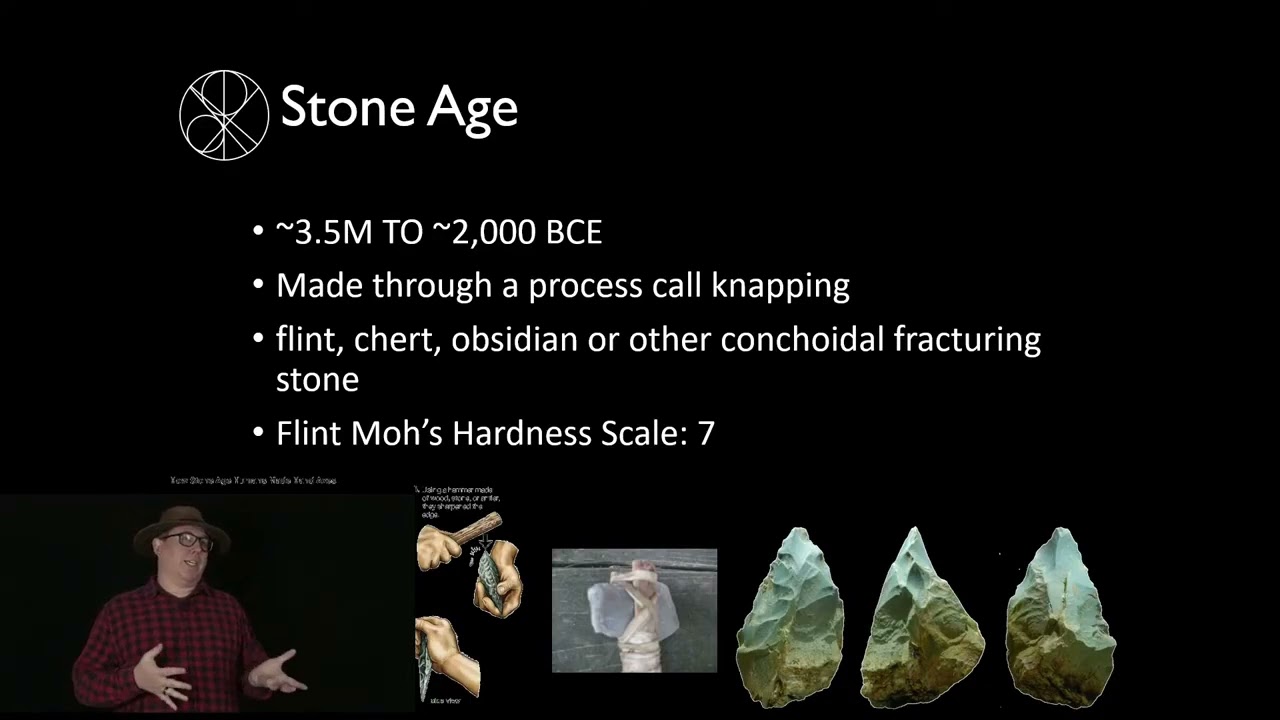
kind of migrated across the world in that form and this is where the materials play a huge role in warfare because the stronger your materials that means the the better weapons you can create and it means the more likely you are to be successful at warfare and while it is an unfortunate property of our species we are very prone to warfare and that's kind of how it's been one of the defining characteristics of human history unfortunately um i like to think things are getting better but uh that remains to be seen so let's talk about the stone age and this went roughly from 3.5 million years ago to roughly 2000 bce and again that varies
depending on which part of the world you're looking in the stone age was um dominated by tools made of stone and this wasn't just any kind of stone you had to make this out of a very specific type of stone that was um prone to to to what they call concordial fracturing and the idea was you'd hit these stones together through a process called napping and that would splinter off these shards and depending on how you hit the rock and with the grain of the rock and that kind of thing you could get different shapes and if you got the right kind of shape and you splintered it the right way you could get a sharp edge and that could
become a knife or an axe or another tool it's important to note that these didn't last long and these had to be continuously replaced and recreated but it was a heck of a lot easier to cut down a tree with a a flint axe as opposed to a blunt rock or or even going in foraging for wood that way it it dramatically increased the means of production for uh both harvesting wood pulling out other rocks that kind of thing and then when you wrap it on the end of a stick you have a spear or an arrow and now you have the ability to hunt and this gives you access to more forms of nutrition
besides just foraging and what you can catch you can now actively go and and hunt other creatures to eat them the immediate parallel there is in addition to being able to kill animals now you can kill other humans with these and so that is where the warfare comes into it now all of a sudden if you have a sharpened flint arrow you're more lethal to your fellow humans who have just clubs because now you can attack them at range and the unfortunate byproduct is that is if one tribe has something that another tribe wants and the other tribe has access to these slightly more advanced tools and weapons they are significantly more likely to be
dominant on the battlefield and be able to get those resources that they want interesting tidbit about flint they have a mohs hardness scale of seven it's important to note that mohs hardness does not correlate directly to durability or strength this is merely um how you can scratch things so for example diamonds have a most scale hardness of 10 but for anyone who knows anything about gemology they will shatter fairly easily that is how the gemstones are created but they are hard enough that they will scratch things very easily and so it's important to note that hardness scale does not directly translate to durability from there the bronze scale from around 3000 bce to 300 bce depending on where
in the world you are again you'll see some overlap obviously 3000 bc happens before the 2000 bc e when the stone age ended and that of course depends on where in the world you are it's important to note bronze is not a naturally occurring element by itself it is a mixture of copper tin and other materials and depending on the ratios of how those are mixed is going to play into its durability and its hardness copper itself has a melting point of 1983 degrees fahrenheit that's 1084 in celsius if anyone's watching from outside the u.s and depending on those metal ratios and the purity the copper can have that most hardness scale of 2 to 2.5
bronze once you mix in all those materials has a has a slightly lower melting point and that's just due to the additional materials you're adding and so that's anywhere between 1881 to 1900 degrees fahrenheit something that's interesting to note is bronze can be soft enough to manipulate at room temperature depending on its the metallurgy ratios uh and bronze has a rough hardness scale of three but it's significantly more durable than the mo than the than the stone tools so they're going to last longer so even though flint has a mohs hardness scale of seven and bronze has a lower hardness score of three bronze lasts significantly longer and that's just due to its durabilityness now it's a trade-off in that case
hardness for durability and that goes back to what we're saying earlier is it's not a direct correlation to how many times you can use the tool and if you think about this the more often you can use your tool that means your shovel's going to last longer your plows are going to last longer your arrows spears and shields and armor are going to last longer and so if your tribe had access to and the knowledge to create bronze before your fellow tribe graduated from stone you had a very significant advantage there um all other things being equal if you had access to bronze and the other side only has access to stone that's a significant advantage on the
battlefield both on the battlefield and also in agriculture and other areas where you need tools from there we move on to the stone age and again you're going to see a huge overlap here this started in 1200 bce which is significantly before the 380. or the 300 bce for bronze so there's a lot of overlap there again it depends on where in the world you were and where that was discovered iron being different than bronze in the fact that it is a specific element on the periodic table it's atomic number 26 if you want to go look that up and it has a significantly higher melting point at 2800 degrees fahrenheit this means you can't manipulate it at room
temperature you need a significant amount to heat heat this up to where you can manipulate it and work the iron and that requires a forage and that means you need to have access to coal or or a significant amount of wood enough to heat that up where you can melt it and work it and so while this takes a lot more energy it ends up being worth it because of its durability factor iron is significantly more durable than bronze and that's why it became the predominant material going forward something to note here is you can you can mix this with elemental carbon to create steel which is significantly harder depending on your ratios and also
more durable so again to point out here the mohs scale iron is going to come in at four while steel is going to come in at between four and eight depending on your carbon ratios and again you have a situation where you have a significantly more durable tool that means you can use it more times before you have to go and replace it and that that allows you more usages so you're again as bronze is going to last longer than your flint so iron's going to last longer than your bronze so your plows are going to last longer your shovels are going to last longer and all your other tools and it just just it means you have to spend less
time making your tools and you can spend more time using them and that adds to your productivity as a society all right so we've talked about the three main material ages the the stone age the bronze age and the iron age and now we move on to what a lot of people call the information age and this isn't as hard and you know researched and documented as those previous ages because we're in it um it's it's not something outside and in the past you can observe it's it's like it's like the pickle right how does the pickle know what's inside it because it can't read the label the pickle jar because that's on the outside you've got
to be outside the pickle jar to read the label so we're currently in the information age so this is more ideas and less proven than the previous ones there's less documentation we're kind of in it and it's hard to analyze something while you're in it brief history of information the telegraph was patented on in 1837 and had a rough data transmission of 25 to 40 words per minute depending on who was operating it shortly thereafter in 19 nope not surely thereafter wow that was ways off moving on 1866 was the transit first transatlantic telegraph cable and so that allowed you to use that device to communicate um relatively quickly across the ocean so you know we're no longer reliant on
ships carrying messages in written form you could transmit them electronically and so now you've got that increased speed um where you're sending you're you're sending your message 25 to 40 words per minute but now it's getting all the way across the ocean much faster than the multi-week voyage it would take a ship in 1876 we had our first telephone call in 1969 nice 29 was the first arpanet transmission and that was going up to 56 kilobits per second and if anyone had a modem back at home uh back in the 90s that's about the speed we got then at home uh in 71 we had our first email shortly thereafter in 78 we had our first spam
in 2001 wikipedia launched and in 2006 twitter was open to everyone and that gives you an idea of how fast we've progressed as a society and how quickly we can transmit mass amounts of information so we've gone from 25 to 40 words a minute to in 2017 we started getting commonly available uh gigabit infrastructure for individuals and consumers and that's that's quite a change and so with that increased transmission of information now we have access to in addition to all of actual human knowledge uh all human thought that those are willing to put out and that opens us up to not just what is true but what do people think is true and what do people want
you to think is true and that's where we go from forging iron from a lump of something you were find out of the mountain to into a sword to how do you forge information into a weapon and that's kind of where disinformation comes in and so uh this has been a common military tactic going back throughout history uh some notable things that i found were really interesting in 1943 we had operation miss meat where the allies were trying to
traffic to convince the germans that we were going to land somewhere else not in normandy in 1944 we had another disinformation campaign to convince them that we weren't going to land in sicily italy we're going to land somewhere else and they took a homeless guy that had died from eating rat poison dressed him up as a as a major in the royal marines and they put fake invasion plants in his pocket and they shot him out of a tortilla tube from a submarine and the the the axis powers found them and assumed everything and there was correct prepared for the invasion at the wrong location diverting resources and allowing the allies to invade sicily and so
some creative uses of disinformation there in vietnam there was operation wandering soul where to convince the vietcong to leave they did some audio tampering and made these recordings intentionally sound ghostly and and have recordings in vietnamese telling people to to leave this place that it was that was the ghost's domain and their territory and leave them to rest we don't know how effective that was but it's an interesting thought nonetheless all right taking information and i'm going to say weaponizing or disinformation here for marketing and advertising because i think that's a little stretchy but it's important to note that information has value and so the marketing and advertising information was a 138.6 billion dollar industry just in
the u.s in 2019 i couldn't find numbers on what it is today but that's where it was then compare that to the 2020 census data of 333 million people in the u.s and you can equate you know how much are we really worth how much is our information and opinion really worth to them recently there was an article out um saying that snapchat facebook twitter and youtube lost 10 billion in revenue since april 26 when apple started their app tracking transparency policy and so if those four companies lost 10 billion dollars in revenue how much was that information worth to them and you you can you cannot directly you can infer some things but it's not
direct right and you can kind of correlate well how much is that data really worth to them how much is your opinion worth to marketers and advertisers how much are they willing to spend to convince you and it's something worth thinking about all right some disinformation campaigns opinions let's talk about flat earth uh it's not this was proposed by pythagoras in 500 the earth being around was proposed by pythagoras in 500 bce important distinction there aristotle argued it during his time frame from 384 to 322 bce and this was actually measured in 2040 bce by eris i'm not going to pronounce his name basically what he did is he put some sticks in the mud he heard that in one
town on the summer equinox that sticks cast no shadows and well and the sun reached the bottom of the well on those days so on that day he was able to measure the distance between these two cities and then measure the shadow in the other town and then calculate with some fancy trigonometry what the diameter of the earth is that's radius and circumference all that and he got to within a point between 0.8 and 2.4 percent accuracy of what we've calculated now with our space satellites and fancy technology that we have today so proposed by pythagorean argued by aristotle measured in 2040 bce and then photographed by nasa in 1946 yet people continue to argue that the
earth is flat um i used to think it was a joke you know that people were joking and trying to be funny and ironic but once you sit down and talk to some of these people i'm i'm convinced that they're convinced and it's it's a ride netflix has a pretty good documentary on this called behind the curve i highly recommend you go watch it it's very entertaining all right some more disinformation vaccines um i grew up in an anti-vaxxer household a lot of my family is still anti-vax it is incredibly irritating this was all started by a gentleman by by the name of dr andrew wakefield he put out a paper claiming that the mmr vaccine that's measles mumps and
rubella caused autism well we know now that it's more that the symptoms of autism tend to show up about the same time that we commonly have the vaccine schedule set for so it's in the same way that ice cream sales do not cause shark attacks they just both happen in the summer this has been proven multiple times over and over uh dr whitefield withdrew his paper formally uh he recanted the claim but people still push this narrative for some reason even though it's been proven that's not the case 5g this one's fun okay 5g just makes your internet on your phone faster mind control not included sold separately [Music] it also doesn't cause cancer cancer is
caused by ionizing radiation that's a different type of radiation than the radio waves and emf provided by our cell phone abilities
no attention to the man in the corner okay stuxnet this one's i find really interesting um when people think disinformation they don't necessarily think stuxnet right away for those that you don't for those of you that do not know stuxnet was a virus used to destroy the iranian centrifuges used to purify uranium for the purpose of creating nuclear weapons well the way it worked first of all the centrifuges were all air gap so you can't just send an email inside the centrifuge network the virus was put on usb sticks and left around until someone brought one inside and hooked one up to a laptop from there the virus propagated throughout the centrifuge facility but what happened was it didn't just destroy
everything it was very random and it was intentionally created in a way so that as the centrifuge failed it was random enough and infrequent enough that the iranians thought there was a manufacturing defect with the with the centrifuges and so they turned the rest of them off and so the idea was not to cause active destruction but to convince the other side that there's a problem and get them to stop doing the thing and that's where disinformation shines it's not in its destruction it's in getting someone else to choose something they otherwise wouldn't okay we're going to touch on politics the 2016 election interference this one's interesting because there's a lot of ways it can be argued from all
the data i've seen the results were valid in that the voters actually cast the votes that were counted in the official polls the interference happens with disinformation prevent presented to the voters to convince them to choose something that they wouldn't have before and this happened in multiple ways where uh individuals in russian troll farms were using vpns to pop up in the us internet to make it appear they were local to post opinions on twitter and facebook and other reviews it went so far that the russian troll farms created actual fake news agencies news organizations that did not actually exist or formally existed and had closed out and published articles in their name so the idea was that here in dallas i might
see an article from somewhere in chicago i don't live in chicago i don't know if it's a legit news agency but if it the headline is something i agree with i'm more likely to share it and so that's primarily what happened so the votes were valid the the the poll and counting was valid the election machines themselves were not hacked as far as i know but what happened was the the voters themselves were influenced to maybe vote in a way that they wouldn't have previously oh it's important to note the us does this too this isn't just russia so before we go pointing too many fingers all right more disinformation uh looking at q anon
this started in 2017 specifically october 28th with a post from a user named q security clearance in a post on 4chan called the calm before the storm and it's been going wild ever since this disinformation has led to the the terrorist attack on the capitol in on january 20th this year and has even gone so far where a bunch of these people showed up this past tuesday november 2nd at the grassy knoll at the jfk memorial thinking that jfk was going to get resurrected and i saw some posts saying he was going to proclaim trump king i don't understand it i don't understand how people can believe that someone who's been dead and out of the spotlight for so long is
going to come back and do something like this but there are people that believe this enough that it's um a strong enough political force in this country to be taken seriously this country being the u.s in case anyone's watching from outside welcome i'm sorry you have to deal with all our [ __ ] can i swear is it okay okay all right some techniques that have come into practice for disinformation uh you all know about photoshop uh you take someone else's face put it on top of a different individual i saw a really interesting analysis um while researching for this talk where someone put abraham lincoln's face on top of the an image for a known
uh slavin owner racist and and it was really interesting is actually only discovered by an accident at a printing facility deep fakes a lot of you heard about this that's where you use take ai run it through a powerful computer and you can make someone say and act and look like they're saying something that they never did um this is becoming more of an issue though i'm surprised it's not gotten super prominent yet and there's been a lot of work into put into detecting these but they're super easy to create to the point that you can get an app on your phone to do it for you and if you want a custom one done you
can get someone on the dark web to do it for you for 20 bucks more recent techniques the troll farms we talked about them briefly for the 2016 elections uh you can use twitter bots to amplify um a a message so instead of one person saying one thing you can have you know several thousand people saying that thing there's been a lot of good work going into detecting and removing those um but uh you know just as we get creative to defeat them they're going to get creative to make better ones so it's a constant battle we'd also talk about the literal fake news agencies like a news agency that does not exist putting out news stories
and that's mind-boggling to me the idea that you can create from nothing an agency an organization and give it legitimacy just by claiming to be you know a four-letter radio station or you know some some tv news station in a city that you've not been to so you don't recognize other things that are less uh impactful i'm going to say from a political standpoint uh product reviews right how many times you've seen amazon and okay so this this amazon product has a uh you know five or six hundred perfect four star reviews and maybe only two one or two stars how likely are you to believe that as opposed to another product that has way more reviews but is only like a four
six and so that's really interesting from that perspective that a lot of efforts gone into appearing to be general consumers to affect the ratings and influence our purchasing decisions uh rebranding is another one um there's a lot of people that don't like nestle because of their um the way they operate their business and so people refuse to buy nestle water well they're rebranded as other brands so in this region of the country we have ozark water that's that's nestle and so if you don't like nestle you gotta look at what pro what brands they own as well if you're trying to avoid them nutrition labels are also fun uh tic tacs always make me laugh the idea that
there's zero sugar in a tic tac because it's weighs less than a gram so that it averages to zero because of the way the rounding errors work and those rules so something to be careful of all right how did we get here um
this is hard it's just like it's human nature right we don't necessarily want to be correct we want to be proven correct um we don't seek the truth we seek what reinforces what we already believe and i think this is this is very common in human nature everyone has it i have it and uh it can be quite challenging to get around that uh i found this navajo proverb while uh researching his talk and it's you can't wake up a person who's pretending to be asleep you can't change the mind of someone who doesn't isn't open for their mind to be changed so someone who doesn't believe the sky is blue if you show them
that doesn't mean they're going to change their mind right they have to the individual has to be open to change first and you can't show someone who refuses to see this is a screenshot from uh if google was a person video on youtube and i don't remember what was happening exactly here but someone walked in and asked autism yeah yeah we talked about vaccines earlier yeah yeah watch the recording man uh we did flat earth too so check that out um where were we yes okay so the youtube thing if google was a person someone comes in and asks a conspiracy theory i don't remember i think it might have been flat earth and the guy says
basically here's like a bazillion results saying that's not the case but i found this one that says it is and the person grabs the one and says yes that's perfect i knew i was right ignoring everything else and so that can happen where we want to be proven right more than we want to actually be right i saw another quote from someone and it said it's easy to fool someone it's impossible to convince someone they've been fooled but i think i'm getting ahead of myself because we're going to talk a little bit about combating disinformation all right so self-defense how do you make sure you don't get fooled by the disinformation this is challenging um
so what i do is i start by determining my values what's important to me what drives me to do things what what causes me to make my decisions and once you've identified that you can then identify your blind spots what is so important to you
too quickly right if you see a headline or a meme that you agree with too quickly um there's a decent chance that that's one of your blind spots and it's worth checking on that and that's something i do every so often periodically several times a year i'll go through why do i believe what i believe what has caused me to choose this that i believe this is correct that i believe this is right is it actually what are the consequences what happens if i'm actually right what happens if i'm wrong and and you can evaluate those and start to determine being open to being incorrect and that's where you move from wanting to be proven right as opposed to just
wanting to be right all right again we kind of touched on beware of the memes and the clickbaity headlines if you agree with it too quickly you want to check on it so verify those sources there are some really good articles and links about how to spot fake news and look for logical fallacies and those links will be in my slides when i post them and so those are pretty cool just being aware of those and being able to identify them super important how do you help others identify disinformation this one's really hard especially if they've already decided that that's what they believe first thing you got to do is you got to decide if it's worth it
is it worth the effort to try and show this person that they are incorrect is it worth the relationship um and and i'm not i'm not saying is it easier to go with the flow and let them be wrong but like is it worth it um is it something that comes up that often is it is is that belief causing them to take actions that are hurting other people um and that kind of thing and so and that goes back to your values right so what actually is hurting other people is someone being anti-vaxxed putting others in danger possibly where are your values is someone believing the earth is flat putting others in danger not directly but it's
still spreading disinformation and hurting people oh climate change i should have talked about that i'm gonna add that to the next time i give this talk thank you uh dang it why did i not think about that jeez all right yeah climate change
um let's see okay where were we yes so decide if it's worth it um and then be aware of how people can fall into this disinformation um the fact of the matter is the world's a scary place and it's a lot easier for some people to believe that the us government orchestrated 911 because then someone's in control and there's something causing things as opposed to terrorists from the other side of the world because that's way more scary and i get it that is scary and it's it's it feels safer to believe that this was planned and orchestrated and that's just how it was but at the same time it's what you want to believe versus do
you want to be right the moon landing but the moon's not real you believe people landed on the moon that's another thing i saw was take it and escalate it and like make it even more weird right when someone gives you a conspiracy theory like that just to see what they do with it um that can backfire though so be careful um let's see oh yeah practice sympathy um so part of learning how people can fall into this you got to be aware that sometimes it's really easy to slip into this and it can hurt and cause a lot of pain and be very hard to go from wanting to be proven right to being right and so some people aren't
going to change their mind and this is the next thing is you got to acknowledge that sometimes you're not going to be able to change people's mind um as we talked about in the previous slide you can't wake up someone who's pretending to be asleep and that's important to know and that goes back to the decide if it's worth it right is the disinformation that this person believes actually hurting someone the more the closer you get to yes on that the more effort you might want to put into to fixing that but it's important to be gentle and roll with it and acknowledge that there's a chance that they might not change their mind they
might they might stay that way they might choose to believe they are right as opposed to choosing to seeking what is right all right well we've kind of been all over the place we talked about we talked about tools we talked about warfare animal warfare which is fascinating and then a little bit about human materials and what we've done in some information age and disinformation campaigns this is how you can get in touch with me i'm very interested in any feedback or information that anyone might have this isn't a scientific technical talk like you know intro to cali or anything where i tell you exactly what to type or whatever this is just kind of ideas and kind of
stream of consciousness if you will and so if you have additional knowledge or other ideas or resources i'd love to hear them as you said the climate change and the moon landing that would be fantastic looks like we got 15 minutes for questions so let's see what we got
huh i'm on discord yeah the monkey gang works in the singapore otter wars wild and and let's think about it as vast as the earth is these are just a few of the ones we know about right we happen to know about the gambi chimpanzee wars because there were researchers there in that national park doing primate um what's the word not investigation learning research research that's the word and so that's the only reason we know about that one the only reason we know about the singapore audience is because of how densely packed singapore was and how do you not notice all these aquatic mammals fighting each other um so to think what else might be out there
in the areas that are not as densely populated or as closely watched let's see what else we got i'm not seen anything else
okay that might be uh that might be it all right y'all got any questions monkeys like pick pocket monkeys oh yeah yeah that's like that's the one of the primary sources of food for the thailand monkeys so interspecies combat is what you're referring to yes yeah that would be interesting i'll have to do some more research on that i've not experienced that but i'm vaguely aware of it and vaguely heard of it all right well i guess that's it thank you all for coming it's been fantastic
Related talks
 46:45
46:45 37:21
37:21 34:39
34:39 46:20
46:20 36:40
36:40 51:16
51:16