Siret Schutting - Language Matters
Show transcript [en]
Heat. Heat. [music]
[music]
Hello. Uh, thank you for the grand introduction. Uh, I'm Sidat and I'm going to be talking about language, namely how we talk about technology and why it matters. So uh why am I here? Uh I am mainly focused on cognitive security and I was thinking for a long time what to talk about today. I had a lot of great case studies, a lot of cool technical things, but about um like maybe three months ago, I was invited to talk about how to securely use AI in the workplace. And uh it was a very upsetting experience for me to see that even if you're trying to talk to people about the technological parts, then everything gets overclouded with what
people believe is about this technology. And I am very passionate about human and machine interactions. This is one of the main uh research areas and topics for me. Uh especially how do we think about the machines uh that we use every day and how it influences us. So the premise of today is very simple. Uh we are calling the technology AI. Really we're talking about neural networks, machine learning models, LLMs, large language models. And today they're being mythologized. It happens both deliberately but also subconsciously because of our backgrounds, our religion, our history, all of that it plays in. And mainly the people the people who are controlling this language are technology companies. So the owners
and management and marketing teams etc. Uh and also all of those words come from very limited cultural backgrounds. Why this matters? There's a direct effect on global policy, environment, defense, individual humans, the way that we see the world, the way that we interact with machines, the way we interact with each other. So, um, we can change this. Uh, we can simply choose better words. And I'm going to show you how. Uh, so what the situation is today, uh, we all know, uh, about the very negative impacts and the doom that is here right in front of us. Uh there are three narratives that are being perpetuated uh over the western remember this for later uh over
the western cultures. There are three things. Thing number one is that technology evolves. So you can hear it uh uh everywhere even students write in their essays technology is something in the modern world that keeps evolving. Does technology evolve? Let's see. Second thing, robots kill. We know that AI is bad. It's usually in the shape of a Terminator. Yesterday, Claus gave me this fantastic sticker, uh, Rage Against the Machine Learning, which is featuring also a very deadly robot that is out there to come and get us. And the third thing, uh, the oop, sorry, not the rupture, AI apocalypse will come. So, this is something that's presented to us as a truth on a daily basis. You can
swap out the AI apocalypse with uh, the current technology trend. It doesn't have to be AI. So why is it like that? Uh when we talk about artificial intelligence, uh then this is not new. This is something that humans have been talking about for literally thousands of years. So it's not something that was created by anthropic or open AI. It's not new. And AI has been used for very many different things. So for example, about 10 years ago, people used to talk a lot about supercomputers. Uh Dan Brown has a fantastic thriller book about how an evil supercomput takes over the entire world. Lucy is a similar myth. Skynet obviously Terminator and it all plays into the myths that humans have
been telling themselves for thousands of years. So it's not anything new. It starts with robots and golems and Talos. Uh so there's a very good computer game Talos Principle. If you haven't played it, please do. Uh but Talos is the very first AI robot like an android. So it originates uh from about thousand years before Christ uh in the Greek mythology. Thales was created as this artificial being and he was imbued with Ikar which is like the mystical life force what you could call uh like basically AI today. Uh and we have a lot of those. So in Estonia we would call the governmental AI applications gratit. So Gret is a mythological creature. You give it three
drops of blood and it retrieves things for you. Very strange. Uh but yeah, so these are the things that we believe. What is the common denominator for all of those things? They're western. If you go east, there's a completely different narrative. So I'm going to show you some data later about how different cultures interact uh with modern technologies. Japan is a clear outlier. So they have the lowest AI and other technologies anxiety in the world. They are talking about it differently. It's called differently. So we would say artificial intelligence. They say literally so this is a literal translation humaned intelligence. And intelligence is not in the way that we use it but literally intelligence as in
the capability to learn. In 1952, Astro this I believe this is a very common everybody knows Astro Boy. Yeah. So Astro Boy was launched in 1952 in Japan and the idea was to make technology kind and nice and uh sort of like adaptable to humans and this was a time after World War II. Uh people were scared. There were lots of talks about the nuclear future etc. So, Astro Boy was created to kind of create this uh positive connection to technology and the story is completely different. Astro Boy wants to protect humanity to become more human and learn about humans and wants to help. So, if you go to any Asian countries, not only Asia but
mainly Asia, then the relationship to technology is completely different. Tech is a tool. We're using it in our society to achieve certain goals. He does not want to kill us. Uh so there is an amazing man called Roland Bars. Uh I have a I have a book here 1957 mythologies. Some other slides also have like check it out books and articles that you can read. Uh so this is a good one. Definitely read this. Roland Barts uh said in the 50s that myths are not only ancient that we tend to create myths all the time. Uh and they're normally tools uh to perpetuate stories uh that you know like perpetuate policies of the ruling class. The ruling
class here does not mean political elite. It literally means the ruling class of a family, a social group, cyber security community for example. So we tend to tell each other's stories. we never question them. They become ultimate truths and uh they all carry some sort of meaning. So one of the most famous examples from him is red wine. People love to drink red wine. When you drink red wine, you are not consuming a red liquid. You are putting out a message. Uh red wine is very sophisticated. Only people can drink it who have a great pallet. It shows culture, sophistication. French wine is the best. Any other wine is, you know, crap. This is a myth, you know. Uh this
is something that you kind of have construed around red wine. It has nothing to do with the liquid. AI will kill us all is exactly that type of myth. So how have we got here? Like what are the tools that are being used? There are two main sources of disinformation. Uh so uh the current trends in public relations and marketing very closely relate to the original like the father of PR uh who created propaganda and uh it's basically using the tools of language and words uh and words uh to create sort of like uh halftruths. Why this is important? uh especially after covid the entire human interaction has grown more verbal which means that we
use primarily words to communicate with each other. So before that we had physical contact people would you know get together more you would have body language you would have eyes micro expressions all of that but we tend to communicate with only words which means words and the choice of words becomes way more important. So how could we use this information in the context of AI and future technologies? First of all, we could remove the agent. And the agent, I do not mean a piece of software. I mean an actual human being. So AI data centers continue to demand more freshwater as global concerns for El Nino keep rising. Data centers. Does a data center ever
demand anything? Have you ever spoken to a data center? Do you like exchange numbers with the data center? You don't. But it's much better to say AI data centers uh than to say the people behind them. And that's the same case with technology evolves. Technology does not evolve. So there are people who make choices which result in the evolution of certain pieces of technology. Technology doesn't magically evolve by itself. This brings us to the second point which is misrepresentation. So it is very cool to tell that you know like our model is so powerful that it broke up from its uh uh restricted areas and uh and hacked the servers. No, it didn't. Your engineer did a poor job. So
you know something happened. It was an incident. You have to repair it. It didn't happen because the model suddenly gained consciousness and wanted to start stealing. Uh and then of course humanizing. Uh so this is the most important one. uh and the one that I ask you the entire cyber security community to always correct when people do that. Uh so humanizing uh the language models the model does not hallucinate the model is wrong. So it did a mistake. Uh it calculated wrong. And we have a lot of this language especially from the marketing teams of big companies thinking reasoning like uh if you use the LLM Claude for example then you have these really cool little uh words that
it uses to kind of tell you uh what is going on in the brain of Claude. Claude does not have a brain uh which is marketing. So we like to use these uh words uh because it makes us want to buy these products. These are products right mostly all technology is uh so why say we currently lack the budget or computation power to you know we have to like postpone our launch it's a lot better to say our product is too powerful to currently release it to the world which happened with myths uh or our product broke out of the sandbox no your engineers made a mistake or the most dangerous one which is currently
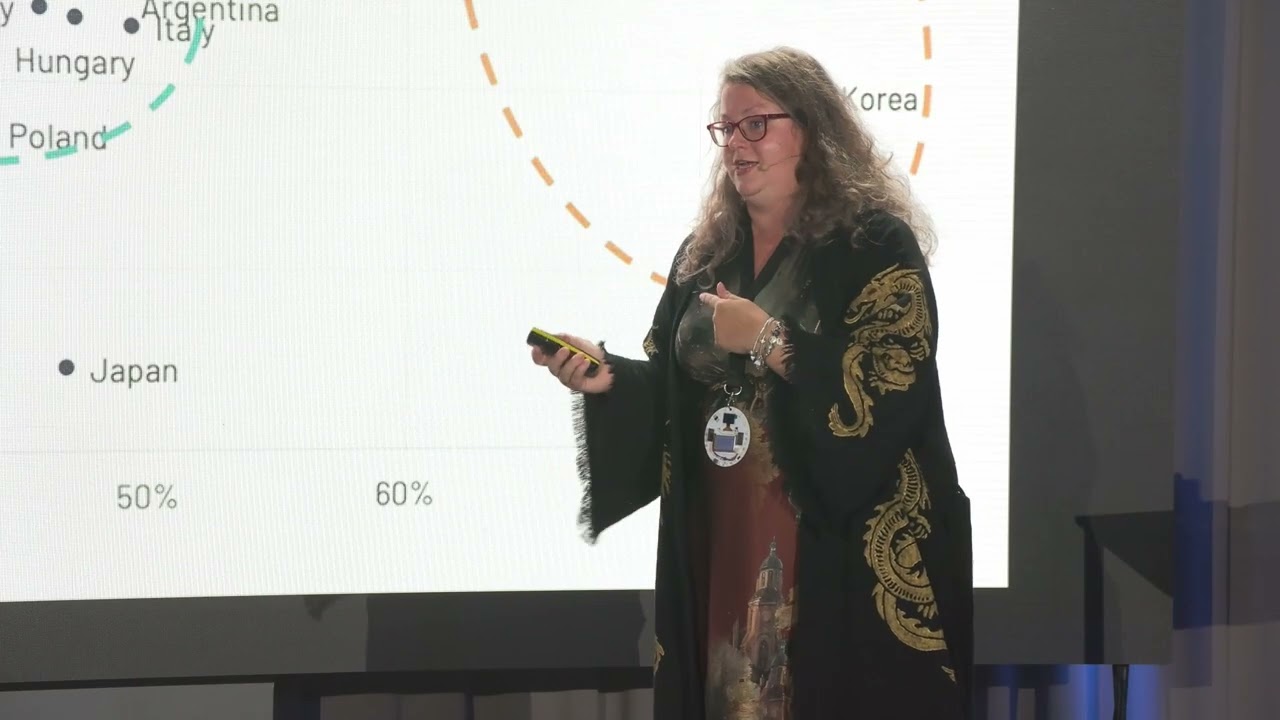
happening our product must be controlled outside of existing regulative mechanisms which basically means the companies have to exist outside of existing regulative mechanisms. So some research uh this is the map of AI anxiety. I have added QR codes. These are safe. This is not a test. These these bring you to the images so you can look at them later uh or or now because it's very small. So basically what you have is just the laser. No. Uh so you have Anglosphere Europe and then Asian and then here on the very bottom you have Japan clear outlier. So what this tells you is how nervous the society is and how excited they are. You can be both very
nervous and very excited or you can have everything very low. So we see a clear difference here right? Uh we see that uh angosphere and Europe are kind of similar in their uh attitudes. Asia is different, but you can also see that the Anglosphere tends to be more nervous. Now, let's look at the Englehart cultural map. My favorite. Uh, Estonia is up here. Uh, we are not Catholic. The color there is a Protestant, but we are quite close to Japan as well. So, what do you see? You see actually quite similar clouds, right? So the cultural backgrounds tend to be similar which means we have very similar approaches to society and as an effect also towards uh
the technology that we use. So here you can see like quite interesting things because if you start to look at the culture map and you start to correlate it with the attitudes towards for example AI you start to see overlapping mechanisms right uh what are they? So the first distinction uh that is used is collective versus individualistic societies. We are individualistic by the way. So collective societies have very different views and very different utilizations on technology. I think we all know the example of China where technology is used literally as a you know as a tool of oppression unfortunately often uh but people don't really oppose it because their entire goal is harmony so the balance of
society whereas individual cultures are more worried about their sort of like their own gain. So the adoption is normally more positive in for example Asian countries which is the case as well. So the adoption is far far quicker also probably because they're totalitarian so that helps with the speedy adoption but individualistic cultures tend to be more negative as a whole uh in their scenarios of adopting uh new uh new technologies. Then the second point individualistic cultures tend to be techno elitist. So this is a point very important to me personally uh and something that I always try to control myself about. When we talk about the global doom, what do we mean when we say
that AI is going to kill all humans? Every human including those like living in North Sentinel Islands. So we tend to kind of uh uh think very imperialistically technology- wise that every country is like a western country. Everybody uses Facebook. Everybody has internet. They don't. And so the basically the only way how to have any global effect would be the environmental uh effect of technology but not the technology uh itself and this is something uh that both the companies but also us me included do very often unfortunately. Uh another interesting thing is that individualistic cultures like us the western cultures actually tend to view technologies more mythically. So if you go to Asian cultures then they're very
rational. technology is a tool. We're using it for certain things, whatever we need to do. Uh but we tend to like uh mythologize them and collective cultures usually use the common good as the denominator, but individualistic uh talk about individual loss. So, you know, like the main story has been for the past thousand years that uh somebody's going to lose their job. You know, the wheel entered the game. Oh my god, we're going to lose uh we're going to lose the people carrying the boxes, right? So this has been ongoing for centuries. Uh but there is another darker and deeper effect to that and that is the effect of religion. So I don't mean faith, I mean
specifically religion. So we have this clearcut between Abrahamistic religions. So these are the Middle Eastern like Judaism Christianity Islam which are pretty much similar. Zoroastrinism for example very monotheistic very hierarch high hierarchical uh and animistic cultures such as Shinto Buddhism Japan uh and Estonia Estonia is also an animistic culture so they have a very very strict uh difference on how technologies are viewed so Abrahamistic talk about all of the biblical things apocalypse etc Greek mythology so Kronos was the one who you know who was scared that what he creates will overthrow him. So he killed his children just like we are scared that the robots that that we have created will come and kill us. And
then animistic cultures they rather have like avatars, cosmic balance, everything is sort of you know has to be in harmony and this is something that has been ongoing for thousands of years. It's not new but we are simply telling the same stories and attaching them uh to new pieces. So and I have also put a picture here. So this is Kronos. So he has also been pictured very differently uh throughout different centuries but the myth is the same. Uh so definitely check out Talos uh the the myth of Talos because he is literally the very first Sophia right? Uh so uh so this is something that has been ongoing uh for a long time. Why? Because we like to think
that everything is familiar. This is something that makes us feel good. We like belonging and humans like to anthropomorphize humanize. Uh so we do it with everything. Uh you all I believe you have seen the images from Mars where people are seeing the face in the sand etc. So we like to see humans we like to see patterns and we like to feel belonged or or belonging. So uh we tend to attribute humanlike feelings to a lot of things. And this is very common for example with pets you know uh like everybody who has a pet probably knows that you know your dog or your cat is your family member. You tend to sort of
read the emotions and all of that but that can also be very dangerous because certain signals are actually different between you know humans and dogs for example. So we tend to do that and it might be dangerous. It's especially dangerous when we start attributing these traits to software. Uh so there are very clear reasons why the companies want to do that. The companies want to build trust. They want you to buy it. They want you to use their product. Of course, it's cool, you know, to like uh talk to Alexa or Siri who are assistants or Claude, you know, like their personas, right? So you want to engage with them, you want to talk to them.
It's like creating this sort of relationship. Um and this is also not a new thing. uh so already in 1970s Drew McDermott he was writing to the researchers uh of cybernetics uh information science etc who were talking about artificial intelligence. So he named it wishful pneummonics. So he already then he said that people go crazy when they're researching things like that because they start to see humans where there are none. And of course, one of the most uh probably most famous uh thing is from 2022 uh Blake Lemony uh from Google. I bet you all remember that. So it was a Google engineer who suddenly said, "Oh my god, our model went conscious, you know, like
I'm, you know, I'm I'm speaking to him." And he even said that, "Oh, okay. Like the intelligence is at the level of like an 8-year-old child." Okay. Well, yeah. uh but it was very very famous because uh obviously the community attacked him. He lost his job and he had a very strong conviction. So it was not something that he was willing to let go. He literally believed that the model that he was developing lambda uh was conscious. And of course like the cool question here is what is consciousness right? But I'm not going to go into metaphysics right now. Maybe in the evening after you know maybe in the later hours of the party we
can talk about that. right now to focus on just the fact that we are talking about systems uh neural networks, machine learning, whatever, but they're still systems with, you know, creators and they're still software. They're not conscious beings. Very often when I talk about that, people say you're wrong because already touring was talking about, you know, like thinking and reasoning. It's not the creation of AI companies. It's not entirely true. Uh so Turing I hope everybody in this uh room knows who Touring is and he created imitation game exactly because of this reason. So he was the person who said okay uh I don't want to talk about thinking because we don't know what thinking is. It is impossible for us
today to define what thinking is. We can't define thinking. We can't define uh consciousness. Of course we don't know what mind is. We don't know where it comes from. We don't know how we work. We don't know how the brain works. So how can we attribute these traits to something that is machine-made? So uh Turing basically was of the idea uh that we have to take away thinking uh in the human sense away from the equation. So he said that if we only focus on calculations so at the time uh most of the computers and the view to computers was deterministic. So most of the machines at the time uh the physical machines of course but even conceptual
mach machines were deterministic. So he said if we want to compare humans and machines machines will always win. It's just a mathematical certainty because as the machines get better they will calculate better faster stronger and more than any human can. It is simply mathematics. So we can't really use that to compare them. However, what we can do, we can do imitation game, right? So, we can basically uh experiment with how it works. If we were to uh connect with a machine, are we then able to distinguish between those processes? There's another very important case study that I also recommend everybody to read or at least acquaint yourself with and it's called the Chinese room experiment by Sir I hope I pronounced
this right. So it's a very famous experiment from Stanford and the idea is simple. If there is a room and inside that room there is a person with a Chinese dictionary you know all the Chinese like every Chinese material that you can think of all the pictures of the letters all the dictionaries everything basically Google translate but in human form he's sitting in the room I am outside of the room and I wish to speak with somebody in the room I don't know what is in the room I just wish to do that and I do that in Chinese now when I do the input in Chinese. The person inside the room is going to, you
know, like see what I have written, take his dictionaries, take all of his letter pictures and all of that and compose a perfect reply in perfect Chinese and give it back to me. So I receive then output which is you know it's replying to me and it's in Chinese. But does the person inside the room understand Chinese? No. Simply has a dictionary. So this is called the Chinese room experiment and and it's used very often to illustrate that we tend to again like humanize and give AI certain attributes that it does not have. The second quote one of my favorites which um I wanted to actually maybe maybe this should be the only slide. Uh
so this is from Visenbomb uh very famous guy. So he developed Eliza in 1960s. Eliza was a chatbot. So like a glorified collection of if sentences basically. But he noticed something very weird. So people who would talk to Eliza, so people who would like use those if sentences went a bit crazy. So they started to actually communicate. they started to form attachments. They started to believe that Eliza was real, that there was something behind the code, you know, that they were actually talking to an entity rather like just experiencing a piece of computer code. So he said, "I had not realized that extremely short exposures to a relatively simple computer program could induce powerful delusional thinking in
quite normal people. Unfortunately, uh this is obviously something that we are experiencing in the security community pretty much every day. Uh there's even a name for that, AI psychosis. So, it's again feeding into the same instinct. We like things to be humanlike. We like to have friends. But there is something more toxic about the modern systems than Eliza ever was. Namely, Eliza was an if sentence compilation, right? Uh you say something, you get an answer back. So the effect of the answer is what made you know people kind of get attached. But how do large language models work? They're probability calculators basically right. So uh they try to estimate what would be the most probable
next well token but let's say word for simplicity sake. Uh so basically they just want to you know like uh provide the best answer but they want to provide the best answer for you which means that as yesterday's conversations uh very clearly pointed out they are yesmen simulators. So you constantly get this, you know, like this this boosting and uh very very agreeable communication back to yourself and this plays into your brain in a very very dangerous way because unfortunately uh Maslo was wrong. So Maslo pyramid is actually wrong. Uh your physical needs are not as important to your brain as the brain itself. And the most powerful drug for humans is belonging. So there is research, quite new research
that says that ostracism, so shunning people and like cutting them off and uh blocking blocking and ghosting them by the way as well causes um the same sensation as physical pain for your brain. Uh so now think about the past 20 years. What do we have? We have new social networks with likes, you know, which is like a clear doppamine hit. Uh we tend to use forums that now have, you know, like up votes, down votes. So everything we do is basically a dopamine machine to create this sense of belonging. You want to belong. It feels so good when somebody says you're right. I agree with you. You're great. Um and as Claude likes to say, right? Like uh
oh, thank you. Thank you for pointing that out. You're right. You know, I was wrong. I'm so sorry. So what happens here is that you get literally physically addicted. Uh but it's not the chatbot anymore. It's not just somebody somebody talking to you. you're not only getting answers now you are getting agreeable answers. Uh so there's there is there is literally uh an unlimited amount of this support. So of course it is affecting people in a bad way uh but why so uh we are talking a lot about uh like what it is but what does it actually cause? So humanizing uh AI and other technologies cause literal behavioral effects. So I see that a lot
uh like I'm doing advisory uh cyber security advisory and I see that already in the companies. So people are treating language models as colleagues. Well that's a good scenario. Sometimes they treat them as you know like friends or lovers. So what happens is we start to do a lot of bad stuff. We start to share data we're not supposed to share. We're starting to put uh documents, customer data, etc. into the model because you know like it's you know I'm like I'm getting help from a colleague this I'm not doing anything wrong. Uh why this works so well is because the companies also use a lot of this intimidating and mythological language best example of course mythas uh you
know this is like very clearly or uh anthropic uses a lot a lot of this masterpiece language like you know sonet etc. just like uh this brings into your mind Beethoven you know like this tortured artists who are creating these masterpieces it's just language model people you know uh and this in turn makes also the people generally more susceptible to malicious agents because you are already rewired you are sort of losing the uh the normal risk level that you have I see that every day so I see it a lot with people uh who are using a lot of language models because they already have a different way of interacting with machines. So you tend to have lower
guard uh and you tend to have uh a lot more risk there vulnerability towards disinformation. So models are wrong constantly wrong. Uh but models can be also wrong on purpose. So a lot of the times disinformation works like this. So um I'm doing like a narrative research how especially Russia is doing information operations simply feeding random facts. So you see that I hope you see that every day like uh there's this weird new thing appearing like one fact or one sentence and it's suddenly being flooded through like all social media platforms Reddit threads everywhere really weird things you know like um uh writing Talin with one N or like uh making sure that there are a lot of uh
uh photos of the of the Russian church in Talin for example. This was huge uh a couple of weeks ago. These messages are not meant for humans. These messages are meant for those machines because they train on this public data and then they start feeding the you know like the biased information. So the more that we use language models like this the more we actually create the vulnerability towards disinformation as well. And of course cognitive warfare. So uh if we are using language models we change the way that people interact. We're creating more vulnerabilities within the communities as well. We are changing the way that we interact with machines and we are creating a very good ground uh
for the use of cognitive warfare, information operations, destabilizing all of that. But there's also economic and legal consequences. I'm not talking about, you know, putting a wrong document into uh LLM and getting sued by your client. I'm talking about bigger things. Uh so why I started this with myths and particularly the AI apocalypse myth is because people are planning for this. It's not really an issue if one individual plans for the coming doom of robots killing us or AI killing us. It does become a problem when your military starts doing that. It does become a problem if your government takes a hundred million euros and puts it into you know protection for AI or education of AI or whatever has
happened. Uh snowballing collapse. So if we say do not study this, do not go to the university, do not prepare yourself for life where we need uh copywriters, artists, musicians, then guess what? People won't. So you are sort of snowballing the collapse by itself. It's becomes like a self-fulfilling prophecy. Uh large scale investments. So because you have this fight or flight, oh my god, AI is coming. Everybody must adopt it. Everybody must adopt it. It's another myth, right? So then companies and countries get into these places where they have to take investments. We have to build this data center. Let's just build it and let's deal with the consequences later. We don't need to do
any environmental analysis. None of that because we are in this fight or flight, right? This is the language that is used by these companies. And my personal favorite, the shifts of agency and liability. It's the data centers that are using the environment, not the people behind that. Right? And if we're using the uh LLMs particularly in work context we are already seeing that that people when they make mistakes are saying oh no no no but you know this is something that I read from this is this is something that my model fed me it was not me. So we have this very dangerous shift of liability and agency. It becomes a huge issue when this is
societywide or nationwide. So we can then face literal democratic fractures. Policy pressure is something that happens all the time also happens in Estonia maybe in your countries as well. So the companies are saying you know like we need to legislate this we need you know like better controls less controls more controls but we need policy that is directly created by companies. So in Estonia we have for example a council legislation fasttrack which is a council made up of companies who you know benefit obviously from it massively but they are sitting in the prime minister's office and saying what the legislation should be right uh same thing happens in US I bet it happens in several countries but these are fast
tracks for legislation saying that we don't have time for democracy like we don't have the time because you know AI is coming it's coming for us so we need to do it so this This is obviously another scare tactic to force us into these decision processes that are by default undemocratic you know unmandated undebated undemocratic and the final one uh this is language that is used extremely much specifically by open AI already for a decade it's the idea that large language models large language models you know pieces of software that calculate their mathematical map of language that somehow they are so powerful and so omnipotent that they are above the law. So they're called ungovernable
technologies. So this basically means that these companies have to have like special orders outside of the law, special councils, special legislation, special roles, special advisories. Uh and this is a real problem because the narrative right now is that we cannot we cannot regulate AI. It is impossible because the law is you know like so dated that it cannot uh take into account all of those amazing facts about uh a language model. It's not true uh because humanity has already done it. For example, one of the biggest scares probably collectively for humans uh was nuclear uh the threat of nuclear right in the 50s and 60s it was a huge thing. Entire world was scared. We managed to
create legislation for nuclear weapons and we can't regulate a chatbot. I mean it does not make sense. So is there anything we can actually do about it? I don't want to you know like cause depression. So uh George Orwell has said a beautiful sentence in a time of universal deceit telling the truth is a revolutionary act. So we as the security community uh we have the best chance of fighting back because there's the thing that has changed with the advent of large language models is that you no longer need computer. You no longer need us to interact with machines. Anybody can do that. You're a sizzo. You go and present your security plan to the CEO. He says
well but chat GPT told me that. Unfortunately it happens every day. So we actually do have the tools to talk both to the business side to talk to our peers to sort of have the deeper understanding of what's going on and simply tell the truth. So I put together like uh a couple of things that uh you know everybody can do to kind of like fight back uh for those narratives. And the first one is of course the simplest one. Use technical terms. Don't say AI or you know thinking reasoning whatever. Say large language models. Use it instead of she him you know like using the names etc. It's very hard. I do it myself as well all the time. Uh but
simply sticking to technical terms also takes the magic and the power out of it. Always avoid using marketing language of tech companies. So you know it was like very apparent uh with methus especially the launch of methus because it was also the security company who was feeding into these myths you know like oh my god everything is going to collapse uh you know we are on the cusp of another apocalypse I'm not sure which one that was so this kind of fear-mongering and the use of the same languages this is what feeds into the same narrative so there's also a way to look at it rationally you know I do risk assessment I teach risk assessment. I can go to
these sizos and tell them you know how to correctly assess risks without uh quoting the myths marketing pages. Uh so this is something that is uh you know like you always have to be very very careful of that. Avoid passive speech. Technology does not evolve. People develop technology. People are the ones who make choices. The owners, the business people, the developers, they're humans. Humans make choices. Humans have agency. not technology, not language models, none of that. So if we avoid passive speech, we're giving both the agency back, but we're also giving the liability back, which is sometimes even more important. Call for regulation, call for inquiry. Uh why are we doing that? Uh and this this is also inhouse,
right? So whenever you have this new uh AI initiative coming, you know, like everybody has to I don't even know what the what the what the latest uh examples are. uh it was popular to do like all minutes with um with co-pilot for example then ask why like what are we actually gaining uh in Olvar's keynote in the morning he had this beautiful example of uh doing like using €30,000 to gain uh four hours in one year so ask you know what are we winning like actually make the people who have made these choices actually be responsible for them educate the wider community educate your organizations tell them how AI usually works. Show them that large language models are
simply mathematical maps. Show it to them. Like literally examples of tokenization, etc. So it's not about creating conflict. It's not about creating cate. It's simply about educating and making sure that people know how the technology actually works so they can make educated choices. Question your own bias. And so I brought in the cultural differences so that you would understand that the myths and everything that we have been raised with affects a lot on how we think, how we, you know, think about technology. We tend to mythologize it because it's easier like that. We like these stories. So always when you say something like that or put a picture of a killer robot on a sticker, why if you had never seen
Terminator, would you still think that there's an evil robot coming to kill you? Um, Japan doesn't have apocalypse because they don't have a Bible. So, they don't know what apocalypse is. So, all of these things, this bias, it affects us. So, this is always a good idea to sort of question a little bit whether you're talking about your learned mythology or you're talking about the actual technology. Question your knowledge. Are you sure that you are talking about the right thing? Are you sure that when you are, you know, talking about the capabilities of the new model, are they real? Are you sure? Is there technical background to that? Is there any research? So for example, I
like to quote the 2025 paper from Google. So Google say I actually put out a paper that said large language models do not think. But I [laughter] don't know I don't know why uh people uh tend to ignore that. It was a really good paper. So it showed that even the reasoning models if you give them very very complex tasks they tend to break down but then they do not go back to the pre like they're then unable to uh also answer the easier questions which shows that you are breaking the calculation rather than you know like inquiring uh intelligent thought. Acknowledge the effect of all the myths they're existent in your company as well in your family
in your friends group. There are certain truths that we tell ourselves that are not necessarily real. It's okay to have myths. Myths are not bad, but you simply have to acknowledge them and understand where they come from. And the last be human. So this is I think maybe the most uh important one but also very complicated in the modern time. Um do things you know create art, write, go out with your friends, drink wine, be with each other. That's the best thing you can do to sort of fight back to the narratives that technology is here to kill us all because it's not. Thank you. [applause] >> That was really great. Thanks a lot. Um
and that really makes sense uh why you studied the fun fact dagri and Japanese culture and language. So question time anyone that side? Yeah.
>> Hello. Um, thank you for the the encouraging talk. Let's [laughter] say uh one question. Uh, what's your opinion on benchmarking and evaluation? How does that uh >> you mean specifically LLM? >> LLMs and how does that fit into all this marketing speech etc. >> Yeah. uh I think benchmarking is actually the positive example of that. So because it's a very technological kind of thing. So if it's done in a way that emphasizes the technological parts and for example computation capabilities, we're talking about tokens instead of you know like whatever uh they like to do then this is actually a positive thing and this is something that I would highly encourage. We talk about technology, we talk about software
so let's use technical terms. Uh so that's good but but of course unfortunately there are already examples when the benchmarking also has been faulty right so we're being shown capabilities that are actually not there or like one very good example of that was mathematics because >> like the bar exams and >> exactly exactly and I remember when uh um like when chat GPT I think came out with oh you know we can do math now no they can't because they're non-deterministic machines right so it like writes code it writes Python for itself and then Python like does the maths right so this is something that needs to be explained this is how the models work not that suddenly uh like
suddenly neural networks uh became able to do like deterministic maths right so again honesty yeah I hope I >> answered your question >> more questions we got one >> thank Thank you for the very good talk. Uh during the presentation you mentioned the situation where uh we often get into the positions where well but the chat GPT told me uh how to act and and fight against those situations. Ha. I have a very good I have a very good example for that because my friend uh pissed me off the other day uh by uh sending me uh a screenshot of Jachi BT like literally JBT told me that uh it was um uh I will
use an example like uh uh why is it bad to eat frozen blueberries? So there was like this beautiful explanation. So I gave up in trying to explain to him what is like bias and how do LLMs work. What I did was I sent him back, "Why is eating frozen blueberries good?" The perfect answer. A screenshot from JBT. And then he was like, "Oh, I see." So, you know, so, so, uh, so, so unfortunately, you know, you have to be a little bit uh, aggressive because you're forgetting one thing. If a CEO approaches a siz and tells that you know like I put your security plan into jet GPT and they told me that then it's not
only using an LLM that is bad but it is also you are undermining your colleague you are you know so this is like this is a real human issue so it is okay to also approach this as a human issue and say you know like this is my expertise you're hiring me as a human you know like so so yeah but but I mean there is no right or wrong answer here it's a really crappy situation and the people who do that are bad colleagues and bad bosses. So it needs to be definitely [gasps] approached. >> Thank you. >> More probably. Yes. I think we got no more questions. Thanks a lot for the amazing talk about
it. [applause]
Related talks
 42:54
 30:26
 39:37
 51:13
 1:03:25
 43:44