What Do The Jetsons, Cybersecurity, and Flying Cars Have In Common? - Illyana Mullins
Show transcript [en]
I'm wearing probably don't need to as I could just do this because I'm um so hi and welcome and reason um this talk type change I put it in pre talk yesterday so this is a brand new talk for me normally if you've seen me talking at any one of the number of events that I talk about it's norally about neurodiversity speaking community or culture um But I decided to do something a little bit different. Um, and this is kind of my Roman Empire. So, I love futurism. I love sci-fi. And what I wanted to do was kind of compare. So, this talk is about what do the Jetsons, Busted, and Thomas Edison have in common.
So, to begin with, my name is Iana. Um, I'm the person you can't get rid of in cyber security. I'm sorry. Uh, previously I was NBI Shelton and ran that for 3 years before handing it over this year. I ran Bristol cyber cluster for a year. Um, but mainly I am known for running the women in tech and cyber hub and not for profofit. Uh, in order to make money I also have two other things. I'm one of those people like many in cyber who might be a little bit neuroscy and have about 10 job titles. Pretty much what it boils down to is I talk about culture, community, and talking for the most part while also
consulting in society because it pays bills. So where does this start? So this actually starts in the world of tomorrow. And the world of tomorrow was an exhibit in the 1938 world fair. And this gets us started on where futurism came from. So futurism is the idea of innovation and what does new and exciting look like? It actually started back in the very early 20th century. In 199 is when the art movement started and along that came this philosophy around the art of possible. And so what I wanted to do today was talk about if we go back and we see all these things that they said were possible, what's come to fruition, what hasn't, what is very
quickly becoming the new norm and what does the future look like from there? Also, how has the cyber risk grown because of that? So, I've been to the year 3000 and not much has changed, but they went underwater. I think Boston did when they wrote that song realized that they were doing futurism. Turns out they were. We'll see if they're right. I don't think any of us will be around to see it. But things like futurism and the world expose and world fairs spawn things like the Jets. So, the World Exposition is exactly what it said like. starting at 1893 I think you had the first one and for the first kind of until 1930s so the first four 40
or so years with the world expositions or world fairs they were where you went to see the latest and greatest it's not like you could just turn on your iPhone and be like who did what did what did AI do this week or look at this fun piece of tech so things that you would have seen if you went to one of the royal exposition could have been the telephone, television, x-ray, my favorite catch. Uh, and those are the things that they were talking about. That sort of changed in the ones that were held in New York in either 1939 or 1964 where they kind of stopped focusing on the technology that was coming out and more started
looking at this art of possible. So General Motors in the 1930 91 created this futurama. It was this model city of what the future looked like. Pretty much you just put everything on an elevated platform, put some domes on a building and make everything a convertible. That was the version of the teacher. Um probably some more bubbles and I don't have a convertible yet so they didn't quite get it right. I don't think they were all that far from being wrong. especially when you're talking about things things in extension are now moving upwards instead of outwards. So I love using the Jetsons because the Jacksons was this really fanatical thing. This was so foreign fantasy. Now
does anybody know the first year that the Jetsons came out? It was 1962 and the year that they were depicting was2. We are closer to when the Jetsons was set to when it originally aired. There was also two seasons of 80s that I have to point out, but they didn't fit my narrative. But when you were talking about the Jetsons and these writers having this fantasy, they were talking about things like the dressatic, I still really like that. Although we are getting close as there's apps that can really cate categorize your wardrobe and pick outfits for you. You have things like the machine that just creates now it's nothing. Well, actually we're working on gra lab grown food. It's the
um oh the ch where he swallows this like camera in pill form. Actually they're doing that. So there are a lot of things that the starting to think about that weren't so far off what we have now. Now there's some that's a little bit more fun. So this is what would you would see when you went to the exo. This was the 1940s. This was the the fun things. The first two ones that I'm going to are the quotes. So what you have originally are these are my Thomases. Sorry if your name's Thomas. I'm about to threat like Tres because they're not. So right. So first one was the president I the idea. And in 1943 he said that there
was going to be room for exactly five computers. He could not imagine a world that would have more than five computers or the need for five computers. You then have the world's biggest control Thomas Edison and he went books will be obsolete in school. We're not there yet. I can kind of see the idea that you now have Kindles during co lessons online. So there is maybe not the most true like outlandish thing that you can do. Weather control, we can't do that yet despite claims in some America. Uh push button education, but actually the TV on your wrist, we don't have a TV, but we absolutely have calls. You have a ring that can monitor your health. So these
fantastical ideas that came out between pretty much 140 to 100 years ago aren't that old. These are things that people who are still alive would have been seeing in the change that they would have gone through and that change is ridiculously fast. How fast is fast? Well, terrifying is actually I think the answer. So the first thing that you should know is more. So I am going to do the absolute no no and read directly off the slide. So in 1965, so in the height of this futurism thing, uh Gordon Moore pretty much said made an observation that the number of trans um transistors in an integrated circuit doubles about every 2 years. Well, what does that mean? It's number
it's a graph. It looks pretty. It goes up. It proves my point. Those directly tie to advancements in digital electronics. So everything from the increase in memory capacity, the decrease in price, the number of pixels in your camera photos are directly tied to what this does. It also means and I'm going to actually use the thing that won't let me scroll because I love it bits. Well, that was just a big old spoiler is pretty much that we've been able to increase our storage by 200 or two billion I should say. Yeah, billion with the B. So, what does that actually look like? So, this is one of my favorite absolute in the world. So kind of the first
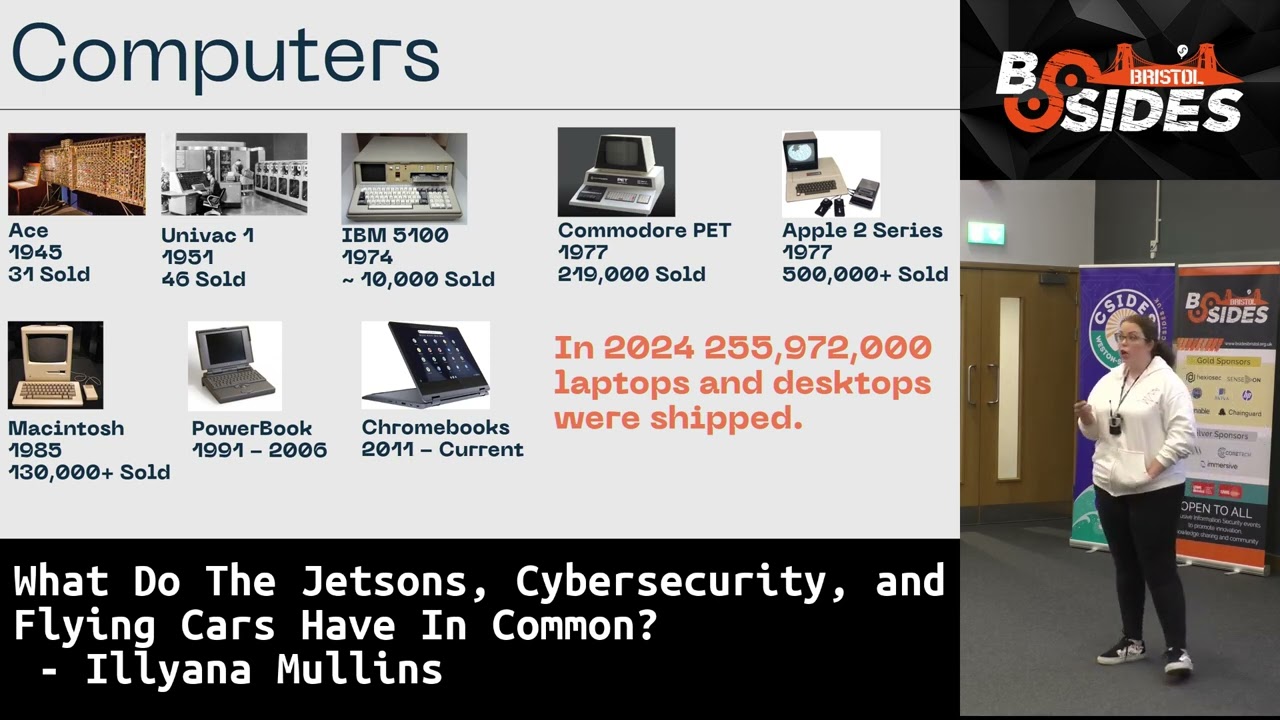
commercial uh storage uh large data storage I put large in quotes was 3.75 megabytes. In order to store that it had to be 5 ft tall 6 ft wide way over. It also cost if I were to translate that into inflation over $8,000 per month to lease. So, you're talking about a large area, a large amount of money, and now, well, you can buy it off of Amazon for less than £100, and it will be 4 TB. So, let's just be honest, a lot lot bigger. And instead of being 5t tall and 6 ft wide, I put it in my back pocket. And that was on to the rise of computers. This is probably my favorite thing. So,
let's remember the first Thomas who said that in 1943 that we would only ever have room for five computers. The first mass produced computer only 2 years later beat that figure by six times. So, it doesn't take long in this feed to vastly increase what was already predicted. And then you get, you know, in 1977 you sold 200,000. You then move on to 1985. It's a little bit of a weird one because then you have to say it's not as easy, but it combined. You still see the growth until you get to 2024 where 255 million either laptops or desktops were sold in a singular year. What does that translate to? It means that the first
billion computer sold and households was in uh 2002. The second billion total soul was in 2007. So it took 5 years to double what had taken the first pretty much 60 to get to. And these are just units sold in total um not per year etc. Um, and that's not even when we're talking about IoT and the rise of, you know, well, everything being a computer. Rosie Naruma, which might be my best slide title actually ever. Um, so the AJI hardware market is expected to sort to 18.8 billion by 2030. That is the most conservative number I could find. If you were in the talk earlier, you'll know that it's something around 30 billion devices that they're expecting.
But this isn't a thing that can necessarily be agreed upon. So I chose the absolute lowest one we could find. Um so in January 2019 2019, um to put this plainly, that translates to over 100 million Alexa being sold and that was 6 years ago on average currently. And this was a report from the consumer um association from last year. The average US household now has 21 connected devices. So what does all of that mean? It means that we're moving so fast we can't keep up. It also means that we don't know how to keep up and that even if we're keeping up that the amount of risk that we're facing is becoming exponential at
the same rate. So, uh, for example, that same consumer report found that the amount of IoT devices that you had in your home directly correlated with an increased amount of data breaches that you would be expected to find. So, it says if you had between 1 and 15, there was 11% chance that you would have been a victim of two two data breaches. Not sure why they were two, but they did. If you had more than 30 that's right 21 average which means that's just you know a nice middle number it meant that there was almost a one/3 chance that you would have been a victim of at least two data breaches once again not sure why they
used to that's what the report said trusting data speaking of data we're going to talk about the rise of risk. So the first thing when we're talking about risk and how fast we're moving, the first one we have to look at is people. And I don't mean people in the sense of people are this risk. I'm simply talking about people as a commodity. The number of people who currently have access to the internet now is first graph that you'll see where now over five billion people have access to the internet. That's an astonishing number. You then talk about co data generating data. Not only do you have more people who are going to be at risk because simply by
being online they exist and have an internet presence. You're talking about how much data we have on there. I'm going to say something probably a little dumb, a little controversial, but just going with the flow that the more data that there is, the more likely there's probably going to be a data that's breached because just you can't. If you have a hundred of something, it's a lot harder to defend than if you have one of something. I can keep one chicken in place. I can't necessarily, you know, keep a 100 chickens in place. At least not without fence and cyber security like you need to. Then you have AI. Sorry, you're not going to get out of
this talk without me. I'm only going to mention it briefly, but what I'm going to mention is that AI is lowering the entry level for malicious actors to zero. So, not only do you have more people online, you have more data online. And suddenly that fence that we're building for the chickens is really easy to climb over. Used to be 6 ft high. Now, I can type into an AI tool and it will create ladder sex tool. It literally just lets me walk right over it. And all I have to have is intent. I don't necessarily have to know a specific tool or methodology. I just need to go, hey, I think it would be fun
that how do I hack into Facebook and in theory AI can quite often deliver something that is at least somewhat usable as an exploit. You then have quantum computing. Quantum computing is our next level and we will touch on this in a little bit about what these future predictions are, but it is the current future and it is theorized to be able to break every known method of encryption hasn't quite been proven yet. But if all of a sudden all of those passwords and all that data that's encrypted, so that suddenly we've left the door open because we don't actually have lock anymore. And with that comes the cost. Everyone's a good IBM report. Uh but it does mean
that the cost of a rich in the last 6 years has gone up by 1 million uh dollars as America probably should still default to dollars. I don't it sounds but pretty much you're talking about a cost because people like us businesses like costs government like costs we like to know the money impact of it not the data impact but even that's growing and the thing is we don't quite know where that is. If we look at Mo's law it's not doubling anymore. It has decreased but it hasn't stopped. And part of that is because we're looking at new technology. We're no longer trying to improve on what we had. So why am I the culture community
specialist talking about this? Um and it's honestly because people are one of those days as I know we heard a lot. We heard it in yesterday's kind of opening. When we're looking at the diverse and when we're building the fence, it can be made more secure if you're looking at for problem solving more effective in a crisis management because at this point it's not if it's a when data will be breached userentric design. This data is being used by those humans whether that's to use analogy man and someone that you probably don't want just free range access that chicken needs to be a man um or just everybody else. We have to be thinking about how
we can make the design easy and intuitive because if it's not we won't use it. Watch the recording talk yesterday. business success because we all know the world is we live in a capitalist society. I'm not going to make any political comments but I will say that dollar figure that we were just talking about is what generates that's what makes people move. The economy is what drives change. So people drives that and that's what drives business success. Technology adoption if I can't get you to use the fence my data is just on there. I'm probably not best. Most of you saw me had a sticky note on my desktop with someone's VAT number and address on it cuz I was doing
an invoice and needed to copy and paste. Luckily, that's nothing too private. It's a company and it's all public data. But I probably read something sensitive down at some point that could have been seen on that sticky note. So, it's making it as easy as possible. Innovative thinking. The same people who are thinking about making flying cars are going to even ask people who think in the next security breakthrough are going to be behind the quantum research. Employee retention. That's a fun one. I'm not going to get into it. You guys know why employees are important. I hope so. Most of you are employees. And productivity. Community. I'll go really quickly to this. Why is community important and
what's it going to do to help stop or help combat the speed of technology and the speed of risk? You're sitting in it quite honestly. It's about the the sharing of data. It's about coming together and talking about it and why you're sitting here and listening to well maybe not my talk but most of the other ones that happen today. It's about creating support. So if I have a problem or I need help with my data that you are there that I can ask you for solutions because most of the people in this room are going to be smarter than me. That's just a fundamental fact. But where else can I come up and just
walk up to you and go what do you think about this? I'm introverted. I could do it online. I'm not going to. You also get validation. But my funnest part of this whole thing is if we've been moving this fast and to get us back on the topic that's not being viewed cultured but back to how fast we're moving is where people see next and this is more the technology side. So most of us the vast majority of us will continue working the same way we are but the jobs offer will be ones that haven't been invented yet. Uh one of the things on community slide that I just asked is reskilling. There is something to be
said that by 20 I think 35 is on the slide. Uh over 72 people uh 72% people will need to resill to say valid or current in the current job market. You also have the fun things like autonomous driving cars and smartphys that manage shelf life restocking and apps that help with recycling. I have bad news from people who thought that was going to be really innovative in 2015 and 2022. That was three years ago. Most of the things on that list exist. And then there was a future business tech. I like that because I think that article actually encapsulate in caps encapsules the actual futurism. The what if. The what if I think that
we've lost the plot of because what we have is moving so fast that it makes it almost impossible to have such trenuous ideas that they seem impossible. Now the jet was popular because the things like flying cars just seemed like this absolute dream, something that could never happen. Earlier this year, the FAA released their first license for a flying car for testing purposes. That's here and now. So when I talk about this future business, I think this is the what if that what does the future look like? The same attitude that we need to be taking into cyber security, the proactive, the what does amazing look like? Like what is the most outlandish idea that you can think of
that would seem silly if you put it out there? And how do we get there? Sweet things have like hyperloop tunnels or enable fashion worldwide travel. We like to see that one. How plausible that is. Who says Ionic eyes? Two space elevators. I think that will be interesting. I know the seed of construction in those contracts. We haven't started yet. So, I don't think we're going to get there in 2050. But these are the types of plausible like impausible fantastic ideas that actually I hope they prove me wrong. I hope that when I get to like 2050 that I'm able to be like, "Yeah, I was an idiot. I should have seen that coming." And that's it. It's a really quick fun
talk. Thank you for putting up with me.
It isive. I was like, "What?" Yeah. What I normally talk to people and community side of things. Thank you very much. If any of you have questions, I will give you a very loud opinion about it. Bruce, >> um, not so much question. One of the things that I've predicted for the forthcoming future is we will end up in a situation of post privacy because everybody's data will have been stolen or large portions of the population and we're going to have to manage our privacy in some and our identity in some other way because it will be out there and it will no longer be private. Obfestation >> actually love that you say that cuz I
don't think it's such a prediction. I had my first personal data breach back when I was 16. I fundamentally know that my data has been breached at least six times. My social security number is known as I know it is. So I have come to that full term of accepting that risk and just understanding that I know how to mitigate it. kind of like in your office if you know you have a vulnerability but you know that the risk and you can mitigate it it's there. So I do think you're absolutely right. It's something that will have. Same thing with things like deep fakes and AI and using fishing and it will exist. Your information's out
there. You could live in a box, but that's still highly unlikely. But I think it's a good picture and I think that's where cyber security will go in a in a very futuristic. >> It's um Australia, India, parts of America. um have had large quantities of the medical pushed out through recent world as well. >> Absolutely. >> Yes. >> Your prediction for 2050. >> 20. What's my prediction for? My dream prediction that we could be in some sort of version of Wall-E and I could just have one of those chairs and robots will be doing absolutely everything and I don't have to do anything. Uh realistically that's a lot harder from a technology point of view. I think
we'll be a lot more reliant on the technology that's there. I think things like AI, they've already started to show brain, right? That if you're doing that as they've already copying, you're losing the language skills. So that's a hard question for me to ask because I think there will also be a push against it. So if the push against it and we've gone back to paper and pen everything or the world powers of be have, you know, brought us back to the stone age, that's one thing. But if we're talking about technology, I think it'll be something so different that I couldn't imagine it. And that for me is awesome. I think we'll have flying cars.
Is there a house at >> um there was up at the top? >> Uh you mentioned there being there are multiple universities working on them. There's nothing that is currently functioning from a robotic sense. However, cornea transplants and actual physical eye to eye transplant have now almost been provided. So the answer is maybe not robotic sense but in a medical sense you can replace your eyes. >> We already have the force robotic eye. It's just not >> yes >> we can see some pixels and color is not usable. Um the other thing though is what we do have is I think sometimes you have to look at what things actually are. We also have now heads up displays.
We have things that help with your vision or you know do the termin that's not built into your eye. It's just built into your helmet. You have the exact functionality. So does that mean in 2050 that we've moved it and it's much smaller? The nice thing is is that technology has a historical tracking of innovation coming at smaller and smaller uh devices. Yeah, totally doable. >> Could it happen? Yes. >> What do you think is going to be the most important attribute for identification authentication? Guess if something I have seen my A that if it's my know what I've taken lots of selfies over my probably knows it already is going to be like the horizon of the
middle west like hold for identity discount and it just scans your generologist what do you think unless we're really innovative there's always going to be a work around for what we have is it going to be biometric MFA where I need my eye my finger my blood type could Could it be? Yes. Will it look at things like tidy patterns, personality? Maybe. Um, [Music] I think we'll be looking at just more lack of privacy. I think, which is not what anybody in this room wants to hear, but I also think that we'll be looking at physical storage. Again, I mean, we're already starting to see the move to into purely cloud-based. We're looking at hybrid onrem and cloud again,
which I think is great cuz only 10 years ago, we're like everything needs to be all on the cloud. Nothing can be and now we're like actually so I don't think we have that solution. That's why I like talking about this because I'm not going to be the smartest person who comes up with a solution for that. I'm kind of just one of the people who's along for the ride going, "Huh, this is cool, but also slightly terrifying." Um, I like the human aspect. I think what you'll see is a much more advanced. You'll start talking about integrated devices, aka it knows it's me because it's built into me, which is also slightly scary. Now, I'm not saying, you know, 100
years. We're talking like the bionic eyes. Well, if someone plucks out my bionic eye, I'm so sorry for the really graphic image. There's not much I can do, but I think there is always going to be we can put as many steps in place and they will start adapting with technology, but there's always going to be work around just might be going. >> Yes. Um, do you think with the rise of debates and things becoming less believable online that it might actually move that people just start investing more in in person communication and like losing trust with the online world and regaining more of the sense of like we need to just do things in person.
>> Just kind of like the what I said about businesses moving back to some long-term solutions. And I think we will see that on an individual basis of if I want verification, I walked to my CEO's office. I hate to be very bad news. I do think we will see the push back to office based work environments because of things like that. Um, >> being on social media, I mean, >> yeah, >> I don't think that there's a way to >> I think what we'll do, I know there's being research put in it and it's kind of they're looking into blockchain for is actually how do you authenticate the data? So, if I'm a news reporter and I'm
on air, what can we do to embed in the video behind the scenes that I can then go look for or prove is real? The problem is the second that we do that they'll figure out a way of closing that and it's going to be I think that's why I'm really struggling to have this one size fits all answer for what does security look like in 2050 what doesn't it's going to look like the constant race it has been until this point so we'll come up a way using blockchain to verify data pictures etc they'll find a way of doing it and then we'll be on to the next iteration of how do we verify
that data I think data verification is going to be one of the probably biggest up and coming and it already is space is innovation in the next 20 years because it will have to be or we will have no trust in what we're seeing what we're told and unfortunately personal opinion I don't think business can't run like that communities don't run like that there has to be an element of trust I need to trust the contract you sent me is actually the contract that I'm signing with your company truth There's nothing to worry about. >> Any other questions? Yes. >> This is going to sound like a joke. >> Are they ever going to make the world?
>> No. Well, what I mean by that is there are certain technologies that just in terms of advancements are those types of technologies just going to fizzle out of existence or do you think there will be iterative improvements? >> No, I think absolutely see where I seen it. There are very few fax machines. I think I know medical actually still uses it which kind of terrifies me. Of course you knew how I so but for the majority of people we're not going to have a vaccine. We don't have a beeper except for and I love how medical it's all medical who's really like but actually um for those of you who know know when you're talking about
the underground it was only until a few years ago that they got rid of all their like hard punch because of the testing processes. But the answer is it might take a very very long time because someone will always want to print something out. But over time you will see a decrease until it is obsolete. I would say overall a packaging is obsolete. Will we get to the point with printers? >> Yeah, you're already seeing docu sign the implications for grain around paper usage are still there. Even pension companies in finance who are the least so tempered to change are moving on to online signatures particularly also because of co so you're getting rid of
more and more of the poor things like printers because it's all official it's all online it's all about the oh I didn't even get to make my zeta the disab so um the graph back here way back here um that global data is done in pabytes which is a pabyte but much much much much bigger. Uh there's actually currently like three other measurements bigger than that that aren't being used. Most of them I can't pronounce and but they have been created. They're not just a standard like this is we kind of gone past the what we already had being made. They are pretty much made up keyboardes. Um because we know that we're going to
hit that amount of data usage. It starts the big one's talking about it starts with the G and I'm not even going to try. Um sorry. Anything else? >> Once uh computer interfaces are function as expected when you Yes, if I could just have an interface that gave me like all the memories in my inbox and my calendar that I could like not double book. Um, would I have it all? Absolutely. Would I also still not use it like any of my other devices? Probably. And forget I can do it. Yeah. Um, but I think would I be the first doctor? No. No. I I'm a slow I'm slow on adopting anything although I have a smart washer
so there is that um you relationship between community and futurism it seems to me there are two important pillars of your talk but I guess historically futurism is like eradicated
>> I think you really work on any communities will have to adapt but communities are still there. You have online communities now. Communities move to Facebook. Um you have entire companies who have community managers have online presence on things like Reddit or have Discord service. So you are moving communities online. I think we are already taking a push back into a more human center based community preference. And I say that because we are sat in the community event. >> I think it makes it easier to connect. I think if you were to talk about it, uh actually I have a really really good example of this. My mom met my dad playing Neverwood Nights when it was on.
Their long-distance relationship was done through dialup and really really expensive calls. So they talk like 15 minutes a day and I know what you're saying but community is a relationship to people. My whole business relationship I got Skype. You then talk about bigger communities and you're talking about businesses who had work fully remotely online. So technology is actually a really good connector of people and communities are simply a connection of people based off of a shared interest in something. Uh so it could be cyber security. We're in a community of cyber security professionals right now. It's an event run by community for the community. You could have a community that based off of location. So you know
your community hall and your village is based off of a community that is pretty much no different than the cyber community at the core function of what the communities do which is connect people. Where's futurism fit in that? It's simply the ability to connect people. The world exposed because it brought a whole lot of people together to talk about what future looked like. So there was an entire community built around these expositions and these fairs where people would meet particularly in the 1930s historically. It was the thing to be at. You're talking about like you were not anyone. They had like social walls that were tied to this day. So the elite elite all the way down to just the
people who were like learning about technology and so forth get in. So I think when you're talking, you know, what does 2050 community look like? virtual uh you have meta and the space and you know creating I don't think that will actually take off as much as people think but people will adapt but I actually think what you'll find is this will still be around you'll still do conferences you'll still be able to then create the connection you can have physical book I love this you can have a physical book club that your coffee shop or you can have an entire platform that makes no money literally hosting online. So I think all it's going to do is sorry this was a
really long rambling answer to get the fact that I think futurism is just going to give communities different and better ways to meet. I don't think it's going to create a downfall of communities. I just think it's going to make a more accessible example in my mind story like deeper root is futurism >> and one community that the futurism like it becomes very big and stronger like get this adaptation just joining the team. I'll take that one offline because there's a camera there that I know is recording and it gets really political my answer to that because I think you're wrong. I think that larger access to communities and larger access data and thought can be detrimental aka you have
to fit in with this or carry the last person in the room start to win mentality. Not sure who I'm thinking of what country at the moment, but I think there is a danger of it. But I actually think that that's why the push back into the physical will be just as important. >> Yes, Kyle. >> What's your favorite world invention of it? >> Ketchup. It's ketchup. Why do you think I included ketchup on a technology slide? >> Um, yes. I'm logging the for which one I used. But if I'm honest, um, if this seems a little bit rambly, like I had to practice it, I did this talk originally a year and a half ago. It was
a 15-minute talk before I sat in front of wife giving a talk about Lazarus ice and I was filler. Uh Hazel contacted me about 11:00 p.m. on Thursday night when we had drop out. Can you do a talk? I like here's something that I can do. And she picked this one. And so I picked about 10 minutes before I did this. It is still a huge passion of mine. I love looking at that. But um I do actually speak in cocaine. So it's a little as you would think, but yeah, that would be really slowly one more. >> Yeah. What are you speaking? I know. I saw Stacy. >> It does make the question in future
events that are physical, we'll all just send ourselves versus virtual events are AI. [Music] >> So, you're not particularly wrong. That's almost already happening. So Lisa Ventura does a cyber networking event that's completely done in an online platform where you have it's not in VR yet but it absolutely is set you have your person it kind of second yeah so you have things that are already starting to do that um I don't think we'll ever get to the point where we're only selling sending our own and I say that because even the most introverted People tend to want human contact. I may never want to go into the office, but I love coming to events like
this because I disconnect. >> I think but I do think that fundamentally from a psychological standpoint, people want to connect with other people. There is a human element. Even if you don't like hugs, you kind of crave. >> I agree. Uh I am Oh, >> I'm okay with that. Uh I will be around for the rest of the streaming and
Related talks
 29:58
 40:39
 38:31
 36:39
 42:55
 18:33