Implementing privacy and democratic digitalisation strategies for education and other institutions
Show transcript [en]
i think we see only one corner i feel i mean it's uh it's split actually i can see one part of these lights yeah now yeah now i can see all of that yeah that's perfect oh so ha okay so so now you see the slides right i see yeah i see the exact slide yeah now i can see them perfectly hey let's go for it go for it so you don't see me that's a
okay let's go for it but uh so hello everybody i am uh uh i think it was not i would speak in creative english so please let me know if you don't understand what i'm saying uh and i hope we have some time at the end to to talk uh i i really don't know what i'm doing here in the sense that they have a huge admiration for your crowd i i am founder of an organization of digital right in spain pretty known is called x-net we are hanging around since 2008 but i am not technologist at all in fact i uh in my group i am used as a beta tester uh so that uh
when when they want to test some technology and see if it's user-friendly for very bad skilled user they ask me so uh but i think what they want me to the reason why the friend of the organization want me to be here is because we are trying with xnet to lead a project in the school so i think there is much that we can bring as the user of you all do and uh very much what is needed for the institution to understand in order in order to not make very bad mistake in policymaking on this i i am pretty skilled i i am 40-year activist uh i'm doing active in since 40 years so
i've tried to um to have conversation with many many institutions and in this moment we are having a project we create we dixnet plan which is called the plan for democratic digitalization because we were approached in 2019 by a group of families of mothers and fathers of kids in in school pretty small kids 9 4 4 5 6 10 years old that they were um this is was even before the covet they they were they in school they asked uh them to to sign the authorization uh for their scholarization by using completely only [Music] some of the big tech suite for for education and some family that didn't want to sign because they had uh some
uh problem with the the privacy politics or the danger of what it can mean that you have all that your digitalization in uh in a cloud that is not sovereign that the the school doesn't control et cetera et cetera uh was worrying for them and uh but if they didn't sign uh the other alternative was for the kid to to just be excluded from from the activity in the class so we saw that there is uh no alternative at the moment in school this uh plan and uh is uh is created for catalonia because in spain the competency on education are regional for for the autonomia so this is the design for catalonia but we of course
now know pretty a lot about the subject and we know that in spain is the same but not only in spain also in europe and probably not only in europe now our research just reached reaches europe but i'm pretty sure uh that the situation is not only in in europe so uh our essential public services like education or uh health even the world the whole administration are uh done are left uh they are not digitalized in in a particular way they are our uh government are just not uh not busy with the business of doing nothing about the digitalization of the structure so this huge gap left in the digitalization of societies by the the lack of duty of care of the
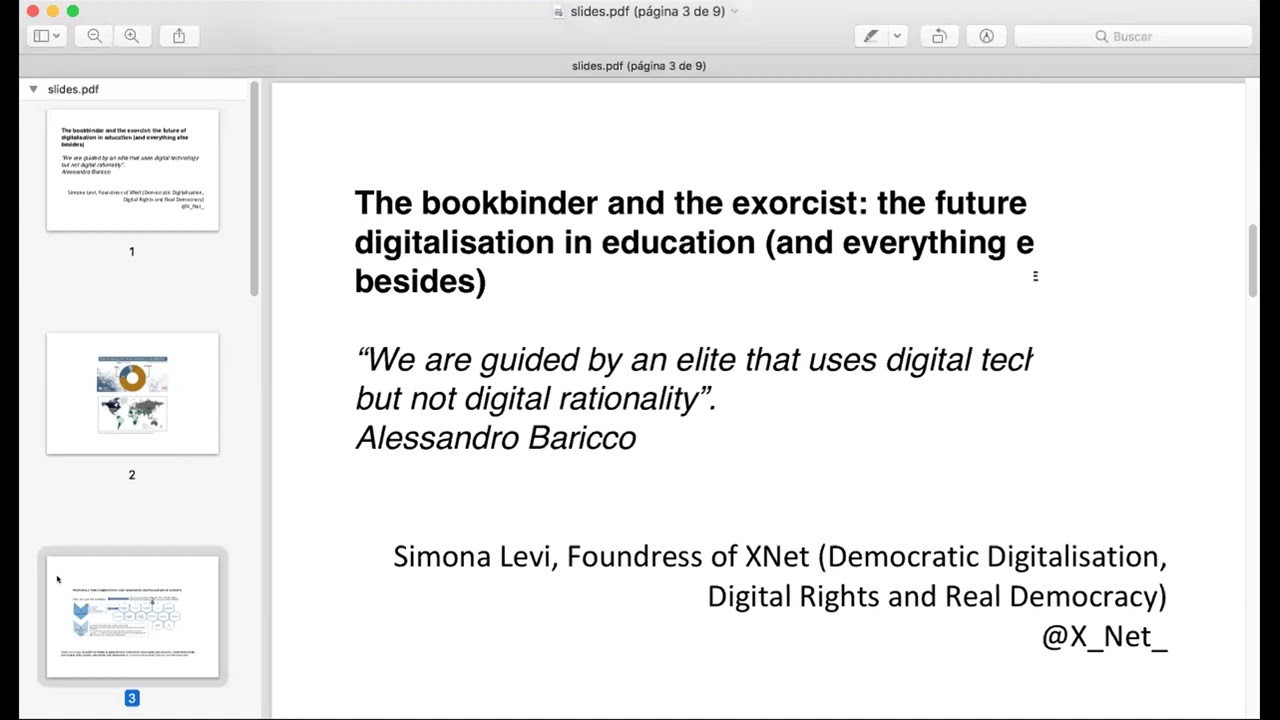
institution left the door open of the digitalization completely designed on on idea of corporate profit which i am in favor so i mean corporation enterprises small big or huge are doing their job they look for a place where they can have a business and they do the business the problem what i'm criticizing here is the lack of uh of uh uh duty of care from the institutions this is why my um my talk uh man my the title of my talk is just mentioning uh a line that i like very much from an author which is uh alejandro barrico say that we are guided by an elite that use digital technology but not digital rationality and when i give this talk
then i have a long explanation on what i mean by uh digital uh rationality and but today i really don't think i have to do this part of the talk because i'm sure we all share this idea that the network activity uh bring to this intermediation bring to uh a way of means of transparency and to reading the governance which are much more not only efficient but democratic in the very sense of the etymology which is uh the people having the authority um but so what what is more interesting that may be for for the community that you represent uh what i think is more uh important is a bit to ask for your help in fact because as i
say really much of admiration of all the work and i would like to have a little of all the skills you have uh so a bit sharing with you the the surrounding in which the digitalization is happening uh as in in the policy making field as a digital right activist as a citizen that want that the digital age is an age of democracy and and not the opposite way around um in in in this context i um i think we can divide the the way of how we see it in into in two parts um just a second i skip this this part so what i'd like to um what i'm trying to to explain uh we
have designed around this uh project as i was explaining this plan which is called the plan for democratic digitalization and from this plan we have produced a prototype i will tell you after but this uh um what i'm trying to to explain to the policy makers is that when they now the digitalization since you have the next generation money and all these certainly our governments uh uh see that there is a digitalization going on especially the covet have helped them to see but of course digitalization is already going on for half a century and uh and digital the internet is not what what they know now is now is uh uh uh we got fun is not the internet we know
that gaffer is not the internet but often policy makers since they do policy viagra fans or or similar entities they think that this is the internet and this is very dangerous because all other possibilities for they cannot imagine they don't know that there is something there is real life uh behind that no it's like imagining the public uh the public space as a big like like in the novel knows no crash as is if the public space was just uh parcel that belongs to one or or or or very few big company and we all are clients in each part of our life of this company and we know that the internet is not this but the policy maker they don't
know so what it is for me important and i'd like you all to help me and to bring around this hema that i just uh when whenever you have the occasion to use a essential service or to or to have contact with the the responsible for this digitalization of societies that uh we um and i imagine the the digitalization of society as e-participation which is okay i'm not against e-participation but this idea that we we we push all the people doing um [Music] what we in exnet we call it occupational digital so we we keep them busy with blinking useless um think of participation that will not be taken in account without learning anything of
the communities that they they are they are get all organized for a long long time the unlike communities uh having learned nothing about the hacker philosophy or not even even heard about etc and um and so or media literacy because now this information is because of the internet instead of understanding that this information is because before they had the the monopoly of manipulation of the information and the propaganda and now this monopolies is uh broken by uh this internet system which permit a better surveillance and other sources of information etc etc but a part of this they already does they already do this pretty [Music] not well but they don't know that before uh all this there is digitalization itself
which is which tools do we use while no you know is it possible that our calendar of our health the the health system calendar with all our private private data on health for example covet etc is linked directly to a google calendar what kind of policy is behind this why they don't ask themselves how such huge services that in the case of education is is providing in education uh we have uh uh in catalonia only in catalonia one million and only from for public education one million students so why in the politics is not ask how we can be possible that a corporation which is so a for-profit company is uh interest in giving us for free the
digitalization of one million persons kids right so it is important that we force we actively demand for a digitalization that has privacy but not only privacy interoperability sovereignty of data invaluability of communication we all use gmail so which is uh you know kids having gmail with four years old and being captive of a a concrete type of email services for probably all their life uh net neutrality of course the auditability of the code uh etc etc freedom of expression etc that we have to rebuild the digitalization of our society on tools that have the security of course but this is a field that i leave it up to you because i'm not very good at it
but uh they are very worried on security so this is this is okay this is a good news this is the part of the story that they have understood but all the other elements security is not enough we need society that also are beneficial with all this by default and by decide that design rights um the situation is um so okay i go back for to uh um to our own prototype so we do a design of something in fact it's it's pretty simple what we propose uh is basically to uh to have a sovereign digitalization which consists in using first of all servers that you control and servers that are respecting the relation between them
and the client and the client shouldn't be the state the client should be their client so in this case the schools or the hospital or me and you so we we propose to change the servers that some servers that if they resi receive a requirement from from the from the authority will inform the client because they consider the people as the smallest unit of democracy the client and not only the authority the client uh and and then the other idea is to is is something absolutely obvious is to create to use open source software so that they can be distributedly auditable in school but to uh to solve the problem that because this is we didn't invent of course
always we had in school also the possibility to have open source of course but the problem is that people don't adopt it because of a lack of usability and because what this the big tech have done with the suite is that they have aggregate all the tools which for someone that doesn't know anything about digital and doesn't want to know anything about digital because he's busy with other fights which is not the digital make them the life too difficult so they will for for sure use so the thing is to force institution that up till now they were leaving leaving blank field with just by retreating themselves like in the fight and leaving the space
to big text to occupy the spaces and be taking it because it's their business and they are right in doing that so uh asking uh uh asking uh institutions to take the resp their responsibility because if not i don't know why we we paid them the uh the their their daily their their monthly money um to give to option that have the design by default and of sovereignty by defaulty by design to inverse in code already existing open source code already existing such as let's cloud moodle ether path blue bottom gypsy blah blah blah blah and to aggregate in the in one only suite but i don't want to speak with you of technicality because you beat me um
i'm sure with i i cannot even ask most of your questions so we are basically creating a suite only with traceable and only in uh very consolidate open source tools uh is constituted by by blocks that can be an end a big part on interoperability with other tools both with the open source or private uh source code so interoperability is also very important because many of the format that they have they create in the school then they cannot anymore recuperated for example a google site or for example we have seen now that a lot of classes are are completely built and teached with the google site which is great but you can't it's it's not in interoperable
format so you cannot bring all your work as a teacher for example or a student somewhere else if you decide that you don't like anymore this provider so with this we have done a prototype it's already functioning in in three school in barcelona we had this we tried to add the support of the catalan government but we we didn't get it at the moment they should be responsible for education but they are not very much interested in this story but maybe they change your mind because the one that we are uh prototyping in barcelona it's working very well uh it's only three school but we have already other 15 asking in barcelona only and we have not yet
done a big big propaganda and other 40 asking for all catalonia and i'm sure that this prototype which will be of course open source etc and it's already online um will it is shareable for many other situation and many other not only education in many many other places and countries and but also in other fields like administration help etc so uh but and now i am i want to just to finish go to another piece so from from prototyping so we we did a plan then we did a prototype and we tried to install and we installed a prototype and and check how it works uh and from this experience we have learned many other things
which i just want to share with you a couple of them because they are related to the market and to the fact that the talent that you have that i'm sure a lot of you are there is not used for this because what we propose is exactly that institution put money in consolidate a code that by being open source can be grabbed and of course i don't need to explain you that can you can be grabbed and used for many many other uh situation and this is this big inversion uh should go to a very distributed talent not too big conglomerate you while i'm explaining this the catalonia is renewing all is digital technology is elicitation of uh
i think i'm not sure if you are recording i am a bit afraid of saying numbers and then be sued but uh a big number let's say 6-0 and then before the six zero i would say other three more zero right to digitalize in the next between two and six years no more again all catalonia and this is not split in in loads smaller than the smallest i think is around 60 millions and you cannot reach it i suppose because you have to be a real ability enough to if something go wrong to give back 60 million so i'm sure that most of you cannot compete there and so by seeing this because we have a
prototype we have a prototype that works we have school that wanting it a prototype with the sovereignty uh of the crowd education in the center everybody can audit control et cetera et cetera using open source everybody happy but to reply if they block us if the institution doesn't want to put money in this it's very difficult that we can compete with the other model right and uh and we don't want to beat the other model by prohibition we just want to beat it because slowly but surely people start understanding that privacy is as important and freedom of speech you can or you can decide you to never use it but the one day that you need it you
need it to be in to everything sure so to end up i just want to say that this graphics so so seeing that was very difficult to involve all the digital talent and capacity to build this other alternative with sovereignty in the center because the money doesn't reach the small unit like you are your expertise your great expertise uh et cetera et cetera so we start studying and seeing if and i'm sorry for the people that they are not here from the eu because our study is related to the european union but i hope this could be useful for you to repea reproduce in your context but the study is on the european union so so we we thought that uh the european
union was pro-monopole i mean it is from monopoly monopolies but uh the legislation there was craft in a way to make this very difficult and we discovered that not at all that in europe you have to know that the legislation protect us the citizen in order that small unit could be part of these big budgets so if it's not europe we thought oh my god so then it's spain but it is not spain it is not spain because uh the the regulation on how to prepare legislation coming from this um uh directive european directive um it's good also permit participation in fact those regulations not only the european regulation not only permit small and medium and very small
micro enterprise to participate but it is compulsory so our governments should split all the elicitation in very very small lots in order so that it can be more distributed but this is are the graphics from the from the you so i'm it's not from some radical activist these are the graphics showing the situation in europe basically no country reached the the 50 of small and medium enterprise uh participation in in any this is not only in digital and uh so we are in our right to complain to start pushing institution in order that they change their elicitation because i even think that we could go through some tribunal to try to shift this situation i just say this because
we need all your talent involved in democratic digitalization because the digitalization that is going on will not be democratic this is the situation uh shared by by our camera the from the corporate europe and um and lobby control very nice people working on analyzing uh all this we are part of the network with them also and this is the situation the actual situation on digitalization these are the meeting of the european commission as you can see the people defending the digital right are not the the major um interlocutors um uh stakeholders for for this business for this uh matter for the european commission and uh the situation is a situation of a huge dependency on non-sovereign solutions
uh and uh i think we there is the condition for all of us to ask for the right and to grab the right and to and to be part of the digitalization of the institution and essential services that is going on and that we need to have this information they just passed to you in order to defend our position and slowly but truly occupying those spaces so that the digitalization the the digital transition as they call it because they just arrived uh is happening in a democratic and sovereign way sovereign for us each of us the people thank you great thank you very much simona um if there is any question again you can write that in the q a here in slack
we're going to take a look and uh and share you know with that with her uh katana will actually take a look and and you know um share those with us uh while we wait for people again first and foremost thank you very much i mean your research is always very interesting and that's one of the reasons why we also wanted to have you here we feel like again security but also you know privacy it's a big part of who we are and and although definitely we do specify we do go very specific in cyber security we also have uh you know a high for everything that comes down to uh privacy open source and we also feel like it's
very um actual uh especially after the pandemic the the topic of digitalization of institutions and we do share you know the division that you have that it's something is a process that has to be done needs to be done more carefully that has been done in the past yes i sorry sorry i interrupted you because i didn't speak about privacy at all uh because i i know that you yeah this crowd is a crowd that is of privacy and digital right defenders but of course the core of what i'm saying is about defending our basic right but i didn't enter because you know even more than me how all this is about no absolutely no absolutely again we do
believe that privacy is one of those right fundamental rights and especially i was very struck about the percentage one of the few slides that you showed us that basically said 92 of you know all data is in the u.s uh i know this quite a lot but i was just even thinking about the percentage of people using internet we should be more or less the same between europe and and us but that our data is over there um so let's see if there is any question over there uh let's give me one second oh yeah okay no it's just someone who basically thanks you for you know sharing this information and basically putting the point on how important it is
to you know have data sovereignty actually um i don't know i do have a question though i mean so we have some more time for people to to come up with some questions and i think he starts back to the at the beginning whereas your presentation when you think when you were mentioning about the policy makers that basically they don't know better right they don't know how to do they don't know how what they are doing basically and what they are doing um do you feel that perhaps these issues that we are having these contrasts we are having comes from stem from the fact that perhaps those policy makers they are how can i say born outside of the
digital revolution and they are actually seen as an external actor rather than for example people of a different i guess generation or age that actually are more into technology and and in general digital do you think that it could be one of the reason or no they are born out of the world so there is no no any there is no it's not the sector real is not no but you know i really believe very much on what mr sturgeon was saying that the 90 of everything is junk so uh and this is for me the only law i really believe in is this one the sturgeon law ninety percent of everything is junk so
uh uh i'm sure that this ten percent of good policy maker will permit me to say that uh which are very good people struggling that the 90 of so that policy making especially now because it's based on a structure that is pre-digital as a structure so the political party behave still if their mediation would never happen so before we need our representatives to go inside of the parliament and then they come out and they tell us what was happening inside but now with the camera we can say see it all day so they they still behave like political party were never been disintermediate like the media like like uh the the creative uh uh industry
they are just protecting a status quo which is the monopole of the power between uh their to be the intermediary between us the people and the mechanism of governance but they are wrong because they are they are just so they are just defending their place so i am speaking with politicians since 40 years and except this 10 percent what you find in front of yourself is someone that doesn't want to move is someone scared of everything because if every moves something could change and somebody could get annoyed so um the the governance structure that we have up till now is a structure that bring us to fascism because in a situation of very uh big economical difficulties
uh to not fixing things it just bring people to get desperate and taking extreme desperate solutions so this is why it's so important that us the people that we have i myself have learned many of you have born like this that you understand what is this intermediation what is a fast communication in a network what is a forking by by keeping an eye on another what another node does but without needing to be all together everywhere all the time but we can cooperate in a fast agile way we try to transfer this way of governance in all the spaces of governments we have from our families to the school to wherever to our workplace to our
hobbies or whatever we do because it's a matter of the future democracy which only can be a network democracy copying the structure of the internet or fascism so i don't think that we have any other alternative okay yeah thank you very much yes simona absolutely i don't see that we have any more questions so i would thank you again and really appreciate your your uh your keynote um for the our attendees we're gonna have 15 minutes break then we're gonna meet up again at for a quarter past four for our next talk again thank you simona and hope to see you again here in barcelona are you still in barcelona yes i think i know you
we met once we just arrived in barcelona exactly five years ago okay so let's do it again five years old enough to do it again absolutely we should have made up absolutely and we will definitely do it so we can discuss these topics more in that okay again thank you very much
Related talks
 25:47
25:47 41:42
41:42 43:16
43:16 30:15
30:15 34:01
34:01 35:21
35:21