CFPs 101 - Tottenkoph, Guy McDudefella, Security Moey, David Mortman
Show transcript [en]
improving grounds I'd like to start by thanking our sponsors verse right pertivity tenable Amazon and source of knowledge I'm not clapping for tenable I will that's why I'm sitting in the middle so as guy guy dude guy mcdude fella guide mcdude fella has said um we're going to be recording this talk and uh I'm going to be running the mic so just please wait for the mic before you ask your question so have you ever wondered why call for paper reviewers drink so much are you tired of having talks rejected from conferences without knowing why would you like to know what really makes reviewers happy or irritated we'll stick around for our next panel on call
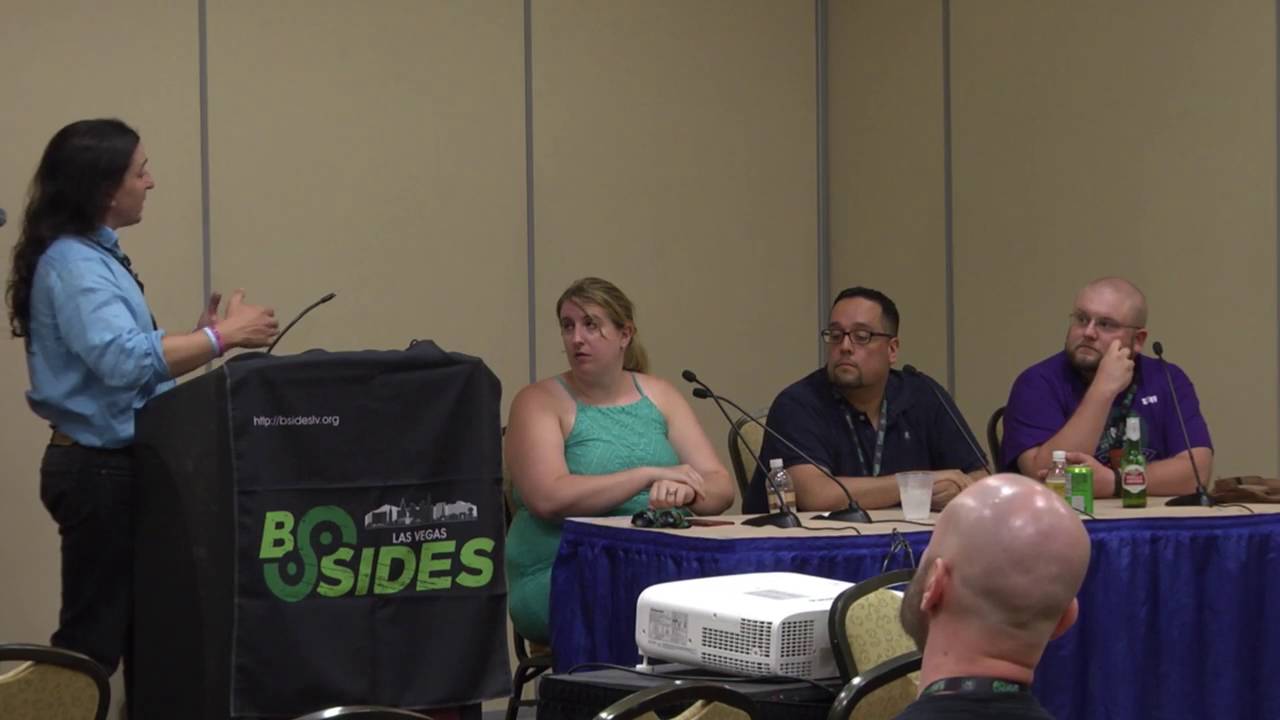
for papers 101 so please join me in welcoming the panelists so we're going to start out with introductions right all great okay hi everyone I'm David I'm your Earth while moderator today uh otherwise known as David of the plan cfp oh hi I'm Megan Toten cof uh I'm a senior security analyst with uh or consultant with rapid 7 uh my name is moy I avoid work on a regular basis so I'm in management guy mcdude fella I am a compliance audit research engineer for tenable network security which is way better than rapid
n um so really quickly David before we get started and all honestly and I was giving Eric a little bit of a hard time earlier I think there's going to be two types of people in the room right now either one people who are part of cfp review boards this is why we don't take you places you're not my real dad um either people who are part of cfp review boards and want to make make a comment or something and we we want this to be conversational this is bsides afterward uh overall and then um also people who have active questions so um if you do have a question at any time feel free to interrupt us raise your
hand Eric will run over there with the mic and uh uh give it to you and we could we could talk about it sorry about that so I mean actually I want to touch on that a little more so I mean ostensively this was about you know how cfp works and how to get your talk accepted but if you have questions like Mo said about you know you're on a cfp committee and you're trying to figure out you know how do you decide what talks to accept or not accept or how do you figure out that criteria things like that please you know feel free to ask those questions as well we're we're very very agnostic as long as it has
something to do with acfd uh we're good why do I have two oh two two two token
cups oh yeah okay so I think I'm going to start just so we were discussing this earlier uh and the first rule which is actually also the second rule for cfps is follow the directions and follow the directions so there were a couple of of submissions that we received this year that felt that some of our um fields in open comp were optional if we put something there we want you to respond we want you to give us that information don't just give us a couple line blurb for your abstract and think it's sufficient for your outline as well cuz it's not uh right if they ask for x y and z give them X Y and Z don't add anything
um don't feel like Z is optional uh if there's a you know a 2,000w limit in the field try to use as much of that as possible what you want to make sure you do is you're conveying your thoughts clearly uh and but more importantly you know how to follow instructions this is your first introduction to the con overall so you want them to know yeah working with me is going to be a positive experience cuz they're putting some trust in you and and if if you're if the con if the the cfp instructions are things like new talks only don't submit the talk you gave at at bsides Ontario if if it's calling for new
speakers don't submit the talk you gave at Defcon you're not a new speaker there are instructions there there are the cfp committee is looking for certain certain types of talks for certain tracks of the conference and going against that isn't going to win you any favors and also just a little bit about that so with the Proving Grounds track in particular we ask for new speakers only and it's a little cloudy because we have to do the announcement via Twitter what does that mean so we say no national conferences things like Devcon um Derby con Shmo con besides Las Vegas and besides San Francisco are included in that as well but if you've spoken at another Regional Conference
like uh one of the smaller sides or another um Regional Conference that wasn't recorded you're still um applicable to apply for Proving Grounds so one of the things that it was alluded to is that you know unless you are an incredibly well-known speaker and even then with with the committee when you submit a cfp this is your first impression and one of the things that I encounter a lot I'm pretty sure my my panelists you will agree is that people don't always spell check or grammar check there submission so I'd like to hear your thoughts CU there was there was some rather striant language being used in the speaker room um guy I think you had some some
good thoughts on that if you have if you were of the opinion in high school that English class was something you were never going to use you were [ __ ] wrong use punctuation use capital letters follow a style guide go go get a style guide go watch James arland's talks on how to how to communicate to other people because the man is not wrong a lot of a lot of people in infosec are in technical roles and so we're not responsible for direct communication with clients or direct communication more than you know two or three sentences in in a ticket or two or three sentences in an email unfortunately when you're writing a talk or writing a cfp
response it is the exact opposite you need to be be verbose you need to be clear you need to be concise and you need to be well organized and we get talks that look like a [ __ ] ye Cummings poem so but with less structure with less structure um and and to build on that you know even if you're not going to go and get a style guide there's tools out there that will help you out I'm not a great writer I know that that's a weakness of M um but I use things like grammarly to help me out to review what I'm going to submit before I submit it to make sure that that you know I'm I'm
good and I'm I'm signed off you have to to look at it from the reviewer's perspective as well in some cases and and David could talk to this even a little bit more you know these folks are reviewing tens of not hundreds of submissions so immediately not being able to cohesively understand the writing is going to put you at a disadvantage because it's like I I have to figure this out in order for you to convey your ideas to me what makes what makes me think that you're going to be able to do this you know in front of 50 100 people cfp sorry no go ahead a cfp board of reviewers will spend on average
two to five minutes per talk in the first round just to figure out whether or not you are sane enough to put in front of a group of people right and if you're not able to convey what you want to talk about in two minutes of writing we're just going to ignore your talk and you're not going to make it onto the second round of review so I do have something to say about the verbosity thing I actually am fine if you're concise yeah like if you can clearly State what you want to do in 10 words instead of 50 that is totally fine I just need to be able to understand okay this is what you want to talk about and
the why and how you're going to get me to um the main purpose of your talk but the thing is that you really can't give a cfp committee too much detail that your talk exactly and also now as say so and actually want to start to take that back CU we actually had several submissions where people were actually pasting code like and Sample code into the into the and that's not actually a good example of that's actually a little too much detail because my case at least for a lot of talk yeah it would depend on the audience I would argue so for things like uh Defcon for example you know you might want to submit code to be like Hey
listen I'm not just talking out of my butt but actually that's a situation where if you can submit supplemental materials ex that's that you don't put it in your abstract or you don't put it in your that's what supplemental materials are for are things like presentations white papers things that establish your bonafides or your qualifications to speak even if you're a new speaker say look here's this white paper I wrote here's this here you know here's a link to my GitHub repository it's more code oriented conference here are blog posts written on the topic here's a sample presentation I did elsewhere um and also if you have sources that you used while you're writing your talk like okay this is
where I'm drawing my ideas from that can be helpful too yes I mean I love it when someone submits a citation saying hey I'm talking about this but it also relates to this other talk in a different way and then I'll go in and look at it I'm like okay that's kind of interesting actually and I can see okay this is a pre-existing talk that's been done before yes but this person has a new or different outlook on it citing work when you're submitting a cfp response shows us two things first it shows us that you have a a a grasp of the subject matter and it also shows us that you've done your homework and
you're not just trying to reiterate something somebody else has already said you're building upon it and that's important I mean the whole point of giving a talk in front of people is to advance the stateof the art and so by showing us citations in your cfp response you're showing us that you're willing to do the work in order to advance the state of theart so and and speaking of since we're s of on this on this General Trend one of the places where that we've significantly seen issues over over the past several years are talks where someone is releasing a new tool or discussing a new tool that they've been involved with and they don't make it
clear whether it's a free tool a commercial tool open source shared Source whatever and what ends up happening is the submiss the submission up reading like a product pitch and the feedback we give is this sounds like a product pitch and really a good Chun of time the person comes back is oh it's open source and you don't need to you know it's being released by my company who happens to be a commercial vendor but you don't need to use the rest of the company's products you can use independently you can build it yourself and we tell us like and does anything look like a product pitch it just that every conference is going to
get automatically rejected you know at bides especially we're not here to let you advertise if I wanted to hear product pitches masquerading if talks i' go to RSA anyways yeah some and plus a lot of cfps when you sub when you read the instructions will actually say we don't want vendor pitches exactly so that goes back to following directions and a lot of cons will actually have a separate area for vendors I mean you don't need to do product pitches in talks at black hat when you've got the entire vendor floor with an auditorium directly for product pitches just to add on to that one of them so RSA where there are just to add
on to that there are conferences like those where there are tracks that are designated as you know you could think of as pay for play like it's clearly it's it's kind of like when you go to Google and you search and you have their search results you have the sponsored listings that are clearly separated and they're both useful in their own ways as long as they're separated y any questions so far or any like we don't have to stick to the model make this man work folks yeah okay so one of the things that's frustrating to me I I I probably submit to somewhere between five to 10 conferences a year and a frustration of mine is that it's kind of
a black box um when I have asked about how do these talks get selected I've had varying answers all over the board sometimes there's a system where they get scored and that scoring process is a matric and it's very organized and they use like open conference and there's that and sometimes it's like uh you know we kind of sit around and drink a bunch of beers and if we like it then it gets Advanced and if we don't like it gets turn on the floor um do you see do you see any conferences moving towards some transparency when they say we're announcing a call for papers and we use a three-person panel with a scoring
system like this and these are the people on the panel because that makes a huge difference in the way that I submit and I think that providing that transparency might help give some context to the people that are submitting so besides Las Vegas is uh one of the conferences and David could actually talk to this so uh whether you're submitting to Proving Ground or you're submitting to the general cfp here you know we we have our our cfp panel that reviews but everyone is required on every talk that they review to provide some kind of feedback uh we typically David correct me if I'm wrong we typically especially on the proofing ground side we will send that feedback
directly to the submitter um just so that we're saying hey we didn't think this was fully baked out or we liked it and but we we were you know we had some better content or or what's going on um I know in previous years before guy has has joined us uh we actually would sit down with people that were not accepted and say okay this is what happened we have half an hour hour calls on that yeah so in in in the past it besides we we have published to the cfp committee is and we should actually get back to that and kind of fill down purely because there was too much to do not
enough time to do it all um for the purposes of transparency um what we do here for bid Las Vegas for the for the main tracks is that we have a scoring system all talks get scored on a scale of 1 to six um and then we look at and then we basically break down the scores by track that you submitted to and it's it more or less we have enough talks that it basically falls out on a curve and we sort of pick a a spot we don't have a hard spot sort of spot where it's clear anything this line this year is a clear except anything with this number is a clear Decline and then we end up with
with each track every year is like 20 40 talks depending on the track that would be fine for like that score-wise are great for the conference but we have like six slots left and that's when in past Year's just me and in this year I have a co-chair we sit down and we look at the talks all these talks and say what makes the most coherent conference what do we think really pulls that trap together in a coherent frame of thought or is there talk that we think is really important for people to see um and then we sort of go back and forth and you know this a little hand wavy stuff at that point honestly and we say okay this
looks like the best this is the best talk we can put together best conference we can put together that'll make for the best you know that the attendees will enjoy or find the most uh useful and then we sort of go down a little bit and say okay hear the backup speakers we think we continue that Trend and then we say damn we have other 15 talks that we just couldn't accept and that's that that sucks um actually can I just continue on this question because I think it piggybacks well off a point we want to make a a little bit later but really around um it is I I hear what you're saying Jay because it is
frustrating cuz I've had some I have had talks accepted at derbycon but not accepted at sector um and and things along those lines I think it's it to kind of internalize it you really have to understand your audience right and ensure that hey not every talk is for every venue um and it may not be anything on your submission or a problem with your submission directly it just me to David's point they're trying to fit a specific theme or fit a specific feel to the event and no offense but maybe your talk wasn't part of it cuz like I said my talk I've had this exact same submission great detail on both Derby took it seor said no that's okay and
also there's quite a few places that don't give you feedback by default so do make sure that you follow up for feedback for those those of you who aren't familiar with that like we try to give uh each of us give feedback for why we rejected something if other than not following the directions but uh I mean it takes a while to are Tastefully State why you're rejecting certain things yeah it's it's I've had I mean and again it's it's okay to ask a cfp board why a talk was rejected if you don't get feedback I've had talk that I've submitted to shukan that got rejected and the first time I was just like oh man this sucks the second time I
was like why did you guys reject this talk and they said because the subject area is good but we had talks like this in previous years and we want to give the subject a rest for a little bit and that's reasonable okay okay it wasn't me it's the fact that they're trying to keep they're trying to broaden the perspectives of the attendees isuko but frankly besides as a movement started eight years ago seven years ago something like that something like that I lost track what number we're at um because a bunch of us had talks get rejected by black hat and the feedback consistently was these are good talks and we still have enough room we said
you know what we really want to give these talks and said I have a house come to my house SC we'll have our own conference with black CH and hookers and someone else said I'll I can I work for whoever it was and we'll stream it for free online we said D and we showed up and bid became a thing um purely because we had more there was more content I mean this the black hat every year in death as well they get way more talks than they can accept and to a certain extent it's a rule of the dice remember how I said a few minutes ago that we take two to five minutes per talk in the
first round that's because you all submit a [ __ ] ton of talks we don't have time to sit down and and give every talk a measured unfortunately we don't the cfp boards are are relatively small and it's impossible to go through and give detailed nuanced feedback on every talk and so sometimes when you're at a talk you're talking about a conference like Derby or Defcon or black hat or sector it's impossible for the cfp re board to give you the feedback that they want to give and that's why it's important to ask and that actually leads me to next question for my panel then we'll get to your question which is uh we were
discussing earlier uh titles matter and title even harder than writing a good abstract is coming up with a good title and it's an unfortunate truth that so bides had 180 some submissions across the four core tracks that's a lot of submissions to go through and I've been on the review board for shukan and they get even more than that I know RSA gets literally thousands so you need to and you know especially the scale like RSA they're going to get 10 talks about the same topic it's they're almost identical and you need to be able to catch review eyes just so they you get more reviews people looking at your sh and spending more time on it um and a catchy title is
really hard and I think my panelists will share some of the formats or the sort of Macos they're really tired okay guys if any of you submit a talk that is word colon word ever again you're going to make everybody on the cfp board have a sad also blank for Fun and Profit it's been done stop stop please you just you just gave you just made G happy I I okay so today I delivered uh my first presentation at Proving Ground congratulations and the feedback has been good as this man has attested um so where do I go from here I I want to keep giving presentations submit them to other cons then do I submit the same one to other
cons do I have to now come up with new stuff if I come back to bsid do I never come back to Proving Ground it's only the other I will never be back here ever again okay okay because that's that's the design so so I'm I'm I'm done with the single a I'm now in the double a league yeah okay so on that note as a guy who's local to you and who's telling you that the bside cfp is opening next week yes conference some conferences feel different I don't know about the rest of besides LV different conferences feel differently about the same material my man is I never give the same talk twice sometimes I give the same talk
twice but it's not really the same one like it's it'll be uh the same basic idea but it'll have new material or updated or ongoing research or whatever oh so if you are going to submit the same talk a lot of cfps have the question have you submitted this pres presentation before and if so where and it's your job to say okay yes I gave it before but here's how it's marketly different or improved from before because otherwise you know you're just giving them old material like I gave a half hour here so if I'm applying for an hourlong slot obviously more material okay um is it kosher to submit more than one cfp oh absolutely sure yeah yeah Vote or
submit and submit often an important thing though is so like we had over the years and this happens every year we have someone who will submit almost the same talk multiple times so like they'll the name'll of the but it's the same talk and pretty much as soon as that Happ I go cck click click B remember this the the whole point of giving talk is to advance the state of the art and if you're giving the same talk multiple times you're reforming leftovers you're not advancing the state of the art so I back to the thing I'm submitting for submitting multiple ones you're saying that if I say well I have an idea about this X and
one about y one about Z that's great you may say well X and Y but Z we had someone submit three talks about three different topics and we said yeah maybe a yes yeah but then also or we had someone else spit to talks I was like oh man I wish I could have both of these talks I'm going to go for this one and I really wish I could have accepted both but there's only so much time and I want to you know diversify speakers so I'm going to go for this one I'm sure this other one will geted somewhere else yeah just my only warning about that is be careful cuz they may be
accepted and then you have to do the work cuz I've been in that position as well where I've had multiple talks I'm like oh I it's stressful as a speaker and I I can attest that I I had two talks that thankfully I co-presented they got accepted and placed back to back so just and the more Community the the event the more probably likely that you may get accepted for multiple talks so yes that's actually a problem so RSA in particular it's traditional multiple talks because it's it's so much of a crapshoot uh two years ago I was I ended up giving five talks yeah and one I had do twice so was six six slots in 3 days and it was murder
yeah I guess what I would say is yeah feel free to submit multiple talks as long as you're following the directions follow the [ __ ] directions as long as you're following the directions yeah follow the [ __ ] Direction it's not that hard you guys have been doing it since well no you guys haven't been doing it that's why we're all here but in this one case Okay follow the directions yes I have a question and I'm happy to hear this from either side even before the submitters or the reviewers because like Bo like I do a lot of both um one of the things that I get tired of and besides LV is fantastic about and is I'm tired
of going to conferences and seeing everybody look like me you mean like like like like a white dude with a beard and a black in a black shirt I mean that's just the reality I'm wearing a blue shirt yeah like I'm young well youngish okay well I'm not right right right no but but we in other words it is important to me for a lot of different reasons I know it's important to a lot of people that at certainly from the speaker level we get people who are not traditionally as represented I am curious both from the side of how do we encourage more of these submissions because I want that and how can we make sure that yeah
so how can we make that happen more from your perspective I I think I'm hitting the hot button here I'm just like Jesus Take the Wheel um T's moved back to the South and this is my response this is my response so first of all as a reviewer the name of the person so with open comp we don't see the name of the person when we first review the talk and I would actually caution against looking at the name or Googling the handle until after you've determined whether or not you want to accept the talk because I'm going to be pissed off if I find out that my talk was accepted because I'm a female versus the merits of my talk sure
right however as someone who has involved in several conferences I have very little problem with getting to that window of we have 20 talks that are that we would like to accept and four slots to make sure there's diversity because if they are all the same yes that's the thing well thing is I'm down to the bucket I don't look at names until I have my bucket up I have 10 talks and four slots I'm going to bias because the thing is there's a lot of inherent bias in the system as you as you know yeah and so and so that's just my the thing is like when when these side started we had almost no women submitting yeah and
now we had that panel on the first sides right that was the only one that's that was submitted and I only exactly and now the submission is like 40% female yeah and fantastic like last year half of our one of the ways you get more women submitting is by having representation of women and now it's not a problem because we didn't submit now because trust me so there there are far smarter people who have given far better talks and presentations on this than I but one of the reasons why I love this program why I love The Proven grounds program is because you're pairing people with mentors and I think mentorship is one of the biggest things that we can do to
sort of work towards solving this problem because a lot of people come from backgrounds and a lot of people women especially friends that I've talked to are saying well I don't know if I'm good enough to submit this talk I'm like you're doing amazing work in Cutting Edge areas with really cool [ __ ] you need to submit this talk imposter syndrome is really strong and mentorship is one of the ways we counter that matters um this is going to okay having a code of conduct on the website to start with matters yeah it actually will change the your submission metrics hugely yeah just the basis of that explicit statement to that effect yeah so I would say Mentor like even outside
the bsid program I was talking to him earli one of other involved we were INSP sorry one of the other comps I'm involved in we were actually inspired by Proving Ground in particular so when we were first having the discussions you know because we you have you have three buckets right you have the talks that you're absolutely not going to accept it's just not going to happen you have the talks that you really want to and you some that maybe you don't know right that they with the right thing so we're trying to find ways to assign men mentors um or or do some sort of mentorship in some bias speakers were less well known
so that was what I was going to say when I have 10 speakers in four slots I'll look at the names see their speaker resume and those who are the least experience or have something that's actually like a fresh voice I'm more willing to choose those individuals exactly and frankly like I don't need random speaking slots yeah I mean I've given literally hundreds of talks at this point in my career oh I'm old and frankly that's the thing about proving ground and this is true is that conferences need good speakers they need speakers period And I got told by a a mentor of mine 12 years ago she said you should be speaking at conferences I said I have
nothing to say she said trust me you do um and once you give a two or three talk people will you become a known quantity and then you'll start getting asked to submit to conferences and it's totally true even now and yeah the best mentoring you can do in the community is even I was talking to someone um at the airport I sitting on our layover and they're like well I I've been think about talking subit to conferences but I don't really have anything to say I said what do you do and they said well I do I worked a storage company that does storage in the cloud and I said look and I have to make sure I run security for
them I'm like so how do you deal with comp and your customers like You' got a talk like okay you have a talk right there write that up you're subit proving gr next year they said okay yeah and they got accepted didn't they no this is for this was literally like this year because we had a Storage security talk this year yeah this is like they're cloud storage Cloud man and he's like I'm like okay you have the submission now and they're like okay I'm sub proving next year yes so EXC yeah and the other thing I'm sorry I just want to on diversity for one more second the other thing we do in improving ground to to kind of rule that
out as a as a factor at all is a lot of our process and TDY hit it on it on the cfp review side is that's blind to us we don't see names we don't see anything but when we're doing our pairing between speaker and Mentor the speakers and me or the the mentors get to choose their speakers they don't know who that speaker is so they don't know if they're choosing a male or female so they're they're basing hey I really want to jump on this based on the content and why this talk is chosen so uh that's another thing is is try to remove that diversity as even a factor because the content
standing standing on itself yeah we question question awesome uh so we've been talking a lot on the sort of bsides or larger conference style uh where you have way more talks than slots and I'm curious about the other end of the spectrum and sort of what you've seen on that side where you potentially don't have enough talks and what you can do about that whether it's trying to Garner more more people restricting slots lowering your standards like what sort of approaches do you take there this is this is really hard don't lower your standards possible no um hit Twitter hit Facebook and you know find people you know who have given talks in the past
are willing to give talks ask around try something different try doing you know redesignate a SE as bird segment is birdge of a Feather session where people just show up and sign up spur the moment to do things or start say one who's willing to do a free training yeah no just go ahead yeah it it I mean to your point there's so many different things I mean at the end of the day if you're if you're an organizer you want to bring content and that content could be in several different formats and and trying to again get content that fits your Venue and the theme that you're trying to hit think one for your first
think one day one track then you only need like six speakers yeah um in fact we recommend there's a if you talk if you email info at Security besides. Org uh we can send you your we have a sort of cter kit for bides which applies pretty much any conference big recommendation is one day one track to get started if you've never run a conference before particularly a smaller on a smaller region a question back there yeah I had a question about putting in a cfp that is not a specific technical talk in infosec so I was ining ground and I was a past software developer in law school and I submitted a legal talk and I kind
of really struggled with the cfp on how I'm going to come in and do a legal talk how much legal background do I need to put into the cfp so you have any idea what I'm talking about do you have any recommendations in general when it's not a super technical so that was actually one of the things we talked about earlier so excited for this by the way Wendy had a fantastic talk today you all need to go up and see the recording it was fantastic but Tony had some thought earlier today about specifically this topic about CF section so I think if you submit something that is related to the infosec field but not super technical it
ALS it would definitely help to use uh words and terms that we can understand and grasp because a lot of lawyers speak goes way over my head but if you can give me metaphors and analogies that's more than sufficient short one Sil the words are good Mi I feel like half of my mentor's job was I don't know what that word means to you yeah exactly so that's good feedback because if he if they don't know what it is then chances are the audience doesn't know so we have a problem in infosec where we're kind of stuck in this Echo chamber where we just like preach to the choir we're like oh we need to talk
about user awareness and it's like oh um well you guys know about user awareness what we need to do is bring in people from other fields to talk to us about things like privacy compliance auditing management whatever L law psychology um and then we need to go out to other Industries and talk to them and in order to do so in order to be successful with this we need to use a Common Language one thing I would would actually this is actually something I've had a discussion with with a number of colleagues if you're having trouble getting your talk submitted to a security conference submit it to a non-security conference there are tons of development conferences there are
tons of of other industry specific conferences there I mean Tech is is a large umbrella we are one small part of it and we're the ones that focus on security but that doesn't mean that people in other fields need to hear about don't need to hear about this as well submit a security talk submit a web application security talk to a web application conference so so we it was actually two of advice that your question brought up to me that we were discussing earlier uh as we were planning our our panel here one is that when you're sub your talk alter your bi you know focusing your bio on the parts that are relevant to your Talk's content
um you know and at most security conferences no one's going to care if you're a cisp or notless your talk is about about certifications in which case it may be relevant um the other thing is um and I'm sure my P have some thoughts on this is that the whole many eyes make all bug shallow so if you're not sure about your abstract even if you're positive your abct get someone else to read it particular I me just in general make sure you have bring it down people say is this a talk you would want to see like does this excite you but the other thing is particular if you're in a field that touches on security say legal stuff
like that bring that to someone who is not a lawyer or who's not training legal and say would you go see this does this make sense to you right um so you can get that that perspective like your Mentor was giving to you going I don't know what these 12 words mean this could mean anything before I submit any talk I have three friends that that I asked to review I have a very technical one friends for the purposes of this I wouldn't be friends with this [ __ ] are you kidding no no um so I have someone very technical someone uh someone very technical someone who's not Technical and and and just a third party just another set of
eyes someone who I consider a peer at work or something that will review something for me just to say hey is this something you would like to see what are your thoughts uh just to kind of bounce that off and and sometimes they have given me very harsh feedback technical guys a lot of my talks are a little bit more soft skilled technical is like no I don't want to see this and and also this also falls into the whole know your audience thing so you're not going to want to go to um I don't know I don't have a good example don't take take a deer talk to the compliance folks yeah vice versa and
vice versa don't take a secure development talk to the compliance folks one thing that I like to do is before I submit a talk anywhere I'll look up the conference that I'm looking to submit to and look at the past two years presentations and say and say see okay this is the kind of talks they accept would my content fit this would the audience be interested in this any really was question okay hi I'll preface it by saying I only speak English but I'm just wondering if you guys have ever received talks or would consider talks um in another language like not English yeah so we have a lot of non-native English speakers uh presenting at our at Proving
Grounds actually at this Proving Grounds too I think this year we had at least one or two yeah and so yeah Virginia Robbins is is French and she's presenting a talk on Fess malware and she's giving a fantastic talk so for non-native speakers I would actually I don't know if you would want to say that you're a non-native speaker in the cfp or not us it's pretty evident it's not always evident but sometimes when it is evident I try to take that into consideration when I review like okay this content's still good and if they have something to share I still want to give them a Vue to share yeah I I would I would actually think the opposite and
the ones that that I've read at least sometimes their grammar and their English is probably better than native English speakers yes so just just to clarify um so so not necessarily accent basically the actual presentation itself like if it was entirely in French is that something that's uh cuz like there there's a conference besides Paris yeah I mean generally yeah I mean most conferences these days are actually in English regardless of where you go in the world um I mean there's lots of lots of conferences that are language specific specific but anything that pulls an international audience is generally in English um unfortunate well un good for there are a lot of Latin Aman that's true but but they will often
have an English language track even at that right so I I actually spoke at a conference in uh in Colombia and all the talks almost all the talks were in English uh and um they were doing simultaneous trans they had trans they had simultanous translation into uh Spanish French and Portuguese and Japanese actually uh going on for people who were non who were not comfortable with English uh it's under a little scope if you give a talk to a nonnative English speaking population jokes don't work and you need to slow the [ __ ] down because they're translating in their heads but seriously jokes just don't work yeah okay time for one more question they're in the back and then we need to
wrap it up yeah because food yes hi hi uh thank you for you know being there and answer our questions um I actually this is my first time to bides and welcome um so I I'm really excited to actually present here um sometime whenever either here or somewhere um because I you just told us that I mean unlike blackhead and Devcon where they see your bios and you know how many times you have presented and how famous are you you actually look at the content cuz honestly I was attending one talk and and and I have a startup I'm a founder of a startup and and I the area I was working on I was attending those
talks and it was interesting to see how customers are thinking about that problem and and I think there I don't know how you feel about it but I think like as a vendor not about your product but as a vendor I felt like talking about the challenges that we have to reach to these customer customers and get their data and share with us and work with us to build these products so I wonder if you give a chance to people like me to speak and and and if yes what's the next step that I should be doing for the next event absolutely to Proving Grounds to Proving Grounds if you yeah submit to Proving Grounds if you haven't been
doing public speaking at at a major conference uh clearly you know please submit to you know the main tracks as well um every um I don't we having this year most years we have a few talks that get submitted to Proving Ground where the speaker is just so outstanding that we actually actually last year we had two talks yeah we had one that we kicked over this year yeah they had two talks last year that were so good they kicked it over to us and actually both of them were given in I think Common Ground uh but they got they got to keep their mentors so they got their but the talks were good enough uh
that there was too many there was too many too many proving gr ground submissions and there were two talks that these two said you know what these would be great in the main track since they had mentors and they gave there were brand new speakers never spoken but gave 50 minute long presentations and they were awesome yeah um I I mean something like that is is just really how you position it you know we we kind of hit on earlier we we not necessarily want to hear a product pitch but you know if you were to position that something like how do you work with vendors to build better products you know and under so that people here could
understand that the life cycle you know cuz I I forgot who was presenting earlier but you know no one raised their hands when they say oh who likes talking to vendors right oh oh yeah but but you know I I if we could understood well vendors are part of that conversation that's a way to introduce your topic appropriately just don't call your talk vendors cooling how to work with them however and follow the [ __ ] directions but call it vendors vendor vendors might actually get accepted I would actually I would actually bump that up just for developers developers developers developers right exactly developers developers but I'm cool with that okay so we we we do need to wrap it up um any
final thoughts I know my final thought is read the [ __ ] directions and then follow them um so I I have one final thought um something that we didn't cover is um when you're submitting if you have the room um provide an outline um show us that I mean probably I know I do before I submit you have a thought process of what's going on what you want to present how you're going to present it use the space and show how you're going to actually get to your talk uh that provides us as the reviewers a a good clear understanding of where you're going to take this talk and and what's going to go what's going to go on you
know a quick bullet list these are the the five seven topics that I'm going to cover this is the format I'm going to cover it in even if it's not fully baked out I mean start sketching that out really helps us as reviewers details details detail to to follow up on what is saying having that outline in place saves you a [ __ ] ton of work when it if your talk actually gets accepted because now hey we've got a basis for your slides yeah and so mine is kind of like a two-parter first of all don't be afraid to submit something just because you think someone has covered it in another talk it's okay cuz you might
have a freshh perspective or give us information in your cfp that we might not have seen in a previous talk and then also if you submit a cfp about something you're really passionate about that comes across in your writing and we're more excited to accept it because it's something you're actually interested in and we can see that by the level of detail you give us the information that you give us instead of something like oh iot is cool right now I guess I'll do an iot talk yeah so um raise your hands if you if you've done a fair if you do if you speak regular conferences I would say that I I do as
well I would estimate that anywhere between 30 to 60% of my talks in a year get rejected yeah yeah right yeah giving to CF writing cfps is really hard and the only way to get better at it is to do it a lot so don't be disparaged if you when you submit to you submit to a conference and it gets rejected don't be disparaged if you submit to three or four or five conferences you will start getting talks accepted particularly if you can get good feedback on what's going on but the first couple are going to be hard even if you've been sub for years you're still going to get oh yeah speak for I
mean look at David's hair I mean and he still gets rejected I do thank you all so thank you for coming thank you
Related talks
 51:51
51:51 32:48
32:48 33:48
33:48 54:33
54:33 31:06
31:06 20:51
20:51