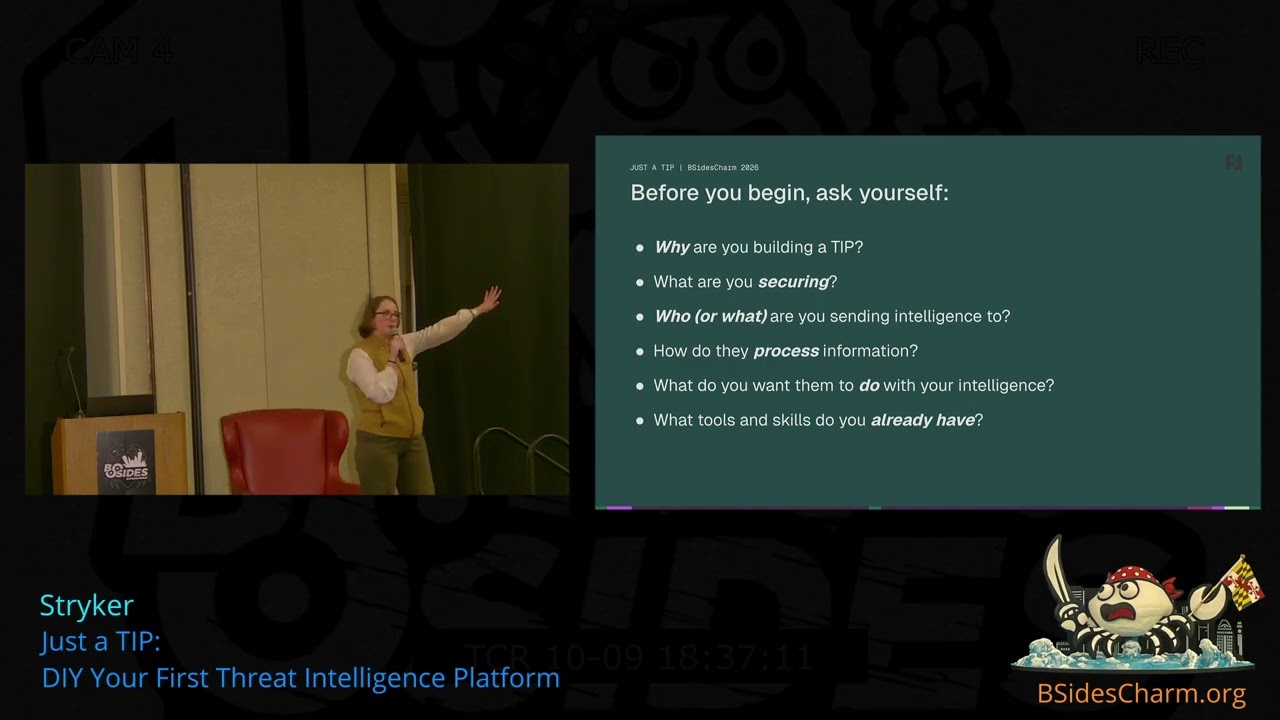
Just a TIP: DIY Your First Threat Intelligence Platform
Speakers
Tags
TopicOSINTThreat Intel
About this talk
A hands-on walkthrough for assembling a minimum viable Threat Intelligence Platform using no- and low-cost tools like ChatGPT, Feedly, Airtable, and Zapier. Covers identifying why a TIP is needed, seeding intel feeds with customized primary sources and hidden RSS feeds, and prompt engineering for OSINT summarization — including common failure points. Attendees leave with a functional schematic and war stories to iterate on their own.
Show original YouTube description
Ready to hack a threat intelligence platform (TIP) together with ChatGPT, Feedly, Airtable, Zapier, and duct tape vibes? In this interactive, hands-on presentation, I'll walk you through how to assemble your first minimum viable TIP using whatever no- or low-cost tools you've got on hand. Bring an Internet-capable laptop if you'd like to follow along, and we'll: * Pin down why you need a TIP—are you drowning in docs and articles, still cutting and pasting indicators, or just trying to appease the corporate gods who think it's a good idea? * Seed your intel feeds with customized primary sources while discovering hidden RSS feeds together. * Perfect your OSINT summary prompt engineering for the Gen AI bot of your choice—with a few experiments showing common failure points. You’ll walk away with war stories, a functional schematic to assemble your own TIP, and a community ready to help you iterate—no six-figure surcharge required. Stryker Stryker is the director of content and threat analysis at Fable Security, where she translates technical research and qualitative intelligence into the "so what?" and "what now?" solutions that keep more people safe and secure. Before Fable, she produced threat intelligence for GEICO, Blackpoint Cyber, and other cybersecurity vendors. You can often find her playing “Backdoors & Breaches” in the hallway after her talks at DEF CON, SecTor, and Bsides conferences around the United States. Stryker lives in Baltimore, growing parsley for butterflies and algae for shrimp.
Related talks
 20:26
20:26Stop the Leak! Adversarial Thinking in Cybersecurity with PRE-ATT&CK
BSides Charm · 2023
 22:20
22:20Into the Breach: An Analysis of State Political Party Account Exposure
BSides Charm · 2022
 31:02
31:02Phineas Fisher: A Timeline of Hacktivism
BSides Leeds · 2020
 44:13
44:13Using SOCMINT In Threat Intelligence by Matthias Wilson
BSides Dublin · 2021
 47:05
47:05OWASP Amass Beyond Subdomain Enumeration
BSidesROC · 2019
 34:04
34:04Automating Threat Hunting on the Dark Web
BSides Philly · 2020