Citizen Drone Defense Force - Michael Collins
Show transcript [en]
So, I'm I'm Michael Collins. That's a apparently a somewhat famous name around here, I've heard. I don't I don't know if I'm related to the big fellow or not. I My original family name appear I come from a long line of Texas Collins, as you can hear from my my accent. I'm not from around here, if you can if you can tell. I'm from the States. Grew up in Dallas. I live in St. Louis, Missouri currently. Work for a MasterCard. This is not a MasterCard sponsored talk. My drones do not take payments, so they're not interested in my in my stuff here. I have a couple of secrets I'm going to keep for you guys.
I have figured out that the the Guinness is way better in in Dublin here. It's it's trash in the in the States. And then my my Ireland friends have been telling me for a couple weeks now that the the weather here is terrible. And it's clearly clearly not. So, you're you're doing this to keep the Yanks away is what I've decided. So, so I'm onto you. Um, this is I'm I'm your I'm your chief drone defense officer. We'll we'll talk about my character arc here and kind of how I got into this. We are all members of the Citizen Drone Defense Force. I do have I do have stickers. If anybody wants a sticker, come up and meet me afterwards. It's the
it's the graphic here that my my AI wife or husband designed. I hope everybody picked out their AI wife or husband after the talk. Um so and there is a uh a website associated with this. I would point out that the website is what I want the design to be because this is going to be an open-source project. And then there is a GitHub repo that has all my current code in it. It's a bit like my garage right now. Kind of wander around. Some stuff works, some stuff doesn't, you know. But but yeah, and you can you can hit that from the from the quicker code there also. So, um, so what got me started on this
at the uh my original drone talk uh I did after a uh we had a at the data center that I worked at had a drone crash. Um it turned out at the end of the day it was just some drunk guy. Um but you know, you're at a you're at a secure data center. I was wondering, you know, what other than the obvious, you know, camera surveillance would be interesting for a drone to do, you know, flying over a site, right? So, um what I figured out was maybe like a an obvious one was wireless hacking, right? Because wireless is very proximity based. You have to have generally have to have your equipment fairly close uh
to the target to be able to do whatever wireless hacking you're doing. So, um I I developed a platform. It was a a DJI drone. Um it was a Raspberry Pi. Uh and then I could plug in different antennas to it, uh nano devices, all sorts of stuff. Um I had a battery on it. And I had a uh a cell card on it. So, what was nice about the design was I could get about 5 minutes of flight time to my target, land it. I could get about 12 hours of compute time off of my battery to do whatever wireless hacking I needed to do. Um it would shell out to my lab, basically. So, from my house I could be
it could be in California and I could be in New York and I could still be shelled into the drone doing my hacking stuff. Um if I captured any kind of uh you know, hashes, anything that I needed to crack, I could pull those down to my local computer, do that locally. Um I thought it was a pretty pretty cool setup. Um I uh I actually I had a whole bunch of calculations. I calculated all because it's very specific on the weight, right? The drone will only carry so much weight. So, I had to um you know, I had to be very specific about the weight of it. Um I did calculate it in English and
metric for Americans and then the entire rest of the world, basically, you know, so for the weight stuff. Um if you Google don't Google Michael Collins cuz I'm not the first one that shows up, believe it or not. If you if you Google Michael Collins hacker, I'll show up. And if you Google Michael Collins DDAP for drone-delivered attack platform, you can see my original talk that I gave on all this. But um I lived in the country at the time. So to take the sting out of it, I wrote it as if I was hacking my chicken coop like my chickens had propped up a rogue Wi-Fi thing. So um Keep all of this in mind for two slides
because this is where the character arc goes, right? So this is what I designed. I thought honestly this capability was pretty widespread probably at the time with intelligence agencies and stuff. I've since been told maybe not so much. Um So you can kind of see what my kids look like. Again, Raspberry Pi, battery, different types of wireless hacking antennas and tools, you know, plugged into it. You can see it flying there. It actually flew. It would at least make it to my chicken coop, which is nice. I never I never actually flew it onto a data center, which again becomes important on this next slide. So this wasn't me. Let me Let me start there.
Um Someone Someone stole almost my exact kit. So I joke like the FBI should see who watched my talk and that might give them a clue who who did this. But um same exact thing. Even stole the cell card idea, which I thought was kind of unique to my design. Used this in an actual attack. Um They used some more expensive drones. The When I did my original one, I think my whole kit cost like $400 between the Pi, the drone, everything else. They spent a little more money on some expensive drones and then I guess lost them because they were they were stuck on the on the roof there. So But yeah, so little bit of a lesson learned like I
probably wouldn't re-up this talk because I would just be like arming people with like the latest kind of technology at this point. You know, sometimes when you point out risk, I think is where I'm going. Like and we're all hackers, right? Like, you know, we point risk out. There's a There's a There's a back-and-forth to it, right? So, um but again, I was a little like really like, you know, so so I always had that in the back of my mind. Um and then I'm sure everybody's watching American news all the time over here, but in case you don't, in the in the states we had this thing going on where there was like all of
these drones kind of flying over the East Coast. And everybody's like, what are they doing? Nobody could really identify what they're doing. And I quickly realized, I did a little bit of research on it. And military side capabilities, ridiculous capabilities with like drone detection, response, shoot them down kinetically or with lasers, you know, there's all sorts of stuff. Um really not a lot on the civilian side of the house. There's There's definitely some a couple projects that have spun up and I'll talk about those, especially around like detecting remote ID. I think he called it DRI over here. We'll talk about that a little bit but not a lot in the civilian space. And especially um
I'll talk about my kit here in a second. There's a a guy who writes like DragonOS, which is a Linux distribution for a lot of like RF hacking and things like that. Tons of good videos. I highly recommend that whole thing. He sells a drone detection kit. It's around 1,300 dollars. Translate that to euros. It's not not super cheap, but um what I wanted to do was basically build a community capability for Juan where we could share data, me and my neighbor, me and, you know, the next state, you know, I saw the drone here, you saw it there. Be able to mark threatening drones, things like that. Um and and have it both open source and
the hardware not be super expensive. So, again, kind of like my original project, you know, built this thing on a Raspberry Pi, cheap hardware. Uh my whole kit probably cost around 300 dollars for this to do the whole thing. And then make the make the software open source and then, you know, invite people like yourselves to come help, you know, develop and make this a community project, right? So, um Again, this is my is my protest sign. I'm going to carry around to the protest. Um, again, like no one no one really knew what was going on. I was shocked. Like even like local law enforcement were taking drones off trying to, you know, fly drones around. And I'm like,
"There's way easier ways to do this." And so, I was like, "We we need we need a detection capability." Um My oh a couple things. In my original talk, it was an hour, so I'm going to bust through some slides here really quick. I also flew a drone during my original talk and showed my kit off. I don't quite have as much time today and I feel like when I was doing some investigation on some of the laws over here, they're a little more privacy oriented. So, I didn't want to like show the Bluetooth thing off and everybody's phones on there and things and then end up in Dublin jail, which is not nice. I hear
it's terrible. Um, uh So, I also I didn't want to like damage anything in the room here at Trinity College especially cuz I would never get into Hogwarts later. So, so uh So, what and my slides will be available. We're going to work as quickly through some of these and I'll just kind of show you what I'm thinking. There's a bunch of different types of drones and they all have kind of the different modes of detection, right? So, one of the things here is like, you know, there's consumer drones, there's racing drones, there's agricultural drones, there's military drones now, there's all of these different things. They all have different threat profiles, they all have different kind of
detectability. Everything now, and I believe it's the same over here from a rules perspective in the states you're supposed to have drone ID on your drone now, right? So, the easy one is like detecting remote ID. The problem is is older drones don't have that and I would argue if you don't if you're not transmitting remote ID, that probably raises the threat profile, right? That might mean that maybe you are doing something uh malicious with the drone. So, um I'll I'll talk a bit about how I think like threat intel is a big a big capability here. I originally when I originally started this research, I was thinking I would map types of drones to capability
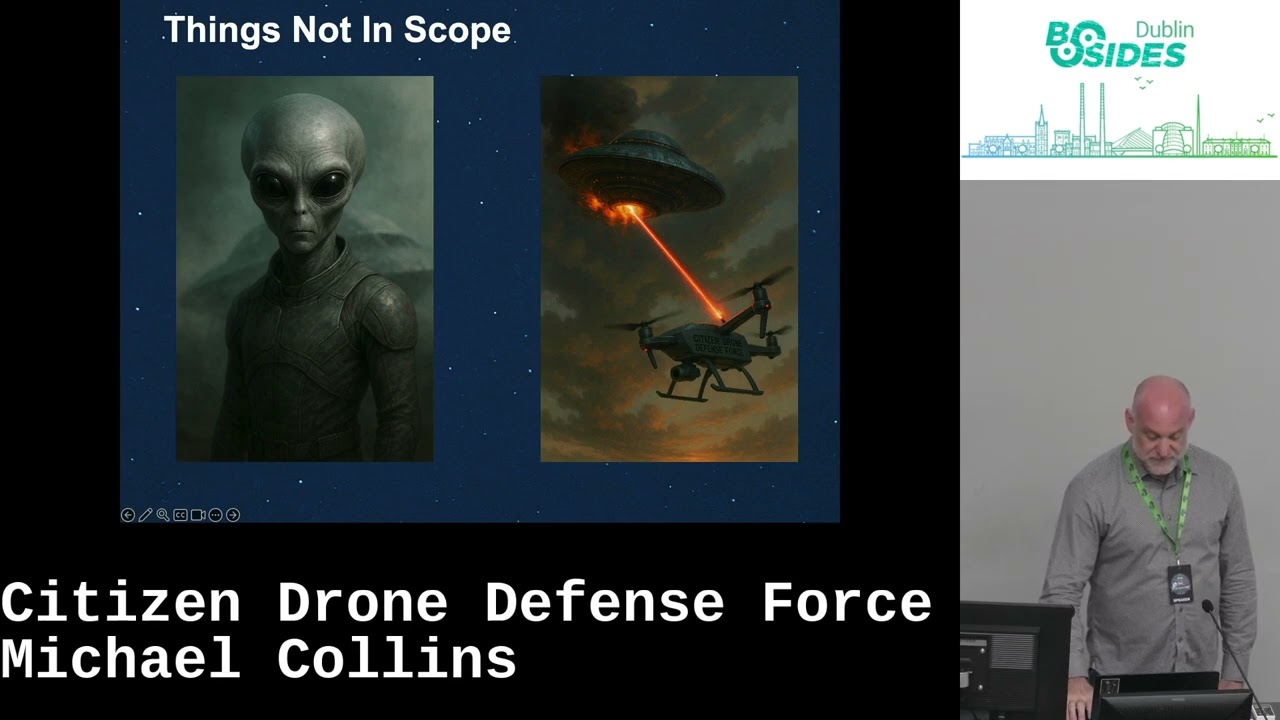
kind of based on the weight stuff I was talking about like this this type of drone could carry this type of kit specifically and what I what I quickly figured out is that probably more of like a threat intel model where you mark things as like this is typically the types of things that these types of drones are doing in this type of the country is is where you want to be with this, but I have a whole slew of slides about uh types of drones and things in scope. Not not in scope. I wish it was. Uh I would love it if aliens uh one of the things people thought is that it was
aliens flying over the East Coast and they're taking off from the water and maybe that's true. I don't know. Maybe we didn't land on the moon. It could it could all happen. Um I'm also not covering countermeasures. Um typically a a a normal drone is going to cost, you know, around a thousand dollars if you have a decent drone. Um I know in the states uh if if I shoot that down, that's felony property damage almost immediately. So, I don't recommend shooting your neighbor's drone down. If you do, don't. Please don't. Don't blame me. So, but we won't we won't really cover cover countermeasures uh too much here. Um So, everybody's familiar with like the
Ukraine conflict now and kind of the use of drones, asymmetric warfare. Um I'm not focused on the military applications here, but I do definitely uh kind of kind of think about these things because as is typical, capabilities in the military space will eventually kind of end up in the civilian space, right? So, um different things that they're doing to avoid detectability um may end up on the civilian side eventually. So, I'm I'm thinking about these things, although right now I think we've got a much easier kind of detectability kind of modalities, but I think eventually some of these kind of techniques that they're using uh over there uh um could could bleed into the civilian space. Um
the uh a lot of them have, you know, crazy range now. They're kind of built specifically, you know, for uh for warfare things. Um uh it's a lot of kind of electronic warfare, which is interesting. They'll they'll do jamming to like interfere with the RF signals on the drones to make them drop out of the sky. Um they'll spoof GPS coordinates. So, then what they did is they put much more AI elements into the drones where they like are flown, you know, a certain way and then they get they get so far and then AI takes over and kind of knows where to find things. A lot of them are very manually driven still as far as like the
kill vehicles and things like that. Um but but extensively used. I I I think the I think the note now is that many more people have been killed by drones at this point than like traditional kind of weapons, which is super interesting kind of for the future of warfare and things like that. Um I'm a I'm still uh I'm still politicking the wife to get a house robot, which none of this is helping, you know, she's uh um but uh but we'll we'll we'll see. Um If it could fold laundry, I figured that's like an easy sell, right? Like, you know, it it folds it folds laundry, you know. Um When I first heard the fiber optic
thing, I thought it was I'm like, there's no way that somebody's stringing a fiber optic cable way out the butt of this drone. Um but you can see from the picture it's literally like fishing line. There that's my Texas accent there. I apologize. There are so fishing line. Uh and it spools literally these big fiber optic cables out the back of the drone. Um what's interesting is they're actually somewhat hard to see um, unless you're really close to them. Um, and it's impossible to kind of get in the middle of what it's like typical fiber, right? Like there's no RF signal, there's no nothing. It's just a long fiber cable kind of driving these things. So, I thought I thought that one
was interesting. Um, again, you know, jamming. Um, there there for a while actually actually met the guy that wrote the crypto man-in-the-middle for the drones for a while. So, if you've seen the things where like especially like some of the government agencies can like take a drone over and then fly it in a fly it in a box. That that's somewhat what's going on there. So, um, again, footprinting these drones becomes very important because some of these drones have exploits that you can do. Not that I would rec- again, I'm not recommending counter hacking a drone, but maybe you could. You know, some of them have exploits. So, you're you're tired of the Amazon delivery thing over
your house every day, you know? Um, uh, so, some of this stuff where I want to steal from them is kind of this distributed sensor and detection network, right? And we can do that through a community-based kind of detection scheme where like I have one at my house, you have one at your house. I see it fly through my space, I mark it as threatening. You see it later, you kind of know directionality at that point and different things like that. So, there's a lot of benefit to kind of having a mechanism not only for like community-based detection, but like some ability to share data as as you as you see these things, right? Um,
there are there are a number of kind of current threats in the civilian space. So, as I pointed out, you know, it's a very good way to get a a wireless hacking kit onto a data center and kind of use it there, right? That's that's a real thing. That's not just something I came up It's something I came up with, but you know, it's it's been used in the in in the real environment now. Um, lots of surveillance, um, especially for criminal activity. I've seen I've seen cases where they're flying around looking for open garages. It's a very easy way to like do surveillance with a very low risk to you, right? Because it's just your
drone, it's not you like wandering around the neighborhood, right? So, um I feel like uh I feel like some of the explosive mechanisms are super concerning to me uh for like a terrorism type of thing. So, I do think like I think a lot about like executive protection and kind of site protection and things. Um I'm I'm surprised that we haven't seen an incident yet with this given it's so common in the warfare side. Um and I I'm not encouraging that at all, but I do want to be thinking about that and I do think there's uh especial You guys are much closer to, you know, things over here than we are in the states, but you know, there's already
been like drone incursions into neighboring countries that are not involved in the conflict. There's a lot of, you know, real real to be worried about here, right? So, um There's a lot of There's quite a bit of criminal use of these as you would expect. Uh drug smuggling across uh borders. Um apparently it's a big problem now where drones will fly over prisons and drop drugs and contraband into uh into whatever the site is. Apparently the drugs taste better if they're delivered by drone than the earthy mechanism that they usually come in as. So, um so um Yeah, I covered all that. Um So, so countermeasures uh you know, detecting low gauge. Um most of most of the countermeasures that are
being used on the warfare side are very kinetic, right? It's either It's either shoot it down or with like a laser or some sort of missile or some sort of weapon uh tends to be the most effective mechanism. And the problem is is that the electronic countermeasures are continually kind of moving, kind of like we just talked about, right? Like uh they'll they'll figure out like an electronic countermeasure to it and they'll quickly adjust and have a new kind of mechanism, right? So, it's much easier detect it, shoot it down. Please please don't shoot a drone down. Please please. Um but uh I don't I don't want you going to Dublin jail. Um Uh so, I did I did say that um I'm not
focused on countermeasures, but I do have a drone countermeasure at my house. Uh Winston. Uh luckily that luckily the AI is very good at uh coming up with acronyms here. Um You may think this is not an effective countermeasure, but I would say it's a 100% success rate. I've never had a drone attack at my house with the dog here. Um he also, as you see, protects me from uh wild animals on the uh on the screen. It's very hard to watch Game of Thrones or Westerns uh at the house with uh with him in particular, but uh but he does The problem uh when I first came up with that joke, cuz he literally walked in
the backyard and barked at planes as they fly by, and then I couldn't catch him. Like it literally like for for months before my talk, I'm like really? So, we uh I had to use an old one when he was uh he was uh looking at the thing here. Um I'm going to skip licensing requirements. I did update these for uh for Ireland here. I think everybody uh can can look these up. Uh they're somewhat similar to to the states, um if I'm being honest. Um same same kind of uh weight requirements if it's a 250 or below, generally you have different rules than if it's a heavier drone as far as like uh flight requirements and
licensing and things like that. Um So, detection mechanisms. Um Ra- ra- radars a decent one. Um the problem is is that these are so small, they they're it's very hard to detect them unless you have super expensive radar, um and not in my budget for a cheap kind of detection kind of capability, right? Um RF monitoring turns out to be a really good one, especially if it is transmitting remote ID or DRI. Um And then uh um imaging is is a is a pretty good one. We'll talk a little bit about uh Edge ML stuff that I'm working on, but one of the one of the scripts in my thing is literally like it'll take a
picture of a drone, feed it to Open AI, say tell me what kind of drone it is. It's got great capabilities there already, right? Just to tell you like what kind of drone it is to kind of footprint it. And then I think one of the best ones is is acoustic sensing, honestly. They've got a very specific kind of sound to them. Yeah, so uh uh uh uh laser. Again, not not not super cheap. And then you know, kind of a the the whole approach here is going to be a fusion of different detection mechanisms kind of kind of coupled together with some AI to help kind of do the detectability here. Um planes do ADSB, which is
if you're at the house, it's actually fun. You can you can see the planes flying over, helicopters. I did I did see a Justice Department for the transport of aliens. And then I was like, aliens are back in scope, you know? Like, yeah. No, but you know, police helicopters, all sorts of interesting stuff. I do not have a lot of drones flying over my house, believe it or not, so um I I you know, had to acquire a drone. A good friend of mine that I used to work with, Bob Donnell, loaned loaned me a drone. I literally ordered a drone from China. It showed up and it was the cheapest $50 drone you can imagine. And I was so pissed off.
And so my buddy Bob, I was like, can you just fly your drone over my house, please? I have no talk if I don't have anything to detect. So he literally loaned me his drone and then he passed away before I could get the drone back to him. So when we're drinking Guinness later, throw one up for Bob for me. So he was he's he's kind of why I'm here. So um I changed the slides up. You guys call it DRI over here for the uh for uh the remote ID stuff. It's all based on the same kind of spec, so all of my tooling should readily detect stuff over here also. It's just different information in
some of the fields, right? Um I got packet details here. I want to quickly get to uh cuz I'm going to run out. Um so the whole architecture is going to be edge nodes to do the detection. Um they can be very cheap because you don't need the full kit on them. Um maybe transport nodes. Um I what I have figured out is I thought Wi-Fi was going to be the best way to kind of connect these together. Now I'm I'm thinking uh LoRa, right? Like uh and I think you guys do the same thing over here. Tons of range on them, super low power. Um so what I'm working on now is basically LoRa backhauls that talk to like my
central server at my house, and then my house does like all the analysis and you know can talk to the internet and things like that. Um so that's kind of the central system. And then again, working on some AI capabilities there. Um threat intel again I think is super important here. Um there is a company I looked it up. There is a company that does uh drone intel. Um the uh the price is roughly uh 100k a month is what I heard. So it's kind of again, it's outside of my uh my price range. So I'm thinking about developing kind of intel capability on the side, too. I've already developed the database that kind of will help kind of footprint this
stuff, but um I think it's much more interesting to know like these types of drones are doing these this types of things. This drone is stolen. That that might up its threat profile. This is this drone is not transmitting remote ID. That might up its threat profile, you know, things like that. Um you can see how like the edge nodes might be deployed like across a neighborhood, so you get like wide coverage of detectability. Um they typically they typically transmit over BTLE or uh Wi-Fi. I'm finding more typically BTLE again because of the range, which makes them very detectable at range also. This is what my home setup looks like currently. It's in the garage. I have a couple
Raspberry Pi's. I do run DragonOS on one and then I run a custom custom build on the other one. You'll see in the code repo there's basically an install edge node script which will lay down all of the stuff that I've currently got ready onto a pie to kind of get you going and I'm continually kind of updating that. Me and Claude, I don't know if you guys know Claude, he's he's a very good programmer. So so I use I use that guy a bunch. Again, this is what my edge my edge node looks like. It's got it's got basically, you know, Raspberry Pi. It's got a an alpha antenna to do the Wi-Fi detection stuff.
And then I've had pretty good luck with the NRF dongles for doing this. There's also ESP32 devices are pretty good. And the only trick is all of the BTLE detection stuff you have to flash. So there's I'm going to work on some better instructions on like flashing different types of things. I did get a cat sniffer what which I really like which will do all sorts of like IoT sniffing and stuff. You can tell it's a genuine cat sniffer cuz it mainly wants to sniff other cats. So but it's it's it's a really cool device actually. It's just a little more little more expensive. And then here's my uh here's my Karen system. Look, we're we're right back to where we
started. I can fly this thing on a drone now. It's it's super light. I can I can take it off if I need to like do counter surveillance on something. So so again, the the the design of the kit is meant to be very very very small. Um and then yeah. That's my talk. I'm almost right at time there. Sorry no demo. I didn't have enough time today. Again, I do have I do have stickers. If anyone wants a sticker come up and say hi and then thank you for having me in Dublin. I'll gladly drink a pint and chat more later with with anyone. So thank you guys very much.
Related talks
 41:25
 45:34
 44:13
 39:46
 39:03
 28:06