Elevating First-Time Female Voices on Stage
Show original YouTube description
Show transcript [en]
This next talk is by Deepipika Gupta and Puna Raja Ramen. We'll be talking about elevating firsttime female voices on stage. Thank you for joining us. This is the Deanna initiative. We are nonprofit for speakers just like you and for elevating first-time voices on any stage. If you would like to know more about what we do, please follow us. We have some QR codes, some business cards, and also some free goodies up at the first few seats. But without further ado, take it away. >> Great. Thank you.
>> All right. Thank you. Uh and welcome everyone and thanks for joining this session. Uh I have been here since morning and listening to some of these exciting sessions and the content that has been presented. I want to give a huge round of applause to all the Bside community and the volunteers for putting up such a great show here. So thank you all of you the volunteers. So before I dive into the topic for which Puna and I are very passionate about, I wanted to start with a personal story. Couple years ago when I was an individual contributor, I was developing a lot of applications and tools to do security monitoring of private cloud and
public cloud. I was also doing training for a lot of large development teams for uh secure development and privacy engineering. At that time my mentor came one day and said why don't you submit a talk for one of the conferences and I just froze and I said oh no I don't think I'm expert enough but then after that she immediately responded cyber security does not seem like a talent problem it seems like a visibility problem And I just wanted to ask here in the audience how many of you have thought about submitting a talk but didn't I guess yes that is the hesitation which is why the pipeline of the first time speakers especially women is so small or
in sometimes it's even zero. So before we dive in more into talking about this topic let me first introduce myself. I'm Deepipika Gupta. I'm a senior leader at Cisco's security and trust organization CTO team and I'm very excited to be joined with Puna and I'll let her introduce herself. >> Yeah, thank you Deepika. I am Puna Raja Raman. I am a security engineering technical leader for Cisco in software security. >> Right. Thanks Puna. So, so let's let's dive into what we are going to be talking about. And currently I was as I was saying that the pipeline of the first time speakers is small. We would go over quickly the challenges that we have seen and based on those challenges
we came up with some hypothesis and then we tested that hypothesis. We will discuss the results of it and then there would be some takeaways. Let's dive into the challenges. You all must have heard a lot of conferences have started saying now that we do want more women speakers but their problem is and what they're complaining is there not enough submissions. So how do they get more women on the stage? So the first challenge happens right here when women self opt out themselves. They already don't even submit anything. they don't even enter the pipeline. It's not because they're technically not challenging, but it is because they don't think they're 100% ready. Some of the experienced speakers,
they would go and submit their CFPs, their talks even if they're 50% ready. So that was the first challenge. Now the second challenge is the gap between the technical expertise and the presentation confidence. Most of the time a lot of these women have been doing complex work in cyber security may be developing secure systems or responding to incidences or even securing the infrastructure. All of these are pretty complex stuff. They're very highly technically expert. But when it comes to speaking and presenting their ideas in front of an audience like this on a stage like this, they're not there yet. A lot of times when women are trying to think about submitting a a talk, the
first thing that comes to their mind is the competition with the pros. They always feel very intimidated that I they're not strong enough. They're not expert enough to be able to compete with these speakers who have been presenting for a long time or or at least have been presenting for some time in these external conferences. So at Cisco we started to think about what is it that we can do if the first time speakers get intimidated with the pros. Can we build an environment where they are not there is no competition? Would that be something possible? Would that let more women step up? Now this was our hypothesis and what we did from here is I have to
take you back to my story where when we were thinking of how to build an environment without any competition we thought about how did I get on the stage and when I told my mentor I don't think I'm good enough to submit a CFP my mentor came back to me couple days later and she said All right, I get it. But how about if we work together? How about if we submit together and if we get selected, we present together. Now, that was something that was acceptable. That was something it took the fear out of me. I knew she will have my back. I knew I can fly under her wings. And this is how she gave me a launching pad. That's
how I started creating submitting more technical talks or non-technical talks. It's just presenting a topic on security in front of a stage. So we thought about it that in order for us to test our hypothesis why don't we build a program which is kind of similar with a mentor mentee the speakers the first time speakers they have mentor each of them has a mentor so they feel confident maybe and then they'll be less intimidated and that's what we did so since last 3 years we have been testing that particular environment and and hence testing our hypothesis I won't go much deeper into it and I'll let Pruna take you and deep dive into what we did
and how we tested our hypothesis. Over to you Pruna. >> Thank you Deepika. So when as Deepipika pointed out if we started this internal conference with the CFP it would have been similarly intimidating right do you think we would have gotten all these firsttime female voices even if we tell them it's a CFP for first-time female it's still not that useful. So that's where we came up with this two-pronged approach of call for mentors and call for speakers. When we did the call for speakers, it was strictly call for novice speakers. These are people who have never gone on a stage and spoke before more than 200 a people in the audience. And uh think
about a peer that you have in your team who is a expert in everything. If you have a problem, you go to her and ask her to help you. Do you that is the kind of person we are looking for who is not ready to put their name in the hat by themselves. So that is the kind of noway speakers we are looking for. And at the same time for mentors, we are looking at people who are in our speaker bureau right now. and um going back to RSA, going back to uh Cisco live or any other big tier one presentations right conferences and once we get the call for mentors and the speakers we
have a very strict vetting process. The golden rule is novice only guardrail but how do we enforce it is the point right like we have a good volunteer uh le team who goes back and checks the speakers to see if they have been in any big conferences. Sometimes we do get the women who have actually spoken in big conferences maybe one time maybe two times and they're always thinking oh I've just done that only once so I'm not ready to mentor anyone I'm not an expert yet and uh we have this voice that keeps telling us you are not an expert anyway so when when we get inputs like that for the speaker we go and talk to them and
see if they are ready to mentor others and if they are ready to consider themselves as not a nova speaker but be ready to help other women who are in their shoes two years ago. So I we always get a lot of people saying yes. Nine out of 10 times these women will say yes I would like to help other people and uh that's where we have these engaging mentors and um women participants who are willing to put all they have and try to come up with that good presentation good abstract in that will be taken in uh I mean that will be considered for the conference. I can move to the next slide. >> So this even though we say uh it is a a
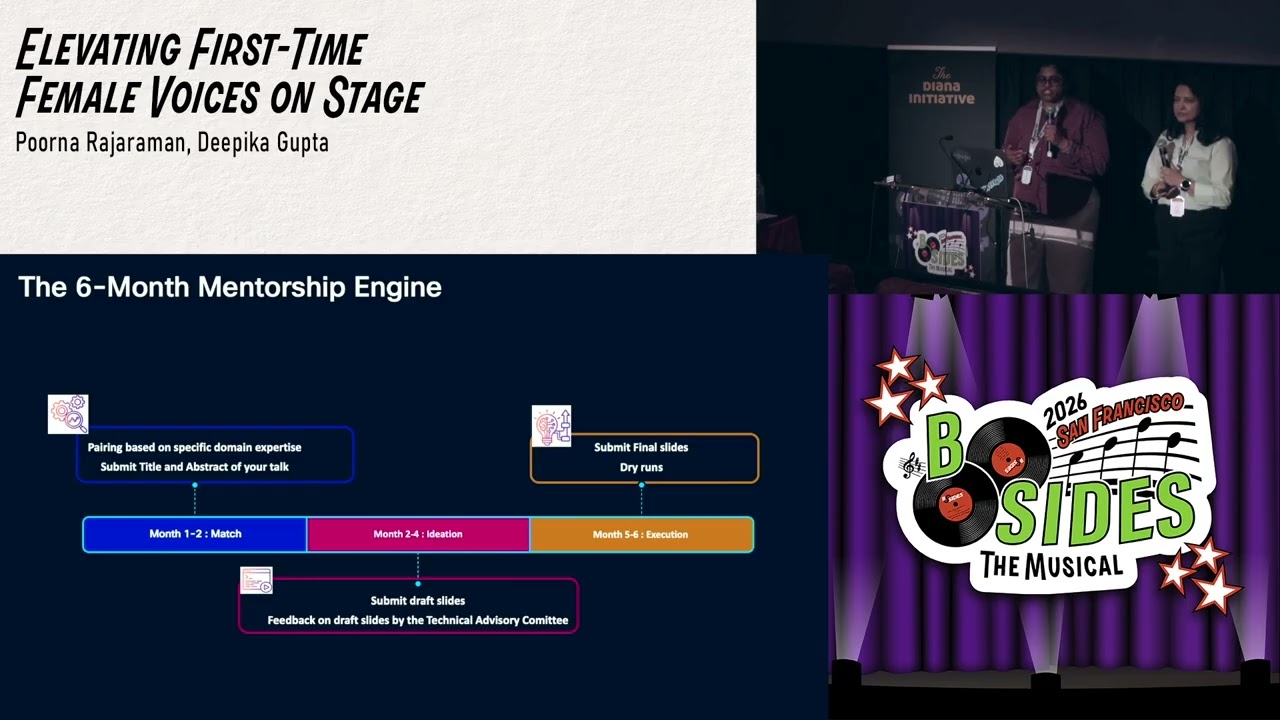
mentorship program this is not a one weekend exercise. We are talking about a sixmonth mentorship pipeline wherein the first month is first few months are all about matching right. Some of us sit down, look at all the uh speakers that came in, all the v mentors that have submitted their names and try to match them based on the domain that they work in as well as their time zone. Even though it is a volunteering event and even though people are trying to help others, we do not want anybody burning their midnight oil. We want them to be able to collaborate and ideate in the ideal time for both mentors and speakers. So that's why we look at the
time zone as well as the domain they are in and match them and make the perfect match as much as possible. And uh when it comes to the months 2 to four these mentors and speakers they go one-on-one uh on discussions and uh try to argue try to uh review what the speakers have done in their career till now and uh they are able to find that one good presentation that they can actually provide with a strong story. This story is then built in the last two months as a iterative presentation where they keep looking at it, changing it based on the feedback they get everywhere and do dry runs and are ready to go on that stage which is our
internal conference of more than 200 to 400 people worldwide. Um and about 8 to 12 speakers make the cut. So even though you apply as a speaker or mentor in the first step, all the speakers are not making it on the stage, they still have to compete and they'll still have to prove that they are the best. So when we are even though we say it's a novice only um speakers and we are talking about firsttime speakers, it doesn't mean this conference is easy. There is a very high technical standard that we maintain. All of these abstracts are supposed to show us if there is any architecture diagram that they have built. Is there any poss that they did or any testing
that any any of the um small model that they have built that they can show us and how they proved any of the hypothesis that they are working on. Is this novel right or are they bringing something that is from a different white paper? Is this something that is relevant and timely for our audience? So all of these things are tested in as as part of our um technical advisory committee process and only the ones that make the cut will be on stage. So coming to the technical advisory committee, this is our senior technical talent. This is the woman who are again volunteering their time along with their male allies to help people who have
never been on stage and they are looking at these abstracts in a double blind review. So we are not even though everybody is from the same company we are not looking at whether we know this person whether we are they are from our team. So it's a proper double blind review and once we select the uh once they look at these abstract and they are not going to tell me no this is not applicable. Instead we always look for feedback. The um technical advisory committee is supposed to give us proper feedback which which is actionable which something that we can pass it on back to the speakers back to the mentors and they are able to again work on their
title and abstract or the presentation and get something much more strong which will go to another external presentation if they are not selected for this one. After doing all of these things, did the hypothesis work? >> Right. Thank you uh Puna. So we did all of this part where we called for mentors, then we called for speakers so that we can pair them up. We defined the domains and we are doing this not in our abstraction. We are looking at all the other external conferences to see how other external conferences are doing because our ultimate goal is to be able to have these uh first-time speakers to be able to speak outside. So the rigor
that we bring in is at the same level at what the external conferences do. Now as we mentioned we wanted to see this whole program that we ran for a couple months. Did it really work? The first year, if you look at this chart up there, the the number of uh the number of speakers that raised their hand that they wanted to participate was comparatively low. And that was because not too many people knew about this program. But in the third year, you can see which is the highest 50 speakers came up and they participated in this program. And the alarming thing was 38 speakers. And so we got a lot of mentors too. And so out
of that 38 speakers were able to we were able to pair them up with their mentors in the domain that they wanted to be uh speaking for. So out of that 34 because we said we stood up an internal conference where these all these 38 should have been able to present. We did not have enough slots because we did not think so many speakers would be available who would have completed their presentations with full abstract title and reviewed by the technical advisory committee. So what we did was we selected out of that 24 but our hypothesis as we can say has been working mainly because all of these speakers were coming up only because they had the confidence of the mentors.
So but one thing that we did was after that we started sharing all the CFPs from the external conferences. We built this internal pipeline. Now we are going to share it with external CFPs so they can start applying putting their talks up there. This is also to address if you remember I had mentioned that a lot of these external conferences are saying we don't get enough submissions. So this is another way for us to make sure we are now starting to submit CFPs in these external conferences and building that bridge between the internal and external. The other good part that happened because of this program was some of the speakers from the first year which is
the first cohort and the second cohort they came back and they got opportunities of speaking actually some of them are speaking here at Bites who are from our first cohort they got enough opportunities outside and they came back and they said we want to give back and so they started then mentoring the then the first time speaker pipeline folks. So this became like a 360 view where as you are gaining expertise you're coming back to mentor more people and so the pipeline in the third year it grew faster was because some of the speakers from the first and the second cohort came back and that's the conversion rate became higher. So with that I want to say one thing that if you
remember initially I told my mentor I'm not good enough or I'm not expert enough so I don't want to submit a CFP. The the thing is that she gave me to fly under her wings she gave me a launching pad. I was fortunate enough but there are so many other women who have the same hesitation but don't have the mentors to help them out. And I feel as a community we need to create structures. We need to create programs like this where we can convert this hesitation into opportunity for all of them. I know there are a lot of good ideas but there might be sitting in the audience. All it needs is a pathway to a
stage like this. And with that I want to end here. I also wanted to just share quickly that um all the program that Puna discussed we have very good playbooks which have matured over the last 3 years and we'll be happy to share with anyone who wants to stand up a similar program at their organizations or anywhere else and if there is any interest uh you can reach out to us through LinkedIn or we will be outside and we can we'll be happy to share those And it's open for questions now.
Well, if nothing so Oh yeah.
It's the first time intimidation that that needs a little bit of a push. >> That's right. I mean that's exactly what we were trying to say. >> In my case, my mentor gave me that push, but not everybody has that. First thing is everyone should have a mentor. It this is um principle 101 you can say as part of that you should have a mentor not only for this part but just in general but if you don't then what we are trying to do is set up these programs so that uh we can provide you mentorship not only for speaking then that bond between the speaker and the mentor becomes a a longer bond. doesn't
stay till the time the presentation is done because now they're both from the same domain. So they connect better. Now the speaker whoever uh whatever it's he he or she is speaking she can continue to get mentorship from that person as the career grows. So that's the other part of it that we wanted to bring but we were focusing first on how do we get the first time speakers. Yeah and I think to add to that we have had success stories where uh some one of our uh first term or second term uh person she then went out and presented along with her mentor. So when the mentor had opportunity to go present she took her
along with her. So that is the kind of thing that we are trying to focus and build. So um when we do the matches we put a lot of time to think about the person we are matching and how they will gel and how how how the work they are doing is similar. So that way it is not just a six months mentorship it is a long-term relationship. Thanks for the question. Thanks for here
uh let me repeat the question so that I have understood. So you're asking what is the criteria for which some of these presentations are not selected. Mhm. Um well so remember we were talking about um that we are trying to keep the same rigor as all the other external conferences are doing. If we find that sometimes it's that that peak that the they don't have the either the content or the title and good enough that if they present it to an external conference it will get rejected will not be. So our technical committee gives them that advice. Go back, work on it, and then when you're ready, we can bring you in. Maybe not this year, maybe next
year. But that's the advice we do. We don't reject them completely that no, you can't do anything. We give them more time to just think about it, think of a new title, come up with a presentation, and give them the time to create that uh content. Una, you want to add it? Yeah, I think last time around we also had a case where two two submissions were somewhat similar but they were not 100% similar. It looked like both of them from different teams in different geographies. They were working on something similar. So uh it was a very good opportunity for us to connect both of those speakers and we told them you guys can come up with one single speech
which will be more effective, more um meaningful and that happened and they went and presented somewhere outside and we didn't we didn't get to us on time. So they got a chance to do it outside. >> Yeah. >> Yeah. Please.
>> I'll take this. >> Yeah. Go ahead. here the she she asked what would be the tip for a first-time speaker who is very hesitant and go trying to go I mean I would be honest this is my first time speaking in a big conference and uh what I did was I saw the uh d initiative and I told Deepika that this is a good story that we can come and tell here and the first thing is you can talk to your mentors and try to come up with do the work right like do the hard work which you need to do for this but You definitely need your mentors and board of directors, personal
board of directors they say, right? Um whom you can actually discuss, actually have a heart-to-heart and discuss about it and say this is what I'm thinking, but I don't think I can go there alone and that really helps >> and that is true. So um at least I can tell you in my story I was trying to get uh I wanted to present but I knew that um I can probably build the content or anything because I had the technical expertise but the idea of coming on the stage and presenting was something difficult. So in the past sometimes we also do we have this uh Cisco's women in cyber security another place where women who are hesitant to come outside they
get an internal forum to just present to a smaller group so that that way it doesn't feel intimidating they know the audience and they're presenting in front of them that could be one area but the area the part here is you have to first take the initiative that you want to do it or somebody who knows that you have the capability to come and say why don't you do this and you have the so some somebody has to push you to get you beyond the the line that you have drawn for yourself >> so it could be either your mentor your fellow uh friends or or any fellow speaker uh who can help you out that's
the that's the barrier line that you have to just cross once yeah >> I was wondering toast masters right >> toast masters is another place uh we do have a lot of um like I don't know if uh if you apply like for bides they had lot of training material nowadays you can go online you can get a lot of uh ideas how to do a good presentations what are some of the skills what are some so you can start off from there too even if you have to do it for a small team start off from there what are some of the tricks and tips that you should think about when you're presenting what are some of
the good guidelines for presenting. How do you keep yourself calm when you have to get on a stage like this? There are a lot of material for that too. >> Use AI. >> Yeah. Was it >> use AI, right? Like nowadays, I mean, most of the practice I did was with Gemini or some other AI, right? Like you can even talk to them. >> Yep. >> Yeah. Please. Hi.
you want to go. >> Yeah. I think one of the things that we changed after talking to our participants was definitely the time zone thing, right? We we didn't think so much about matching their people with time zones. uh but that was a very uh strong review that people gave me and uh we also brought in a speaker advisor committee who will be engaged with the speakers consistently during that six month um where because we saw that sometimes you have match been matched with a mentor mentor leaves the company and these people are they don't have a person to go and talk to and they don't even come back and tell us that oh my
mentor left so it was needed to have that consistent check-in to The people are really moving and they are advancing. But the people who went all the way down they came back and at the conference all the people who presented I think each one of them gave this comment that we feel so confident we feel so good about this journey that uh I mean each one of them sent this note to us >> that uh they were very >> um excited to be going further out and submitting their CFPs into the external conference and just presenting in that stage. even though it was internal was enlightening to them that they were able to do it.
So yeah. All right.
So surprisingly so her question was were there any challenges in motivating the mentors and you will be surprised VPs directors senior engineers principal engineers all pulled in and they kind of we didn't have to do anything because the the title itself When we reached out to them, this is what we want to do, they all raised their hand. All we the challenge for us was to make sure we had the right number of mentors for the domains for which we had the speakers. But no, we fortunately we did not. But as the pipeline keeps increasing as you were seeing there might be challenges going further unless we have this 360 view that all the 50 speakers who went
ahead or the 38 speakers who went ahead if they come back after speaking at other places that might be but so far we did not touch on yeah >> I think one of the things we saw was some of these BPS and senior directors they didn't have time for the they helped out in the first one and then they didn't have time they actually came back to me and said can you select this this and person from my team and made make them the mentors. So that was that is like multiplying that mentorship, right? So that was nice. So >> yeah. >> All right. >> Thank you everyone for coming and attending this session and
give it to you.
Related talks
 43:40
43:40 26:11
26:11 28:20
28:20 25:36
25:36 24:32
24:32 47:41
47:41