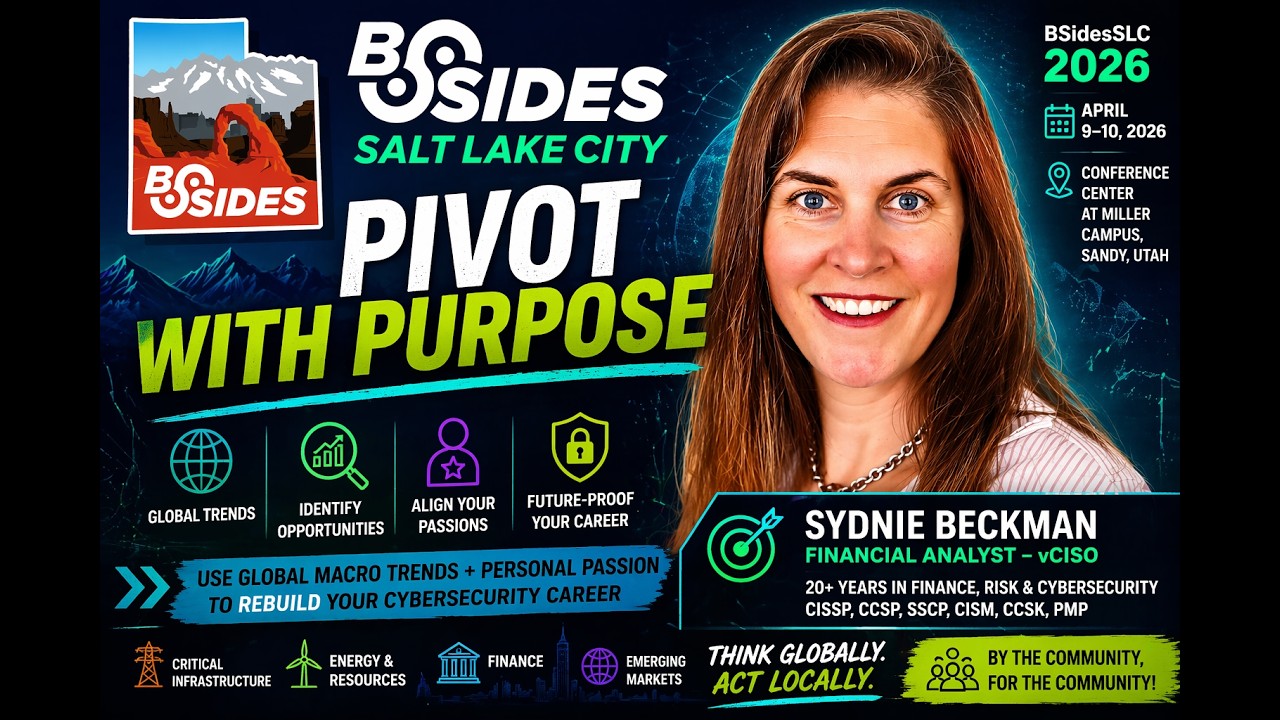
Pivot with Purpose: Future-Proofing Your Cybersecurity Career
Show original YouTube description
Show transcript [en]
So, hi. I'm Sydney. Um, this is Pivot with Purpose. So, I'm so glad you guys are all here. Oh, where? Oh, wrong one. There we go. I had it upside down. So, I'm in risk. So, I put a disclaimer. Um, this is for information and entertainment purposes. I don't know anyone's individual situation and I just want to say this is not in investment advice. So, a little bit about me. So my name is Sydney and I started in the industry in hedge funds, asset management. I moved over to banking and then more recently on the cyber security side, I worked in fintech um SIS, Pepco and HA global. In my spare time, I am an endurance athlete. So if
we have anyone running a marathon or joining the Salt Lake City Marathon, I would love to connect. Also, um, feel free to, uh, connect with me on LinkedIn or if you want to know more about me, that's my LinkedIn page. Okay, so just to make sure we're all here for Pivot with Purpose. And this is what I'm going to go through on the agenda today. I just want to say um, I don't want this to be passive. So, if you guys can, you even have like little tables here. If you need to be old school and get paper or please have your phones out or laptop, I definitely want you all to be working through this with
me. Okay, so pivot with purpose. This is what we're going through today. The old way. So I think of this as like the popular way of looking for a job and then the new way of getting the job. And this is something I'm extremely passionate about. I've been doing this for 30 years. Like this is how I've lived my career. And so I'm super excited um pass it on to you all. So, I'm going to give you the repeatable framework, some real world sectors that I'm watching and some examples along the way. Okay, so the first thing I promised you was kind of the old way of getting a job and the way the new way the way that
I've been using that I think is really great. So, the old model, you might go ahead and get your certifications and then look for a job or you might see what kind of jobs are out there or see what kind of tools or skill set you have and then pivot and look for those roles. Now, how I really recommend thinking about it is actually stepping back and looking at the macroeconomic signals, looking at what's happening around you in the world, looking for big sector movements and then understand where that demand is coming from. And then you can go ahead and strategically position to those macro movements. All right. So this is the repeatable framework that we're going to break
down. So as I mentioned, we're going to look for large global trends. We're going to map these industries benefiting from those trends and then we're going to figure out your skills, your interests, and we're going to reposition it. We're going to look at what you've done. You can reframe projects, the narrative, uh your your network, and then we're also going to think locally, but we're I mean, we're going to have global awareness. So, think globally, but act locally. So, this is what we're going to go through. All right. So, the large global trends right now, critical infrastructure. You all know about AI and you all know that it takes a lot of energy. So right now I see a
lot of growth in energy, utilities, natural resources and mining, financial systems, capital markets, government and defense, emerging markets and supply chains. I want to keep in mind that the trend is your friend. Now I work with pictures and I think it's a lot easier to remember things from pictures. So, I'm going to go in a little bit more detail into these trends. Now, the first one in the corner, you can see security and defense. So, I think probably all are aware of what's going on in the world. Uh, think of uh Venezuela, think of Ukraine, Russia, you know, what's going on in the Middle East. So, there's a lot of demand for is in the picture for like a tank, you
know, airplanes, that sort of thing. So, we see a lot of demand there. We also supply chain and this is a reorganization a change in the supply chain. So this impact and the straight of her most I'm sure you all are aware what's going on right now with oil pod ash fertilizer and so it creates opportunity. The next one I have in the corner is on shifting global alliances. We're not using the dollar so much anymore. There's other forms of transacting in other currencies. We see gold and commodities as the alltime high. that provides opportunity and I mentioned earlier about AI and the need for all this energy. So we see a rotation or influence in solar uh we
see the need for batteries for this consistent power um to operate AI and I'm sure you all are aware but we also have a geopolitical risk uh so the supply security is critical so we're bringing a lot more onshore uh as an example in the mining industry a large percentage I think over 80% was being manufactured in China and with the tariffs and the change that supply chain changed and so now we see more demand in the US and I mentioned security and defense driven demand uh especially from government uh providing a structural tailwind kind of bringing all that together so I want to talk about growth opportunities and these are just to give you some examples of ways to think about
how these um momentum this industry is impacting cyber. So if I look at examples of a job growth and I'm just using this as one example you might look at we talked about energy critical infrastructure and we see cyber cyber demand is growing. So there was a survey done in PWC in May and it was 83% of energy utilities and resource executives have identified cyber attacks as serious or moderate risk. So we know there's a demand in this area. So this is again following that macro trend and looking at how we can benefit from it in our cyber security careers. Okay. Another example is we talked about the financial systems and capital markets. So traditionally at the tier one the big
banks had a very generous very strong governance risk and compliance but it didn't trickle down. And so now we see the importance of putting in these processes and procedures into the broker dealers, investment advisors, um, and the smaller cap companies. So there's these jobs that are now becoming more, uh, prevalent and available. All right, the third one, and again these are examples to get you thinking of other examples, uh, is government and defense. So NATO pledged to spend 1.5 of GDP on cyber resilience, zero trust mandates and multi-year federal procurement allocations. So this is coming down from the top. So we see a lot of job opportunities that are existing in this area. And I wanted to talk about the real
world sectors that I'm specifically watching right now. And I believe in these so passionately that in 2024 I actually resigned from my position to go fulltime into mining critical minerals energy and with a financial well this year I pivoted and included the financial regulation and set up Cella. Sorry that was a little loud. Um so these are the areas I think are major focus. Obviously, um the last one is AI governance and risk. So, I'm sure you guys have heard Wayne Gresky's quote, but I want to keep this in mind as I go through the rest of the presentation. Get to where the puck is going, not to where it's been. So, really looking at
these macro and seeing where you're going to go forward. Now, you might be like, "Hey, Sydney, I don't really agree uh with what you're watching. I do think I'm very passionate about it, but you might not be. So, I'm going to give you three other ways to look for macro trends so that you can follow this. You can pick whichever one you want. So, I gave you mine. Um, this is another view is just understanding the business cycle. You This is where you if you have your phones out, you can, you know, grab your favorite AI tool and you can say, "Okay, what is the biggest opportunity in the business cycle in the current for
the US right now?" And I believe we're coming over the peak and we're potentially heading for a a drop. So it could be a hard landing which is a depression or just a soft and we turn up again but I think we're slightly over the peak. I think we're having slowing growth. We the job creation I think the inflation numbers came out today. We had a little more inflation than expected. And then we also see this sector divergence. So we see the AI bringing lots of jobs but other sectors not so much. So again when you're looking at where that puck is going you can use the business cycle as an example. The next example is Ray Dalio. So I'm
not sure if any of you have come across him amazing um on the economic and on the cycles front. He's done a lot of research. He has this video. It has 154 million views. I highly recommend watching it. It's on the changing world order. So, what you can do is you can take his views of how the US is changing to see where that puck is going and where you're going to position yourself in the future. He also has books that are available. Uh, how countries go broke is one of them. It's a PDF version for free. I highly recommend it as another view for big thinker. You're like, "Hey, those don't work for me. I've got one
more. Kathy Wood, she's a futurist. This is where I put the This is not investment advice because she's actually investment advice or runs a hedge fund or fund. So, her website is ARC funds and again it's for education only, not investment advice. But what she does is she looks to five to 10 years out and she invests in each sector of her funds in a drill down manner that where she focuses. So, you can take her ideas to look where you need to pivot in the next five, you know, where it's going to grow in the next five to 10 years. And she actually did a phenomenal podcast for people who are looking to um
get into jobs in these growth sectors for the future. And it's called From Vision to Valuation, Disrupting the Future with Kathy Wood. Um and I highly highly recommend it. Okay. So, this is where we begin to put everything together. And this is where I would love, if you have your phone, if you have notes, I really don't want this to be passive. I'd love for you to take ideas and leave here with something tangible that you can use. So, I use a ven diagram. So, the blue area is your skills. The green is where the puck is going. So, you can pick any one of the my ideas or the other three models. And your spot is in yellow. I'm not sure if
you all have done this yet, but I highly recommend it. So, get your AI tool out. Put in your current job description. So, Robin, will you be so sweet and give me a few minutes? Okay. So, I would love for you to seriously do this. So, put in your current job description and ask, "What aspects of my current role will not be replaced by AI?" And with that, that's going to be in your blue your blue circle.
So you can take you can take your LinkedIn where you have a couple ideas or um a resume or just write it out. What aspects of my current role will not be replaced by AI?
feels like a long time. I know it's not, but
All right, perfect. All right. So, with that, you have an idea of what's in your blue circle. And fingers crossed you have at least some ideas of where to get to the green circle, where the puck is going. Or if you have sectors that I've just discussed that you're really interested in, you could put in there to get your sweet spot of where you're going to focus on. And I want to give you some examples of the yellow of the sweet spot. Um, giving some hypotheticals. These are completely and they're only to be a jumping off point because sometimes it's easier to work with an example. All right, so hypothetical let's say we had a software developer
whose code review job is no longer. So I'm going to use the financial systems and the capital markets as the industry because that was one of the ones that I allocated as a trend. And what the developer can do is they can go ahead and pivot and look at that application risk governance governance. So they can see like how third party code introduces material cyber risk and here's how we govern it for fintech and broker dealers. So that's an example. Here's another real world or hypothetical example. So we could have a tier one two stock analyst uh that just got automated out of the shop. So they have an AIdriven theme. Uh platforms are collapsing. Uh so I mentioned critical
infrastructure energy and utilities uh from Smand and AI as an example. Well, they have legacy SCADA systems. where they still need human judgment, right? So, you could go ahead and pivot in into that area knowing that that's a growing sector in the critical infrastructure. All right? So, now we're down to the key takeaways. Cyber demand is going to follow the capital. So, where we see this increase in demand is where we're going to see cyber jobs. Certificates alone won't differentiate you. So, have a certificate, but in your in an area that's going to be replaced by AI or an industry that's not growing, it's not going to matter. Positioning matters more than credentials. Think globally, act
locally. And ideally, what you want to do is you want to build a career that's going to compound over time. So, in one of these areas that's growing. So the advantage goes to those who who can read signals, move first and move fast. That's the my talk, but I wanted to do one other thing if you all don't mind. Um I believe in the power of mentorship. I've had amazing mentors throughout my career. Hopefully I've been amazing mentor too. So I actually brought stars. Um Calvin, can I bug you to hand them out? Um so what you can do is if you are interested and participate, it's fine. Um, if not, if you want to be a mentor
to somebody in the room, um, pick a gold star. If you're want to be a mentee and you're looking for a mentor, pick a silver star. I have both stars on my badge. Uh, so I would love to get a mentee and I would love to get a mentor in one of the areas that I think are a key focus. So if you've been in energy mining, critical minerals, I would love to come and chat. So feel free to participate by doing a silver and a gold star. And that way it's also easier to talk to people outside of the session. Um if you're, you know, you can see the star and introduce yourself. So thank
you for playing around or playing around with my uh fun activity there. And this is the point where I get to questions and fingers crossed I have some questions because I'm very passionate about this. the framework I've used personally for 30 years.
>> Yeah.
I love that question and that's such a great question. I personally do it on an annual basis. So I look at the new year and I just double check, hey, are these trends still uh the ones that are in place? So AI has been around for a little while. So you can check that box and say yes, it's still critical. But when the tariffs came into play and you see something major happening, an election, I hate to use the word war, a conflict, um then you can go ahead and reassess and say, "Hey, this is something big that happened. Do my themes still make sense?" Um also, um when something does happen, you can go back to the
frameworks if it's something major and you can also say like, "Hey, did we have a big cycle shift?" Um, you know, you can check back with Ray Dalia or Kathy Woods and look at their um, you know, what they're watching and how they're positioning. So, look for global leaders as well. So, I do it annually and then if there's anything big that happens, I'll reassess. Yeah. Yeah. Great question. Yeah.
I I don't have the probably the best answer for you because I really follow the the the trend. Um I did do a bunch of certifications as I felt they were helpful with the CPEs. Um but I've never looked at it as a necessarily gateway. My gateway has always been to go where the demand is and because of that demand it's a greater opportunity. There's always been a much more availability. So, I generally throughout my personal career, I focused on where the putt goes. So, I know that doesn't answer your question. Um, I don't personally do the return on investment for this for the start. I I'm more global macro trend person there. >> Yeah. Go ahead.
Yeah, everybody has different opinions and I'm sure he's um he's got something great for you. Um I personally think it's more important to position than to actually get the credential. So you sounds like you might get a different opinion. So yeah.
Yeah definitely. Yeah. Yeah. Thank you for that. It can be um globally as in you can leave a country, you can leave a sector or you can leave just leave um a role but yes you can take advantage of macro trends in many different ways.
Yeah.
Yeah, I actually have a lot of thoughts on it. Um, so one of the things that I focus in on is the when we go back to the um go back to the picture. when we see the and manufacturing can refer to many different items but when I think of like the critical minerals that are coming out of the ground uh the US government has gone ahead and has supported MP materials um all these critical minerals lithium um so that we can advance and that we can bring manufacturing back to the United States so we're not so reliant on China um so there's different forms of manufacturing but when I think of the demand I think
it very much on like the manufacturing and these um critical minerals and putting them to production and getting like dual use goods or goods that will support the manufacturing base here for what for what we need based off of the risk that we had with tariffs and the supply chain um changing. So yes, I might not have answered your specific one for your manufacturing, but I take it back to the areas where I focus uh which is on like battery, you know, lithium. We're looking at uranium and nuclear and going into the manufacturing of drones as an example, weapons for um you know for security. I'm looking at the corner there.
Okay, I have five minutes left, but if there's no questions, I'll give you all your time back. And feel free to uh connect with me if you have questions that you don't want to ask um now or that you think of later. I'm Sman. Thank you.
Related talks
 57:47
57:47 33:03
33:03 37:26
37:26 55:20
55:20 39:48
39:48 28:49
28:49